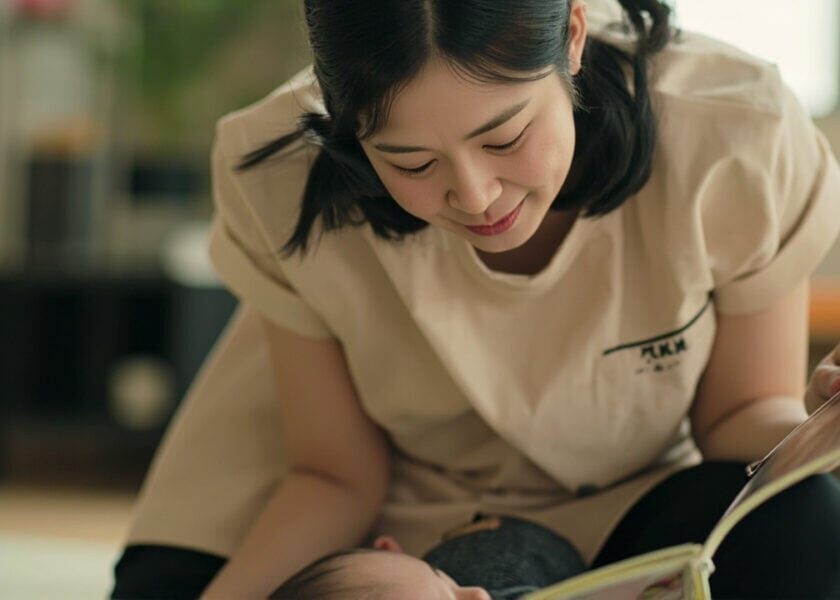
What Your Child’s Evening Homecoming Really Tells You
What Your Child Carries Home
Think about what your child brings through the door tonight. Not in her bag, not in her lunchbox, but in her body and in her behaviour.
A child who has spent the day in an environment where she felt truly seen may come home calmer, more curious, more willing to share what happened. She may run to you with something she made—not because she wants to show off, but because she has been encouraged to make things and has grown accustomed to sharing her discoveries. She may be tired in a good way: the tired of a day full of appropriate challenge and gentle growth.
Or she may come home with her guard up. Not because she has had a terrible day, but because she has spent the hours learning to manage uncertainty, learning to be a little less herself so that she can fit into an environment that does not quite fit her.
This is not necessarily a failure of care. It may simply be the result of ratios that make individual attention impossible, of routines that prioritize efficiency over attunement, of caregivers who are doing their best in a system not designed for intimate knowledge of each child’s inner life.
What children bring home is not random. It is a message. And if you know how to read it, the evening homecoming becomes one of the most powerful parenting tools you have.
Reading the Signs: What to Notice
- Physical state: Is she relaxed or tense? Does she seek closeness or pull away?
- Communication style: Does she volunteer stories, or do you have to coax them out? Is her language richer or more flattened than usual?
- Energy quality: Is this the tired of a fulfilling day, or the depleted tired of emotional managing?
- Play and engagement: How does she play when she gets home? Is she creative and exploratory, or seeking constant stimulation?
- Emotional regulation: How quickly does she recover from small frustrations? Is she herself, or a version of herself that feels guarded?
These signals will not tell you everything, but they tell you enough. Over time, they become your most reliable feedback loop about whether your childcare choice is serving your child well.
The Skill That Changes Everything
There is a difference between the parent who simply collects their child and the parent who understands that the next thirty minutes are, in many ways, the most developmentally significant part of the day.
When you kneel down to your child’s level and really look at her face, you are not just greeting her. You are receiving what she has carried home. You are telling her that what happened while you were apart matters to you, that her inner life is worth your attention, that she does not have to perform or simplify or hide the complexity of her day.
A child who is received this way learns something profound: that the world outside home is not separate from love, that the hours apart from parents are not a void to be endured but a space where growth happens, and that when she returns, there is someone there who will help her make sense of it all.
Receive what she gives you. It may be a story, or a toy, or silence. All of it is information. All of it is connection. Then tell her it matters. “I missed you. Tell me about your day.” “What did you make?” “I want to hear everything.”
The few minutes after your child walks through the door are not a transition to manage. They are a conversation to receive. This is not just parenting advice. It is the practice that transforms a logistical handoff into a meaningful reunion.
What Quality Childminding Actually Looks Like
For the evening homecoming to be meaningful, the care itself must be built for attunement. Here is what that requires.
Low Ratios That Make Individual Attention Possible
When a caregiver can truly know your child—her moods, her preferences, the sounds she makes when frustrated versus when merely tired—the care she provides is not just supervision. It is a continuation of what you are building at home. That kind of knowledge cannot happen at scale. It requires small numbers. It requires caregivers who have time to notice.
Communication That Keeps You Close Even When You Are Apart
Parents deserve to know what their child is doing, who is with her, and how she is growing—not just when something goes wrong, but every day. Regular updates are not an add-on. They are the foundation of trust between caregivers and parents.
Environments Designed for Development, Not Just Compliance
Quality care is not defined by whether a centre or home meets minimum standards. It is defined by whether each child is known as an individual—whether her curiosity is encouraged, her emotions are held, and her days are filled with appropriate challenge rather than mere time-filling.
EduNanny Singapore: Built Around the Homecoming
We want to be honest with you about what EduNanny Singapore does, because we believe the evening homecoming is where the proof lives.
We are part of the ECDA Childminding Pilot—a government-supported framework designed to give Singapore families access to care that is not just available and affordable, but genuinely responsive to each child’s developmental needs.
We offer two pathways. Home-based childminding, where a trained caregiver comes to your home or a designated community setting. And centre-based options where small groups allow for meaningful individual attention.
Our infant ratios are intentionally low—up to one to three, depending on the arrangement. This is not a marketing claim. It is the practical foundation of everything else we do. Because attunement cannot happen at scale, and we refuse to pretend otherwise.
We know that trust is earned, not assumed. That is why communication is built into every aspect of our service. Parents receive regular updates—not just incident reports. Where monitoring measures are in place, they exist not because we distrust our caregivers, but because we believe parents deserve visibility into the hours they cannot be present.
Addressing the Concerns You Are Carrying
We know that choosing childcare is one of the most consequential decisions a parent makes. It is also one of the most emotionally charged. If you are researching your options right now, you are probably living with some version of these questions.
“Am I letting my child down by going back to work?”
The research on this is consistent: children thrive when their parents are fulfilled and confident, and when the care they receive is nurturing and responsive. The question is not whether you work, but whether the care you choose is worthy of your child’s need for connection and growth.
“How do I know what really happens when I’m not there?”
You ask questions. You observe the homecoming. You look for a caregiver or centre that offers regular, meaningful updates—not just photos of activities, but real information about your child’s mood, interactions, and development. If a provider resists transparency, that itself tells you something.
“What if the care doesn’t feel right?”
The homecoming will tell you. A child who is well cared for will come home with something to give—stories, discoveries, a sense of ease. A child who is merely supervised will often come home guarded, depleted, or dysregulated. Trust these signals. They are more reliable than any tour or brochure.
“How do I even evaluate something this important?”
Ask to observe. Ask about ratios. Ask how caregivers handle emotional moments. Ask what a typical day looks like. Then go home and watch your child. Her response to the care she receives will tell you more than any conversation with a provider ever could.
Questions to Bring to Every Childcare Conversation
- What is the caregiver-to-child ratio, especially for infants and toddlers?
- How do caregivers support children’s emotional regulation throughout the day?
- What does communication with parents look like on a typical day?
- How would you describe a typical morning and afternoon in your setting?
- What happens when a child is struggling emotionally?
- How do you help children transition between home and care, and back again?
Then go home and ask yourself: did this feel like a place that knows children as individuals? Or does it feel like a system that manages them?
The Evening Homecoming: A Ritual Worth Protecting
In a city that moves fast, where parents are pulled in a dozen directions and children are expected to adapt to adult schedules, the evening homecoming is one moment that belongs entirely to your relationship with your child.
When your child walks through the door and you can see, in her face and her voice and the way she moves, that she has had a good day—not just a safe day, but a day of growth, of connection, of appropriate challenge and warm responsiveness—you know that the choice you made was the right one. You know that the hours apart have not weakened your bond with your child. You know that she has been held in more ways than one.
This is why we built EduNanny the way we did. Not just to care for your child while you work, but to make the evening homecoming everything it deserves to be. To be the reason your child has something worth bringing home. To be the partner who walks beside you in this daily, ordinary, profoundly important act of raising a human being.
Because you deserve to walk through your door each evening and see your child running toward you with something to share. And your child deserves to come home to someone who has been paying attention.
That is what we are here for.
EduNanny Singapore is part of your evenings. Part of your homecomings. And part of this journey with you, one meaningful reunion at a time.
Learn more about EduNanny Singapore · About our approach · Start a conversation
#SingaporeChildcare #InfantCareSG #ChildminderSingapore #WorkingParentSG #EduNanny