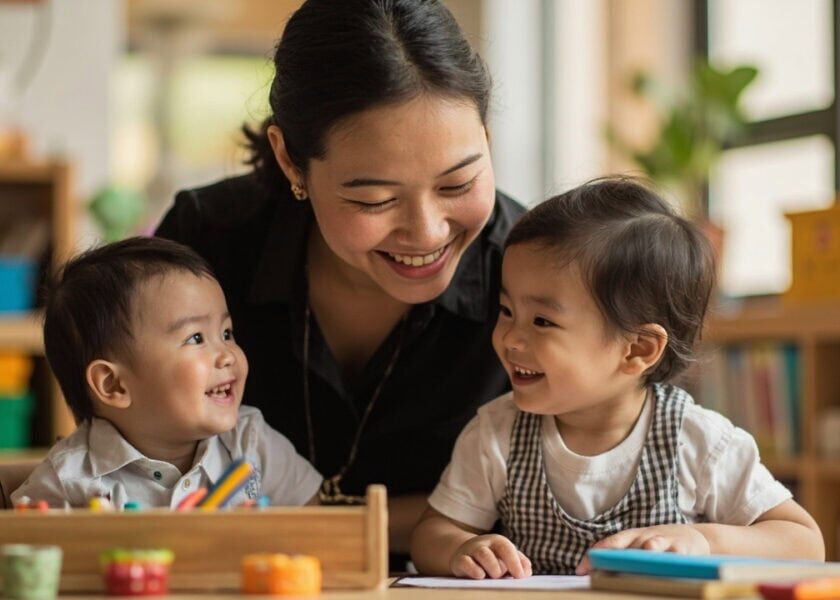
How Singapore Parents Learn to See Quality in Infant Care
How to Read Quality in Infant Care
Quality in infant care is not a secret reserved for trained professionals. It is not written in a language only experts can decode. It lives in patterns, in the texture of ordinary moments, in the way a child moves through their day.
What separates parents who feel confident in their childcare choice from those who feel anxious is not access to better information—it is the ability to recognize what they are already seeing. You have watched your child since the moment they drew their first breath. You know their cry, their laugh, the way they test the world.
That knowledge is not diminished by distance. It is, in fact, the very tool you need to evaluate what happens when you are not beside them.
Key Signs of Quality to Look For
- The evening homecoming—a calm, settled child who can play independently often reflects warm, attentive daytime care
- Unguarded moments—how caregivers speak when they do not know parents are listening reveals true temperament
- Specific observations—caregivers who notice individual details such as hand preference or cup choices demonstrate genuine attention
- The sensory environment—natural light, accessible materials, and quiet spaces signal respect for children as full human beings
- Longer-term development—language, skills, and confidence emerging over weeks and months prove quality that a single visit cannot reveal
These are not just signs to look for. They are a language you already know how to speak.
Reading Your Child: The Evening Window
Start with the evening. Not because it is a diagnostic tool, but because it is a window.
When you pick your child up from care, watch what happens in the first ten minutes at home. Not what they say—you may hear little about their day from a baby or toddler—but how they are.
A child who has spent their hours in warm, attentive care often comes home in a particular state: calm but alert, content in their own company, able to play without needing constant reassurance. They may be tired—that is normal. But there is a difference between a tired child who is settled and a child who is depleted in a way that goes beyond physical fatigue.
The first has been filled up. The second has been running on empty.
Signs of Genuine Security
This is not about perfection. Children have difficult days everywhere—they fall, they struggle, they cry. What you are looking for is not an absence of normal childhood distress but a pattern of recovery.
- A child who feels genuinely safe will recover from small upsets with relative ease
- They will not come home in a state of hypervigilance, watching every door, startling at small sounds
- They will not need to be held constantly to feel okay
- They can play independently—exploratory and curious rather than performative
- They move between you and their caregiver with trust in both spaces
Security shows in what a child does when no one is asking anything of them. That is when the truth emerges.
What to Watch During Visits
Most parents watch the wrong things during childcare visits. They watch whether the caregiver smiles and whether the children seem happy on the surface. They look for cleanliness, for bright colors, for the absence of obvious danger.
These things matter. But they are not where the real story lives.
Unguarded Moments Reveal Truth
The real story lives in unguarded moments. Watch the caregiver when they do not know they are being watched—when they are washing a dish, when they are speaking to another adult, when they are not performing care but simply living it.
Ask yourself:
- How do they speak to the children in these moments?
- Is there a shift in tone, a dropping of warmth the moment a parent leaves the room?
- Or does the voice remain consistent—gentle, engaged, warm—even when no one is watching?
If you can linger at pickup time, if you can arrive a few minutes early and simply stand at the edge of the room, you will learn more in five minutes than in a one-hour formal tour.
Listen to What They Notice
Listen also to how the caregiver speaks about the children when they are not present. A caregiver who knows your child well will have stories—not scripted updates, but real observations.
- She noticed that your daughter prefers to build towers with her left hand
- He asked for the red cup again today
- Your son has been trying to climb the small step stool all morning
These are not just pleasantries. They are evidence of attention—of a mind that is tracking your individual child rather than simply managing a group.
What the Space Communicates
Walk through the environment itself. Not just whether it is clean and safe, but what it communicates about how children are held in it.
Ask yourself: would a small person feel comfortable here?
- Are there spaces for quiet, for retreat, for a child who needs to be less stimulated?
- Is there natural light? Children feel the absence of it even when they cannot name it.
- What do the shelves hold—are books and toys at a height where children can reach them, or do children have to ask for everything?
- Is there evidence that this space was designed with a child’s inner experience in mind, or does it simply look like a place where children are managed?
The sensory texture of a childcare environment tells you something important: whether children are respected as full human beings with needs that go beyond the visible.
The Patterns That Reveal Quality
Quality in infant care is not a single big thing. It is a collection of small patterns that become visible once you know what to look for.
The Pace of the Day
Is there time for a child to finish what they are doing, or is every transition rushed? Rushed transitions signal an environment that prioritizes adult schedules over children’s need for continuity and completion.
How Conflicts Are Handled
Watch how a caregiver responds when a child is upset. Do they:
- Bend down to the child’s level rather than speaking from above?
- Use words to acknowledge what the child is feeling?
- Give the child space to feel and recover?
Or is the response quick and dismissive—a swift “it’s okay, stop crying” that treats emotion as a disruption to be managed rather than a signal to be received?
How Caregivers Speak About Emotions
Listen to the language used around feelings. A caregiver who understands child development will often say things like:
“You are feeling frustrated because the tower fell. That is okay. Let’s try again.”
Compare this to an environment where emotions are neither named nor validated. The difference in what a child learns about their own inner world is profound.
Singapore Parents: The Real Weight of This Decision
I want to pause here and acknowledge something real about navigating this decision in Singapore.
You are doing so in a city where time is scarce, where the cost of living is real, where the pressure to return to work is not a lifestyle choice but an economic necessity for many families. The childcare decision often cannot be made slowly. It has to be made in weeks, sometimes days.
And yet the stakes feel enormous. You are not choosing a service. You are choosing the context in which your child will spend their first, most formative years.
The weight of that is not lost on anyone who has lived it.
When Trust Is Built on Understanding
Trust is not the absence of worry. Trust is the presence of understanding.
You will still wonder how your child’s day went. You will still feel the small ache of parting in the morning. But when you understand what quality looks like, when you have seen it and can recognize it again, the wondering shifts.
It becomes curious rather than anxious. It becomes the wondering of a parent who knows what to look for, who has developed a relationship with their child’s environment based on observation and insight rather than hope.
A Partnership Built on Clarity
This is where a thoughtful childcare arrangement enters the picture—not as a solution to your anxiety, but as a partner in your clarity.
At EduNanny, this partnership is rooted in a conviction that parents deserve to see. Not to surveil, but to understand.
That is why EduNanny participates in the ECDA Childminding Pilot, maintaining the kind of transparency and accountability that gives parents real information rather than polished impressions. Whether families choose home-based or centre-based pathways, EduNanny maintains practices that allow observation—communication rhythms that keep parents informed, structures that make quality visible.
What Lower Ratios Actually Mean
When EduNanny operates with ratios of up to one caregiver to three infants, that is not just a credential to list. It is a condition that makes genuine attention possible.
You cannot read quality in a room of ten infants. You can read it when a caregiver has the space to truly know each child.
This plays out in practical ways that parents often describe as transformative:
- Daily updates that feel spontaneous rather than staged
- Photos that capture real moments, not performances
- Caregivers who can tell you something real about your child’s morning
- Communication that flows both ways—not just reports, but conversations
Transparency as Practice
Where CCTV measures are deployed, they are there not to police but to protect—to create a shared understanding between family and caregiver that nothing is hidden. When you can see, you do not have to imagine. And imagination, in the absence of information, is rarely kind to parents.
The Dignity of the Caregiver
There is something to be said for how childcare professionals are regarded. In a country where the word “maid” is still sometimes attached to childcare roles, EduNanny takes a different view. The caregivers in the EduNanny network are trained, observed, and treated as the professionals they are. They are not interchangeable. They are known.
A caregiver who feels respected will give differently than one who feels merely functional. The culture of an organization reveals itself in how it treats the people it employs. Watch for that too.
What Your Child Truly Needs
Your child does not need a perfect environment. They need one where they are seen.
- Where someone notices when they reach for the blue cup instead of the red
- Where someone has the time to wait for their words to come
- Where the day is paced in a way that respects that they are still learning what it means to be a person in the world
They need patience, warmth, and consistent love to do that work well.
Long-Term Markers of Quality
Quality in infant care is not proven in a day. It is proven in development—the slow, extraordinary process by which a baby becomes a person who can think, feel, speak, and wonder.
As your child settles into care, use the evening window as a regular practice. Not to diagnose, but to calibrate. Over weeks and months, you will begin to see patterns that tell you something real:
- Is your child growing in confidence?
- Are new words appearing?
- Are new skills emerging?
- Are new ways of playing developing?
When you see that unfolding, you know something is working.
And if you ever have questions, if the picture ever seems unclear—that is exactly when to reach out. Not with suspicion, but with curiosity. A good childcare partner will welcome your looking. They will not deflect or discourage your attention. They will invite it.
Because an informed parent is not a difficult parent. An informed parent is a trusting parent, and a trusting parent is one who can let go just enough to let their child grow.
Your Next Step
The most important thing I can tell you today is this: you were never meant to trust blindly. You were meant to learn to see.
And that is exactly what you are capable of doing.
Whether you are just beginning to explore your options or are ready to take the next step, EduNanny welcomes parents who want to understand what they are choosing. Ask your questions. Watch how they respond.
Because the right childcare partner will never ask you to hope. They will show you.
Learn more about EduNanny Singapore and who we are.
#ChildcareSingapore #InfantCareSG #ChildminderSingapore #QualityChildcare #EduNannySG