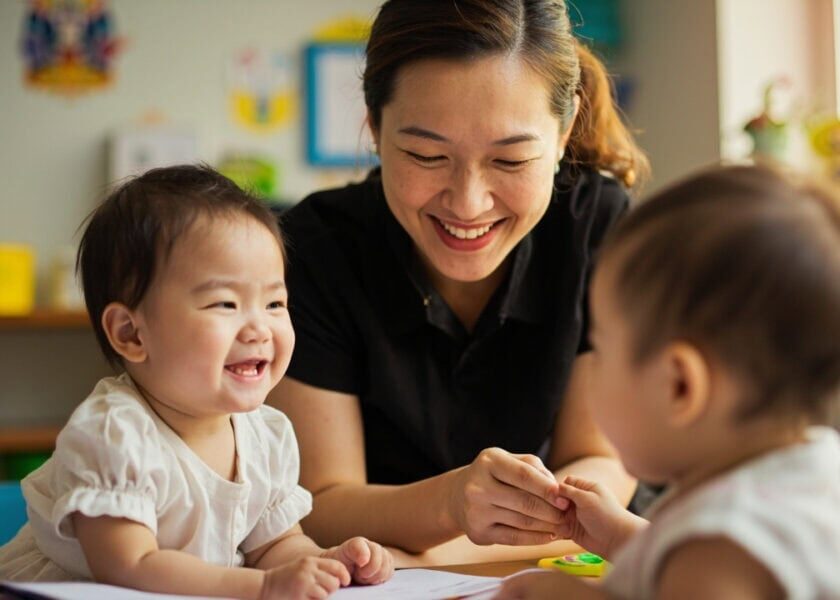
The Quiet Practices That Transform Childcare Into Partnership
Beyond Enrollment: What Genuine Partnership Looks Like
We have observed something consistent across families in Singapore who have moved beyond the enrollment phase into sustained partnership. The families who report the deepest satisfaction with their childcare arrangements — and whose children seem most secure, most curious, most at ease — share a common quality. They have stopped thinking of childcare as a service they receive and started thinking of it as a relationship they build.
They have moved from wondering whether they can trust their childcare team to knowing, through lived experience, that they can. And they have done this not through grand gestures but through quiet, consistent practices.
Co-Observation: Watching Your Child Together
Co-observation is exactly what it sounds like, and yet its power is rarely named. It is the practice of families and childcare teams watching the same child together — not as separate parties reporting observations, but as partners who are genuinely looking at the same thing.
When you pick up your child in the evening and the caregiver shares not just what your child ate and slept, but what she reached for at the sandbox, or how she responded when another child took her toy, or the new syllable she discovered today — that is co-observation in practice.
When you notice something at home — a new fear, a new fascination — and you bring it to the caregiver not as a demand but as an offering — here is something I noticed; is it the same here? — that too is co-observation.
It is the act of building a shared picture of your child that belongs to both of you, not to either one alone. This matters because your child exists in two worlds, and those worlds must be in conversation for your child to feel whole.
Shared Developmental Language: Speaking the Same Truth
Co-observation, over time, builds something even more valuable: a shared developmental language. This is where the partnership truly deepens.
Shared language means that you and your childcare team develop common terms for understanding your child’s growth. It means that when the caregiver mentions that your son is working through a sensitive period for order, you know exactly what she means — not because you have read the same books necessarily, but because you have talked about it together, observed it together, and named it together.
It means that when you bring up a concern about your daughter’s language development, the caregiver is not caught off guard but responds with the same frame of reference you use at home.
This shared language reduces misunderstanding, increases the precision of your communication, and — most importantly — communicates to your child, implicitly, that the adults in her life are aligned. When children sense this alignment, they relax in a particular way. They stop testing boundaries between home and childcare because those boundaries feel less like separate territories and more like connected spaces within the same loving world.
Communication Rhythms and the Daily Practice of Partnership
Building shared language requires a communication rhythm that works for both parties over the long term. In the early weeks of enrollment, communication is often frequent and detailed. Caregivers send updates, photos, careful notes. But as time passes and routines settle, there is a risk that communication thins — that it becomes perfunctory, or sporadic, or limited to logistical exchanges.
Sustaining communication is not about frequency for its own sake. It is about finding rhythms that honor both the caregiver’s capacity to observe and report, and the parent’s need to remain genuinely connected to their child’s experience.
For some families, this means a brief daily check-in that goes beyond food and sleep to touch on the child’s emotional quality of the day. For others, it means a regular written summary that becomes a kind of shared journal over the years. For others still, it means quarterly conversations — 坐下来 — where the focus is not on logistics but on development: Where is your child right now? What is she interested in? What is she working through? What do you both see, together?
What matters is that both sides are committed to staying in conversation — not just when something goes wrong, but throughout the ordinary, unfolding days that make up most of childhood.
Addressing Concerns Openly and Sharing in Your Child’s Joy
Genuine partnership means that both sides are committed to the child’s wellbeing above all else, and that includes the willingness to speak honestly when something needs attention. Many parents hesitate to raise concerns because they fear it will damage the relationship. This hesitation is understandable, but it is also a missed opportunity.
What distinguishes a healthy partnership approach to concerns is not the absence of friction but the quality of the conversation that follows. When a parent raises a concern in the spirit of collaboration — I have noticed this; what do you see? — it invites dialogue rather than defensiveness. When a caregiver responds with openness and genuine engagement — let us look at this together — it deepens trust rather than eroding it.
But partnership is not only about managing concerns. It is also about sharing joy. When your child takes her first steps at the childcare centre, or masters a new word, or overcomes a fear — these moments belong to the whole village caring for her. The parent who shares a photo of a new skill, and the caregiver who responds with equal delight, are practicing a form of co-parenting that has no official name but enormous developmental significance.
The Adaptation Phase: Where Partnership Begins
The first weeks and months of a new childcare arrangement are a period of mutual learning. Your family is learning the rhythms and style of your childcare team. Your childcare team is learning your child’s temperament, preferences, and patterns. This is not always smooth.
There may be misalignments in expectation. There may be days when your child seems unsettled and you wonder whether the arrangement is right. There may be moments when you are not sure whether your caregiver truly understands your child, or whether you truly understand what happens during the day.
What distinguishes families who move through this phase into sustained partnership is not the absence of friction but the approach to it. They treat the adaptation period as the beginning of an ongoing dialogue, not as a test to be passed.
- They ask questions
- They offer information
- They share what they are noticing at home and invite the caregiver to share what she is noticing
- They give the relationship time to develop, but they also give it attention — the daily, deliberate attention that transforms a service arrangement into a genuine partnership
When this is done well, something shifts. The adaptation phase resolves not into complacency but into settled partnership. Parents stop wondering whether their childcare team knows their child and start having conversations about who their child is becoming. Caregivers stop feeling like employees performing a service and start feeling like co-parents with a shared investment. The child feels it most of all: the ease of being known, the security of consistent care, the quiet confidence that comes from growing up in a world where the adults are aligned.
Your Role as an Informed Partner
There is something I want to name directly, because it is central to everything we have discussed, and yet it is rarely acknowledged honestly.
This is the parent’s own sense of purpose — the need to feel that your role as a parent has not been diminished by the presence of childcare but rather supported and sustained by it. So many parents in Singapore carry a quiet fear that choosing childcare means stepping back from parenthood, that every hour spent away is an hour of separation from their child’s story. This fear is real, and it deserves honest acknowledgment.
But here is what I want you to hear clearly: partnership with your childcare team does not diminish your role as a parent. It extends it. It affirms that your knowledge of your child matters, that your presence in your child’s life — even the parts mediated through a trusted partner — remains central and irreplaceable.
When you are in genuine partnership with your childcare team, you are not a passive recipient of updates. You are an informed partner, bringing your insights, your questions, your observations to a shared conversation. You are not an outsider looking in. You are the parent — the person whose relationship with this child is the primary and permanent one — and you are choosing to extend that relationship thoughtfully, collaboratively, and with trust.
That is not a diminishment. That is a profound act of parenting in the modern world.
What This Gives Your Child
For your child, the gift of this partnership is something that grows over time. Children who experience alignment between home and childcare develop a particular kind of security — one that is not dependent on a single caregiver but is rooted in the knowledge that their world is consistent, loving, and connected.
These children know, in their bones, that the people who care for them are talking to each other, are working together, and are there for them. This is not a fragile security. It is a deep one — built not on the absence of change but on the presence of reliable, loving adults who have committed to growing alongside the child.
How EduNanny Supports Genuine Partnership
Underlying all of this partnership work is a simple but powerful belief: that your family and your childcare team are on the same side. Both of you want the same thing — a child who is safe, loved, and flourishing.
Both of you bring valuable knowledge to the table: you about your child’s history, temperament, and home context; your childcare team about your child’s peer interactions, group dynamics, and expression outside the family unit. Neither knowledge is complete without the other. When these two sources of understanding come together in genuine partnership, the child benefits in ways that no single perspective could provide.
This belief shapes how EduNanny operates within the ECDA Childminding Pilot. Our infant ratios — up to one to three — mean that caregivers can genuinely know each child in their care, can observe carefully, can communicate with the precision and depth that shared language requires.
Our communication practices are built around transparency, with reporting and documentation that keeps families informed not only of logistics but of their child’s daily experience, development, and emerging interests. Where deployed, CCTV measures provide an additional layer of reassurance — not because trust is absent, but because partnership is strengthened when families have the comfort of knowing that the door is always open, in every sense.
For families navigating the genuine financial considerations that childcare involves, the usability of the Child Development Account and Baby Bonus schemes offers practical support that reduces the friction of payment and lets families focus on what matters most: the relationship with their childcare team, and with their child.
Because EduNanny is home-based and community-focused, the partnership takes root in a setting that is familiar and connected to the child’s everyday life. For many families across Singapore, this is not just logistically convenient — it is emotionally significant. The childcare relationship becomes part of the neighbourhood, part of the community, part of the fabric of the child’s world.
What to Look for When Choosing Infant Care in Singapore
If you are beginning to research infant care options for your family, here are some questions worth asking — not as a checklist, but as a guide for the conversations that matter most:
- How does this arrangement handle the adaptation phase? Is there a clear, supported process for helping your child — and your family — settle in? Or does the approach feel more like a handoff than a transition?
- What does communication look like beyond enrollment? Ask specifically about how the arrangement maintains connection over time, not just in the early weeks. What rhythms are possible? What can you realistically expect?
- How does the caregiver describe their role? Do they speak of partnership, collaboration, and shared understanding — or do they describe themselves primarily as service providers? The language matters.
- Is there structure for genuine observation? Caregiver ratios, daily rhythms, and documentation practices all affect whether co-observation is actually possible.
- Does the model invite your participation? Partnership requires two willing parties. Does this arrangement create space for you to share observations, ask questions, and engage in your child’s daily experience?
The right childcare arrangement will not erase the normal anxieties of early parenthood. But it will give you a place to bring those anxieties, a partner to work through them with, and a rhythm that grows stronger over time.
The Long Arc of Partnership
So let us return to the question with which we began: Am I still part of my child’s story here?
The answer, if you choose partnership, is yes. Not because the childcare team grants you access, but because you have built something together that makes your presence real and meaningful.
Because you have invested in the practices — co-observation, shared language, honest communication, joyful celebration — that keep you connected across the hours and the days and the years.
Because you have found a childcare team that sees you as a partner, respects your role, and is committed to growing alongside you.
This partnership takes intention. It takes practice. It takes the willingness to stay engaged even when the initial excitement of enrollment has settled into the steadier rhythms of everyday life.
But the families who do this — who choose to stay present, to ask questions, to share observations, to celebrate together and work through concerns together — these are the families who look back on the early years and feel not guilt or regret, but pride. Pride in what they built. Pride in the village they created for their child. Pride in the fact that they were, and remain, genuinely part of the story.
EduNanny is here for this long arc — for the quiet Tuesday afternoons and the milestone moments and everything in between. We believe that childcare, done well, is not a service transaction. It is a partnership. And partnerships, like the children they serve, grow stronger with time.