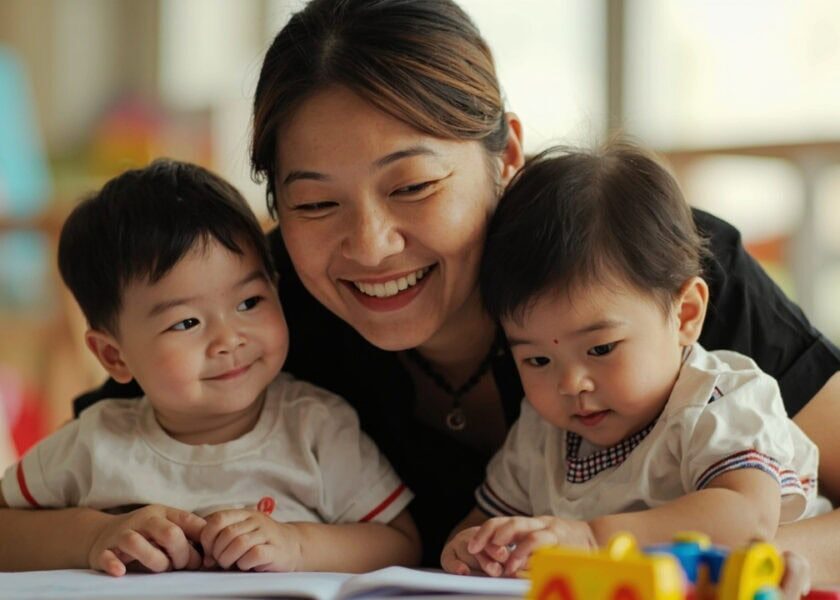
How Quality Childcare Builds Your Child’s Inner World of Trust
What Quality Childcare Actually Means
Because here is what I have learned, standing inside quality childcare, watching what actually happens in those hours apart: your child is not just being watched. Your child is not simply being fed and kept safe and entertained until you return.
Your child is doing something far more profound.
Your child is building a world inside themselves—a world of trust, of exploration, of emotional architecture that will shape who they become.
The Attachment System: Your Child’s Internal GPS for Safety
When a young child enters a quality care environment, their attachment system activates. This is not a theory. This is one of the most robust findings in developmental science across decades of research.
The attachment system is your child’s internal GPS for safety. It tells them:
- When I am uncertain, where do I go?
- When I am frightened, who will respond?
- When I want to explore, can I trust that what is behind me will still be there when I return?
In the first years of life, this system is being written—in every interaction, every response, every moment a caregiver notices a child’s need and meets it with warmth. It is being written in the consistency of the same faces, the same rhythms, the same voices.
What Bowlby Knew—and What Neuroscience Has Confirmed
John Bowlby, the father of attachment theory, understood that a secure base is not a single person. It is a felt experience of safety.
When a child has that felt experience in their care environment, they do not spend their hours longing for you. They spend their hours growing. They play. They investigate. They form friendships with other children. They test their own capabilities with the quiet confidence that comes from knowing they are held.
And here is what is extraordinary: this system does not diminish your role as a parent. It extends it.
When your child forms a secure attachment in quality care, they are not replacing you. They are building the capacity to trust, to love, to explore, to return. They are building the internal security that allows them to be fully themselves with you.
What Quality Care Looks Like From the Inside
Now, here is what this looks like in practice—and this is where I want to be very specific, because you deserve to know what to look for, what to trust, what to recognize.
The Glance That Means Everything
In a setting where caregivers are truly trained and attuned, they read your child’s communication before your child even knows how to ask.
A slight tension in the shoulders before a transition. A brief hesitation at the door. A child who pauses mid-play and glances toward the caregiver—this glance, this checking, is not a sign of distress. It is a sign of health.
It is the child using their secure base.
They look to confirm safety, and when they see it—in a smile, in a nod, in the calm presence of someone who knows them—they return to their play with renewed energy.
The Signs of a Child Who Is Growing
This is what quality care looks like from the inside:
- Not a child who never shows need, but a child who shows need and is met.
- A child who tests boundaries and finds them consistent.
- A child who expresses frustration and is helped to name what they feel.
- A child who falls and is comforted, and then, remarkably, gets up and continues.
This is emotional regulation developing in real time. This is the architecture of a resilient human being being constructed, one responsive moment at a time.
The Caregiver as Translator
The caregivers who hold this space are not simply watching. They are translating. They are the bridge between your child’s inner experience and the language that helps your child make sense of it.
They notice when a child is seeking connection and offer it. They notice when a child needs space and protect it. They hold the child through big feelings because they understand that big feelings are not problems to be eliminated. They are the raw material of emotional development.
When Understanding Changes Everything
And when you, as a parent, begin to understand this—when you begin to see that the hours apart are not a loss but an expansion, not an absence but a building of capacity—something shifts in you.
That quiet question you carried in the morning, the one that lived in your chest: Will my child be okay?
It begins to have an answer.
And the answer is not that nothing happens while you are apart. The answer is that something important is happening. Something that your wise choice made possible. Something that adds to your child’s world rather than subtracting from it.
The Parent at Pickup
Here is what I have observed, consistently, across families who choose quality care with understanding rather than with guilt: the parents who know what their child is experiencing become different parents at pickup.
They are not racing in with anxiety, scanning their child’s face for damage. They arrive with curiosity. They arrive ready to receive what their child wants to share.
And because they are not carrying the weight of their own fear, they have space to truly listen.
The evening routine, the dinner, the bath, the stories, the bedtime—all of it becomes richer when the parent behind it is grounded in the knowledge that their child has been in good hands, has been growing, has been okay.
EduNanny: Quality Care Within Singapore’s National Framework
EduNanny by BUTLER operates within the ECDA Childminding Pilot, and this matters for a reason beyond logistics.
It means that what we do is grounded in a national recognition that how children are cared for in these early years matters profoundly. It means that we are part of a deliberate, thoughtful system designed to give Singapore families real options, real support, and real quality.
What the Ratio Means for Your Infant
For infants, EduNanny maintains a ratio of up to one to three.
Let me tell you what that number means in practice:
- When your infant reaches for comfort, there is a hand available.
- When your baby makes a sound that might be hunger or might be tiredness or might simply be a desire to be held, there is someone whose entire attention can turn to reading that sound, understanding it, responding.
- The chaos of group care—the noise, the competing needs, the inevitable overwhelm—gives way to something quieter, more attentive, more like the environment your child has known in your home.
Structure That Respects Your Family
Whether through home-based care or centre-based pathways, EduNanny offers structure that respects the developmental reality of your child’s first years.
- Monday through Friday care blocks designed around how families actually work, not around an arbitrary institutional schedule.
- Fees structured to be accessible, with payment options including CDA funds and Baby Bonus, so that the question of access does not become a barrier to quality.
Transparency and Trust
I know what some of you are thinking. Trust is not established by structure alone. You need to know what is happening when you are not there. You need windows, not just into the physical space but into your child’s experience.
EduNanny understands this. Communication and transparency are built into our approach. In locations where CCTV is deployed, families have the assurance of visible accountability. But beyond systems, it is the daily practice—the photographs, the updates, the conversations at pickup—that builds the bridge between your world and theirs.
Addressing What Parents Actually Worry About
“Will my child still be themselves when they come home?”
Yes. More themselves, actually.
The paradox that quality care reveals is this: the hours apart, when they are held well, do not diminish connection. They deepen it. They give your child a fuller self to bring home to you.
They give you a child who has tested their own capabilities, built trust with other adults, formed bonds with other children, and returned to you with all of that newness in their eyes, eager to show you who they are becoming.
“Am I replacing my role as a parent?”
You cannot replace what you give your child. No caregiver, no programme, no setting can replicate or supersede the bond between you and your child.
What quality care can do is extend your child’s world. It can add trusted faces to their inner map of safety. It can build the emotional resilience that allows them to be fully present with you when you reunite.
Think of it this way: you are not installing a replacement. You are building an expansion.
“How do I know the caregivers are truly attuned?”
Look for these indicators during visits or trial periods:
- Caregivers who get down to your child’s eye level, not just when greeting but throughout interactions.
- Responsiveness that feels natural, not scripted—conversational tone, warm physical contact, genuine smiles.
- Children who move freely but return to caregivers for “checking in” without distress.
- A calm, unhurried atmosphere where transitions are prepared for, not surprised by.
“Is my child too young for any kind of care outside the home?”
The attachment system begins developing from birth. What research consistently shows is that the quality of responsiveness, not the quantity of caregivers, shapes your child’s secure base.
What your infant needs is attunement, consistency, and warmth—and these can exist in a home-based setting with a small ratio as much as in any environment.
Practical Guidance for Choosing Infant Care in Singapore
If you are beginning to explore options, here is what I encourage you to consider:
Before You Visit Any Centre
- Clarify your non-negotiables: ratio, feeding philosophy, communication style, location convenience.
- Understand the national context: the ECDA Childminding Pilot is designed to provide quality options for Singapore families. This is a signal of serious intent.
- Talk to other parents, not just about their satisfaction but about what they observed in their child’s behavior over time.
During Your Visit
- Observe the caregivers—are they engaged, warm, unhurried?
- Notice the children—are they comfortable, curious, settled?
- Ask specific questions: How do you handle separation anxiety? How do you communicate with parents? What does a typical day look like?
- Trust your instincts. If something feels off, it probably is. If something feels warm and right, that matters too.
After You Begin Care
- Watch for signs of your child’s felt security: ease at drop-off over time, engagement during care, warmth at reunion.
- Ask questions without fear. Quality providers welcome your curiosity.
- Allow a transition period. The first weeks are an adjustment for everyone. Give it time while staying attentive.
The Question Worth Leaving With
There is a question I want to leave you with today. It is not whether you should choose childcare. That is a decision only you can make, in accordance with your family’s needs, your values, your circumstances.
The question I want to leave you with is this: if you did choose quality care—if you chose a setting where your child’s inner world is seen, held, and nurtured—would you trust what you might discover?
Would you trust that your child is more capable than you imagined? That their heart is more resilient? That the secure base you have built with them in your home can expand to include other trusted adults, other trusted spaces, without fracturing?
Would you trust that the hours apart can be hours of growth rather than hours of loss?
The answer, I believe, is yes.
And here is why I believe it: because you are here, listening, thinking, questioning. Because you care enough to wonder what is happening inside your child’s world. Because you are the kind of parent who is building something beautiful, even when it feels uncertain.
EduNanny is honored to be part of that building. Not as a replacement for you, never that. But as a companion in the work of raising a child who feels safe enough to explore, brave enough to grow, and loved enough to return—to you, always to you—with a full and thriving heart.
Begin the Conversation
Your child’s world is safe. Your child’s world is growing.
And so, I believe, is yours.
If you are ready to explore what quality childminding looks like for your family—grounded in understanding, shaped by attachment science, and structured around how Singapore families actually live—EduNanny is here to walk this path with you.
Reach out for a conversation. No pressure, no obligation. Just honest talk about what your child needs and what that could look like in practice.
Because you deserve to make this choice from a place of confidence rather than fear. And your child deserves a world that is ready to hold them.
Learn more about who we are or connect with our team to explore whether EduNanny is the right fit for your family.