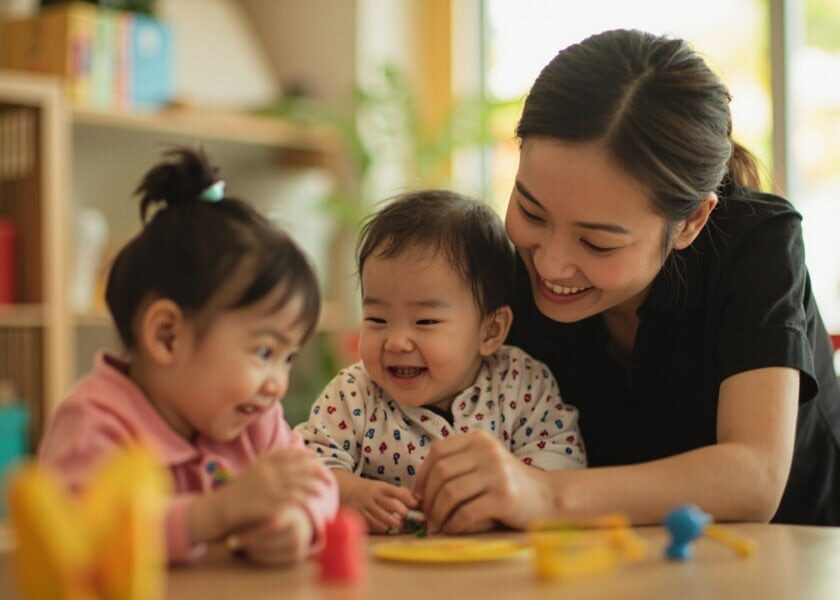
The Trained Eyes That Help Singapore Parents Understand Their Child
What Sets EduNanny Apart: The Trained Eyes Every Child Deserves
When families begin searching for infant care or childminding support, the conversation naturally gravitates toward safety, trust, and logistics. Is the caregiver reliable? Is the environment secure? Are the hours workable? These are legitimate concerns, and they matter deeply.
But underneath these practical questions lies something quieter, something more vulnerable: the hope that whoever cares for their child is not simply keeping them safe and stimulated, but truly seeing them. Noticing who they are becoming. Understanding the developmental story that is writing itself in every interaction, every play session, every moment of discovery.
This is the gap that EduNanny was built to fill.
EduNanny operates within the ECDA Childminding Pilot, a framework that represents Singapore’s serious commitment to elevating the standards of home-based and community-based childminding. It is a pilot that acknowledges what many parents have long sensed: that infant care is not a lesser alternative to centre-based options, but a distinct and valuable pathway with its own strengths.
Within this framework, EduNanny brings something that goes beyond compliance with standards. It brings a philosophy of care fundamentally rooted in developmental observation—the belief that every interaction between caregiver and child is an opportunity to read, understand, and support growth.
What Trained Developmental Observation Actually Means
Let us be specific about what we mean when we speak of developmental observation, because it is not the same as watching a child play or noting that they had their lunch.
When your EduNanny caregiver sits with your child on the floor during morning play, she is not simply supervising. She is noticing. She is tracking the way your child approaches a new toy—with cautious hesitancy or immediate engagement, and what each of those approaches might reveal about temperament and risk tolerance.
She is observing the social signals your child sends during parallel play with another child—the glances, the gestures, the small attempts at connection that will later become the foundations of collaborative social skill. She is listening not just to the words your child uses, but to the patterns in their language acquisition—the new sounds emerging, the sentence structures forming, the meaning-making that happens even before formal speech develops.
These are not guesses. They are the result of training, of frameworks, of a professional understanding of how development unfolds in the first thousand days—that critical window from conception to roughly age three when the brain builds more than a million neural connections per second, when the architecture of future learning, behavior, and emotional regulation is being laid down in ways that will echo for a lifetime.
In these years, nothing is trivial. Every observed pattern, every developmental signal, every small milestone reached or approached differently matters. And trained observation is how we catch these signals before they pass unnoticed.
It is important to be clear about what developmental observation is not. EduNanny caregivers are not diagnosticians. They are not there to label or to pathologize. They are trained observers—informed, attentive, professional—who notice what parents, in the midst of the beautiful chaos of daily life, may not have the bandwidth to notice with consistency.
They understand the difference between a developmental variation that is entirely within the range of normal and a pattern that might benefit from early professional attention. They know when to reassure and when to suggest, with care and without alarm, that a particular aspect of development might be worth monitoring or discussing further.
The Evening Homecoming: When Developmental Insight Comes Home
This is why the evening homecoming conversation matters so much more than a simple status update. When you pick up your child and ask how their day was, you are not just seeking reassurance that they were fed and safe and happy. You are seeking connection to their experience—and ideally, you are seeking something more: developmental intelligence.
What did they notice today? What patterns did they see? What might this mean?
An EduNanny caregiver who has been trained in developmental observation will not simply tell you that your child had a good day. She will tell you about the moment during free play when your daughter chose to help another child retrieve a toy she couldn’t reach—a small act of empathy that, in developmental terms, is significant.
She will share that your son spent a longer-than-usual period of time today working on a puzzle that he had previously abandoned—a sign of emerging persistence. She will mention that your child’s lunch behavior suggested something about their oral motor development that might be worth noting.
These are the conversations that transform childcare from supervision into investment. They are the moments when you realize that the hours your child spends with their EduNanny caregiver are not just hours of care but hours of attentive, professional understanding—hours that are contributing to a picture you could never build alone.
The Parent-Caregiver Partnership: Completing the Picture
Perhaps even more importantly, developmental observation also reveals what is going well. Every child has a developmental story, and that story is not only about gaps and delays. It is about strengths. It is about the areas where a child is flourishing—the particular curiosity, the emerging empathy, the creative problem-solving, the confident physicality.
When EduNanny caregivers observe your child, they are looking for all of this. They are building a picture of your child’s emerging story—the narrative of who they are becoming—and that picture belongs to you. It belongs to your family. It is not filed away in some professional archive. It is shared with you, regularly, meaningfully, in language you can understand and act upon.
This is where the partnership between parent and caregiver becomes something truly powerful. Because here is the truth that many parents sense but rarely hear articulated clearly: parental intuition and professional observation are not rivals. They are not alternatives to each other. They are incomplete without each other.
You know your child in a way no caregiver ever can. You know the context of their birth, the temperament they showed in the first weeks of life, the particular quality of their cry that means something different than another cry, the way they relax differently in your arms than in anyone else’s. You have a baseline of love and attention that no professional training can replicate.
But you also lack the comparative framework, the developmental knowledge, the trained pattern-recognition that comes from observing many children across many stages of growth. You may not know whether the way your two-year-old is resisting transitions is developmentally typical or worth a closer look. You may not have the language to describe what you are seeing when your child’s play suggests emerging executive function skills.
EduNanny’s caregivers bring what you cannot bring alone. And together, in partnership, the two forms of knowing create something neither can achieve independently: a more complete picture of your child’s development, a shared language for discussing what you both observe, a relationship of trust and transparency where neither party is guessing about what the other means.
EduNanny’s Approach: Beyond Enrichment, Toward Authentic Development
This is what separates developmental partnership from the generic enrichment messaging that saturates the childcare conversation in Singapore. It is not about worksheets or accelerated curricula. It is not about the promise that your child will read by age three or master a second language before kindergarten.
Those claims are hollow when they are not grounded in real observation of real developmental patterns. EduNanny’s approach is different. It begins with seeing—truly seeing—who your child is in this moment. It builds from there. It respects the individual timeline of every child’s growth. It understands that readiness cannot be rushed and that development is not a race.
It is, in the deepest sense, a commitment to your child’s authentic trajectory—not the trajectory that looks impressive on paper, but the one that is actually theirs.
For Singapore parents, this matters more than perhaps we fully appreciate. We live in a society that excels at aspiration, at optimization, at the relentless pursuit of advantage. These impulses are not inherently wrong, but they can distort our thinking about early childhood in ways that are ultimately harmful. The pressure to produce “school-ready” children has, in many cases, replaced the more fundamental goal of supporting genuinely healthy development.
Parents anxiously drill toddlers on colors and numbers, worried that they will fall behind in a system that increasingly starts the competitive clock earlier and earlier. Meanwhile, the quieter developmental work—the social-emotional foundations, the self-regulation skills, the capacity for curiosity and persistence—goes unnoticed and unsung.
EduNanny’s approach is a gentle correction to this imbalance. We believe that when developmental observation is done well, it reveals what actually matters: not whether your child can name more colors than their peer, but whether they are developing the resilience to handle frustration, the social awareness to read a playmate’s emotions, the linguistic foundation that will eventually support complex thought and expression, the physical confidence that comes from mastering movement.
These are the true predictors of school readiness—and of life readiness. They are what EduNanny’s caregivers are trained to observe, nurture, and communicate.
What EduNanny Offers Your Family
Key features of the EduNanny service include:
- Trained developmental observation as a core part of daily caregiving—not a separate program, but a way of being with your child
- Affordable fee structures within the ECDA Childminding Pilot framework, recognizing the genuine financial pressure Singapore families face
- Monday to Friday care blocks providing the consistency that developing minds need
- Pathways for both home-based and community or centre-based arrangements, allowing families to choose what fits their circumstances
- Supported use of CDA and Baby Bonus funds, because developmental investment should not be the exclusive privilege of families with substantial discretionary income
- Communication protocols that give parents real insight into their child’s daily experience—not perfunctory logs, but meaningful developmental updates
- CCTV measures where deployed—not surveillance tools for their own sake, but trust infrastructure that allows parents to verify what they are being told
We are not claiming that EduNanny caregivers replace pediatricians, speech therapists, or early intervention specialists when those professionals are needed. We are not claiming that developmental observation is a substitute for clinical expertise.
We are claiming something more specific and, we believe, more valuable: that the everyday, consistent, in-home observation conducted by trained caregivers catches things earlier, notices patterns that occasional professional visits cannot see, and creates a developmental narrative that is richer and more complete than any single assessment could provide.
We are claiming that the relationship between a child and their EduNanny caregiver, built over months and years of attentive care, is itself a developmental resource—a context in which growth happens not despite the observation but because of it.
And we are claiming something for you, the parent, that may be even more important: that this process is designed to reduce your anxiety, not amplify it.
Developmental awareness, when communicated with warmth and without alarm, does not make parents more nervous. It makes them more confident. When you understand what you are seeing, you stop second-guessing. When a caregiver can tell you clearly and reassuringly that what your child is doing is age-appropriate and exactly what they would expect to see at this stage, the quiet wondering that shadows so many Singapore parents begins to quiet.
Questions to Ask When Choosing Infant Care in Singapore
If you are currently researching childcare options, here are some questions worth asking that go beyond the standard safety and logistics checklist:
- How does your caregiver understand my child’s individual developmental trajectory? Look for answers that speak to observation, not just activity planning.
- What does a typical update or communication look like? Meaningful developmental sharing beats “napped well, ate lunch” every time.
- How do you track developmental progress over time? Patterns matter more than single observations.
- How do you communicate concerns when you notice them? Early identification done well should feel reassuring, not alarming.
- How do you partner with parents as the primary experts on their child? The best care models see parents and caregivers as complementary, not hierarchical.
The Promise That Matters Most
This is what we mean when we speak of developmental partnership. It is not a service transaction. It is not a reporting mechanism. It is a relationship—sustained, professional, built on trust—in which your child’s growth is observed, understood, and shared.
It is the trained eyes every Singapore parent wishes they had in childcare, made real through the ECDA Childminding Pilot, made accessible through thoughtful fee structures, made meaningful through the genuine expertise and warm attention of EduNanny caregivers.
As we think about the future of infant care and childminding in Singapore, this is the direction we believe matters most. Not just keeping children safe—though that remains foundational. Not just providing convenient, affordable care for working families—though that is genuinely important.
But seeing children. Truly seeing them. Understanding that every small behavior is a signal, every play choice is a statement, every interaction is a data point in the story of who they are becoming. And building a system that treats that understanding as sacred—as worthy of trained attention, of thoughtful communication, of genuine partnership with the parents who love these children most.
Your child’s developmental story is being written every day, in every moment of play, in every social exchange, in every small triumph and tentative exploration. You do not have to read that story alone.
EduNanny is here—with trained eyes, with professional warmth, with the quiet confidence that comes from understanding development deeply and communicating it clearly. Not to replace your intuition. Not to supplant your love. But to stand beside you, as the informed observer you can trust, and to help you see what you cannot see by yourself.
That is what we offer. That is what we believe every Singapore family deserves.
And that is why EduNanny exists—not as another childcare option among many, but as a different kind of promise: that your child will be cared for, yes, and kept safe, yes, but also, more than anything else, truly seen.
The wondering can stop now. The partnership has begun.
Ready to explore how EduNanny can support your family? Discover what it means to have a trained partner in your child’s earliest, most important years. Learn more about the EduNanny approach within the ECDA Childminding Pilot, or connect with our team to begin the conversation.
Explore related topics: #ChildmindingSingapore #InfantCareSingapore #EduNanny #DevelopmentalObservation #SingaporeParenting