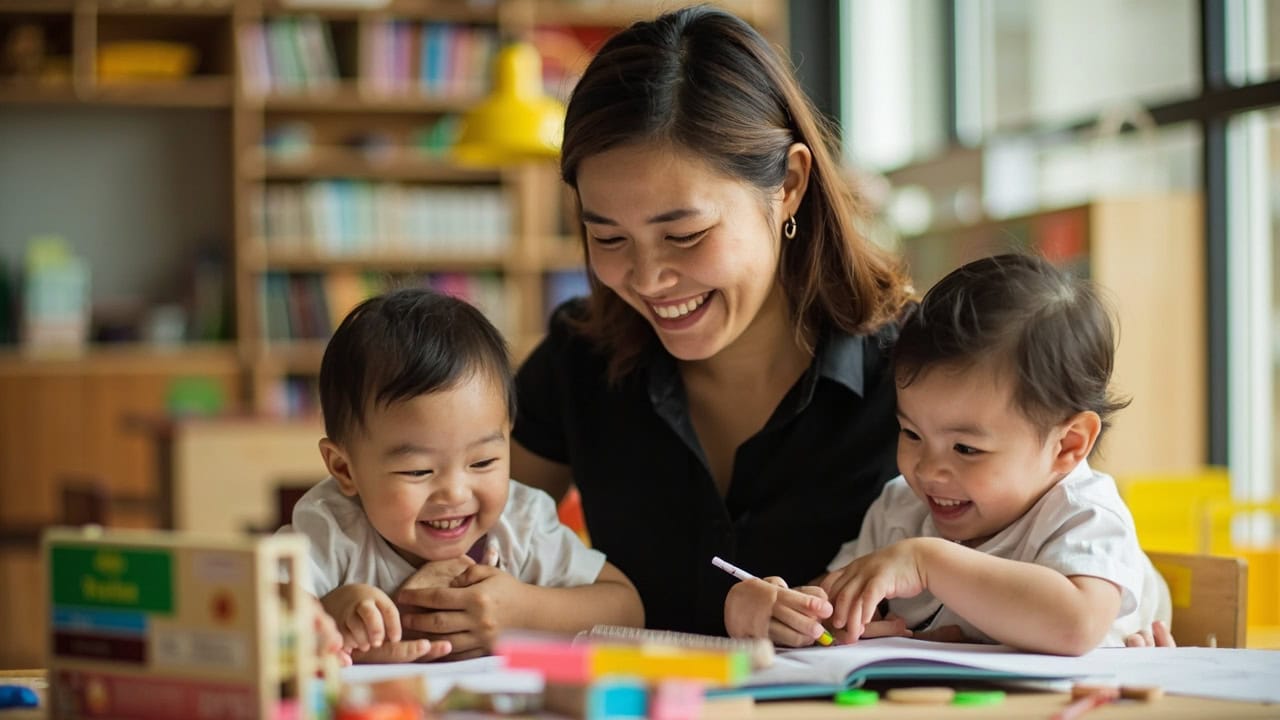
Beyond Supervision: The Art of Attunement in Premium Infant Care
The Invisible Work of Attunement: What Actually Happens in Quality Infant Care
Let us imagine, for a moment, what happens after you leave. Your child, who has been in your arms, who knows the particular rhythm of your breathing, who has learned that when they reach, you reach back—your child is now in a different room, with different sounds, different light, different hands.
The caregivers you have chosen—and by choosing EduNanny, you have made a choice grounded in something deeper than proximity or cost—those caregivers are not simply watching your child. They are doing something far more demanding, far more skilled, and far more important.
They are reading your child.
Not reading a chart. Not checking developmental milestones against a list. Reading your child the way a musician reads a room before a performance—attending to tension, to silence, to the small signals that reveal what is actually happening beneath the surface.
A premium caregiver understands that an infant’s cry is not a single language. There is the cry of hunger and the cry of fatigue. There is the cry that means discomfort and the cry that means something harder to name—the cry that means, simply, I am here and I do not yet understand where you have gone.
What Attunement Actually Means
There is a term in the science of caregiving that describes what premium caregivers do: attunement. It means something specific.
It means the caregiver is not merely reacting to your child but is holding a steady, focused attention on what your child is experiencing moment by moment. It means noticing the almost imperceptible shift in a baby’s body language when fatigue begins to settle. It means recognizing the particular stillness that precedes a child’s attempt to communicate a need they cannot yet name in words.
It means understanding that a toddler’s tantrum is not manipulation but an honest overwhelm of feeling that they lack the neurological capacity to regulate alone.
At EduNanny, attunement is not an aspiration. It is a discipline. Caregivers are trained to slow down, to observe before they act, to ask themselves not just what should I do but what is this child feeling right now.
This is the difference between supervision and care. Supervision ensures a child does not come to harm. Care ensures a child feels held even in the moments when their parent is elsewhere.
Understanding Your Child’s Inner World
Think about what this means in practice. Your child, at fourteen months, is beginning to understand object permanence. This is an exciting cognitive milestone, but it also means that when you leave, your child understands—in some deep way—that you still exist even though they cannot see you.
This is comforting and terrifying at once.
A caregiver who is attuned will recognize this internal conflict. Not through any formal assessment but through the child’s behavior, through the way they reach for a particular toy when anxious, through the specific tone of their voice when they call out.
And an attuned caregiver will respond not with dismissal—no, no, Mummy will come back, don’t cry—but with genuine presence. They will sit with your child’s feeling. They will name it: You miss Mummy. That feeling is okay. I am here.
This is what secure attachment looks like in action. It is not a concept to be explained at a parenting workshop. It is a moment-to-moment practice of being with a child’s emotional reality.
Quick Summary: What Premium Infant Care Actually Looks Like
- Attunement – Caregivers trained to read and respond to your child’s emotional signals, not just their physical needs
- Low ratios – Small group sizes allow for genuine connection, not just supervision
- Emotional presence – Your child is not merely watched; they are witnessed, understood, and held emotionally throughout the day
- Transparent communication – Regular, specific updates about your child’s day, including emotional observations, not just feeding and sleep logs
- Partnership, not replacement – Quality care reinforces your role as parent rather than competing with it
The Language Before Words: Reading and Responding to Your Child
Here is something that may surprise you: your child is communicating constantly. Long before they have words, they are speaking a rich, complex language of expression, posture, eye contact, and gesture.
- The furrowed brow
- The reaching arms
- The way a child turns their head away when overwhelmed and turns it back when ready to re-engage
These are not random behaviors. They are communications, as meaningful as any sentence your child will one day speak.
Premium caregivers learn to read this language. They learn to distinguish the cry that means I need a diaper change from the one that means I am overstimulated and need quiet. They learn to notice when a toddler is approaching a frustration threshold and to intervene not with force or redirection but with the precise support the child needs in that moment.
This is the work that happens all day long in quality care—the invisible labor that makes the difference between a child who merely endures the hours apart and a child who thrives.
But here is what matters most for you as a parent: this language your child is speaking, this inner emotional life that is so real and so vital—someone is there to hear it. Not just hear it, but respond to it. Not just respond to it, but respond in a way that helps your child feel understood.
This is trust. Not the abstract trust of believing a childcare provider is reputable, but the concrete trust of knowing that your child’s inner world is being witnessed, held, and honored throughout every hour you are apart.
The Architecture of Early Emotional Development
In the first three years of life, a child’s brain develops faster than it ever will again. The architecture being built in those early years is not merely cognitive—it is emotional. It is the foundation upon which your child will eventually learn to regulate their own feelings, to trust others, and to believe that the world is a place where their needs will be heard and met.
This is what researchers mean when they speak of secure attachment, and this is why the hours apart from you matter so profoundly. Not because you are being replaced—you cannot be, and no thoughtful caregiver would try to—but because your child’s internal working model of relationships is being shaped in every interaction, including those that happen without you.
Building Trust: How You Can Know What You Cannot See
You might wonder how you can possibly know this. How can you trust what you cannot see?
At EduNanny, trust is not demanded—it is built. And building trust requires transparency, communication, and consistency.
What the ECDA Childminding Pilot Makes Possible
In the ECDA Childminding Pilot, of which EduNanny is a part, there are frameworks in place designed not merely to regulate but to elevate the standard of care. With infant ratios kept intentionally low—no more than one to three, sometimes even more focused in home-based settings—caregivers have the capacity to truly know each child in their charge.
They are not juggling six infants while also managing a checklist. They are present, attentive, and available to read and respond to the emotional signals that define your child’s day.
Communication That Supports Trust
Where deployed, technology serves as an additional bridge between the world your child inhabits and the world you must inhabit elsewhere. CCTV measures, for instance, are not surveillance for their own sake—they are windows. They allow you, when you need that reassurance, to see that the room is calm, that your child is engaged, that the caregiver is kneeling at eye level rather than standing at a distance.
Premium caregivers understand that you are not simply dropping off a parcel. You are entrusting them with the most precious thing in your life. They will tell you—not in generic updates but in specific observations—what your child’s day was like:
- The moment your child discovered something new
- The way your child reached for comfort
- The expression on your child’s face when they finally settled into a nap
This is not to reassure you falsely. It is to include you, as much as possible, in the emotional landscape of your child’s day.
And because these caregivers are trained, because they are part of a structured program with accountability and standards, you can trust that what they share reflects genuine observation and professional assessment—not merely the desire to tell you what you want to hear.
What Quality Childminding Looks Like: A Practical Comparison
When evaluating infant care options in Singapore, it helps to know what to look for. Here is how premium childminding differs from standard childcare arrangements:
| Aspect | Standard Care | Premium Attuned Care |
|---|---|---|
| Caregiver attention | Distributed across many children | Focused, with time to observe and understand each child |
| Response to crying | Often formulaic (feed, change, soothe in sequence) | Discerning—reading signals to understand the specific need |
| Parent communication | Generic updates (fed, slept, diaper changed) | Specific observations about your child’s emotional day |
| Role of caregiver | Supervisor, manager of basic needs | Emotional translator and secure base |
| Handling separation | “Mummy will come back” (dismissive) | “You miss Mummy. That’s okay. I’m here.” (validating) |
Questions to Ask Your Childminder
When visiting potential care arrangements, consider asking:
- How do you respond when a child is distressed and won’t settle?
- What does a typical morning look like for the children in your care?
- How do you communicate with parents about their child’s day?
- What training have you had in understanding infant emotional development?
- How many children do you care for at one time, and what are their ages?
Listen not just to the answers but to the language used. Does the caregiver speak of children as individuals with inner lives? Do they demonstrate an understanding of emotional attunement? These are the indicators of care that goes beyond supervision.
Your Role in This: Partnership in Care
There is a phrase that comes up often in discussions of childcare: it takes a village. But villages are not formed by accident. They are formed by choices—yours and others’.
When you choose a service like EduNanny, you are not simply purchasing a product. You are entering into a relationship. You are trusting strangers with the work of attunement, and in return, those strangers are trusting you to be honest, to be communicative, to be partners in the task of caring for your child.
This relationship is not hierarchical. The caregiver is not subordinate to you, and you are not subordinate to the caregiver. You are two people who share a commitment to your child’s wellbeing, bringing different knowledge and different perspectives to a shared task.
- You know your child in ways the caregiver cannot—the particular ways your child expresses affection, the sound that soothes them, the memory that makes them laugh
- The caregiver knows your child in ways you cannot—how they behave when you are not in the room, the social dynamics with other children, the small moments of growth that happen incrementally throughout the day
Together, you are building a picture of your child that neither of you could build alone.
Premium Care Is Not About Extras
When you choose care for your child, you are not simply solving a logistical problem. You are making a statement about what you believe your child deserves.
Premium care is not about having the most expensive toys or the most elaborate curriculum. It is about having:
- The right person, with the right training
- With the right number of children to care for
- Paying the right kind of attention to your child’s inner life
It is about understanding that the hours apart are not a gap to be survived but a context in which your child’s emotional development is actively occurring.
And this matters for reasons that extend beyond any single family. In Singapore, where the pace of life is relentless and the cost of living demands that most families have two working parents, the quality of childcare is not a private concern. It is a societal one.
When children are held well in their early years—when their emotional worlds are witnessed and responded to—they build the foundations for the adults they will become. They learn that they matter. They learn that their feelings are valid and manageable. They learn that the world is, on balance, a responsive place.
These are not small things. These are the things that determine, in ways we are only beginning to understand, the resilience, the empathy, and the emotional intelligence of the next generation.
A Closing Reflection
So when you leave your child in the morning, and you feel that familiar ache, that question that cannot be answered while you are walking away—know this.
Someone is there. Not just watching, but attending. Not just present, but attuned. Someone is reading the language your child speaks before they have words, and they are responding with care and precision. Someone is holding your child’s emotional world as gently as you would, and with the professional skill to do it well, hour after hour.
You chose this. You chose to look beyond the logistics and the price points, beyond the convenience of proximity and the ease of the familiar. You chose to ask the harder question: not just where will my child go, but who will understand my child when I am not there?
That is what EduNanny is. That is what the Childminding Pilot represents—a commitment to the proposition that every child, in those crucial early years, deserves to be truly seen. That the hours apart are not a separation to be minimized but a context to be honored. That attunement is not a luxury but a right.
You have made the right choice. Not because the science says so, though the science does. Not because the standards say so, though the standards are rigorous. But because you asked the question that matters most, and then you did something about it.
Your child’s inner world is in good hands.
And now, perhaps, you can breathe.
Ready to Learn More?
Discover how EduNanny supports your child’s emotional development from the very first day. Connect with our team to explore infant care arrangements built on attunement, understanding, and the security your child deserves.
Learn more about our participation in the ECDA Childminding Pilot and the standards that guide our approach. You can also read about our team and the values that shape everything we do.