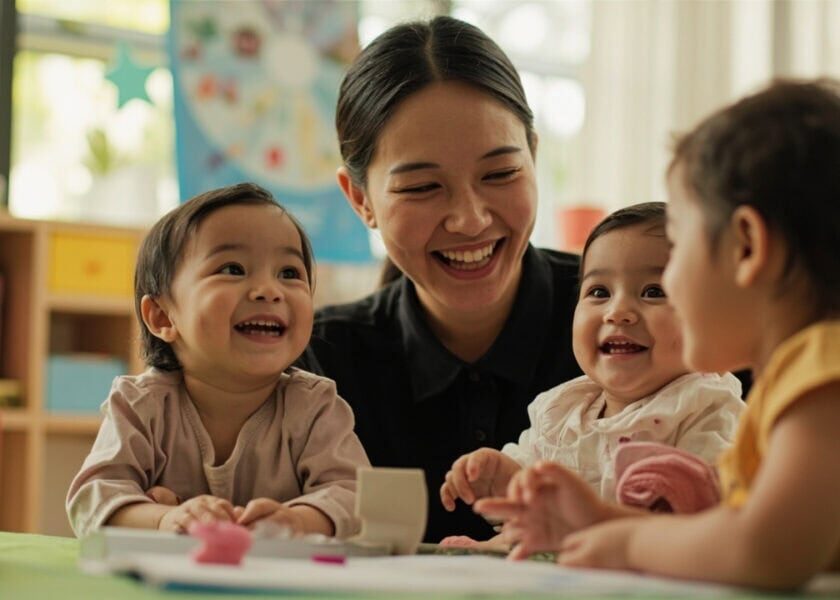
Why Quality Childcare Creates Ripples Through Your Whole Family
The Decision You Thought Was About Childcare
Most parents arrive at the childcare decision believing they are solving a straightforward problem: they need someone to watch the children while they work. They need a safe place. They need coverage from Monday to Friday, ideally with the flexibility that modern Singapore life demands.
And these are real, legitimate, important needs. But they are not the whole story.
Beneath the logistics of childcare lies something most conversations pretend does not exist: your family is a system. A living, breathing, interconnected architecture of relationships, and everything that touches one part of it sends tremors through every other part.
- The tired father comes home from work with little left for his wife, and the children feel the distance between their parents even before they have words for it.
- The exhausted mother has not had an uninterrupted conversation with her older child in weeks, and the older child begins to wonder if the new baby has somehow replaced her in her mother’s heart.
- The grandparents, eager to be involved in their grandchildren’s lives, find themselves pressed into service as childcare providers when what they long for is the simpler, lighter role of grandparent — the ones who spoil, who visit, who hand the child back at the end of the day.
In Singapore, where the pressures on families are particular and real, these tensions are not abstractions. They are the texture of daily life.
Most parents treat the childcare decision as a logistical choice. In reality, it is a family system intervention. The right care creates ripple effects that restore marriages, deepen sibling bonds, strengthen grandparent relationships, and return parents to themselves.
The Singapore Family Landscape: Why This Is Different Here
Singapore families face a particular constellation of pressures that make the childcare decision especially consequential.
Two incomes are often required to sustain a household. The cost of living means that one parent stepping back from work feels not just impractical but frightening. Parents calculate, negotiate, compromise — and often conclude that they have no real choice at all.
Extended working hours are a feature of modern Singapore life. The commute alone can consume two hours a day. By the time a parent walks through the door, the window for genuine connection with a partner or children is already narrowing.
Community must be deliberately constructed. Singapore is a city of newcomers and nuclear families. The village that once surrounded parents — the neighbors, the extended family, the casual village of trusted people nearby — is not always given. It has to be built. And for parents with newborns and infants, building it while managing exhaustion is its own form of labor.
The bone-deep exhaustion of modern parenting is perhaps the least discussed reality of all. Parents who are trying to give their children everything while feeling, increasingly, that they have almost nothing left to give.
This is the landscape in which families make childcare decisions. The families who truly thrive here — who manage to hold their marriages together, who raise children who feel genuinely secure, who maintain warm relationships with grandparents and with themselves — they are the families who understood that they were not just choosing a childcare arrangement. They were choosing a force that would reshape their entire family life. And they wanted that force to be a force for good.
The Ripples: How Quality Care Transforms Your Family
Your Marriage
Here is what most parents will not say aloud, and what many will not even admit to themselves: the early years of parenting can be corrosive to a partnership. Not because people stop loving each other, but because the infrastructure of a marriage — the conversations, the laughter, the physical closeness, the shared plans, the simple act of sitting together without agenda — all of this gets dismantled by exhaustion and the relentless demands of young children.
Parents find themselves becoming roommates. They manage logistics. They divide tasks. They coordinate schedules. And somewhere in the management and the division and the coordination, they lose the thread of what made them a couple in the first place.
Now consider what happens when that infrastructure begins to be restored. When a parent comes home at the end of the day and is not already depleted, when they have had even a few hours of mental and emotional space — the difference is not small. It is seismic.
The parent who can greet their partner with attention, who can ask about their day and genuinely listen to the answer, who can sit together over a late dinner and remember why they chose each other — this parent is not just a better spouse. They are building a marriage that will be a shelter for their children, a model for their children, a living demonstration that love is not just a feeling but a practice that can be sustained through the hardest years.
Your Children
Consider siblings next. In Singapore, many families have two, three, or more children, spaced closely together because close spacing means they will be companions for life. But siblings raised in the chaos of exhausted parents — in households where no one has enough attention to go around — can just as easily become rivals. They can become casualties of a family system stretched past its capacity to nurture.
What happens to siblings when care is truly excellent? They become, as they were always meant to become, a team.
- They learn to share not because they are forced to, but because they have witnessed sharing modeled for them.
- They learn to resolve conflict, to negotiate, to take turns, to care for each other — not because anyone is teaching these lessons explicitly, but because they are growing in an environment where the adults around them have the emotional bandwidth to hold the space for these lessons to land.
In quality care settings with ratios that allow for genuine attention — up to one caregiver to three infants in EduNanny’s programme — children begin to understand that they are not competing for scarce resources of love and care. They are swimming in an ocean of it.
This transforms siblings from what they might have become — combatants in a zero-sum game for parental attention — into what they are meant to be: the first and most enduring community most of us will ever know. The sibling who has your back when your parents are gone. These bonds, forged in childhood, carry us through the rest of our lives. And the conditions for forging them are created, in no small part, by the quality of care that surrounds them.
Your Parents
In Singapore, this is a dimension of family life that carries particular weight. Our parents immigrated here, often, or built their lives here from nothing, and they poured everything they had into giving us more than they had. Now they are grandparents, and they want to be involved. They want to hold this new little person, their grandchild, this fruit of all that they sacrificed. They want to be part of this family in a way that feels meaningful to them.
But somewhere along the way, in too many families, grandparenting became childcare. The eager grandparent became the backup plan, then the primary plan, then the schedule around which the whole family organized itself.
The grandparent who wanted to spoil and play and then hand the child back with a smile became, instead, a tired second parent. They found themselves doing the work of parenting when what their heart was hungry for was the play of grandparenting.
This is not a small thing. This is a grief that goes unspoken in many Singapore families.
- The grandparent who feels used rather than valued.
- The grandparent who loves their grandchildren deeply but is too exhausted to enjoy them.
- The grandparent who wonders if this is all there is, now, in their later years — not the lightness of being beloved, but the heaviness of being needed as labor.
Quality childcare does not remove grandparents from the family. It returns them to it. Now they visit on Saturday mornings and have the energy to play. Now they travel with the family because childcare is covered and reliable. Now they are grandparents again — the ones who give gifts, who tell stories, who spoil, who love with the generous, undemanding affection of someone who has already done the hard work of parenting and has been given this extraordinary second chance to simply enjoy.
You, Returned to Yourself
And the parents — this is the part that is perhaps the most important and the most overlooked — the parents return to themselves.
Here is what we rarely say aloud in conversations about childcare: the early years of parenting can make you lose yourself. Not in a dramatic sense, not in a way that is easy to articulate, but in the quiet, creeping sense that the person you were before children — the person with interests and friendships and ambitions and a body that felt like their own and a mind that had room for ideas beyond the immediate next need of a small child — this person begins to feel very far away.
Parents speak of this as though it is simply the cost of having children. The price of admission to parenthood. You give up yourself, and that is what it means to be a good parent.
But this is not sustainable. And it is not true.
You are not meant to disappear into parenthood. You are meant to expand into it — to bring all of who you are into this new dimension of your life, not to leave it behind.
When you know that your child is in care that genuinely meets their needs — care that is warm, attentive, and grounded in real understanding of how children grow and learn — you can, for the first time in perhaps years, unclench. You can sit in your morning commute and look out the window and think a thought that has nothing to do with your child. You can have lunch with a friend and listen to their life rather than watching the clock. You can come home at the end of the day and be genuinely present rather than running on fumes.
This is not selfish. This is not neglecting your child. This is the restoration of a human being to themselves.
And here is the truth that changes everything: the parent who has been returned to themselves is a better parent. Not a more guilt-ridden one. Not a more vigilant one. A better one. The kind of parent who can respond to their child from a place of genuine warmth rather than depletion. The kind of parent who has something to give because they have not given everything away.
When you choose care that truly meets your child’s needs — care that is reliable, warm, and grounded in genuine understanding of child development — you are not outsourcing your parenting. You are buying back the possibility of being fully present in your own family.
What Quality Childminding Looks Like in Practice
At this point, you may be asking a practical question: what does quality childcare actually look like? Because the vision is compelling, but how do you evaluate whether a care arrangement can deliver on it?
Quality is not a claim. It is a set of conditions that can be observed, measured, and trusted.
Ratios That Allow for Genuine Attention
One of the most reliable indicators of quality in infant and toddler care is the ratio of caregivers to children. In EduNanny’s home-based programme, ratios of up to one caregiver to three infants are maintained. This is not an accident. It is the structural foundation that makes warmth, responsiveness, and genuine attunement possible. In care settings where one person is responsible for six, seven, or more infants, warmth becomes an aspiration rather than a baseline reality.
Consistency and Reliability
Parents in Singapore know the anxiety of last-minute care breakdowns. A reliable care arrangement means parents can plan, partners can coordinate, and families can function with a baseline of predictability. This reliability is not a luxury — it is the condition that makes everything else possible, including the marriage recovery and sibling harmony described above.
Understanding of Child Development
Quality care is grounded in genuine knowledge of how children grow and learn. It is not simply supervision. A caregiver who understands child development responds to a crying infant differently than one who does not. They create environments that support exploration, language, and social development — not just safety.
Transparency and Communication
Trust is built when parents can see what is happening in their child’s day. EduNanny’s approach includes communication measures such as CCTV where deployed, so that parents can have confidence in what they cannot personally witness. This is not surveillance — it is transparency, and it is the foundation of the kind of trust that allows parents to actually relax.
Flexibility for Working Families
Singapore parents need care that fits the actual shape of their working lives — Monday through Friday, for the care blocks that real families actually require. This is a practical dimension of quality that is easy to overlook but essential in practice.
EduNanny Singapore: Our Approach
EduNanny was built on this understanding — not as a marketing message, but as the core conviction around which everything else is organized. We are not simply providing a childcare service. We are partnering with families at one of the most consequential moments in their lives: the moment when they are deciding what kind of family they are becoming.
This conviction shapes everything about how EduNanny operates.
- We participate in the ECDA Childminding Pilot, structured within established quality frameworks that give families confidence in the care they receive. Our programme is designed to be accessible — usable with CDA and Baby Bonus where applicable, and structured within pilot fee frameworks that recognize the real financial pressures Singapore families face.
- We offer both home-based and centre-based pathways, because families are not all the same and their needs are not all the same. Some families thrive with care that comes into their home. Others prefer the community environment of a centre. EduNanny’s dual pathways mean families can choose the arrangement that fits their life.
- We maintain ratios that allow for genuine attention. Quality cannot be claimed in a mission statement. It must be built into the actual conditions of care. Our ratios are not what they need to be to maximize efficiency. They are what they need to be to allow caregivers to truly know and respond to each child in their care.
- We built Thomas, our AI chatbot, because modern parenting is complex and exhausting and the last thing a tired parent needs is another barrier between them and the support they are looking for. Thomas is there when you have a question at eleven p.m. when you cannot sleep because you are wondering if your child is developing normally. Thomas is there when you need guidance on navigating the practical maze of childcare benefits in Singapore. Thomas is there because we understand that support should not require an appointment.
Questions Parents Actually Ask
These concerns come up again and again in our conversations with families. They deserve honest answers.
“Will my child feel abandoned?” Separation anxiety is a sign of healthy attachment — your child feels secure enough to protest your leaving because they trust you will return. Quality care does not replace your role. It supplements it. The warmth, consistency, and responsiveness of quality care actually strengthens your child’s overall sense of security, giving them a strong base from which to explore and grow.
“Can I even afford quality care?” This is a genuine and legitimate question, and we do not dismiss it with platitudes. EduNanny’s participation in the ECDA Childminding Pilot means our programme is designed to be accessible. The use of CDA and Baby Bonus where applicable, combined with pilot fee structures, means that quality care is within reach for families who have done the research. We encourage every family to explore the specific financial options available to them — because the alternative, which is often a care arrangement that does not meet your child’s needs or your family’s needs, carries its own very real costs.
“How do I know I can trust the caregiver?” Trust is built through transparency. Our approach includes communication measures such as CCTV where deployed, giving parents visibility into their child’s day. Beyond infrastructure, trust is built through consistency — caregivers who appear day after day, who learn your child’s rhythms and preferences, who communicate openly about what happened while you were away. This is the slow work of relationship, and it is the work that quality care arrangements make possible.
“What if my parents are offended that we are not using them for childcare?” This is one of the most tender and underdiscussed concerns in Singapore families. The answer lies in reframing: quality childcare does not exclude grandparents. It redefines their role. When a family has reliable care in place, grandparents are freed to be grandparents — to visit with energy, to build the bonds that will matter to them in the decades to come, to be the beloved figures in a child’s life rather than the exhausted daily presence. Many families find that the relationship with grandparents actually deepens once childcare is not the medium through which they interact.
The Long View: Choosing Your Future Family
There is a question we sometimes ask at EduNanny when we sit with families making this decision. We ask them to imagine, not the childcare arrangement they are choosing, but the family they are choosing it for. Not the logistics, but the life.
- Imagine your marriage in five years, in ten years.
- Imagine your children at sixteen, at twenty-five, at their own weddings.
- Imagine being grandparents yourselves, someday, and what you want that relationship to feel like.
And then trace it back. Find the first fork in the road. More often than not, when families are honest with themselves, they find it right here. In this decision. In the choice of who will walk alongside them in the earliest, most formative years of their children’s lives.
This is not pressure. This is recognition. The choice you are making is significant, and it deserves to be made with that significance fully in mind — not with fear, but with clarity. Not with guilt, but with purpose.
If you are reading this article, you are already doing something important: you are taking the question seriously. You are not settling for the first option that appears, or the cheapest, or the most convenient. You are asking what this decision really means for your family.
That question — the willingness to ask it — is itself a form of care. It is the evidence that you are the kind of parent who is paying attention, who is willing to look past the surface of a decision to see what lies beneath it.
EduNanny Singapore was built for parents like you.
If you are researching infant care or childminding options in Singapore — whether you are expecting your first child, navigating the return to work with a newborn, or considering a change in your current care arrangement — we invite you to take the next step. Speak with our team. Ask the hard questions. Tell us about your family and what you are hoping for.
We cannot give you back your marriage, or forge your children’s bond, or restore your parents to their joy, or return you to yourself. Those things are your work, and only you can do them. But we can remove the obstacles that stand between you and the family you are capable of becoming.
The family you are becoming was set in motion by a decision you made today. Or will make, perhaps, tomorrow. Or next week. The marriage that finds its footing again. The siblings who become a team. The grandparents who rediscover their joy. The parent who remembers who they are. All of this — this whole architecture of love and connection and belonging that you are building — begins here.
EduNanny Singapore is honored to be part of it. Not as a service provider, but as a partner. Not as a convenience, but as a conviction.
Your choice begins today.
If you found this article helpful, you may also want to learn more about who we are or explore our homepage to understand how EduNanny supports Singapore families.