The Unexpected Way Childcare Shapes Your Children’s Lifelong Sibling Bond
What You Actually Hope For Your Children
When you think about what you want for your children — not in the immediate, logistical sense of school rankings and developmental milestones, but in the deepest, most honest place — you arrive at something remarkably simple. You want them to have each other.
Not just in the way that siblings are convenient, or cost-effective for holiday planning, or useful for the occasional emergency lift to the airport. You want them to have each other in the way that means something when the rest of the world gets hard. You want them to walk into a room together decades from now and feel, without having to articulate it, that they are not alone.
You want the bond between your children to be the longest, steadiest, most reliable relationship they will ever have — longer than any friendship, longer than most marriages, longer perhaps than even the bond they have with you.
That is not a small hope. It is one of the most profound things a parent can wish for.
And yet, if we are honest, it is also the hope we spend the least time thinking about in any systematic way. We think intensely about what we feed them, how we speak to them, which school we choose, how we manage screen time and sleep schedules and emotional regulation. But the relationship between our children — the one they will carry for fifty, sixty, perhaps seventy years — tends to receive our attention only in fragments. In the squabbles over a shared toy. In the sigh of exasperation when one follows the other into trouble.
Here is a truth worth sitting with: the sibling bond is not only being formed in the hours you are present and watchful. It is being shaped — perhaps more powerfully than we realise — in the hours you are not. In the transitions. In the spaces between your direct attention. In the moments when your children are navigating the world together under the care of someone who is paying attention not just to each child in isolation, but to the relationship between them.
Where Sibling Bonds Are Actually Formed
You might answer: at the dinner table. At the park on weekends. During the long, unstructured hours of a Saturday afternoon at home. These moments matter. They are the soil in which sibling love grows.
Consider a morning in countless Singapore households. Two children — perhaps a three-year-old and a nine-month-old, or a five-year-old and a two-year-old — are being prepared for the day. There is the settling of breakfast, the negotiation of clothes, the logistics of getting everyone out of the door. And then there is the handing over. To a caregiver. To a centre. To whatever form of care you have chosen for the hours you cannot be there yourself.
Here is what most parents think about: is my child safe? Is my child happy? Is my child being stimulated and cared for with warmth and intelligence?
These are not small concerns. They are the concerns of every loving parent.
But here is what fewer parents pause to ask: what is happening to my children’s relationship with each other in these hours? What are they learning about being siblings together when I am not in the room to mediate, to comfort, to step in?
Sibling relationships are not formed by magic. They are built through patterns — through repeated experiences of how the other person behaves when things are hard, or boring, or uncertain. Through witnessing each other in moments of transition, conflict, quiet, and excitement. The environments we choose for our children during the hours we are apart are, whether we intend them to be or not, formative environments for those patterns.
What Siblings Become for Each Other in Quality Care
Siblings as First Teachers
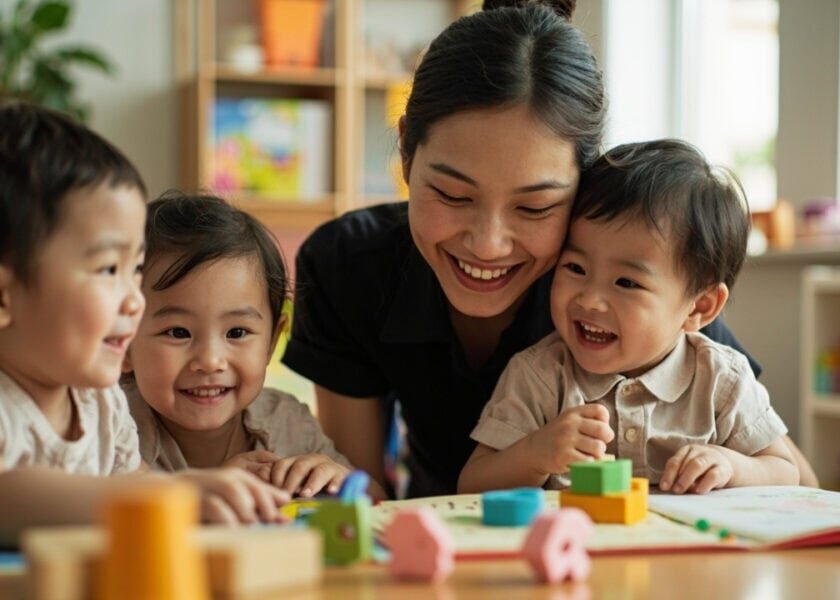
In quality childcare settings with attentive, small-group care, something important happens that rarely receives the attention it deserves. Siblings begin to teach each other.
Not in the formal, didactic way an adult teaches a child. But in the deep, embodied way that children learn from peers who are just slightly ahead of them, or slightly different in temperament.
The older child who has mastered a certain physical skill will naturally model it for the younger one — not out of instruction but out of the simple joy of competence and the gravitational pull of a sibling’s attention. The younger child will watch, attempt, fail, and try again — not because anyone has told them to, but because the person they most want to impress and be near is right there.
And because it is happening between siblings who share a pre-existing bond of familiarity and trust, the learning is accelerated. The motivation is already there. The other person already matters.
The Quiet Power of Co-Regulation
There is something else that develops in this environment — something developmental psychologists call co-regulation.
You may have heard of self-regulation: the ability of a child to manage their own emotional states, to calm themselves, to recover from frustration. It is a cornerstone of healthy development, and quality childcare supports it well.
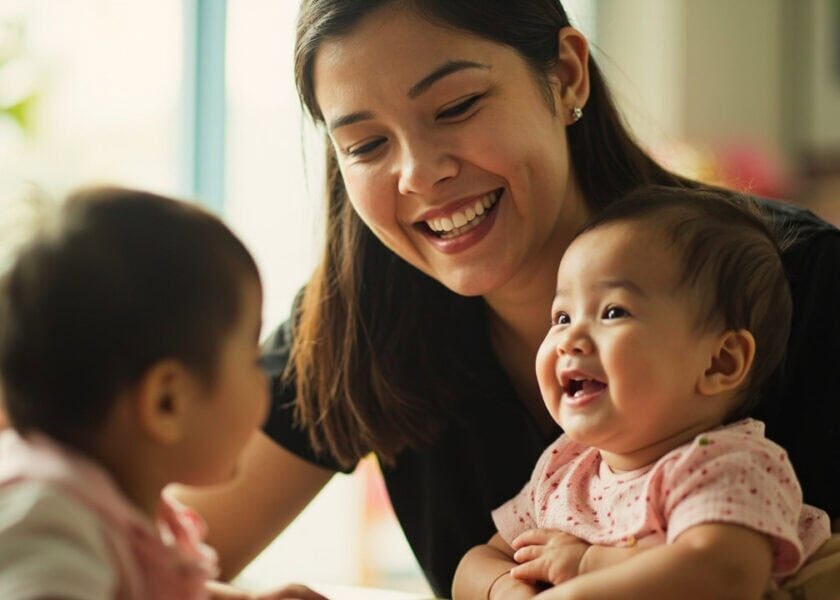
But co-regulation is something different and, in some ways, more powerful. It is the ability of two people to help each other regulate. It is what happens when a child becomes upset and their sibling, without being told to, moves closer. Offers a touch. Distributes a piece of their own snack. Sits nearby.
This is the earliest form of empathy in action — and it is a skill that will serve your children not just in childhood but in every meaningful relationship they will ever have.
What Quality Childcare Gives Siblings That Home Alone Cannot
There is a version of this story that frames childcare as a necessary compromise — a way of filling in while parents are at work, with the hope that nothing important is lost in the process.
A different understanding is possible. The right childcare environment is not a placeholder. It is an active contributor to the kind of sibling bond you hope your children will carry forward.
Quality care provides what is genuinely difficult to replicate at home when you are managing multiple children across different ages and needs:
- Individual attention within relational warmth: Each child is seen as an individual while simultaneously being held within the warmth of a sibling relationship
- A familiar anchor in a structured environment: The sibling is the thread of home in an environment that might otherwise feel new or overwhelming
- Space for peer learning: With smaller groups and better ratios, children have room to interact naturally rather than competing for adult attention
- Guided conflict resolution: Caregivers who understand sibling dynamics can support children through disagreements in ways that strengthen rather than undermine their bond
- Sustained co-presence and shared transitions: The invisible curriculum of learning how to be in relationship — navigating jealousy and generosity, competition and cooperation, frustration and forgiveness
Addressing the Anxiety Behind the Choice
Many parents with multiple children carry a quiet worry that they are not doing enough — not because they are neglectful, but because the arithmetic of raising several children is relentless.
The infant needs feeding and the toddler needs engagement and the older child needs help with something, and somewhere in the multiplication of needs, you fear that each child is receiving less than their full share of you.
That fear extends to the care environment: will my children be competing for attention? Will they be overshadowed by each other? Will the sibling bond strengthen at the expense of their individual development, or will their individual development come at the cost of the bond?
This anxiety is not a personal failing. It is one of the defining pressures of modern parenthood, felt with particular intensity in a city like Singapore where the expectations on parents are high and the village that once surrounded families has grown thin.
Here is the key insight: in quality care designed with developmental intelligence, individual development and sibling development are not in tension. They actively reinforce each other.
The sibling provides continuity. The caregiver provides structured opportunity for that sibling bond to deepen. And the child who benefits from both is more grounded, more secure, and more capable of growing as an individual and as a member of a family.
What Quality Childminding Looks Like — and How EduNanny Delivers It
If you are evaluating care options, here are the markers of an environment that understands sibling bonds as something worth nurturing:
- Small ratios that allow for attunement: When caregivers can genuinely know each child, they can also notice and support the dynamics between siblings
- Structured yet responsive daily rhythms: Consistent routines create predictability that allows sibling interaction to flourish rather than compete with chaos
- Caregiver training in group dynamics: The ability to observe, support, and sometimes step back from sibling interactions requires specific knowledge and intention
- Communication with families: When caregivers share observations about sibling moments — the small victories and the inevitable tussles — parents can reinforce the same relational learning at home
- Mixed-age grouping that respects relationships: Siblings placed together or in close proximity benefit from the familiar presence of each other
Grounded in the ECDA Childminding Pilot — which offers both home-based and centre-based pathways — EduNanny is built around the recognition that families in Singapore need care solutions that are not just reliable and safe, but genuinely supportive of the whole child’s development, including the relational dimension that so often gets overlooked.
In small-group settings under this framework, each child benefits from attentive ratios that allow caregivers to know them as an individual. But they also benefit from the presence of their sibling — not as a distraction or a competitor for attention, but as a constant, familiar anchor.
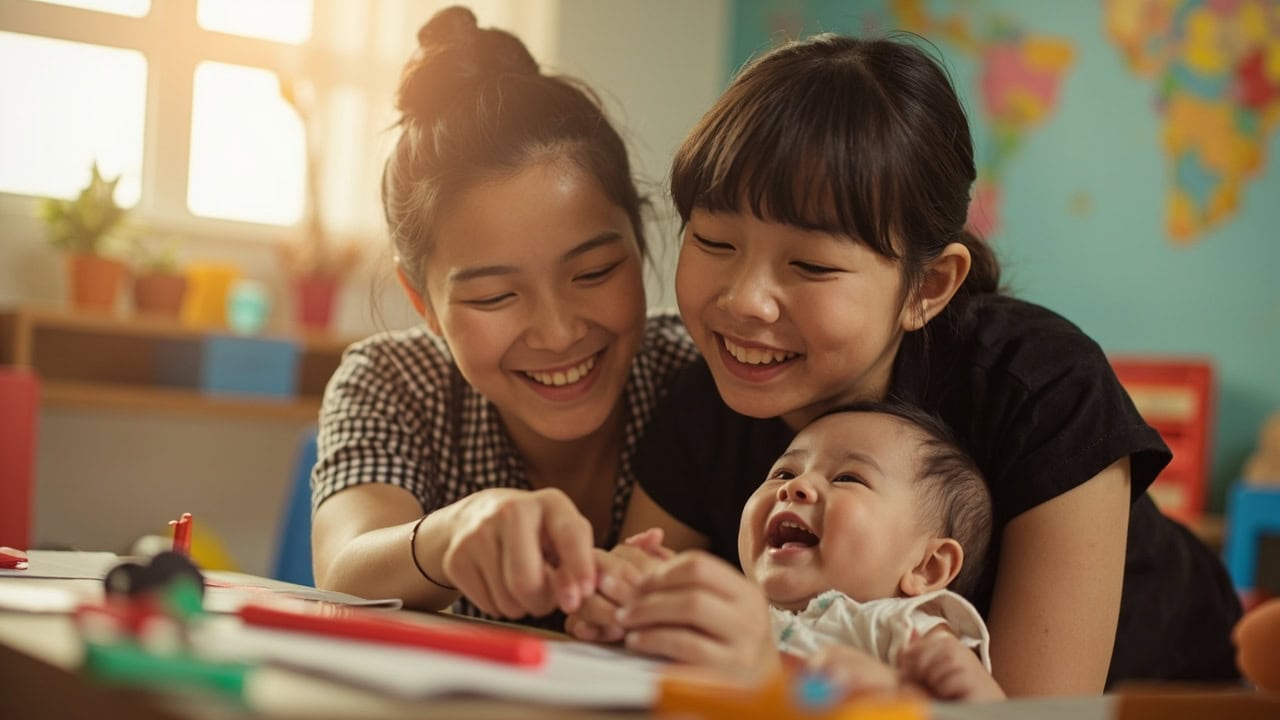
The caregiver in this environment is not merely a supervisor. They are someone whose work includes understanding the sibling dynamic as a whole — noticing when siblings are drawing on each other for comfort, when they are in constructive conflict, when one is deferring too much to the other, when the relationship is becoming a source of strength for both.
On Placing Siblings Together or Apart
Parents often ask whether siblings should be placed in the same care environment or kept separate. The answer depends on the children, the setting, and the quality of care available.
What matters most is not whether siblings share a room or a programme, but whether the care environment understands and values the sibling relationship. Siblings who are in separate rooms within the same centre can still benefit from shared transitions, from seeing each other during arrivals and departures, and from the knowledge that the other is nearby.
The key question to ask any care provider is not just “Will my children be together?” but “How do you support sibling relationships? How do you help siblings navigate conflict? How do you notice when siblings are being a source of strength for each other?”
Accessibility
Grants and subsidy schemes available through CDA and Baby Bonus mean that this kind of thoughtfully designed environment is not the exclusive preserve of families with significant financial resources.
This matters enormously. The sibling bond is not a luxury. It is a fundamental human relationship, and every family in Singapore deserves access to a care environment that protects and nurtures it.
The Long View: Choosing Care That Builds Lifelong Companions
There is a moment — many parents describe it — when you see your children together in a way that transcends the ordinary. It is not a dramatic moment. It is often quiet.
An unspoken understanding passing between them. A shared joke. A younger child looking to an older one for permission or guidance in a way that feels instinctive. An older child stepping into a protective role without being asked.
In that moment, you see the relationship you hoped for made visible. You see something that belongs to them and to each other, and that you, in some essential way, made possible.
That moment did not come from nowhere. It was built — in the mornings and afternoons, in the transitions and the ordinary hours, in environments that understood that caring for children means caring for the bonds between them. It was built by caregivers who paid attention not just to individual development but to the invisible, essential work of sibling relationship-building.
What you are doing when you choose care thoughtfully — when you look for an environment that understands siblings not as background but as a relationship worth caring for — is making a quiet, daily investment in the bond your children will carry for longer than any other. You are not just arranging supervision. You are building a foundation for something that will outlast school, outlast adolescence, outlast the years when they still live under your roof.
Your children will have each other. That is the hope. And the choice you make today — about who cares for them, about the environment you place them in, about the relationships you invest in during these formative years — is one of the most meaningful ways you will honour that hope.
To learn more about EduNanny’s approach to small-group childminding under the ECDA Childminding Pilot framework — and how the right care environment can actively support the sibling bond you hope your children will carry for life — we welcome you to get in touch or learn more about us.