The Distance Between Who You Were and Who You’ve Become
There Is a Version of Yourself You Have Not Seen in a While
Not the parent you have become—though you have become a remarkable one—but the person you were before. The one who had plans. Who moved through the world with a particular kind of confidence, a sense of direction, a quiet belief that the life you were building was yours to shape.
That person did not disappear. But something has pressed down on them, gently at first, then with the weight of every early morning, every commute, every spreadsheet opened at midnight while a small hand reaches for you from the cot.
You have not failed. You have been carrying more than one person was designed to carry alone.
If this sounds familiar, I want you to sit with it for a moment—not as a confession, not as a problem to solve, but as a recognition. Because what I have come to understand, sitting with families across Singapore, is that this feeling of having stepped back from your own life is not a weakness in you. It is the predictable outcome of an unresourced family system.
It is what happens when the demands of raising a child, sustaining a career, maintaining a home, and holding a partnership together all land on the same person, without enough support to carry it.
Here is what I also want you to know: this is not a story about outsourcing a problem. It is not about handing your child to someone else and walking away. It is about choosing a partner in care—someone who walks alongside you in the raising of your child, who extends your family’s capacity rather than replacing your role.
And when you find that partner, the distance between who you were and who you have become is not a gap that can never be bridged.
The Diminishment No One Warns You About
Here is what the conversation about childcare usually looks like. You start researching infant care options the way you would research a product purchase—by comparing ratios, checking credentials, reading reviews about safety and curriculum. And those things matter. They matter enormously.
But I want to suggest to you that there is a dimension of this decision that no checklist captures, and it is the one that will ultimately matter most to you.
Choosing quality childcare is not only a decision about where your child goes during the day. It is a decision about who you are becoming. It is a decision about the kind of partner you want to be, the professional you want to show up as, the human being you want to reclaim from beneath the exhaustion.
It is one of the most quietly consequential choices a parent can make, and it is almost never framed that way.
The Grief That Creeps In Quietly
There is a particular kind of loss that happens in early parenthood, and it is not the loss of sleep or freedom—though those are real. It is the loss of a version of yourself that you had to set down because there was no other way forward.
The morning spin class you stopped attending. The career momentum you put on pause. The weekends that became logistics rather than restoration. The conversations with your partner that used to be about dreams and now are about drop-offs and grocery lists and who is picking up the child from the infant care centre.
This grief is quiet. It does not announce itself. But if you sit with it honestly, you will recognize it.
What Actually Happens When You Find the Right Support
Here is what I have seen happen when a family finds the right support.
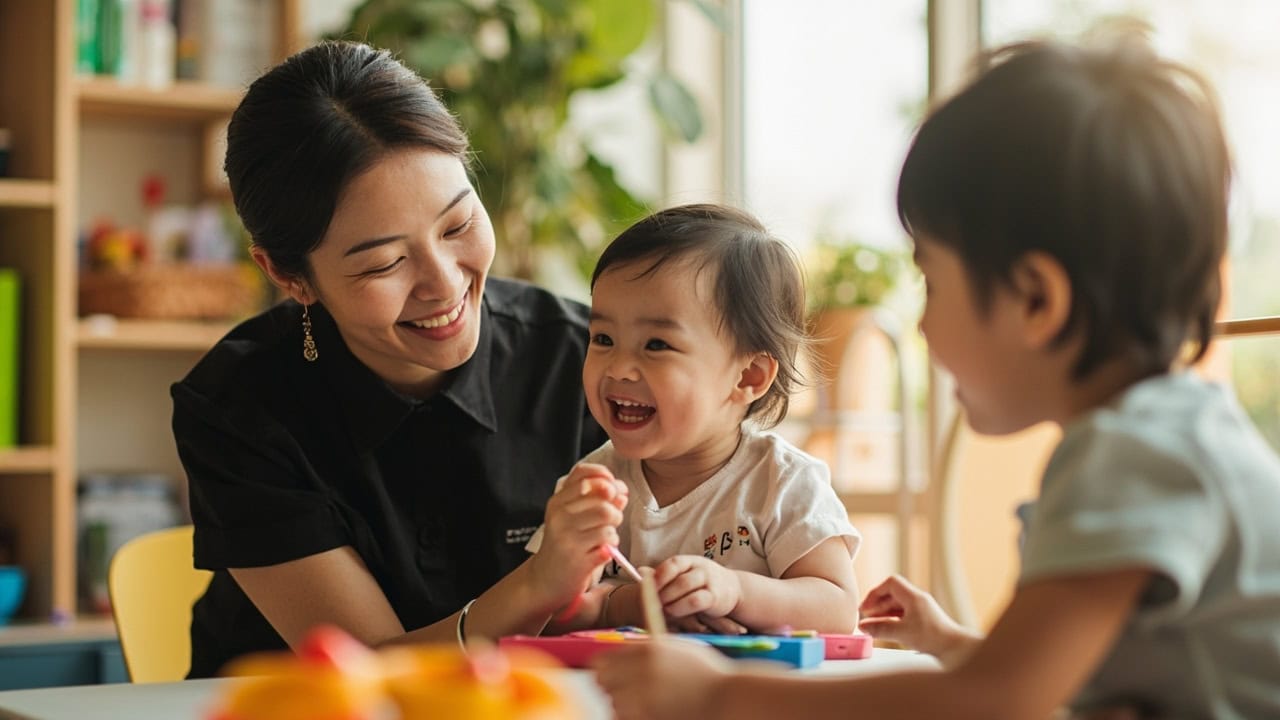
The child settles into an environment where they are genuinely known—not processed through a rotation of unfamiliar faces, but held with intention by people who understand the rhythms of early development. There is a stillness that comes over a child when they feel safe in a way that goes beyond supervision. They begin to explore. They begin to flourish.
And here is what is less obvious, but no less true: when your child flourishes in your absence, something inside you unlocks.
You stop carrying the low hum of guilt that has been running beneath every work meeting, every commute, every evening when you are too depleted to be fully present. You breathe. And in that breath, you find something you did not know you had lost—the capacity to be genuinely, freely yourself.
Restoration in the Texture of a Day
Think about what restoration looks like in the actual texture of a day.
It looks like a mother who, for the first time in months, makes it to her morning spin class not because she has somehow found more hours in the day, but because she knows her daughter is in a place where she is loved and growing and safe.
It looks like a father who walks into a work presentation and feels, for the first time in a long while, that he is leading from his full self—not the depleted, distracted version running on caffeine and anxiety, but the one who actually has something to offer.
It looks like a couple who, on a Saturday morning, sit across from each other over coffee and actually talk—not about logistics, not about who dropped off, not about what went wrong that week—but about themselves. About where they are going. About the life they are building together.
Because the distance that crept in was not about a lack of love. It was about a lack of bandwidth. And bandwidth, once restored, changes everything.
The Singapore Reality: Why the Pressure Is Different Here
I want to speak specifically about what this looks like within the landscape of Singapore, because the pressures here are real and particular.
- The cost of living means dual-income households are not a luxury—they are a necessity. Which means there is no margin for one parent to step back without financial consequence.
- The demands of a competitive professional environment mean that showing up fully matters in ways that feel high-stakes. The career you built before your child arrived still needs you to show up for it.
- Distance from extended family is a reality for so many Singapore households. The village that other cultures take for granted is not automatically there.
- The physical and emotional density of life in a small city-state means everything happens in compressed space. There is nowhere to retreat to.
These are not abstractions. They are the daily reality of families who are doing their very best with what they have.
And the honest truth is that many Singapore parents are running on fumes, not because they are failing, but because the system around them has not given them what they need.
There is a quiet grief in that. But I want to tell you that the door is still open.
What Quality Childminding Actually Looks Like
When you choose a childminder or an infant care environment with genuine intentionality, you are not stepping away from parenting. You are stepping into a more sustainable version of it.
What should you look for? Beyond the credentials and ratios, here is what distinguishes genuine quality:
- Intentionality of relationship. Your child is not processed through a rotation of unfamiliar faces. They are known. They are held with attention.
- Understanding of developmental rhythms. The caregiver understands what your child needs at this stage—not just supervision, but responsive, thoughtful engagement.
- Communication that builds trust. You do not have to wonder. You can know. And that knowing is part of what restores you.
- Consistent caregiver ratios. When one caregiver is responsible for three children rather than eight, your child is not one in a crowd. They are one, seen and known.
- A partner who sees the whole family. Quality care understands that when a child is thriving, a parent is set free. That these two outcomes are not separate—they are the same outcome, seen from two sides of the same door.
There is a particular kind of confidence that returns to a parent when they know their child is in extraordinary hands. It is not the confidence of someone who does not care. It is the confidence of someone who cares so deeply that they made the most considered choice they could.
That confidence changes how you speak to your child at the end of the day. It changes how you listen to your partner. It changes how you show up at work, at the dinner table, in the quiet moments when your child looks up at you and sees someone fully present.
You cannot give what you do not have. And when quality care gives you back your reserves, you give back to your family in ways you had forgotten were possible.
What This Looks Like in Practice: An Example
For families in Singapore seeking care that meets these standards, there are options worth knowing about. EduNanny Singapore, operating through the ECDA Childminding Pilot, structures its approach around these very principles: caregiver ratios designed for genuine attentiveness, communication practices that keep parents informed throughout the day, and a philosophy that sees the whole family as part of the care equation.
What matters most is not the specific name on the door, but whether the arrangement reflects these values in practice—whether your child is known and held with intention, whether you receive the transparency that allows you to breathe, whether the caregiver ratios allow for the kind of responsive care that early development requires.
Addressing Common Concerns
Let me speak to what I hear most often from parents who are considering this step.
Is choosing childcare admitting I cannot cope?
No. Choosing quality childcare is one of the most affirming decisions a parent can make, because it says that you believe your family deserves more than survival. It says that you believe your child deserves parents who are alive, present, growing, and in love with their own lives—not just in love with their children, though that love is infinite, but in love with who they are.
Am I stepping away from parenting?
You are stepping into a more sustainable version of parenting. One where your child receives the richness of thoughtful, responsive care, and where you receive something equally precious: the space to be whole.
How do I know I can trust the caregiver?
Trust is built through transparency, consistency, and communication. Look for arrangements that offer clear communication practices, opportunities to build relationship before care begins, and ongoing connection throughout. Trust is also built over time. A quality care partner commits to being a long-term foundation for your family’s wellbeing.
The Path Back to Yourself
Let me bring us back to what this is really about.
It is about a parent who, one morning, realizes that the distance between who they were and who they have become is not a gap that can never be bridged. It is about the moment you stop apologizing for needing help and start claiming the right to restoration.
It is about understanding that choosing quality childcare is not a concession. It is one of the most affirming decisions a parent can make, because it says that you believe your family deserves more than survival.
Your child is watching you. Not just for what you do, but for who you are. They are learning from the way you move through the world, from the confidence in your step, from the lightness in your voice, from the presence you bring to the dinner table.
And when you are restored—when you are no longer running on empty—your child does not lose a parent. They gain one. They gain a parent who is fully there, not because they never leave, but because every time they return, they return as themselves.
A Few Things to Consider as You Explore Your Options
- Think about ratios, but also about relationship continuity. Who will actually be caring for your child day to day? Can you meet them? Can you imagine your child forming a secure attachment with them?
- Ask about communication. How will you know what happens during the day? What is the protocol for updates, concerns, milestones?
- Consider the whole family system. The best infant care centre in Singapore is the one that sees you as part of the equation—not just your child.
- Trust your instincts. You know yourself and your child better than anyone. After doing your research, ask yourself: does this feel right? Does it feel like a place where both my child and I would be seen?
- Think long term. This is not a short-term arrangement. Choose a partner you can see yourself working with across the arc of your child’s early development.
So if you have been carrying this quietly, if you have been wondering whether there is more to your life than the next drop-off and the next meeting and the next load of laundry and the next sleepless night—if you have been quietly grieving the version of yourself that you had to set aside—I want you to know that she is still there. He is still there.
And the path back is not as far as you think.
It begins with a decision. A small one, in the end. But it is the decision that changes everything.
Choose the care that sees your child. Choose the partner that sees you. And watch what happens when the whole family begins to flourish—not in the way the world measures success, but in the way that actually matters.
In the morning, when your child reaches for the caregiver’s hand with trust, and you walk out feeling something you have not felt in a long time.
In the evening, when you come home and you are actually home—not just present in body, but there in every way that counts.
In the marriage that finds its way back to itself.
In the career that reignites because you have the clarity and the energy to bring your full self to it.
In the quiet, unremarkable moments of a life that is being lived, fully, by someone who has come back to themselves.
You were never meant to do this alone.
And now, you do not have to.
If this article has resonated with you, and you would like to explore what thoughtful, development-oriented childminding could look like for your family in Singapore, EduNanny welcomes the opportunity to begin a conversation.
Learn more about who we are and the standards that guide our approach to caring for children and supporting families across Singapore.