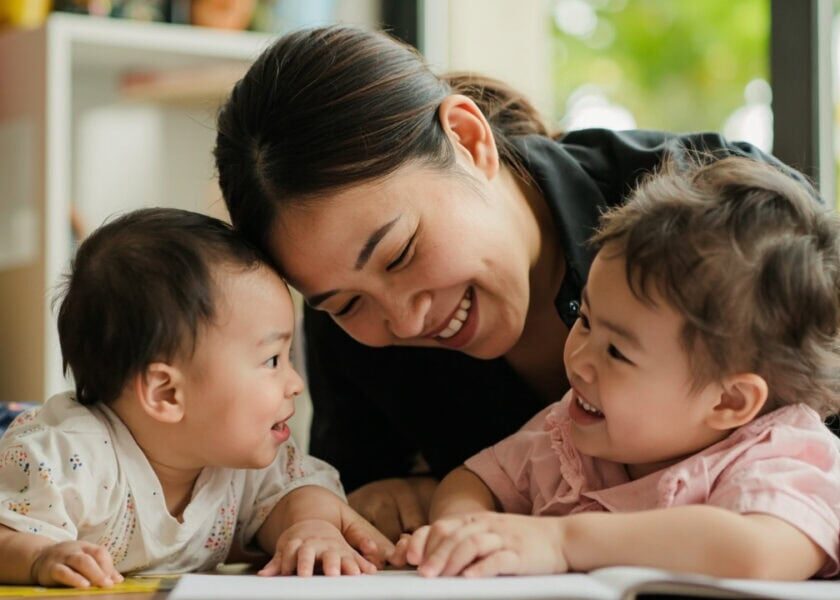
What the First Year of Quality Childcare Teaches Singapore Parents
What the First Year Actually Holds
Before we go further, here is what Singapore parents discover across the seasons of quality childcare:
- The early weeks are threshold moments, not failure—they ask for patience, and they deliver it
- Your child begins to reveal capacities you never saw at home, in contexts you could not provide
- Language, social confidence, and emotional regulation emerge faster than expected
- The caregiver becomes a partner, not a replacement—she deepens what you know about your child
- By year-end, you understand your child more fully than the day you enrolled them
- Your role has not been replaced. It has been elevated.
The First Weeks: Crossing the Threshold
The early weeks are rarely beautiful. You already know this, or you will learn it quickly.
There is the child who clings, and the caregiver who receives that clinging with patience that feels almost superhuman. There is the parent who lingers, adjusting the collar of a jacket that does not need adjusting, asking the same questions about feeding and sleep that were already answered yesterday. There is the awkward choreography of departure, the half-step backward, the final look, the door that closes with a soft click that sounds louder than it should.
This is not failure. This is threshold.
Every family crosses it differently, but every family crosses it. The child who seems to settle immediately has simply hidden their protest in different ways. The child who cries for weeks has simply not yet learned that this new arrangement is permanent—that the parent always comes back, that the caregiver is not a temporary stranger but a steady presence in the landscape of their life.
What your child is learning in these early weeks is not whether they can be without you. They already know that in some way, on some level, from the moment they were born and placed in someone else’s arms at the hospital. What they are learning is whether the world beyond you is safe. And the answer to that question lives in the face of the person who holds them when you leave.
What Quality Caregiving Looks Like in Practice
Quality caregivers are trained for this—not in the way that suggests mere certification, but in the deeper sense, the kind that shows up in the way they receive a crying infant at eight in the morning without flinching, the way they speak to the child as a person, not a task.
In programmes with ratios that allow one caregiver for every three infants, there is space for this kind of attention. There is no rushing, no mechanical routine. There is presence, deliberate and warm, and it is the foundation on which everything else is built.
You will hear about this from the caregivers themselves, in the daily updates that arrive on your phone, in the photographs that show your child at play, in the notes that describe not just what they ate but how they ate it, not just that they slept but how they settled. This is not surveillance. It is transparency by design—a window into the day that affirms what you chose is what you hoped for.
The First Shift: When You Notice Something Changing
The early weeks pass. Slowly, and then all at once, you notice something shift.
It might be small. A wave when you leave instead of a whimper. A reach toward the caregiver instead of toward you. A look of recognition, of genuine pleasure, when the familiar face appears at the gate.
You feel a strange contraction in your chest when you see it—pride and loss braided together—because what you are witnessing is your child’s capacity to love more than one person, to build a second safe place, and this is what you wanted and also what you feared.
This is the first of many moments across the first year when you will realize that your child is more than you thought. Not because they have changed, but because you are seeing them in a context you did not provide, responding to stimuli and relationships that exist outside your orbit.
The child who is bold at the centre may be bold at home too, but you did not have the space to notice because you were so close. The child who is gentle and tentative at the playground may be fiercely curious in a room full of toys and other children, and you would never have known unless someone had shown you.
The Year Unfolds: Growth, Partnership, and Rituals
As the first season turns into the second, you begin to notice changes that are not small at all.
Your child, who was once entirely dependent on you for everything, begins to do things that surprise you. They speak in words you did not teach them, or in phrases that carry the cadence of someone else’s voice. They navigate social situations with a confidence that feels unfamiliar—demanding a turn on the slide, negotiating, compromising, sharing.
They show you preferences you never knew they had—foods they love that you never tried, songs they request that are not the ones on your playlist, books they choose at the library that reflect a curiosity you did not know you had kindled.
Where did this come from, you ask. And the answer is: here. This room. This caregiver. This community of children who are becoming, together, a little larger and a little more capable than they were yesterday.
The Caregiver as Your Partner in Knowing
The caregiver tells you about it at pickup, in the brief conversation that has become the ritual of your afternoon, the five minutes of handover that is also a small intimacy between adults who share a common purpose.
She tells you that your child spent the morning building a tower with another child, that they negotiated whose turn it was without adult intervention, that they showed frustration when it fell and then tried again, laughing by the fifth attempt.
You listen, and you realize you are learning your child in a new way—through the eyes of someone who sees them for six or seven hours a day, in the company of their peers. This is the second revelation of the first year. Your child is not just growing. They are being known, in a way that enriches your own understanding of them. The caregiver does not replace your knowing. She expands it.
Thinking in Years, Not Months
By mid-year, the partnership between you and the caregiver has taken on a texture you did not expect. It is no longer transactional—no longer simply a handoff of information about sleep schedules and diaper changes. It is a collaboration.
You begin to recognize that the caregiver understands something about your child that you do not—not because she is a better parent, but because she has the gift of distance, of perspective, of seeing your child as one among many and therefore seeing patterns more clearly. And the caregiver begins to recognize that you understand something she does not—the history of your child’s earliest weeks, the way certain fears connect to certain experiences, the particular music of your family’s life that only you can hear.
Somewhere around the sixth or seventh month, you realize that this has become normal. Drop-off has lost its drama. Pickup has become a conversation. Your child talks about the centre the way they talk about home, as one of the places where they belong.
What the child brings home, across the months, is not just language and skills and social confidence—though there is all of that. What they bring home is evidence of their own becoming, and that evidence invites you to become too. To see them more clearly. To trust them more deeply. To release, a little at a time, the grip of your own anxiety and replace it with something more generous: the willingness to be surprised by your own child.
The Year-End Moment: Your Role Has Not Been Replaced
This is the revelation that may be the most important of all. Your role has not been replaced. It has been elevated.
The parent you are at the end of the first year is not the same parent who enrolled your child with trembling hands and a racing heart. You are larger now. You have been given back something you did not know you were missing: a perspective on your child that includes more than your own hopes and fears, more than your own way of seeing.
There is a moment at the year-end that will catch you off guard, if you let it. Perhaps it is the graduation ceremony, small and simple, or perhaps it is just an ordinary afternoon when you are folding your child’s laundry and you find yourself remembering who they were twelve months ago, and who they are now. The distance between those two children is not just physical and cognitive. It is something deeper—an expansion into the world.
You will feel, in that moment, a gratitude so specific and so personal that it will take your breath away, and it will be directed at no one and everyone—at yourself for making the choice, at your partner for making it with you, at the caregiver who held your child through the tears and the laughter and the ordinary Tuesdays that turned out to be extraordinary after all.
You asked, on that first morning, whether your child would still need you in the same way when the year was over.
You have your answer now. They do not need you less. They need you differently. They need the parent who has been through this year with them, who knows what they are capable of because they have seen it, who can hold their hand at the playground and their heart at the graduation and their future in their eyes when they look at who they are becoming.
They need the version of you that quality care helped you become.
What Quality Childcare Looks Like in Singapore
Understanding what distinguishes quality care can help you evaluate your options with confidence. These are the elements that matter most:
| Element | What It Means for Your Child | What It Means for You |
|---|---|---|
| Caregiver-to-infant ratios | More individual attention, more responsive caregiving, less time in group routines | Confidence that your child is seen and known, not just watched and fed |
| Caregiver training and continuity | Consistent relationships, caregivers who know your child’s patterns and preferences | A partner who can tell you meaningful things about your child’s day |
| Transparent communication | Smooth transitions, care that reflects your preferences and values | Daily windows into your child’s life that affirm your choices |
| Aligned curriculum and framework | Developmentally appropriate experiences that build on each other | Accountability beyond a website—a structure you can trust |
| Affordability pathways | Sustainable care that your family can maintain | Access to quality without financial strain |
Addressing the Concerns Every Singapore Parent Carries
Before you make any decision, it is worth naming the fears directly. They deserve honest answers, not reassurance alone.
“Will my child forget me?”
No child forgets their parent. What they learn is that the world beyond you is also safe. This is not a loss. It is an expansion. The child who trusts the caregiver is not replacing you—they are building a second anchor, and that second anchor makes them braver, not less attached to you.
“Will I miss the important moments?”
You will not miss them. You will see them differently. The first word, the first friendship, the first time they share a toy—these moments will be reported to you, photographed for you, shared with you by someone who watched them happen in real time. And then you will see them again, lived out, at home, in the days that follow. The moments do not disappear. They multiply.
“Will my child change in ways I don’t recognize?”
Yes. And this is the gift you did not expect. You will meet versions of your child you could not have met without quality care—bolder, more curious, more socially capable. These are not foreign versions. They are fuller versions of who your child was always becoming. The fear of not recognizing your child is the fear of being surprised by them. And being surprised by your child is one of the great privileges of parenthood.
“What if the caregiver doesn’t share my values?”
This is why transparency and communication matter. Quality programmes build partnerships with families, not transactions. You should expect to be asked about your child’s routines, your family’s values, your preferences for how they are held and spoken to. A good caregiver does not replace your values. She enacts them in your absence, in partnership with you.
Making the Decision: Practical Guidance for Singapore Families
When you are ready to move from research to decision, here is what matters most:
- Visit more than once. A single visit shows you a prepared moment. Ask for a second visit, unannounced if possible, to see what the programme looks like on an ordinary day.
- Ask about ratios. The ECDA Childminding Pilot framework specifies ratios that allow meaningful attention. Ask what the actual caregiver-to-child ratio is, not just what the licence permits.
- Meet the caregiver, not just the centre. The programme matters, but the person matters more. Ask who will actually be caring for your child, and ask to speak with them before you commit.
- Ask about communication. What will you receive daily? Weekly? How can you reach the caregiver? How are concerns escalated? You want transparency, not mystery.
- Understand the financial pathway. Ask specifically how CDA and Baby Bonus structures apply. What matters is whether the care is sustainable for your family over a year, not just a month.
- Trust your gut at the visit. Did the caregiver kneel to speak to your child at eye level? Did they speak about your child as a person, not a task? Did the space feel warm, not just clean? These details matter more than the marketing.
Begin the First Year with EduNanny Singapore
EduNanny Singapore was built for this year. For every year. For the families who walk through the gates not knowing what they will discover, and for the children who arrive as bundles of potential and leave as small people with opinions and preferences and the social confidence to ask for what they need.
The ECDA Childminding Pilot, with its careful attention to ratios and training and affordability, is not just a programme. It is a promise that the first year of your child’s life in care will be seen, will be safe, will be rich with the kind of attention that shapes a human being.
Home-based pathways where available, centre-based pathways where appropriate. Monday to Friday care blocks that fit the rhythm of a working Singapore family’s life. CDA and Baby Bonus structures that make the economics possible. All of it in service of the same purpose: to walk this path with you, season by season, milestone by milestone, revelation by revelation.
Your child’s first year in quality care is waiting. And so is the version of you that will emerge from it—larger, more perceptive, more present than you were on the day you enrolled them.
The story is ready to begin. Let us write it together.
Ready to explore what the first year could hold for your family?
Discover how EduNanny Singapore approaches thoughtful, development-oriented childminding—and find out whether it might be the right partnership for your child, and for you.