Beyond the Guilt: How Singapore Parents Are Choosing Wisdom Over Shame
The Question Singapore Parents Rarely Ask Aloud
There is a question that many Singapore parents carry silently, in the quiet hours before the children wake, in the spaces between family dinners and elder opinions. It is a question they rarely voice aloud, because voicing it feels like an accusation — of selfishness, of failure, of choosing ambition over ancestry.
The question is this: Am I betraying my culture by raising my child the way I need to?
If you have ever felt the weight of that question, you are not alone. And the tension you carry is not a character flaw. It is the most honest response a modern Singapore parent can have to a world that has shifted beneath their feet.
The Cultural Inheritance We Carry
We inherit more than genetics from our families. We inherit stories, expectations, the way generations before us built their lives and raised their children. In Singapore, one of the most powerful of these inheritances is the ideal of 三代同堂 — three generations under one roof, or at least within touching distance.
The grandparent as the natural village. The auntie who watches the toddler while mother works. The family unit as the fundamental architecture of childhood.
This is not mere tradition. It is wisdom — the accumulated knowledge of thousands of years that children thrive when surrounded by people who love them, when care is consistent and familiar, when family is present.
And yet, the weight of expectation falls heavily on modern Singapore parents.
There is the mother who returns to work and feels her mother-in-law’s unspoken disappointment. There is the father who arranges professional care and braces for the family gathering where someone will ask, “Why isn’t your mother looking after the baby?” There is the quiet guilt that whispers: if you were a better son, a better daughter, a more devoted parent, you would make the old model work.
The guilt is not irrational. It is the product of genuine cultural values colliding with genuine life circumstances. You were taught that family raises children. You were taught that asking for help outside the family is a sign of something missing — a gap in devotion, a failure of the family unit.
These teachings come from people who love you, from a system that worked for generations, from a world where the village was literally neighbors and relatives who lived close enough to help.
But here is what we must understand: the world your parents raised you in is not the world you are raising your children in. The costs of housing. The demands of careers. The distances between family members who once lived in the same kampong. These are not choices. They are reality.
Making wise choices within reality is not a betrayal of tradition. It is the continuation of it.
What the Original Village Was Really About
The original village was never about blood. It was about trust.
It was about consistent, reliable, loving people who held children while parents worked, who taught songs and told stories, who made sure the small person was fed and safe and seen.
The village was a system, not a blood test. And when modern life makes the traditional configuration of that system impossible, building a new configuration is not abandoning the village. It is rebuilding it with intention.
The culture that shaped you also shaped your capacity for thought, for analysis, for making considered decisions. The same cultural inheritance that gave you the value of family also gave you the wisdom to adapt when adaptation is needed. That is not a contradiction. That is a full expression of what your culture has prepared you to be.
Let us speak directly to the judgment you fear. You are not being judged by your culture the way you believe you are being judged. The elder who sighs about professional childcare is not calculating your worth as a parent. They are mourning a world that has changed, a role that has shifted, a way of being family that no longer fits the way it once did.
Their discomfort is not your failure. It is their own processing of modernity.
Choosing professional care that is excellent, that is intentional, that treats your child with the same devotion you would — that choice is not weakness. It is the most profound kind of strength. It is saying: I see the world as it is, and I am building what my child actually needs, not what the old architecture assumed would be available.
What Quality Childminding Actually Looks Like
When we talk about rebuilding the village, we need to be clear about what that means in practice. Not all professional care is created equal, and choosing quality care is not the same as outsourcing your responsibilities.
Here is what you should look for:
- Consistency and Attachment: Children under three need consistent, responsive caregivers who form real relationships with them. Low caregiver-to-child ratios matter. Your child should not be one of many in a room. They should be known, seen, and responded to as an individual.
- Transparent Communication: You should know what your child’s day looks like. Regular updates, honest reporting about both the good moments and the difficult ones. You should never feel shut out from your child’s daily experience.
- Trained and Vetted Caregivers: Quality childminding means caregivers who are trained in infant development, first aid, and responsive care practices. Background checks and ongoing professional development are non-negotiable.
- Safe, Warm Environments: Whether home-based or centre-based, the physical space should be child-safe, clean, and warm. It should feel like a place where a small person can explore and grow with confidence.
- Partnership with Families: The best childminding works when it is in genuine partnership with parents. You should feel respected, heard, and included — not replaced.
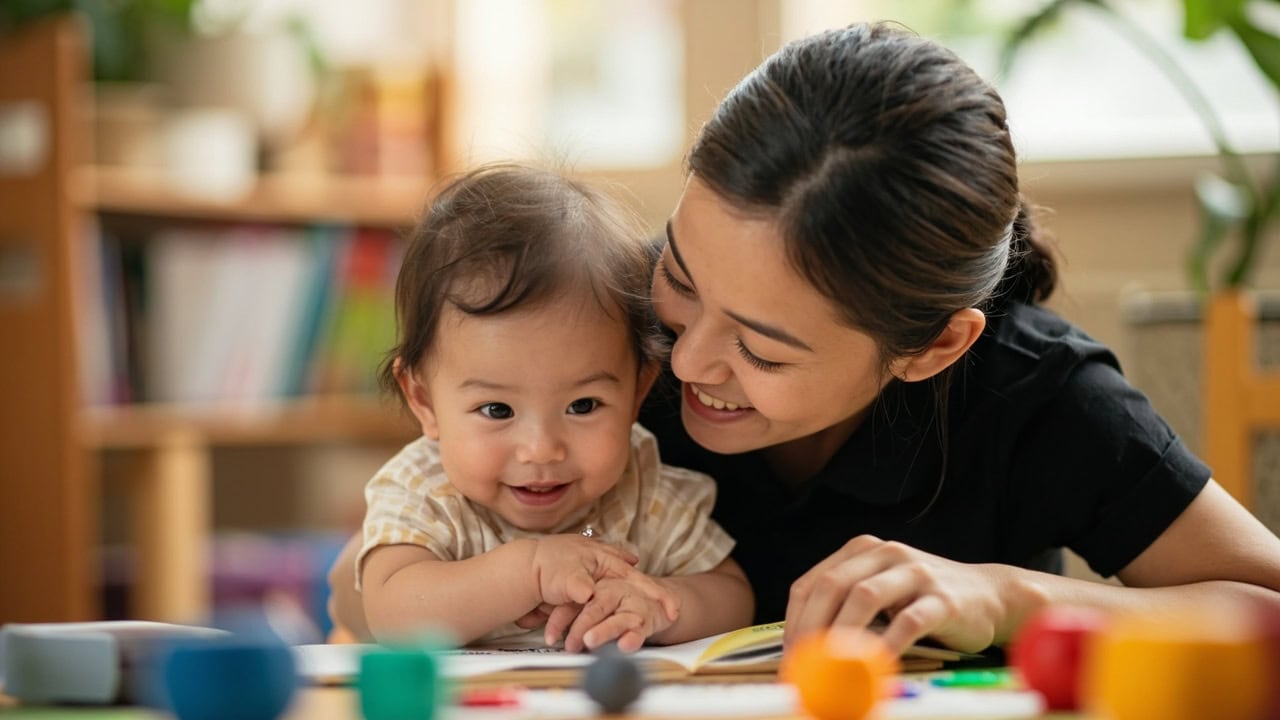
Children are remarkably perceptive about emotional attunement. What they feel is not who is caring for them, but how they are being cared for. When care is warm, consistent, and responsive, children develop secure attachments — to multiple caregivers, in fact, which research suggests builds social flexibility.
What children do not need is fragmented, anxious, guilt-ridden parents who are running on empty. What children need is parents who are present, resourced, and able to engage with them fully when they are together.
EduNanny: A Trusted Extension of Your Village
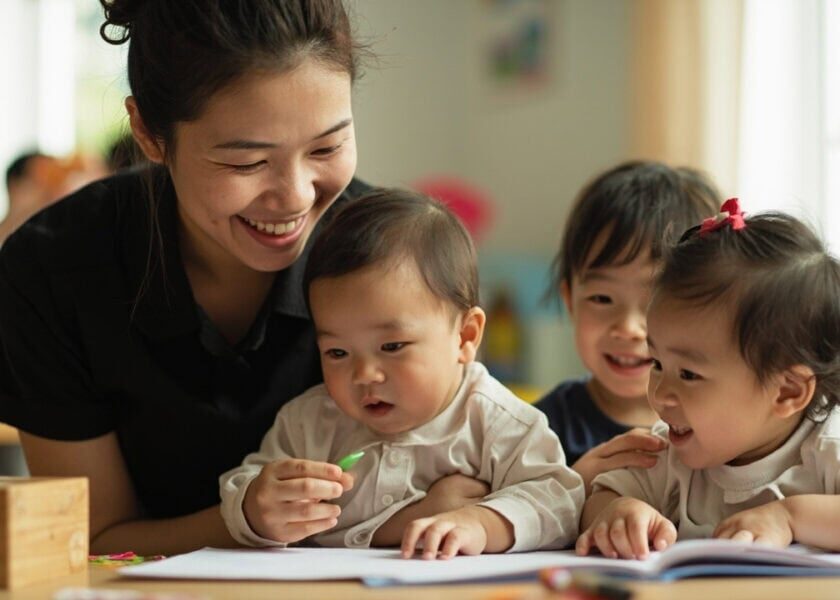
This is where EduNanny fits into the picture — not as a replacement for family, but as a trusted extension of what families have always done when they had the wisdom to build support.
EduNanny by BUTLER operates as part of Singapore’s ECDA Childminding Pilot, and this is important to understand not as a bureaucratic fact, but as a statement of values. This pilot exists because Singapore — as a nation, as a government, as a culture — has recognized that modern families need modern villages.
The pilot is not a concession to failing family structures. It is an acknowledgment that the definition of family structure is evolving, and wise support systems must evolve with it.
When you work with EduNanny, you access flexible pathways designed around your family’s actual needs:
- Home-based and centre-based options — choose what serves your family best
- One-to-three infant ratios — your child is seen, known, and responded to as an individual
- Transparent communication — regular updates so you stay connected to your child’s day
- CCTV measures where deployed — not because we distrust caregivers, but because we trust you to deserve visibility into your child’s experience
- Monday to Friday care blocks — structured to support real family schedules
- Affordable fees within the pilot framework — sustainable over years, not just weeks
- Child Development Account and Baby Bonus eligibility — practical mechanisms that make the philosophy real
We know that Singapore parents need more than philosophy. You need someone who will text you when your baby takes their first steps in your absence. You need someone who will tell you honestly that your child had a difficult morning, and what they did to help. You need someone who will celebrate the small victories with you and hold the hard moments without judgment.
You need a village, and we have built ourselves to be worthy of that name.
Making the Decision: A Guide for Parents
If you are considering professional childminding, here is how to approach the decision with clarity and confidence.
Name Your Priorities
What matters most to you? Low ratios? Proximity to home or work? Flexible hours? Transparent communication? Cultural or language alignment? Knowing your priorities helps you evaluate options rather than feeling overwhelmed by them.
Visit and Observe
Before committing, spend time in the spaces where your child would be. Watch how caregivers interact with children. Notice whether the environment feels warm, safe, and stimulating. Trust your instincts — they are usually right.
Ask the Hard Questions
What is the caregiver-to-child ratio? What is the turnover rate? How do they handle sick children? What does a typical day look like? How do they communicate with parents? There are no wrong answers, but there are answers that reveal values.
Start Gradually
If possible, begin with shorter sessions and build up. This allows your child to adjust and allows you to build trust with the caregiver team. It also gives you space to observe and reflect.
Give Yourself Permission
You are not failing your family. You are not abandoning tradition. You are making a wise, intentional choice that serves your child’s actual needs in the world as it actually exists. That is not weakness. That is wisdom.
Many grandparents who were initially skeptical of professional care gradually become its greatest advocates — once they see how their grandchildren flourish under consistent, attentive, trained caregivers. They also often discover that their own relationship with their grandchildren deepens when they are a grandparent again, not a full-time caretaker. The pressure of daily childcare can strain grandparent-grandchild relationships. The freedom of pure companionship can restore them.
The Village Is Still Here
Consider this: in a few years, your child will grow. They will speak of their childhood in ways you cannot yet imagine. And when they speak of it, they will not catalog the employment arrangements you maintained. They will not calculate whether you or your mother cared for them during the first year.
They will remember how they felt. Whether they felt safe. Whether the people who cared for them were kind. Whether home was a place they wanted to return to, because it was warm and consistent and full of people who showed up.
That is what the village was always for. Not the blood in the veins, but the safety in the rooms. Not the tradition as an unchanging artifact, but the tradition as a living thing that adapts to serve the people it loves.
Modern Singapore parents are not failing their families. You are not abandoning tradition. You are doing what Singapore families have always done when faced with challenge and change: you are finding a way. You are building something new that honors what came before while serving what exists now. You are raising children in a city-state that moves at extraordinary speed, and you are doing it with your eyes open, your hearts full, and your minds engaged in the hard work of adaptation.
The guilt does not disappear entirely — because love always carries some weight. But it can transform. The guilt becomes something quieter, something that asks not “am I failing?” but “am I choosing well?”
And the answer, when you choose with intention, when you choose people who share your values, when you choose a system designed to support both child and family, is yes.
The answer is yes.
We at EduNanny are honored to be part of your village. Not as a substitute for what you have lost or what you wished could be different, but as a trusted extension of what you are choosing to build. We will care for your children as if they were our own family — because in the only way that matters to a child, they are.
The village is not gone. It is here. It has simply grown to include people who chose this work because they believe in it, who train and prepare because children deserve excellence, who show up every day because your child matters.
And you, in choosing to build your family with wisdom and intention, in releasing the shame that was never yours to carry, in embracing the modern village that serves your child’s actual needs — you are its keeper. You are honoring it by refusing to let it become a prison of impossible expectations. You are honoring it by living its deepest truth: that children thrive when they are loved, and that love can come from many doors.
Welcome to the village. We are glad you are here.
If you are ready to explore what the modern village can look like for your family, we welcome you to connect with our team. Learn more about EduNanny’s approach to thoughtful, development-oriented childminding or discover how we became part of Singapore’s ECDA Childminding Pilot.