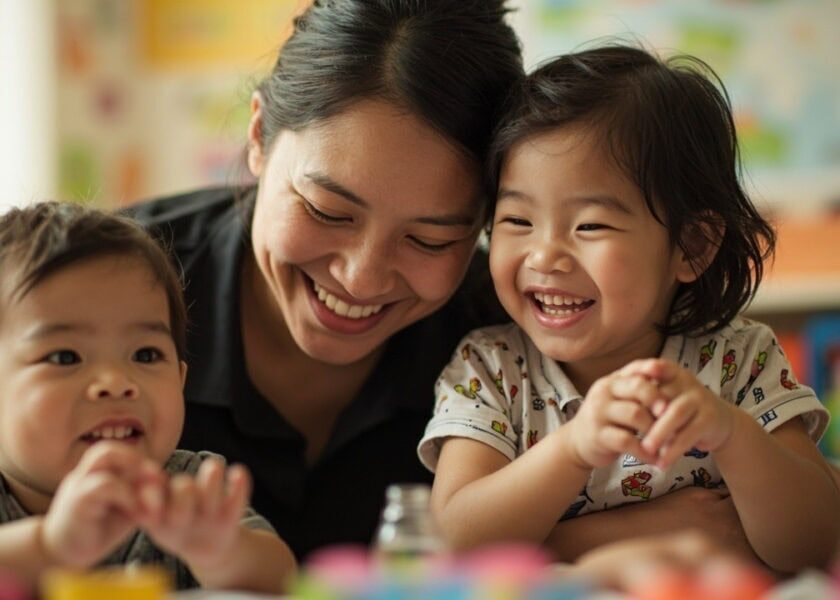
Beyond Replacement: How Singapore Parents Build True Caregiver Partnerships
The Tension You Feel Is Real—And It Is Not What You Think It Is
We call it the caregiver-parent paradox: the recognition that your child is loved by another, and the question it opens. Does this love replace mine, or does it expand it?
In Singapore, where both parents work in the majority of households, where the cost of living demands dual incomes, where grandparents are often still working themselves or living far away, most children will spend significant time in the care of someone other than their parents. This is not a failing. It is the architecture of modern family life.
And yet, despite how common this arrangement is, there is remarkably little guidance on the most important dimension of it—not the centre’s accreditation, not the curriculum’s merits, not the facility’s safety features—but the human relationship at the centre of it all. The relationship between you and the person who cares for your child.
The fear that trusting another person to care deeply for your child means surrendering your role as parent is one of the most persistent and least discussed tensions in modern parenting. It is understandable. We are biologically and emotionally wired to be essential to our children.
When we see them reach for someone else, when we hear them call another person by a name that carries affection, when we learn that they said their first word to a caregiver rather than to us, something in us questions whether we have failed. Whether we have been replaced. Whether the bond we thought was unbreakable is more fragile than we believed.
Here is what that fear is really telling you: it is a sign of how much you love your child. But it is also pointing you in the wrong direction.
The Reframe That Changes Everything
The bond your child forms with a quality caregiver is not a threat to your bond with your child. It is a gift. And this is not merely a sentimental description—it is a practical truth with profound implications for how you approach this relationship.
Think about what a child needs to thrive. They need consistency, warmth, attentiveness, and love—more than they need a single source providing all of it. When a child has a caregiver who genuinely loves them, who takes joy in their progress, who notices the small things that matter, that child is not being divided. They are being held up. They are being surrounded by people whose care reinforces rather than competes with parental love.
The assumption that allowing others to love your child means your own love counts for less is one of the most damaging myths in parenting. Your child does not love you less because they also love the person who cares for them throughout the day. Your role does not diminish because another person plays a meaningful part in your child’s life.
Love, in a child’s world, is additive.
Building a Real Partnership With Your Child’s Caregiver
There is no script for how to build a genuine, respectful, mutually supportive relationship with someone you have hired to care for your child. No etiquette manual that feels natural. There is the awkwardness of hierarchy—who is in charge? There is the discomfort of intimacy—how much do you share? There is the fear of overstepping—mixed with the fear of under-involving.
The parents who navigate this most successfully share certain qualities, and they are not what you might expect. They are not the parents who trust blindly, nor the parents who supervise obsessively. They are the parents who communicate with intention.
The Communication That Actually Matters
I am not referring to daily reports or formal check-ins, though those have their place. I am referring to something more fundamental: the willingness to be transparent about your child, your expectations, your concerns, and your gratitude.
Consider what you might share with a close friend or a trusted family member about your child—the nuances of their temperament, the things that calm them, the values you want reinforced. Now ask yourself: have you shared these same things with the person who spends more waking hours with your child than you do?
Good communication in this relationship means sharing not just logistics—who fed what and when—but philosophy. What do you believe about how children learn? What are the small things that matter to your family that a stranger would have no way of knowing unless you told them?
Building Shared Fluency
A good caregiver-parent relationship is built on what I call shared fluency—a common language about the child that both parties speak fluently.
When you and your child’s caregiver can discuss your child’s development with nuance, when you both understand their rhythms and preferences and temperamental tendencies, when you can have a conversation about a difficult day that is not defensive but collaborative—you have built something valuable. You have built a team.
What Healthy Caregiver-Parent Relationships Look Like
You will notice health in this relationship not in grand moments but in small ones.
- The transition is smooth. Your child moves fluidly between you and the caregiver without anxiety or confusion. Neither of you feels like an intrusion on the other.
- The information you receive goes beyond status updates. You get observations, insights, questions. Not just “they napped well” but “they seemed frustrated by the puzzle today—maybe we could try something simpler tomorrow?”
- The caregiver shares not just what happened but what it might mean. They think alongside you about your child’s development, not just report on it.
- You feel comfortable being honest. You can raise concerns without fear of judgment. You can ask questions without feeling like you are micromanaging. The caregiver can be honest with you in return.
- You feel like you are on the same team. Difficult conversations happen with good faith on both sides.
Warning Signs Worth Attending To
Not every caregiver-parent relationship develops as it should. Watch for these signals:
- A caregiver who deflects questions, seems guarded or defensive, communicates only at a surface level, and resists deeper engagement
- A parent who feels unable to raise concerns, who navigates around the caregiver rather than with them
- Conversations that leave you feeling dismissed rather than heard
- A sense that the caregiver sees themselves as hired help rather than a partner
The health of this relationship matters too much to ignore. These warning signs do not necessarily indicate bad intent—but they do indicate a partnership that is not working.
The Insight You Gain From This Partnership
When you have a caregiver who is genuinely attuned to your child, who notices things throughout the day that you miss because you only see the morning and evening version of your child, you gain access to a richer, more complete picture of who your child is becoming.
You learn things about your child that you would never have discovered without this partnership. You see your child through another’s eyes, and it deepens your own understanding. Your caregiver’s observations become a mirror that helps you understand your child more fully.
This is not a diminishment of your role as parent. It is an expansion of it.
What Quality Childminding Actually Looks Like
For Singapore parents evaluating their options, understanding what quality care looks like matters—not just in terms of safety and accreditation, but in terms of the relational environment your child will inhabit.
Quality childminding is not about finding a flawless caregiver. It is about finding a caregiving arrangement where:
- Your child is known as an individual, not managed as part of a group
- The caregiver has the capacity to be truly attentive—not because they are perfect, but because they are not overwhelmed by ratios that make individual attention impossible
- The environment feels like a home, not an institution
- Communication is expected and supported by the programme structure itself
- The caregiver feels valued and respected—because a caregiver who feels respected will invest more deeply
In centre-based settings, infant-to-caregiver ratios in Singapore can range significantly. The ECDA-prescribed ratio for infants in licensed centres allows for up to one caregiver per five or six infants in some configurations. This is not a criticism of centres—larger settings serve different needs and different families.
But for parents who value deep, relational care, who want their child to be known as an individual rather than managed as part of a group, smaller ratios matter. A caregiver who is responsible for two or three infants rather than ten or fifteen has the capacity to truly see each child. To notice the things that matter. To build the kind of knowledge about your child that makes shared fluency possible.
How EduNanny Approaches the Caregiver-Parent Relationship
The EduNanny programme, developed under the ECDA Childminding Pilot by BUTLER, was designed around a principle that sounds simple but is surprisingly rare: the relationship between parent and caregiver is not incidental to quality care. It is the quality of care.
Everything else—the training, the ratios, the environment—matters. But none of it matters as much as whether the person caring for your child truly knows your child, and whether you, as a parent, truly know and trust the person caring for your child.
Smaller Ratios for Deeper Attention
With infant-to-caregiver ratios of up to one to three in home-based settings, EduNanny’s model allows caregivers the capacity to be truly attentive to each child. Your child is not one of fifteen infants in a room. They are one of two or three, in a home environment, with a caregiver who can notice the small things that matter.
Monday to Friday Care Blocks
The EduNanny model operates within care blocks that align with the working realities most Singapore parents face—no early morning scramble to drop off or late pickups that feel rushed and transactional.
Communication as Programme Structure
EduNanny addresses the caregiver-parent relationship not as an afterthought but as a programme priority. Caregivers are trained to understand their role not as isolated workers but as partners with parents. The expectation of regular, meaningful communication is built into how the programme operates.
Where deployed, measures like CCTV offer additional reassurance, but they are not the foundation. The foundation is human: the training, the communication practices, the philosophy that parents and caregivers are both experts in this child, just in different ways.
Financial Accessibility
Pilot fee structures keep care affordable and accessible. Parents can utilise the Child Development Account and Baby Bonus schemes where applicable—practical measures that remove financial friction so that focus can remain on what truly matters: the relationship.
Addressing Your Real Concerns
“What if my child becomes more attached to the caregiver than to me?”
Attachment security is not about quantity of time—it is about quality of presence. A child who is securely attached to their parents does not become insecurely attached to a caregiver. What they develop, when the caregiver relationship is warm and consistent, is a secondary attachment that adds to their sense of security, not subtracts from it.
The child who knows they are loved at home and loved in their caregiver’s arms does not question where they belong. They feel held by more people, which makes them feel safer, not more anxious.
“How do I know I can trust a stranger with my child?”
Trust is built, not assumed. The question is not whether to trust blindly—it is whether the programme and the caregiver create the conditions for trust to develop. This includes rigorous caregiver vetting and training, clear communication protocols, transparency measures, and the kind of ongoing relationship where concerns can be raised and addressed.
“Won’t this make me feel like I’m not needed?”
When the caregiver-parent partnership works well, parents report the opposite. You feel not less like a parent, but more. Not less connected to your child, but more. Because you have access to a richer understanding of your child, because you have support in the challenging work of raising a child, because you are not carrying the impossible weight of being everything to your child alone.
Your essential place in your child’s life becomes more visible, not less, precisely because you have welcomed another essential person into it.
A Practical Guide for Choosing Infant Care in Singapore
If you are evaluating your options, here are the questions worth asking—not just about accreditation and safety features, but about the relationship you are entering:
- How does this programme conceptualise the parent-caregiver relationship? Is it seen as a partnership or a transaction?
- What are the caregiver-to-child ratios, and what does that mean for the attention your child will receive?
- What does communication look like day-to-day? Is there a structure for meaningful exchange, or just status updates?
- How are caregivers trained to understand their role—not just as childcare workers, but as partners with parents?
- What happens when there are concerns or difficult conversations? Is the relationship built to handle that?
- Does the programme’s philosophy align with your belief that your child’s caregiver should be an extension of your family, not a replacement for you?
Ready to Explore a Different Model?
Your child will have a relationship with the person who cares for them. That is inevitable. What is not inevitable is whether that relationship becomes a source of strength for your family or a source of quiet anxiety.
Whether it expands your capacity as a parent or makes you feel diminished. Whether it creates a team or a tension.
The families who find this kind of caregiver-parent partnership are transformed. Not by some dramatic revelation, but by the slow, quiet understanding that they are not doing this alone.
That the hours when they cannot be with their child are hours when their child is still held. Still seen. Still loved.
That the person who cares for their child is not a stranger or a service provider or a necessary inconvenience, but an ally.
That their child’s world is not diminished by the addition of another caring adult, but enlarged by it.
The tension you feel—the ambivalence, the vulnerability, the fear that you might be replaced—is not a sign that something is wrong with you or with your family. It is a sign that you care deeply, and that you are searching for a way to care deeply while also allowing others to care for your child.
If you are looking for care that understands the importance of the caregiver-parent relationship, that respects both your role and your caregiver’s role, that refuses the false choice between institutional efficiency and relational depth—EduNanny Singapore may be worth exploring.
What they have built is not just a childcare programme. It is an acknowledgement that great childcare is not about replacing parents. It is about expanding families. Not the dilution of love, but its multiplication. Not the diminishment of relationships, but their deepening.
It starts with one conversation. If you are ready to explore what a true partnership in care could look like for your family, connect with the EduNanny team to learn more.
Your child is ready for a larger world. And so, perhaps, are you.