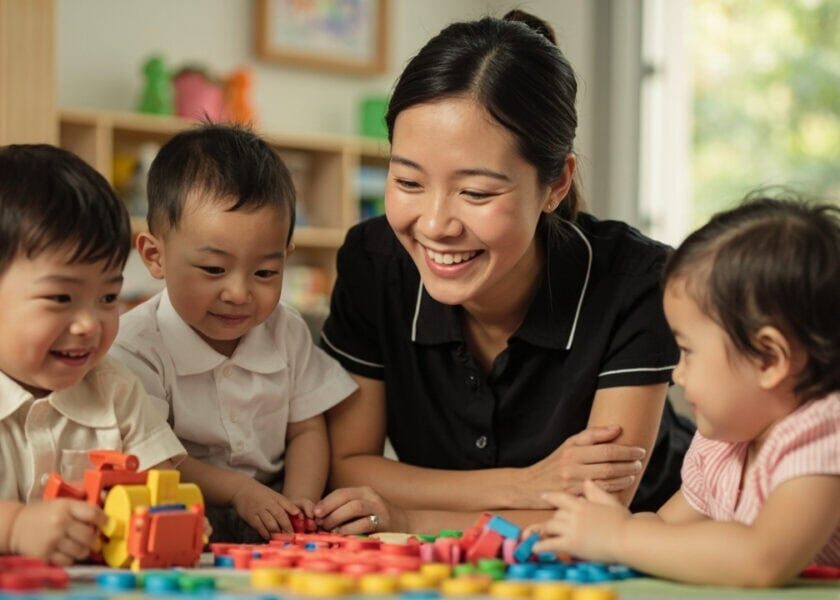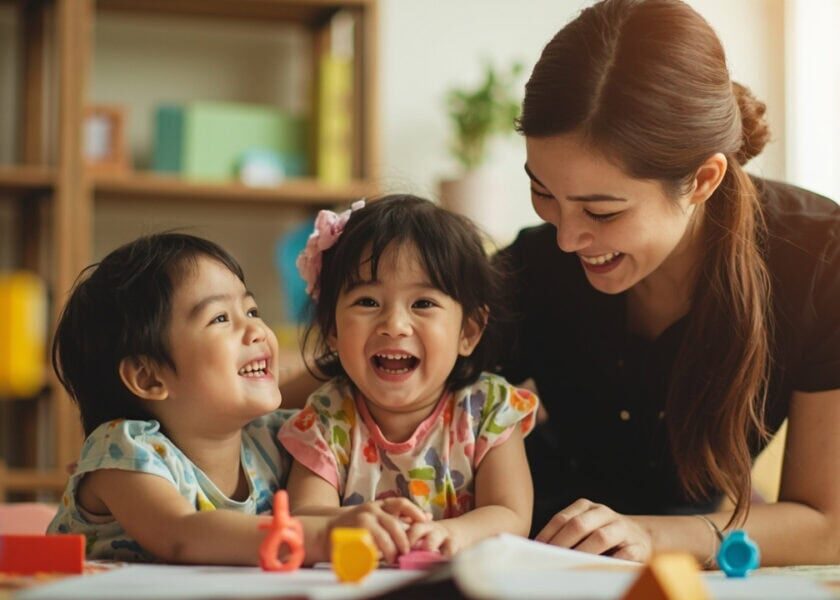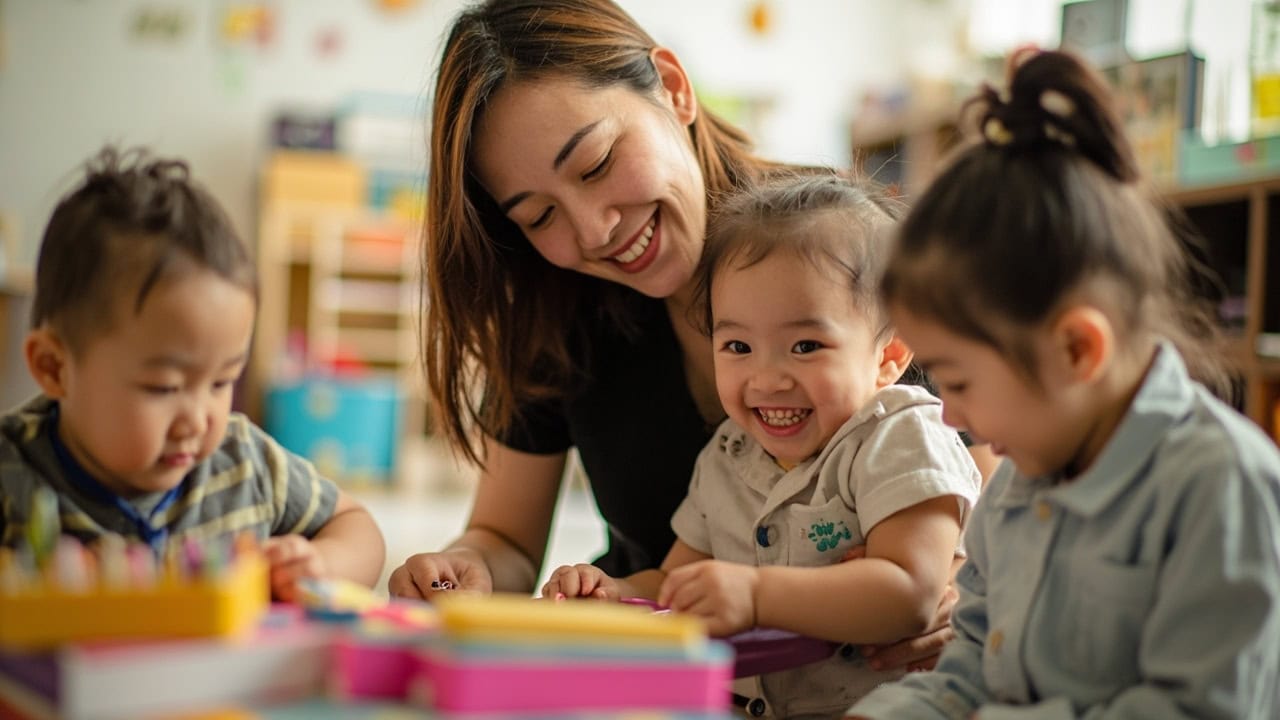
Why Singapore Parents Choose Quality Childcare for Language Growth
When Was the Last Time You Counted the Words Your Child Heard Today?
Not the words on a screen. Not the words from a television programme, however well-made. I mean real words—spoken by a real person, in response to something your child just did, just wanted, just wondered about.
If you are like most parents in Singapore, that question lands somewhere uncomfortable. Not because you are failing. But because you are caught in one of the most complex parenting tensions of our time: you know your child needs rich, responsive language exposure in these early years. You know the science. You have read about the first thousand days. You understand that vocabulary foundations are being built right now, in this window, before formal schooling even begins.
And yet—between work obligations, commuting, the sheer logistics of modern Singaporean life—you cannot always be the one delivering it.
So a quiet question forms. A worry that does not always make it into conversation at playdates or parenting forums, because it feels almost too vulnerable to voice:
What happens to my child’s language when I am not there?
Today, we want to speak directly to that question. Because it deserves a real answer—not reassurance without evidence, not dismissal of your concerns, but an honest exploration of what quality childcare actually does for language development, and why the right choice matters so profoundly in these earliest years.
The Science of Early Language Development
The science of early language acquisition is not subtle. By age three, a child’s brain has already formed the architecture that will support communication for a lifetime. The neural pathways for vocabulary, for sentence structure, for phonological awareness—the ability to hear and distinguish sounds—are all being laid down now, shaped by the language environment your child inhabits.
Researchers have documented the “word gap” with striking clarity: children from language-rich environments enter preschool with vocabularies that outpace peers by thousands of words. Not because of innate brilliance. Because of exposure. Because of interaction. Because of the quality of conversation happening around them.
This is not about passive hearing. It is about active, responsive engagement.
Consider what happens when a child points at a bird. A responsive caregiver does not simply label it. They say: “Yes, that is a sparrow. Do you see how it is smaller than the pigeons? It has a grey head.”
That is not merely labelling. That is scaffolding—building connections between concepts, introducing new vocabulary in context, modelling how conversation works.
Serve-and-Return: The Conversation That Builds Brains
Developmental scientists call this interaction serve-and-return. The name captures exactly what happens: a child’s gesture, sound, or word is met with a meaningful response, which prompts another attempt, which is met with another response. Like a tennis rally. Like a dance.
In these exchanges, the brain is not merely receiving language. It is practising language. It is learning that communication is something you do with people, not something that happens to you.
This is why the first thousand days matter so much. The neural pathways being formed now are the infrastructure for everything that follows: learning to read, learning to reason, learning to understand others and advocate for yourself. Language is not just about words. It is about the capacity to think, to connect, to learn.
Singapore’s Multilingual Reality: A Concern Worth Addressing
Here is where Singapore’s reality adds a layer that most parenting advice from abroad simply does not address.
You are raising a child in a multilingual environment. Perhaps you speak English at home, or Mandarin, or Tamil, or Malay—or some combination. Perhaps you code-switch naturally, the way many Singaporean families do. Perhaps you worry that your child will not pick up English strongly enough for primary school, or that their Mandarin will lag behind their English, or that the balance you are trying to strike will somehow tip the wrong way.
These are not trivial concerns. They are real. And they are specific to contexts like ours, where bilingual development is not an enrichment goal but a practical necessity—and a source of profound parental anxiety.
Here is what the evidence tells us: bilingual language development does not confuse children. It strengthens their cognitive flexibility, their sound discrimination, their ability to understand that one thing can be named in multiple ways.
But—and this matters—bilingual acquisition requires consistent, quality exposure to both languages. It requires caregivers who can model code-switching naturally. Who can introduce vocabulary in context, in both languages, without forcing it. Who understand that a child learning two languages may sometimes mix them, and that this is a sign of active processing, not confusion.
This is not something that happens by accident. And it is not something that happens in front of a screen.
What Quality Childcare Actually Looks Like
So what does a language-rich childcare environment contain? What should you be looking for when you visit a centre or meet a caregiver?
Caregiver ratios matter most. This is not a bureaucratic detail. When a caregiver can focus on one, two, or three infants rather than six or eight, every interaction becomes an opportunity for language development. The difference between a caregiver who can engage meaningfully and one who is simply managing logistics is fundamental.
Intentional language use throughout the day is the texture of quality care: the morning greeting, the description of breakfast, the commentary on what is happening outside the window, the gentle correction of pronunciation, the patient wait for a response before continuing. These are not scripted moments. They are how language-rich care feels.
Read-aloud as a daily ritual—not as a chore, but as an invitation into a world where words and pictures and imagination live together.
Peer interaction matters too. Your child is not only learning language from adults. They are learning it from other children—observing communication attempts, negotiating, protesting, requesting. They learn pragmatic language: how to read a face, how to interpret a tone, how to take turns in play.
The Difference Between Supervision and Development
Both may look similar from the outside. But only one is preparing your child for everything that comes next.
A quality infant care environment is not a place where language happens occasionally, during designated circle time or story time. It is a place where language is woven into the fabric of the day—because the ratios allow it, because the caregivers are trained to do it, because it is understood as fundamental rather than optional.
Screens Do Not Build Language
Screens may introduce vocabulary. A child watching a high-quality programme will learn some words. But they will not learn conversation. They will not learn turn-taking in dialogue. They will not learn that language is something you do with people, not something that happens to you.
The research is consistent: human conversation, even with infants, produces language outcomes that passive media simply cannot match. When you choose quality care, you are choosing environments where human responsiveness—not screens—shapes your child’s language development.
Language Milestones in the First Thousand Days
Language development in the first three years follows a recognisable trajectory, though every child moves at their own pace. Understanding these milestones can help you recognise what quality care is building toward—and know what questions to ask when you visit a childcare setting.
Around 12 months, babies begin babbling with intention, experimenting with sound combinations. In quality care, responsive listening and cause-and-effect in communication are modelled daily by caregivers who narrate, respond, and wait.
Around 18 months, many children enter a vocabulary explosion—learning that things have names, that everything can be labelled. This is when rich, descriptive caregiver interaction becomes transformative: expansion of concepts, serve-and-return exchanges, and the patient back-and-forth that builds neural pathways for language.
Around 24 months, children begin combining words into short sentences, expressing needs and ideas. Quality care supports this with grammatical modelling, expansion of phrases, and facilitated peer communication attempts—opportunities most homes alone cannot consistently provide.
Around 36 months, complex sentence structure emerges. Genuine back-and-forth conversation becomes possible. This is when pragmatic language—reading social cues, understanding narrative, navigating conversation with peers—takes centre stage.
If you have chosen a quality childcare environment, these milestones are not happening in isolation. They are being actively supported by trained caregivers who understand what each stage requires.
EduNanny: Where Language Development Is the Work of Childcare
EduNanny by BUTLER operates under the ECDA Childminding Pilot, which means it is part of a deliberate, structured approach to home-based and community-based infant care in Singapore. The pilot recognises what many parents instinctively feel: that very young children thrive in settings where the ratio of caregivers to infants is low enough to allow genuine responsiveness.
At EduNanny, this means ratios of up to one to three infants. This is not merely a compliance figure. It is the difference between a caregiver who can engage meaningfully with your child and one who is simply managing logistics.
Bilingual Support in Singapore’s Linguistic Reality
You might wonder whether this kind of environment can truly support bilingual development. Many parents worry that a mixed-language setting will confuse their child, or that English will dominate at the expense of their home language.
Here is what the evidence supports: quality bilingual exposure does not fragment language acquisition. It enriches it.
When a caregiver can narrate the day in both English and Mandarin, when picture books are read in alternating languages, when songs and rhymes are introduced in both tongues, children develop an awareness of language as a system—something that can be switched, shifted, played with. They learn to understand context. They learn that “mum” and “妈妈” refer to the same person. They build cognitive muscle that will serve them well in primary school and beyond.
Questions to Ask When Evaluating Any Childcare Setting
Whether you choose EduNanny or another provider, these questions go beyond the surface:
- What is the caregiver-to-infant ratio? Can caregivers genuinely respond to each child?
- How is language development integrated into daily routines, not just during designated activities?
- How do caregivers support bilingual development? Can they model code-switching naturally?
- What does communication with parents look like? Will you receive meaningful updates about your child’s day?
- How much screen time is permitted? How is passive versus interactive time balanced?
- How are peer interactions facilitated? Do infants have opportunities to learn from other children?
Transparency: How You Know the Language Environment Is Real
You may wonder: how do I know that when I drop off my child, the language environment I have been promised is real, not just a brochure?
At EduNanny, communication with parents is not an afterthought. You will receive updates—not generic end-of-day summaries, but meaningful observations about your child’s day. What they seemed interested in. New words they tried. Songs they enjoyed. Moments of discovery.
This is not just about reassurance for you, though reassurance matters enormously to parents who spend their working hours wondering. It is about creating a feedback loop. Because language development does not end when you pick up your child. It continues at home, in the evening, over weekends. The more you understand what is happening in their care setting, the better you can extend it.
What You Can Do at Home: Extending the Language Environment
Childcare and home are not separate worlds. They are one ecosystem.
If your child is in quality care during the day, the language exposure they receive there is a foundation. It can be extended, reinforced, deepened in the hours you are together.
- Create conversation during meals. Ask your child what was the best part of their day. Wait for the answer, even if it takes time to come. Resist the urge to fill silence with your own narration. That pause is where language learning happens.
- Read aloud together every evening. Not as a checkbox, but as a ritual of closeness. Point at pictures. Ask questions. Let your child turn the pages. If Mandarin is important in your household, alternate picture books in both languages.
- Practise recasting. When your child says something partially formed, respond as if you understood perfectly, and model the correct version: “You want the bana? Yes, here is the banana. Can you say ba-na-na?” This is one of the most powerful language-building tools available to parents.
- Narrate your own actions. During routine moments, describe what you are doing: “I am cutting the carrots now. See how they are orange? We are going to cook them.” This may feel strange at first, but you are modelling language for your child.
- Build on what caregivers share. When your child’s caregiver shares observations—a new word they learned, a phrase they tried—reinforce it. Let your child hear that same language in a different voice, in a different setting. This is how neural pathways strengthen: repetition with variation.
A Partnership in Language Development
EduNanny is not for every family, and that is honest. The ECDA Childminding Pilot works best for families who have identified quality language development as a priority—who understand that the early years are not simply a period to be survived before formal schooling, but a window that, once closed, cannot be reopened.
The fee structures within the pilot are designed to be accessible, and many families find that CDA and Baby Bonus subsidies can be applied, which makes premium-quality care more achievable than it might initially appear.
Somewhere, right now, a child in a quality care setting is pointing at a picture in a book. A caregiver is naming it, describing it, asking a question. The child is listening. Processing. Preparing to speak.
That moment—and thousands of moments like it—is building something that will last a lifetime.
As parents, we cannot be present for every moment. We cannot be everything to our children in every hour of the day. But we can choose environments that honour what our children need. We can seek out care that is not merely adequate, but excellent. We can trust that when the science is applied with intention, when ratios allow for responsiveness, when caregivers are trained to understand language development as their core purpose, something remarkable happens.
Children learn to speak. They learn to listen. They learn that words are powerful, that conversation connects, that language is a gift they will carry with them forever.
That is what quality infant care is building. Not just childcare. Communication.
If you are ready to explore how EduNanny’s approach to language development can support your child’s earliest and most important conversations, we welcome the opportunity to speak with you.
At EduNanny, we believe the first thousand days are not a waiting period. They are a foundation. We would be glad to hear from you.