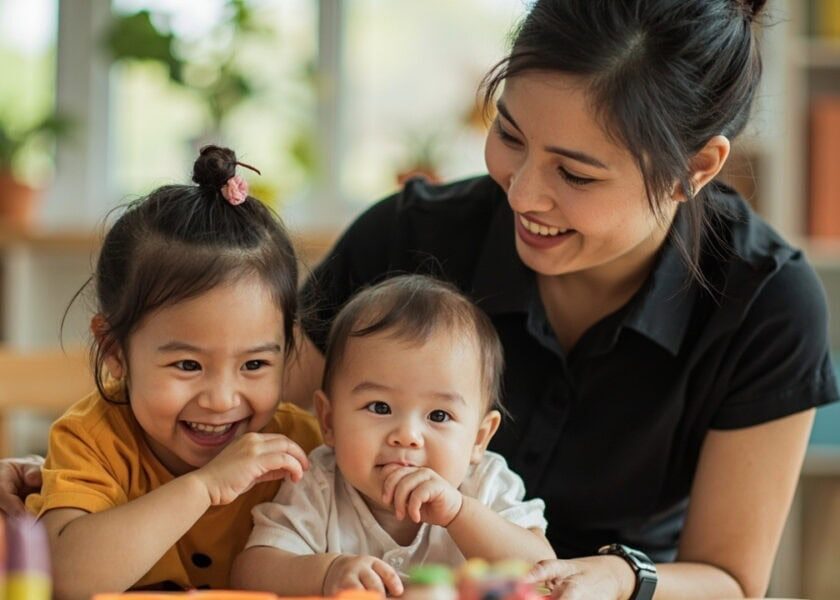
What Your Child’s Brain Is Building in the First Critical Years
Understanding Your Child’s Development: What Parents Actually Need to Know
You watch your baby sleep, and you wonder what is happening behind those closed eyes. In the first few months of life, a child’s brain forms more than one million new neural connections every single second. You have likely heard this figure before. but knowing the number and feeling what it means are two entirely different experiences.
Here is what you can actually see. Your newborn turns her head toward your voice. Your three-month-old holds your gaze for a long moment before looking away. Your six-month-old reaches for a toy and misses, then tries again. Your one-year-old points at a bird in the park with unmistakable intention. These are not just adorable moments to capture on your phone. These are your child’s brain building itself in real time.
You know, intellectually, that your child is developing at a pace that will never be matched again in their lifetime. But between the science and your lived experience as a parent, there is a gap, a wide, quiet space where you find yourself asking questions that no one seems to answer in terms you can actually use: Is my child doing what she should be doing? How would I know if something was off? Is this thing I am noticing a sign of progress or a sign of concern?
And the question underneath all the others, the one that sits heaviest when you drop your child at childcare in the morning: Is this place actually helping my child grow?
If you have asked yourself these questions, you are not alone. You are exactly where most thoughtful Singapore parents find themselves. What we lack is not information. What we lack is a reliable framework that translates developmental science into what you can actually observe in your own child and in the people caring for your child every day.
The Five Developmental Domains That Shape Your Child’s First Years
Developmental researchers have identified five interconnected domains that matter most in your child’s early years. Understanding these domains gives you a map. You do not need to become an expert. You need to know what healthy development looks like and what quality care produces in each area.
Attachment and Emotional Regulation
In the first year of life, your child’s primary developmental task is learning that the world is a safe place, that their needs will be met, and that the people who care for them are reliable sources of comfort and joy. This sounds like philosophy. Here is what it looks like in practice:
- At three months: A baby who is developing secure attachment will show excitement when a familiar caregiver approaches and has begun to show a clear preference for familiar faces over strangers.
- At six months: That same baby will use specific sounds or facial expressions to communicate distress and will settle more quickly when picked up by someone they know well.
- At nine months: Your baby will check in with their caregiver’s face when encountering something new. Researchers call this behavior social referencing. They are asking, without words, whether this thing is safe.
- At twelve months: If your child has had consistent, responsive caregiving, you should observe something remarkable. They will show genuine pleasure when reunited with you after a period apart. They may run to you, arms raised. They may bury their face in your neck.
This is not just love, although it is certainly that. This is the foundation of your child’s ability to eventually regulate their own emotions, to trust others, to take age-appropriate risks, and to form healthy relationships throughout their life. The research on this is unambiguous: secure attachment in the first years predicts emotional resilience, academic achievement, and social competence well into adulthood.
Communication and Language
By the time a child speaks their first word, they have already been practicing communication for months. They have been listening to the cadence and rhythm of your voice. They have been experimenting with coos and gurgles and eventually consonants. They have been pointing and gesturing and watching your face for response.
These milestones serve as a useful map. The important thing is not whether your child hits each milestone exactly on schedule. The important thing is the trajectory, the progression, the sense that language is expanding and deepening over time.
| Age | What You Should Typically Observe |
|---|---|
| 4 months | Babbling that includes consonant sounds (ba, da, ma) |
| 6 months | Taking turns in vocal exchanges, a back-and-forth that looks like conversation |
| 9 months | Responding to their name and understanding simple requests |
| 12 months | Saying one or two words with meaning |
| 18 months | A vocabulary of roughly 10 to 50 words, putting two words together |
A child who is not yet speaking at eighteen months but who is babbling extensively, gesturing, and understanding simple requests is on a different path than a child who is not babbling at all and shows no interest in communication. One is potentially a late talker. The other may need a more thorough evaluation.
Cognitive Exploration and Problem-Solving
In the first years of life, your child is essentially a scientist. They are formulating hypotheses, testing them, and revising their understanding of how the world works. This process looks like play, and it is play, but it is also the most serious learning your child will ever do.
- At four months: A baby will bat at a mobile because they have discovered that their actions produce effects.
- At six months: They will look for a toy that has rolled out of sight, demonstrating that they understand objects continue to exist even when they cannot see them.
- At nine months: They will experiment with cause and effect by dropping things from their highchair and watching where they go.
- At twelve months: They will use objects as tools, such as using a stick to reach something.
- At two years: They will engage in symbolic play, using a banana as a telephone or a block as a car.
These are not random behaviors. They are developmental milestones that reflect the growth of executive function, working memory, and logical thinking. A child who is consistently engaged in rich, open-ended play is building the cognitive architecture that will later support academic learning, problem-solving, and creative thinking.
Motor Skills and Physical Confidence
Motor development follows a predictable sequence, but the timeline can vary considerably among healthy children. Understanding this variability is important for reducing unnecessary parental worry.
| Age | Large Motor Skills | Fine Motor Skills |
|---|---|---|
| 2–4 months | Lifting head, pushing up on arms during tummy time | Raking objects toward themselves |
| 6–9 months | Sitting with minimal support, pulling to stand | Transferring objects from one hand to another |
| 12 months | Cruising along furniture; some children taking first steps | Using a pincer grasp to pick up small objects |
| 24 months | Walking well, beginning to run and climb | Stacking blocks, turning pages, using a spoon |
What parents should understand is that motor development is not just about big movements. Fine motor skills are equally important and often receive less attention. The ability to control small movements, to manipulate objects with precision, forms the foundation for later writing, drawing, and self-care skills.
Social Curiosity and Peer Engagement
In the first year of life, social development is primarily about the child and their caregivers. The baby smiles at familiar faces. They laugh when played with. They show stranger wariness and eventually stranger anxiety, which is actually a sign of healthy attachment. By nine to twelve months, they begin to show interest in other children, watching them, reaching toward them, and eventually engaging in simple social exchanges.
In the second and third years, social development becomes more complex:
- By 18 months: Many children engage in parallel play, playing near other children but not yet cooperatively.
- By 2 years: True social interest emerges, imitating other children’s actions, offering toys, and showing early signs of empathy.
- By 3 years: Cooperative play becomes more common, and children begin to form preferences for certain playmates.
What Quality Childcare Looks Like: A Framework for Observation
Now that you understand what healthy development looks like across these five domains, here is what you should expect to see when you visit a childcare arrangement that is genuinely supporting your child’s development. These are not vague ideals. They are observable, specific behaviors and environmental features you can look for during a visit.
In Attachment and Emotional Regulation
- Do caregivers respond promptly when children show distress?
- Do they get down to the child’s eye level when speaking with them?
- Do they speak in warm, calm tones even during routine transitions?
- Do you see caregivers noticing early signs of frustration and intervening gently before a full meltdown occurs?
In Communication and Language
- Do caregivers talk with children throughout the day, not just during designated story time?
- Do they narrate what is happening, name objects, expand on children’s sounds and gestures?
- When a child reaches for something and makes a sound, does the caregiver respond as if having a conversation?
- Do you hear back-and-forth exchanges between caregivers and children that go beyond simple instructions?
In Cognitive Exploration
- Do children have access to open-ended materials like blocks, art supplies, and natural objects?
- Is there time for unstructured play without immediate adult direction?
- Do caregivers ask questions that extend children’s thinking rather than solving problems for them?
- Are children given the opportunity to persist at challenging tasks before receiving help?
In Physical Development
- Is there space and opportunity for tummy time, crawling, climbing, and running appropriate to the children’s ages?
- Are fine motor materials available and age-appropriate?
- Do caregivers balance safety with appropriate challenge?
In Social Development
- Do children have opportunities to interact with peers in a supervised environment?
- Do caregivers support conflict resolution without taking over?
- Is there a visible culture of kindness, sharing, and respect among the children?
If you cannot answer these questions by observing during a visit, ask them directly. Quality childcare should be transparent about what happens in their environment and should be able to give you specific examples rather than general reassurances.
Common Concerns Singapore Parents Have—and How to Address Them
“How do I know if my child is actually on track?”
The key is to focus on trajectory rather than exact timing. Milestones are guideposts, not deadlines. What matters is the sense that your child is progressing, that language is expanding, that skills are building on each other over time. If you have concerns about your child’s development, bring them to your paediatrician. Asking questions is not a sign of anxiety. It is a sign of engaged parenting.
“Is my childcare actually helping my child develop?”
You should be able to answer this question. Quality childcare will be able to tell you specifically what your child worked on, what they observed, and how your child is progressing across domains. If you are getting vague answers or if you do not know what is happening while your child is in care, that is worth addressing directly.
“What if my child misses a milestone?”
Missing a single milestone is not necessarily a cause for alarm. Children develop at their own pace, and some variation is normal. What warrants attention is when you see a plateau or a regression, when a skill that was present seems to disappear, or when your child shows no interest in communication, social engagement, or exploration at all. If you notice these patterns, speak with your paediatrician. Early intervention makes a real difference.
“I feel guilty about leaving my child in childcare.”
Many parents feel this. The research on early childhood development does not say that parents should never work or that children must be with their parents constantly to thrive. What the research says is that children need consistent, responsive, warm caregiving. That caregiving can come from parents, from qualified childcare, or from a partnership between both. What matters is quality. If your childcare is genuinely supporting your child’s development, you are making a good choice. Guilt is a feeling. It does not always correspond to what is actually best for your family.
“Singapore’s education system feels so competitive already. Does early childhood really matter this much?”
Yes. And not in the way the anxiety suggests. The early years are not about academic acceleration or getting a head start on primary school. They are about building the foundation that makes all future learning possible. Secure attachment, language development, cognitive flexibility, physical confidence, social skills. These are not soft extras. They are the platform on which everything else is built.
How EduNanny Singapore Supports Your Child’s Development
Here is what we believe. You, as a parent, deserve to know what to look for. You deserve to understand the difference between a childcare arrangement that merely supervises your child and one that deliberately nurtures development at each stage. And you deserve a partner in your child’s early years who can translate developmental science into the everyday observations that help you feel confident about what is happening while you are apart.
This is why EduNanny Singapore exists. Operating under the ECDA Childminding Pilot, we offer a deliberate, structured approach to early childhood development that brings together the warmth of home-based care with the accountability and transparency that modern parents rightly expect.
Observation and Documentation
Our caregivers do not simply watch your children. They observe them. They track their development across multiple domains, document progress, and communicate it to you regularly and transparently. You will know where your child stands in each developmental area and what you can do at home to support what we are doing together.
Small Ratios, Higher Quality Attention
Our infant ratios are kept to a maximum of one to three. This means your child receives the attention and responsive caregiving that developmental science tells us is essential in the first years of life. In our home-based and community pathways, this small number is not a limitation. It is a design feature that enables the quality of attention that makes a real difference.
Trained Caregivers Who Understand Development
At EduNanny, our caregivers are trained professionals. They understand the science of early childhood and take their responsibility to each child seriously. They are coached in the art of responsive caregiving, in reading the subtle cues that indicate a child needs comfort or stimulation or simply peaceful presence. They are trained to be intentional language partners, to scaffold social interactions, and to support cognitive exploration without taking over.
Transparent Communication
We communicate with parents about what we observe. You will understand not just that your child played today, but how your child approached challenges, what strategies they used, and what they seemed to be working on cognitively. We celebrate milestones with you and raise concerns with sensitivity and care, connecting you with appropriate resources when needed.
Flexible Pathways for Singapore Families
We offer both home-based and community-based pathways, depending on what suits your family best. Where deployed, CCTV measures provide additional transparency and peace of mind. Our Monday to Friday care blocks are designed around the realities of working parents, and our pilot fee structures support the use of CDA funds and Baby Bonus where applicable.
Practical Steps for Evaluating Childcare in Singapore
If you are evaluating childcare options right now, here is what we suggest you do:
- Visit more than once. First impressions can be misleading. Visit at different times of day, including during transitions like drop-off and pick-up.
- Observe, then ask. Before asking questions, spend time just watching. Notice how caregivers interact with children, how the environment feels, how children move and play.
- Ask specific questions. Instead of “Do you support my child’s development?” ask “Can you tell me about a recent situation where a child was frustrated and how your caregiver responded?” Specific answers reveal more than general ones.
- Notice the ratios. How many children per caregiver? For infants, lower ratios mean more individual attention and responsive caregiving.
- Ask about communication. How will you know what your child did during the day? How often will you receive updates? What does a typical report look like?
- Trust your instincts. If something feels off, pay attention to that. If the environment feels warm and calm, if caregivers seem genuinely engaged, those are good signs.
A Final Word: What You Are Really Deciding
Choosing childcare is not just a logistical decision. It is a statement about what you believe matters in the early years. It is a choice about who will be part of your child’s life during a time when the brain is developing faster than it ever will again.
Every child deserves to be seen clearly in those early years. Every child deserves caregivers who understand what they are building and who help them build it. And every parent deserves to understand what is happening, to feel confident in what they are observing, and to have a trusted partner in the most important work of their lives.
We know that Singapore parents face real pressures. The cost of living, the demands of work, the expectations of an education system that can feel competitive before it has even begun. We know that parents often feel pulled between the desire to be present for their children and the reality of professional obligations. We do not judge these pressures. We simply believe that even within them, parents should have access to childcare that genuinely supports their child’s development, that keeps them informed, and that treats them as partners rather than customers.
What is happening inside your child is extraordinary. It is the most complex, most rapid, most consequential developmental process that any human being will ever undergo. And you, as a parent, are not merely a spectator. You are the most important variable in your child’s development. The relationships you build, the environments you choose, the questions you ask, the confidence you cultivate in your own ability to understand and respond to your child, all of these matter enormously.
But you should not have to do this alone. That is why we are here.
If you are considering your childcare options and want to understand how EduNanny Singapore approaches early childhood development, we invite you to speak with us. We will answer your questions, show you our environment, and help you understand whether we are the right partner for your family during these critical years.
This is not just childcare. It is a developmental partnership built on science, grounded in observation, and delivered with the warmth and respect that every family deserves.
Thank you for the extraordinary privilege of caring for your children.
Learn more about EduNanny Singapore:
- Home — Our approach to childminding and early childhood development
- ECDA Childminding Pilot — Our regulatory framework and standards
- About Us — Our story, values, and commitment to families
- Contact Us — Start a conversation about your child’s care