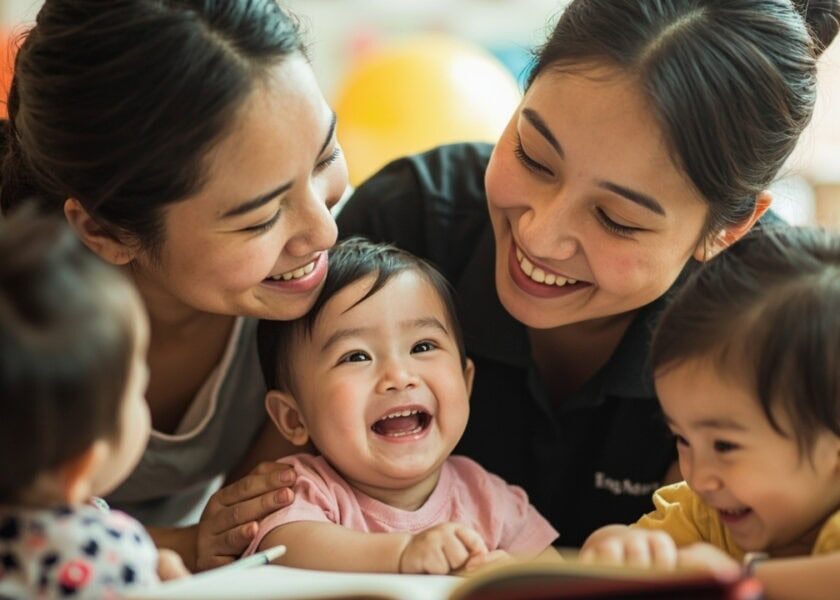
How Singapore Parents Know Their Child Is Thriving in Childcare
The Moment Every Enrolled Parent Recognises
There is a moment, and every enrolled parent in Singapore knows exactly which moment I mean. It happens when you pull away from the school gate or close the front door behind you. A small voice inside asks the question you cannot seem to silence.
Not because you made the wrong choice. Not because anything is wrong. But because you love your child so completely that any separation, no matter how brief, carries weight.
That moment does not disappear after enrollment. It softens, yes. It becomes familiar, certainly. But it never fully leaves—and that is not a flaw in your parenting. It is proof of how deeply you are attuned to your child.
This article is for you: the parent navigating the weeks and months after enrollment, learning what quality care actually looks like in practice, and discovering how to read the signs that tell you your child is not just okay, but thriving.
Understanding and Honouring Your Post-Drop-Off Anxiety
When you enrolled your child in childcare, you made a decision. But here is what most content misses: the decision was not the end of the story. It was the beginning.
Choosing childcare is not a single moment. It is the opening chapter of a relationship—a partnership between your family and your caregivers that unfolds over meals and nap times, through morning handovers and evening reunions, across seasons of growth and change.
The space where most services fall silent is precisely here: after the tour, after the paperwork, after the first tearful drop-off. The weeks and months when parents must learn to see what quality looks like in practice, not just in theory.
What the Morning Handover Is Actually Telling You
The morning handover is not a test you are failing. It is a signal—a rich, meaningful signal about your child’s relationship to care, about their attachment security, about the way they are learning to navigate the world.
In those early weeks, most handovers look roughly the same. There is crying. There is reluctance. There is the child who clings and the parent who lingers. This is not dysfunction. This is adaptation in progress.
But watch what happens over weeks four, five, and six. The crying shortens. The clinging loosens. Your child looks toward the caregiver with something that is not quite trust yet, but is no longer pure terror. There is a name for what you are seeing: the beginning of thriving.
If you are feeling uncertain right now, you are not alone. You are not doing anything wrong. You are simply paying attention—and that attention matters more than you know.
How to Know If Your Child Is Thriving or Merely Tolerating Care
There is a difference, and it matters enormously, between a child who is tolerating care and a child who is flourishing in care.
Tolerance looks like compliance. It looks like a child who goes along, who does not fight, who seems okay enough. They are surviving the hours. They are not distressed enough to make a scene. But they are not engaged. They are not growing in the way children do when they feel truly safe.
Thriving looks like engagement. It looks like your child running toward the caregiver in the morning, not away. It looks like your child mentioning a friend’s name, or a song they learned, or a new food they tried. It looks like your child falling asleep easily at night—which sounds small but is actually enormous.
Because a child who is deeply anxious does not sleep well. A child who is deeply anxious cannot rest.
Reading the Evening: Where Quality Reveals Itself
When you pick up your child at the end of the day, before you even leave the premises, pause. Look at her face. Not for a smile necessarily, because tired children do not always smile.
Look for openness. Look for a face that is not closed, not guarded, not holding something back. Look for the child who reaches for you but also settles into your arms with a kind of release, as though she has been waiting to be herself fully, and now she can.
A child who is merely tolerating childcare often falls apart in the evenings. Not immediately, but within an hour or two, the walls come down. They become clingy, irritable, difficult to soothe. They have been holding it together all day, and now that they are safe, now that they are with you, the tension releases in ways that look like misbehaviour but are actually exhaustion and dysregulation.
A child who is thriving in quality care comes home in a different state. They are tired, yes, because meaningful engagement is tiring. But they are also content. They may be chatty, eager to share. They may want to play independently for a while, which is actually a sign of security, not rejection. They eat dinner with appetite. They sleep with relative ease.
Evening Observation Checklist
- Facial openness: Not necessarily a smile, but a face that is not guarded or closed
- Physical release: A child who settles into your arms rather than tensing
- Contentment vs collapse: Tired but not dysregulated; willing to engage
- Appetite at dinner: Eating well after a day at care
- Sleep quality: Falling asleep without excessive struggle or anxiety
Home Spillover: The Hidden Sign of Excellent Childcare
Quality routines create home spillover. This is one of the most undervalued signs of excellent childcare, and once you see it, you cannot unsee it.
When your child’s care environment is structured, warm, and consistent, it does not stay contained within those hours. It travels with your child. You may notice that bedtime has become easier. That your child now understands the rhythm of the day, the sequence of events, the comfort of knowing what comes next.
Quality childminding does not replace your parenting. It supplements it. It supports it. It creates a foundation of security that your child carries with them wherever they go.
The Partnership Between You and Your Child’s Caregiver
Once you begin to see these signs, once you begin to trust what you are observing, something shifts. You start to see the caregiver not as a service provider but as a partner. You start to ask different questions—not just “Did she eat?” and “Did he sleep?” but “What was she interested in today?” and “I noticed he was working on something with his hands this evening, did he do that at care too?”
When the communication flows both ways, when your child’s caregiver tells you not just what happened but why, not just that your child ate but that she was proud of herself for using a fork, you are receiving windows into your child’s inner life. You are receiving evidence that your child is known.
There is a moment, and you will recognise it, when the caregiver says something about your child that surprises you. Something you did not know. Something that reveals a part of your child you do not see at home, because home is familiar and school is new, and in new environments children sometimes show us sides of themselves we did not know existed.
When your child’s caregiver knows your child well enough to tell you something new, something specific, something true—that is not a sign of good care. That is the proof of it.
What Quality Childminding Actually Looks Like
At EduNanny Singapore, we believe that communication is not a feature. It is a foundation. Parents deserve to know what their children are experiencing. They deserve transparency, openness, the kind of daily reporting that lets them see through the hours of separation.
Our home-based childminding program operates under the ECDA Childminding Pilot, which means rigorous standards, low ratios, and accountability at every level. When you enrol your infant with EduNanny, you are not handing your child to a stranger. You are entering into a relationship with vetted, qualified, genuinely caring adults who understand that what they do is sacred.
The infant ratio of up to one to three in our home-based arrangements is not an administrative detail. It is a philosophy made visible. It means every cry is heard. Every need is met. Every moment of wonder is captured. This is not a luxury. At EduNanny, it is the baseline. It is what we believe all infants deserve.
What Settling In Actually Looks Like: A Six-Week Arc
Your child’s caregiver was perfect for your four-month-old, and they are still perfect for your eight-month-old—but for entirely different reasons. They are responding to a different child, one who is sitting up now, one who is reaching for things, one who is beginning to communicate in their own language. A good caregiver sees that. Adapts to that. Grows alongside your child.
The Settling-In Timeline
| Period | What You Might Observe |
|---|---|
| Weeks 1-2 | Heavy adjustment, tearful handovers, reluctance to separate |
| Weeks 3-4 | Crying begins to shorten; child starts noticing the environment |
| Weeks 4-5 | Clinging loosens; child looks toward caregiver with curiosity |
| Weeks 6+ | Signs of genuine engagement; mention of activities or friends; easier evenings |
Every child is different. Every settling-in arc has its own rhythm. But if you are watching, if you are paying attention, you will see the trajectory moving toward engagement rather than mere tolerance.
Daily Rituals That Build Connection
The daily rituals matter. They are how you maintain and deepen your connection with your child across the hours of separation.
When you pick up your child, give them your full attention for the first few minutes. Put away your phone. Kneel down to their level. Let them know that coming back together is a joy, not a guilt.
Tell your child about your day apart. “Mummy missed you at lunch today. I was thinking about you when I was in my meeting.” These words may not mean much to your infant yet, but they establish a pattern of connection that will matter enormously as your child grows.
Ask, “What was the best part of your day?” and really listen to the answer, even when it is a single word or an incoherent babble that means everything. These rituals tell your child that time apart does not diminish your love. That you were thinking of them. That coming back together is a joy.
You Are Enough — Trust the Process
There will be days, even in the best care arrangements, when you second-guess everything. When your child comes home tired and irritable and you think, “Was she unhappy today? Did something happen? Did the caregiver lose patience with her?”
When these days come, resist the urge to pull back. Resist the urge to withdraw your trust at the first sign of difficulty. The childcare relationship is not static. It grows with your child. What your infant needs in month one is different from what she needs in month six.
We know that cost is a real concern for Singapore families. It should not be a barrier to quality. Our pilot fee structures are designed to be accessible, and we help families navigate the systems available to them: the Child Development Account, the Baby Bonus scheme, and financial tools that the government has put in place precisely to support parents in these choices. We will help you find a way.
Trust Is Built Slowly, Through Evidence
We are not asking you to trust us blindly. We are inviting you to watch. To observe. To see what your child shows you in the evenings, in the weekends, in the small moments of reunion and connection.
Trust is built slowly, through evidence, through experience, through days and weeks and months of consistency. We are prepared to earn yours.
And we believe that once you see what quality looks like in practice, once you experience the communication, the transparency, the genuine partnership—you will not need to trust blindly. You will trust because you know.
You Are Enough
If you are in the thick of it, if you are in those raw early weeks where every handover feels like a small grief and every reunion feels like a small relief, I want you to know that what you are feeling is not weakness.
It is love. And it is enough. You are enough.
The childminding relationship, when it is right, when it is built on trust and communication and genuine care, does something beautiful. It teaches your child that the world is safe. That there are good people beyond their family who will hold them, teach them, delight in them. It teaches your child that they can love multiple people, that love is not diminished by sharing, that security is not threatened by connection.
And it teaches you something too. It teaches you that you do not have to do everything alone. That asking for help is not failure. That your child can thrive in your absence as well as your presence. That you are still the most important person in your child’s life, even if you are not the only person in their life.
Ready to Learn More?
If what you have read here resonates with where you are right now, we invite you to take the next step. Speak with our team. Ask your questions. Share your concerns. Let us walk alongside you as you discover what quality childminding can look like for your family.
Because you should not have to navigate this journey alone. And you do not have to wonder in silence. There is a partner ready to stand with you, starting now.
Explore EduNanny Singapore’s home-based infant care and childminding programmes. Your child deserves to be known. And so do you.
To learn more about EduNanny Singapore and our approach to quality childminding, please visit our story or explore the EduNanny homepage.