Before Your Child Speaks, Their Brain Is Already Learning
Quick Summary: How Language Development Happens in Quality Childcare
For busy parents, here is what matters most:
- A child’s brain builds more than one million neural connections per second in the first three years — and language sits at the centre of all of it.
- The difference between passive supervision and intentional, language-rich caregiving is not philosophical. It is developmental.
- EduNanny caregivers are trained to narrate the day, respond to pre-verbal communication, model sentence structure, and engage in back-and-forth interaction that builds language before children can speak.
- When children receive intentional language exposure throughout the day, parents come home to children who have something to say — and a window into their inner world.
The Science of Early Language Development
In the first three years of life, a child’s brain builds more than one million neural connections every second. This is not a statistic designed to impress you. It is a reality that shapes everything your child will become — their capacity for learning, their empathy, the kind of thinking that solves problems and builds relationships.
And language sits at the centre of all of it.
When a caregiver responds to a baby’s coo, pauses after speaking, names what the child is looking at before the child has language to ask — they are not simply being attentive. They are participating in one of the most sophisticated biological processes we know of. Each responsive exchange strengthens the neural circuits that will eventually allow a child to form sentences, to follow logic, to read, to argue, to comfort someone else.
Neuroscientists call this the critical window for language development. It is the period between birth and roughly age three when the brain is most receptive to acquiring the foundations of communication. After this window closes, the capacity for certain kinds of linguistic acquisition does not disappear — but it becomes harder. More effortful. The pathways that could have been highways become narrow trails.
This is why what happens in those rooms matters so deeply. And this is why the difference between passive supervision and intentional language-rich caregiving is not a philosophical distinction. It is a developmental one.
What Passive Supervision Actually Looks Like
Passive supervision is what most of us imagine when we think of someone watching a child. It is keeping them safe, fed, clean, and entertained. It is responding to crying, managing conflict, ensuring no one gets hurt.
None of this is wrong. But it is not enough.
Intentional language-rich caregiving is something different. It is the choice to narrate the morning — to say, “Now we are washing our hands. Feel the water? It is warm.” It is the patience to wait for a six-month-old’s response to a question, even though that response will be a sound, a gesture, a widening of the eyes. It is the discipline to turn a routine diaper change into a conversation, not a transaction.
This is what research shows accelerates language development: not exposure to screens or recordings, not the presence of toys designed for stimulation, but the presence of a responsive human being who treats every interaction as an opportunity to build communication.
A child who is spoken to intentionally — who is listened to before they can speak, who is included in conversation before they have words — learns something profound. They learn that their sounds matter. That their attention is worth following. That language is not something done to them but something they participate in, something that connects them to another person.
This is the foundation. And it is laid in moments that look small.
What Language-Rich Caregiving Actually Sounds Like
I want to be specific here, because specificity is what separates understanding from abstraction.
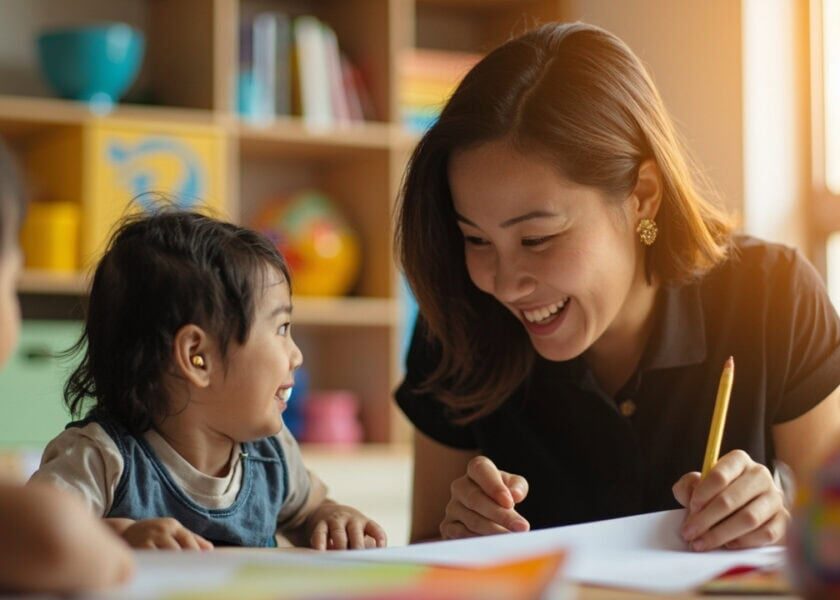
In a language-rich childcare environment, a caregiver might say: “I see you found the blue block. Blue. You are holding it tightly. Can you give it to me? Thank you.”
This sounds simple. It is not simple. In those few sentences, the caregiver has named a colour, described a sensation, made a request, modelled the structure of reciprocal exchange, and acknowledged the child’s contribution.
Now multiply this across a day. Across dozens of such exchanges. Across weeks and months of this kind of interaction — consistent, patient, and present.
The child who receives this does not simply accumulate vocabulary. They learn the rhythms of conversation. They learn that language is purposeful — that it creates connection, that it achieves outcomes, that it is how people share a world. When they finally do speak, they carry within them the invisible architecture of every exchange that came before.
The child who has been narrated to, responded to, and treated as a conversation partner comes home with something to offer. Not just in words, but in expression. In the way they point, in the sounds they make, in the stories their body tells before their mouth can.
In contrast, the child who is supervised in a language-poor environment — where the television provides background noise, where interaction is limited to directives and corrections — develops differently. Not catastrophically. But differently. And the gap becomes visible later, in preschool, in primary school, in the moments when a child is expected to have the language to express what they know.
This is the gap that Singapore parents sense but often cannot name. They worry their child is not talking enough. They worry the childcare they have chosen is not giving their child what they need. They look at other children the same age who are speaking in sentences and wonder what is missing.
Often, what is missing is not a deficiency in the child. It is the absence of someone in the room who understood that language is built, one intentional moment at a time.
The Parent-Child Communication Bridge
One of the most beautiful things about language-rich childcare reveals itself after pickup.
A parent who picks up their child from quality childcare might hear a description of the morning. Not a complete narrative, not an adult retelling, but fragments — a word for a toy, a sound for an animal, a gesture that means something specific. And because the caregiver has been talking to that child all day, naming things, expanding on sounds, the child has something to give back.
This is what I mean when I say language transforms the parent-child relationship.
When your child can tell you something — even imperfectly, even in their own way — you gain access to their inner world. You see what caught their attention, what made them laugh, what frustrated them, what they reached for. You understand their day not as a mystery but as a story they are beginning to tell.
After hours apart, language is how parents get their children back.
The Singapore Context: Multilingual Expectations
For parents in Singapore navigating bilingual expectations, this matters doubly. Singapore children are growing up in a multilingual environment. They hear English, Mandarin, Malay, Tamil — sometimes all in the same day. The expectation that they will be fluent in multiple languages can feel overwhelming. Where does it begin? How do they catch up? Will they fall behind?
The answer is not more instruction. It is more interaction.
A child who is spoken to responsively in one language develops the cognitive architecture that makes learning additional languages easier. Language begets language. Communication begets communication. The child who learns that words connect them to people learns how to learn words.
EduNanny caregivers do not teach languages in the way a school might. But they build the foundation that makes language learning possible. And in a context like Singapore’s, where bilingualism is both an aspiration and a practical necessity, this foundation is one of the greatest gifts you can give your child.
What EduNanny Does Differently
This is why EduNanny was built the way it was.
EduNanny operates as an ECDA Childminding Pilot, which means our caregivers are trained not just in the logistics of infant care but in the pedagogy of early development. This matters. In the early years, how you hold a child, how you speak to a child, how you wait for a child’s response — these are not soft skills. They are technical competencies. They are the difference between care and education, between watching and building.
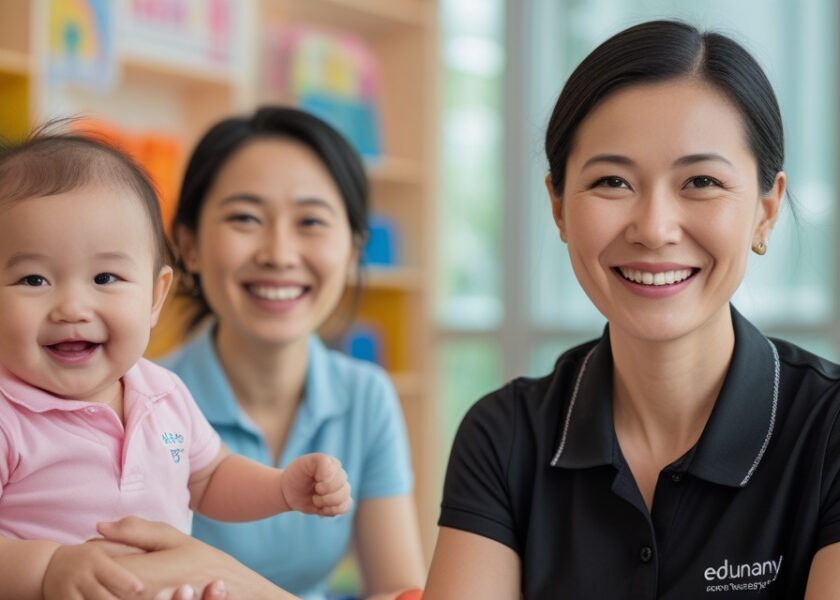
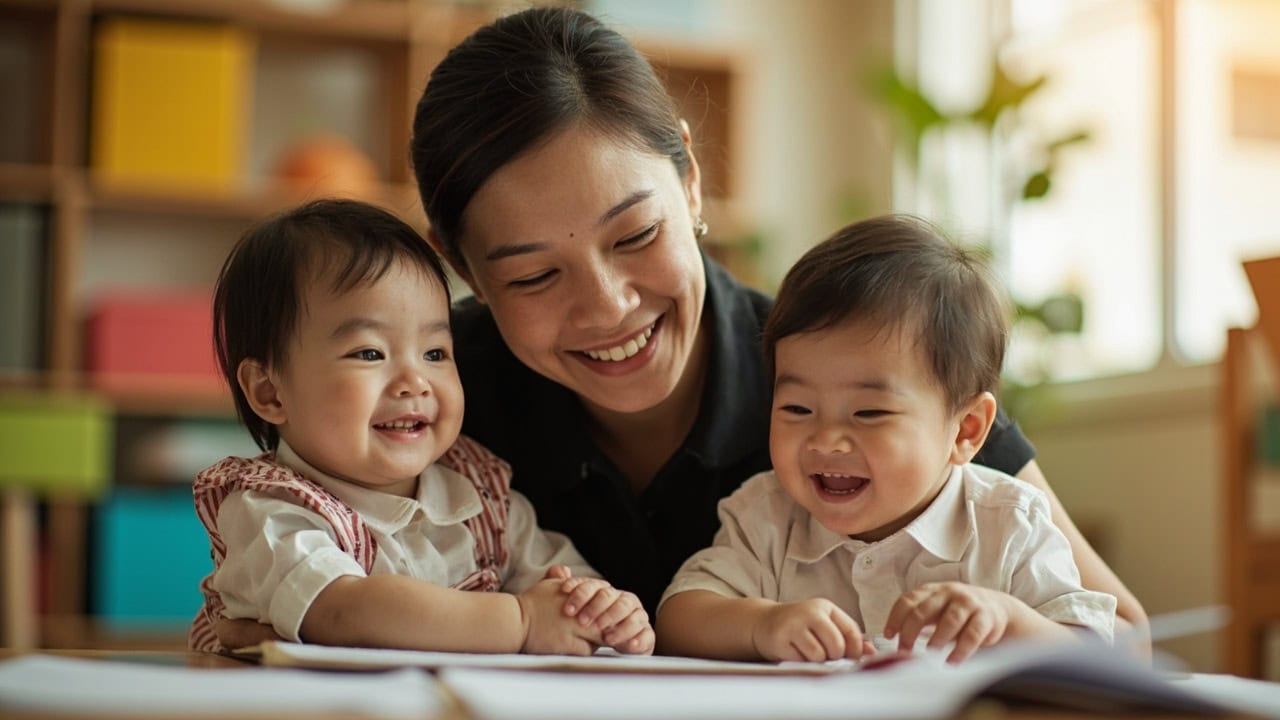
Our caregivers understand language development as a process. They know what milestones typically look like, but more importantly, they know how to create the conditions for those milestones to be reached. They narrate the day. They respond to pre-verbal communication with the same seriousness they would give to words. They model complete sentences, expand on children’s sounds, and engage in what early childhood educators call “serve and return” interaction — the back-and-forth rhythm that mirrors conversation itself.
And they do this with ratios that allow for it. Small groups and individual attention. Time and space to treat each child as a language learner from the very first day.
This is not a feature we added to a brochure. It is the philosophy that shaped everything else.
How Language Development Fits Into a Working Day
EduNanny offers Monday to Friday care blocks, designed around the rhythms of working families. CDA and Baby Bonus can be used within our fee structures, so that the children who benefit most from this kind of caregiving are not priced out of it.
Where CCTV measures are deployed, parents know. Where communication systems are in place, they are designed for genuine connection — not just updates. We have developed tools, including our Thomas AI Chatbot, to support parents in navigating the questions that arise between pickups — to answer concerns, to offer guidance, to be a resource when you are not sure what your child’s sounds mean.
Because the conversation does not end when you leave the room. It continues at home, in the car, at the dinner table. And we want to be part of that conversation — not just the institution you left behind.
Addressing What Parents Really Worry About
I want to speak directly to something that I know sits beneath the surface for many of you.
The decision to place your child in childcare — especially in those early months and years, when every choice feels irreversible — carries a weight that is hard to articulate. There is the logistics of it. There is the financial calculation, the practical arrangement, the scheduling of a dual-income household. But beneath all of that, there is something more personal.
There is the fear that you are missing something. That the hours apart are hours your child is changing without you. That you will come home and your child will be different — not because they are growing, but because you were not there to witness it.
This fear is real. And it deserves an honest answer.
The honest answer is this: the hours apart do change your child. But what they become depends entirely on what fills those hours. A child in a language-rich, responsive caregiving environment is not just being kept. They are being built. They are forming the neural pathways that will allow them to think, to speak, to understand. And they are forming something else as well — a relationship with communication itself, with the idea that their voice matters, that they can reach another person through language.
This is not a replacement for you. It is an extension of what you would be doing if you were there.
Because you have chosen to work, to provide, to build a life for your family, you have made a choice that thousands of Singapore parents make every day. And that choice can be made well or poorly. It can be made with caregivers who understand what they are building or caregivers who do not.
EduNanny was designed for parents who want to make it well.
Questions to Ask When Choosing Infant Care
If you are evaluating childcare options in Singapore, here are the questions worth asking — not because there is one right answer, but because the answers reveal what is actually happening in the hours you cannot see:
- How do caregivers speak to children throughout the day? Not just during structured activities, but during routines — feeding, diapering, transitions. Do they narrate what is happening, name objects, expand on children’s sounds?
- When a child makes a sound or gesture, how does the caregiver respond? Is there a pause? A repetition? An expansion? These micro-moments of responsiveness are where language development actually happens.
- What is the caregiver-to-child ratio? Quality language interaction requires time and attention. Small groups allow for the back-and-forth exchange that builds language.
- Are caregivers trained in early language development, not just infant safety? Training in the ECDA Childminding framework means caregivers understand developmental stages and how to support them.
- How does the programme communicate your child’s day to you? Language-rich childcare creates children who have things to share. A good programme gives you windows into those conversations.
The Connection Gap
There is a word that researchers use when they study what happens to children who grow up in language-poor environments. They call it the word gap. It refers to the disparity in vocabulary size between children who have been spoken to extensively and children who have not. By age three, some studies suggest this gap can be measured in millions of words.
But I think the word gap undersells what is really happening.
What is really happening is not a vocabulary problem. It is a connection problem. It is the difference between a child who believes their voice matters and one who is not sure. It is the difference between a child who knows how to reach another person and one who has not yet learned that reaching is possible.
This is what EduNanny is built to close. Not the word gap as a statistic, but the connection gap as a lived reality.
Every day, in homes across Singapore, our caregivers are doing quiet, invisible, essential work. They are narrating a morning. They are naming a colour. They are waiting for a response. They are treating a sound as if it were a sentence, because they know what that sound is becoming.
And somewhere, in a car on the way home, a parent hears something they did not teach.
A word. A sentence. A thought.
And they realise that the words were built in the hours they could not see, by someone who understood that language is not just what we say. It is how we build our children.
EduNanny does not just keep children safe. It gives them words. And words give parents their children back.
If this article resonated with you and you are looking for childcare that takes language development seriously, learn more about EduNanny or get in touch with our team. We welcome questions from every family considering their options.