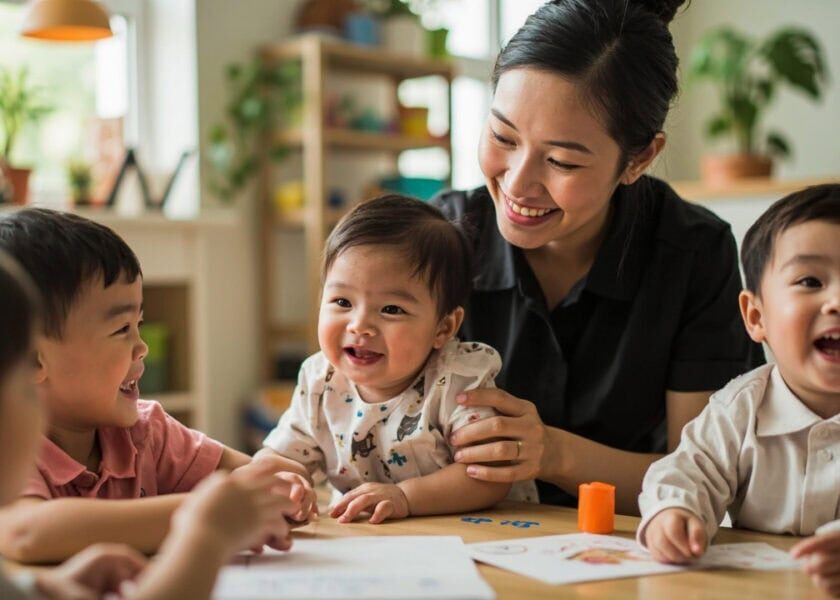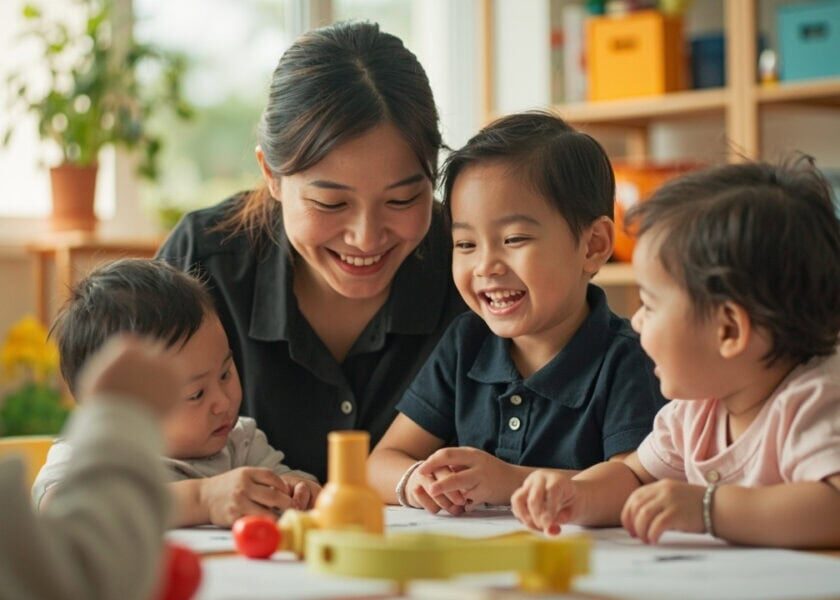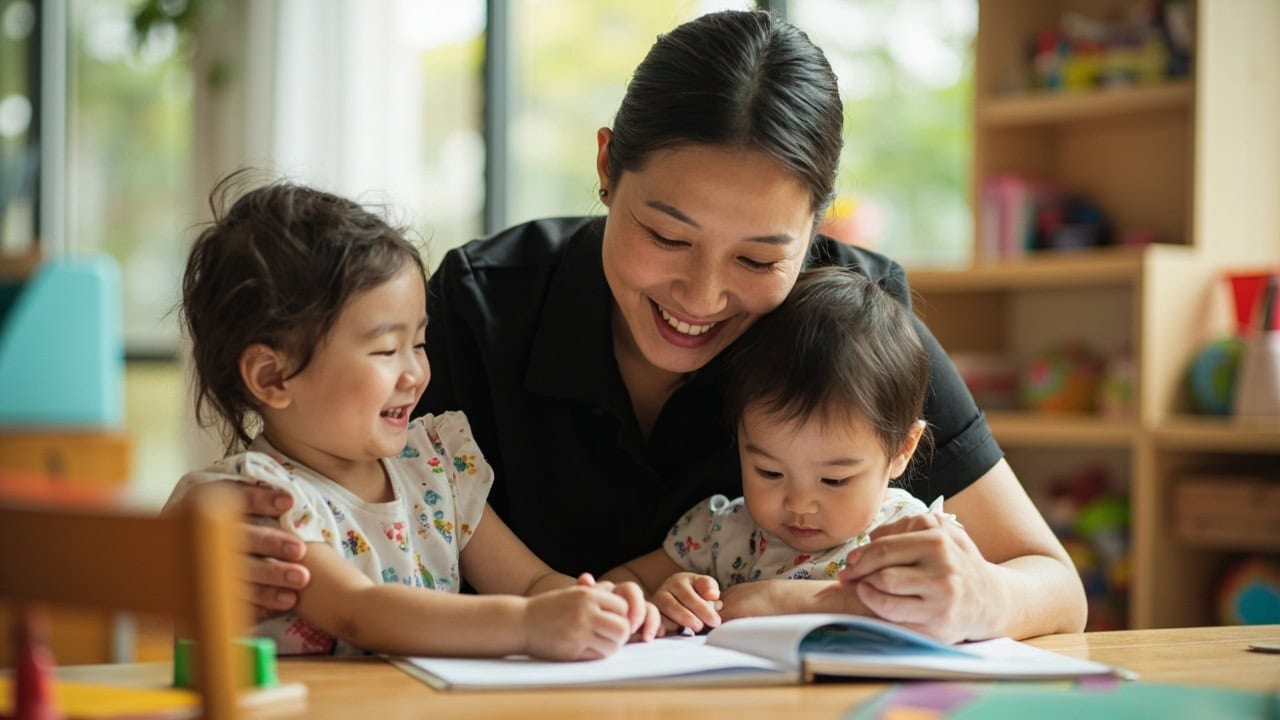
What Your Child Is Actually Building in Quality Childcare
What Your Child Is Actually Experiencing
The first thing we must understand — and this is where most well-intentioned parenting advice goes slightly wrong — is that we, as adults, understand closeness through proximity.
We experience love as presence. When we miss someone, we miss their physical being: their voice in the room, their hand on our shoulder, the particular way they make us feel seen. It is entirely natural, then, that when we imagine our child feeling secure, we imagine them feeling our physical presence.
But this is an adult translation of a child’s experience. It is what we feel when we are away from someone we love. And so we project it onto our children, assuming that they are having that same experience — that when you leave the room, your child feels the same hollowing sense of absence that you feel when you walk away.
Here is what developmental science tells us, not to contradict your love, but to deepen your understanding: your child does not need your physical presence to feel secure. Your child needs your consistent, responsive presence — and responsiveness is not measured in meters.
What a young child is building in the first three years is far more profound than memories of your face or a preference for your voice. They are building what psychologists call an internal working model of relationships — a kind of emotional operating system that will govern how they understand connection, trust, safety, and self-worth for the rest of their lives.
When your child experiences consistent, warm, responsive care — care where their signals are met with attunement, where their needs are acknowledged and addressed, where they are seen not as a task to be completed but as a person to be known — they are internalizing something essential:
- They are learning that the world is trustworthy.
- They are learning that people can be relied upon.
- They are learning that they themselves are worthy of attention and care.
This is not metaphor. This is the architecture of the self being built in real time.
Secure Attachment Does Not Require a Single Caregiver
The research on attachment is sometimes misinterpreted as suggesting that children can only form secure attachments with their parents, that any other relationship is a dilution or a compromise. But the actual findings are more nuanced and, frankly, more hopeful.
What secure attachment requires is not genetic specificity but relational quality.
A child can develop healthy attachment patterns with a primary caregiver who is warm, responsive, and consistent — whether that caregiver is a parent or a qualified, trained caregiver who shows up reliably, who knows your child’s rhythms and preferences, who responds to their distress with genuine comfort rather than routine.
What children need is not a particular face. What children need is a particular quality of attention.
This is not a diminishment of the parent-child bond. It is a recognition of how remarkably adaptable and resilient young children are when they are met with the right kind of care. It is also a recognition of something that working parents in Singapore carry quietly, as a kind of private guilt: the belief that their child is somehow being shortchanged by their absence.
When understood clearly, the truth is something different. Your child is not being shortchanged by your absence. Your child is being shortchanged if the care they receive is not responsive, not warm, not attuned to their developmental needs.
But if your child is in the kind of care where a caregiver genuinely knows them — where that caregiver can read their cues, comfort their fears, celebrate their small discoveries, and provide a secure base from which to explore — then your child is receiving something profoundly valuable. Something you have chosen for them.
The Six Things Your Child Is Actually Building
What young children need in the first three years can be organized into several interconnected domains. Understanding them will help you see your child’s experience in care very differently.
1. Felt Security and Emotional Regulation
In the first years, children are not born with the capacity to calm themselves or to manage big feelings. They develop this capacity not through being protected from all distress, but through being co-regulated — through having a calm, attuned adult help them move through difficult emotions until the capacity becomes their own.
Beyond the skill of regulation lies the foundation of felt security: knowing yourself as worthy of care, understanding the world as a place where your needs will be met. A child who feels secure takes risks, asks questions, explores boldly, and develops resilience. A child who feels insecure spends their early years in a state of vigilance rather than growth.
This is one of the most important gifts a caregiver can give a child. When your child’s caregiver sits with them during a tantrum, not dismissing the feeling but helping them name it and move through it, your child is learning something that will serve them in every relationship they will ever have. This is not babysitting. This is developmental work of the highest order.
2. Exploration and Autonomy
Young children are driven by a deep, innate curiosity to understand their world — to touch it, to taste it, to test its boundaries, to discover what happens when they act on it. What they need for this exploration to unfold healthily is not freedom without support, but what developmentalists call a secure base — a reliable presence from which to venture out and to which they can return.
When your child is in quality care with a trusted caregiver, they are building the confidence to explore because they know, in their bodies, that someone is there to catch them if they fall. This is why children in responsive, consistent childcare settings often show remarkable independence in play — not despite their caregivers, but because of them.
3. Social Experience
Children are not meant to develop in isolation. They need peers — not just for entertainment, but for learning. They learn to share, to negotiate, to feel empathy, to understand that other people have perspectives and feelings different from their own.
These are not lessons that can be taught through explanation. They must be lived, and they must be supported by adults who help children navigate the inevitable conflicts and emotions that arise. In quality group care, your child is learning to be a social being, which is one of the most important capacities a human can develop.
4. Language and Cognition
The first three years are a period of synaptic explosion in the brain, a time when neural connections are forming at a rate that will never be matched again. What wires the brain for language, for thinking, for curiosity, is rich, responsive interaction — being talked to, being listened to, having the world named and explained, being invited into conversation even before words come.
In quality infant and toddler care, language development is not an afterthought or a scheduled activity. It is woven into every interaction, every diaper change, every meal, every moment of shared attention. Your child is not just being looked after. Your child is being talked to, engaged with, and stimulated in ways that are building the very architecture of thought.
5. Motor Development
Young children are bodies in motion, constantly refining their gross and fine motor skills through movement, through play, through the simple act of being in a space that invites exploration. Quality care environments are designed with this in mind — spaces that allow for safe physical challenge, that support the development of coordination, strength, and body awareness.
Your child in a well-designed childcare setting is not sitting passively. They are moving, climbing, reaching, grasping, and in doing so, building the physical foundation for everything that comes later — from writing and drawing to athletic pursuits and the simple confidence of moving through the world with ease.
What Separation Really Means
When you interpret your child’s behavior through an adult emotional lens, you may see things that are not quite what they seem.
When your child cries at drop-off, you may read this as evidence that they do not want to be in care, that they are suffering, that you are failing them by leaving. But consider an alternative reading.
Your child cries at drop-off because you have a strong bond, and your child feels the transition — as all children do, in all circumstances, whether that transition is from one parent to another, from home to a grandparent’s house, or from home to care.
The crying is not a verdict on the quality of care. It is the normal, age-appropriate response to a transition, which is exactly what it would be if you were leaving them with a grandparent for the day.
What matters is what happens after the transition. After you leave. What matters is whether your child, in care, is greeted by a face that knows them, that has been expecting them, that offers comfort and redirects their attention to the engaging world around them.
In quality care, children recover from separation distress remarkably quickly — within minutes, often — because they are met with warmth and engagement by a caregiver who understands that this is part of the child’s day, not a crisis.
And here is what you may not have considered: the experience of recovery from separation, of being comforted and re-engaging with the world, is itself a developmental lesson. It teaches your child that transitions are survivable, that caregivers are reliable, that the world continues to be interesting even when something difficult has happened. This is resilience being built in real time.
What Quality Childminding Actually Looks Like
Quality childcare gives your child something that you, in love, might not be able to give alone — not because you are lacking, but because you cannot be everything at once.
When you are working, when you are managing the logistics of a household, when you are carrying the weight of providing for your family, you cannot also be the constant, responsive, fully present caregiver that your child needs during every waking hour. That is not a failure. That is the reality of human life, and it has always been so.
What quality childcare provides is the consistent, attuned responsiveness that your child needs to thrive — not instead of you, but alongside you.
Here is what to look for:
- Individualized attention: Your child is known — their preferences, their rhythms, their cues, their fears, their joys.
- Responsive interaction: The caregiver responds to your child’s signals, not just on a schedule.
- Language-rich environment: Your child is talked to, engaged with, narrated to throughout the day.
- Secure base provision: The caregiver is a source of comfort and a launching pad for exploration.
- Emotional attunement: Big feelings are acknowledged and supported, not dismissed.
- Developmental intentionality: Every interaction is understood as an opportunity for growth.
How EduNanny Singapore Meets These Needs
EduNanny was built on a simple but profound premise: that every child in Singapore deserves care that meets them where they are developmentally, that responds to them as individuals, and that provides the kind of consistent, warm, quality attention that builds the internal foundations described above.
We are part of the ECDA Childminding Pilot, which means our approach is grounded in national standards for quality, safety, and developmental appropriateness. This is not a peripheral detail — it is the foundation of everything we do.
We offer home-based childminding, which brings quality care into the environment where your child is most comfortable — your own home. With ratios of up to one caregiver to three infants, your child receives the individualized attention they genuinely need. We also support families navigating centre-based pathways where that is the right fit for their situation.
Our care is structured around Monday to Friday blocks, designed to align with the realities of working families across Singapore. Our pilot fee structures are built with accessibility in mind, and we help families navigate the use of CDA funds and Baby Bonus provisions, so that quality care is not a privilege available only to some, but a genuine option for families across the economic spectrum.
We believe in radical transparency. Where CCTV measures are deployed, parents have visibility into their child’s day. We communicate proactively and regularly, not because we are obligated to, but because we understand that the parent who does not know what their child is experiencing carries a weight that no one should have to carry alone.
You chose this care arrangement. You deserve to feel connected to what your child is living through their hours away from you.
This is perhaps the deepest difference in our approach. We are not just minding children. We are attending to the child’s felt experience in care — to what they are building emotionally and developmentally during the hours we are entrusted with them.
- We understand that a diaper change is not just a task but an opportunity for language, for interaction, for connection.
- We understand that a meal is not just nutrition but a social experience, a learning experience, a moment where your child is learning about the world and their place in it.
- We understand that every interaction, however small, is shaping the person your child is becoming.
Our caregivers are not just trained in safety protocols, though those are essential. They are trained in child development, in responsive caregiving, in the science and art of attunement. They are people who genuinely love children, who see your child not as a charge to be managed but as a person to be known and cherished.
Your Questions, Answered
“Am I failing my child by working?”
You are not failing your child. You are providing for your child, and you are seeking quality care to support their development. The work of raising a child has never been meant to be done in isolation. Humans are communal beings. Our children have always been raised within webs of care that extend beyond the immediate family. The village is not a nostalgic concept. It is a developmental necessity.
“Is my child too young for quality care?”
What children need in the first three years is responsive, warm, attuned care that builds their internal foundations. This can happen in your home, in a childcare setting, or in a combination. The age of your child does not disqualify them from quality care. What matters is the quality of that care — and the consistency, warmth, and attunement it provides.
“How do I know if care is actually quality?”
Look for signs of individualized attention, language-rich interaction, emotional attunement, and developmental intentionality. Observe how your child responds to their caregiver. Ask about caregiver training and approach. Trust your instincts, and inform them with what you now understand about child development.
The Honest Answer to Your Quiet Question
The question that lives in your chest — the one about what your child is experiencing — is a question born of love. That love is not a weakness to be managed. It is the very thing that will guide you to make the right choices, if you trust it and inform it.
Here is the honest answer: it depends entirely on the quality of care your child is receiving.
If your child is in care that is warm, responsive, consistent, developmentally attuned, and safe, then your child is experiencing something profoundly valuable:
- They are being known.
- They are being seen.
- They are being responded to with genuine care and attention.
- They are building the internal foundations that will serve them for the rest of their lives.
If you have found that kind of care for your child, then I want to tell you something that you may not have told yourself in the quiet moments: you have done something important.
You have made a choice that honors both your family and your child. You have recognized that your child needs more than logistics — they need quality, and you have sought it out. That is not something to feel guilty about. That is something to feel proud of.
Moving Forward with Confidence
Your child does not need a perfect parent. No such person exists. Your child needs consistent, warm, responsive care, and they need parents who are present, loving, and secure enough in their own choices to trust that they are doing what is right.
If your child has that — in your home and in their care setting — then your child has everything they need to grow into a person who is emotionally secure, intellectually curious, socially capable, and deeply knowledgeable about their own worth.
That is not a small thing. That is everything.
The information in this article is not meant to replace your instincts. It is meant to inform them, so that the love that brought you here can do its work in the world with clarity and confidence.
EduNanny Singapore is honored to walk alongside families in this work of raising the next generation. Every child in our care is a whole person, deserving of the very best we have to offer — our attention, our skill, our warmth, and our deep respect for the developmental miracle that is unfolding before us every single day.
If you are ready to explore what quality, developmentally grounded childminding can look like for your family in Singapore, we invite you to take the next step. Your question deserves an honest conversation, and we are here to have it with you.
Thank you for trusting that voice inside you that asked the question. And thank you for reading the answer.
#ChildmindingSingapore #InfantCareSingapore #QualityChildcare #AttachmentAware #EarlyChildhoodDevelopment
At EduNanny Singapore, we believe every family deserves access to quality, developmentally grounded childminding. Learn more about our approach or connect with our team to explore whether home-based childminding is right for your family.