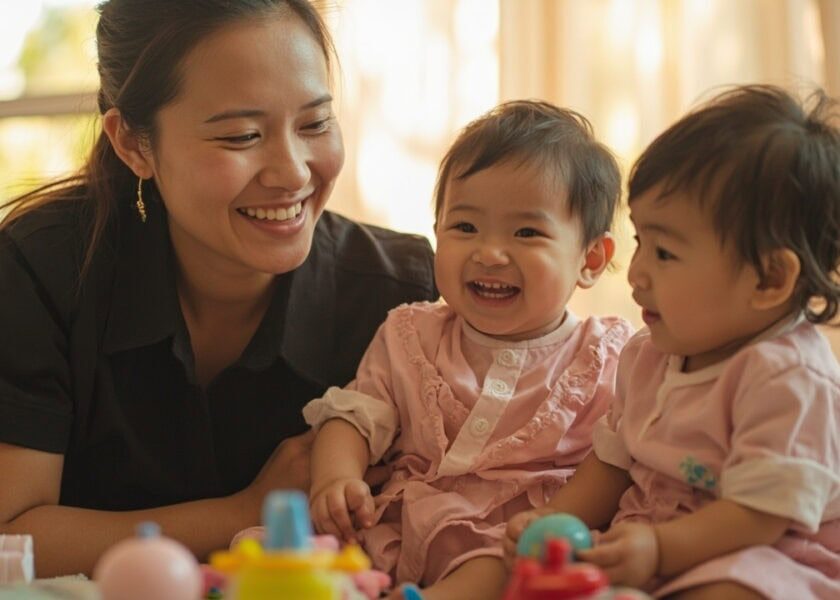
The Father Who Shows Up: Redefining Childcare Partnership in Singapore
Where Do I Fit? A Father’s Honest Look at Childcare Decisions
There is a moment that happens quietly, almost invisibly, in carparks and school gates across Singapore every single weekday morning. A father stands among the gathering crowd, holding his child’s hand. He is present. He has shown up. And yet, more often than not, his eyes move to the doors of the childcare centre with a particular kind of question in them — not just whether his child will be safe, but something deeper: Where do I fit in this picture?
He drops his child off. He watches the small figure disappear into a world he has chosen but cannot enter. And somewhere in that moment, a quiet uncertainty settles in. Not about the decision itself — he has made it carefully, with all the rigour a man who takes his responsibilities seriously would bring. The uncertainty is about his own place in what comes next.
Whether his instincts and emotional connection are being consulted the way they should be. Whether, in a space that often defaults to one kind of conversation, his voice is part of it.
If this sounds familiar, you are not alone. And the fact that you care enough to notice the gap is not a weakness in your parenting. It is, in fact, one of the most honest indicators that you are the kind of father your child needs.
The Quiet Reality of Modern Fatherhood in Singapore
Singapore has changed. The fathers here are different from what the stereotypes suggest, and they have been different for some time. Walk through any park on a Saturday morning, and you will see fathers reading picture books on park benches, navigating infant feeding and nap schedules with competence that should never have been surprising but somehow still manages to surprise, taking parental leave not because it was politically convenient but because they wanted to be present for the first weeks of their child’s life.
These fathers exist in significant numbers. They are not an anomaly. They are, increasingly, the norm.
And yet, when it comes to the way childcare is spoken about, marketed, and delivered, there remains a gap between who modern Singapore fathers actually are and how they are typically addressed. The conversations at parent groups, the language on websites, the assumptions baked into handover procedures — these things have been built, often without malice, around a particular default. And the father who wants to be genuinely central to his child’s early care can find himself standing at the edges of a conversation that was not quite written for him.
The early years of a child’s life are not a rehearsal for fatherhood — they are fatherhood. Every morning drop-off, every handover conversation, every question asked and answer received, every moment of trust built with the person caring for your child — these are not peripheral activities. They are the substance of the relationship you are building with your child and with the ecosystem around them.
What Fathers Actually Need From Childcare
Ask a father what he wants from childcare, and the surface answer is simple: he wants his child to be safe, happy, and well-cared for. But beneath that answer is something more specific, something more vulnerable.
He wants to know not just that his child was fed, but how they ate. Not just that they slept, but how they settled. Not just that they played, but what captured their attention, what made them laugh, what frustrated them, what they reached for next.
This is not anxious over-involvement. This is the instinct of a father who understands, on some level he may not have articulated to himself, that the quality of his connection to his child’s daily life matters — even when he is not physically present.
The question he is really asking is this: Can I trust this arrangement? Not just to keep my child safe — though that is the foundation — but to keep me connected? To treat my relationship with my child’s caregiver as a genuine partnership rather than a service transaction? To see me as a parent in my own right, with my own instincts, my own questions, my own stake in understanding who my child is becoming?
These are not unreasonable expectations. They are, in many ways, the baseline of what quality childcare should offer every family.
The Father’s Role in Attachment Architecture
Here is something that developmental understanding supports, and that quality childcare providers are increasingly recognizing: the father’s relationship with his child’s caregiver is not secondary. It is not a footnote to the mother’s partnership with the childcare provider. It is its own essential architecture, and it matters in ways that are both deeply human and developmentally real.
When a child forms their understanding of the world, they do not do so in isolation. Attachment theory tells us that children build multiple secure bases. The primary caregiver is the first and most foundational, but they are not the only one. A child whose father is emotionally present, consistently engaged, and genuinely partnered in the child’s daily care is a child who has more than one anchor in the world.
Developmental psychologists sometimes speak of the “other secure base” — the idea that when a child knows, in their bones, that there are multiple adults genuinely invested in their wellbeing, who notice them, who know them, who show up consistently, that child does not have less security. That child has more. That child has a richer, more resilient foundation from which to grow.
When a father walks into a handover and asks not just “Did they eat well?” but “What was their mood like today? Did they seem particularly curious about anything? How did they respond when you read to them?” — that father is not just being attentive. He is signalling something profound to both the caregiver and, more importantly, to his child. He is saying: I am here. I am paying attention. The things that happen in this space while I am not physically present are things I care about.
For a child still learning what the world is and who they can trust in it, that message is foundational.
What Quality Childminding Looks Like
Asking better questions requires having the space and the relationship in which better questions can be asked. That is not something fathers can will into existence on their own. It requires a childcare environment that genuinely makes room for them.
So what does quality childcare look like when fathers are part of the picture it was designed for?
A handover that is not rushed. A caregiver who makes eye contact with the father, who answers his questions with the same depth and care she would offer any parent, who understands that his questions are not doubt — they are love.
Daily updates that tell a story, not just a log. Details about the morning, about a particular moment of discovery or frustration or joy. Not administrative overhead, but a thread that keeps parents connected to their child’s life even when they are not physically present.
Low ratios. In a home-based childminding setting, up to one caregiver to three infants — where every child receives the kind of individual attention that is hard to achieve in larger settings. For fathers who want to know not just that their child was fed but how they ate, not just that they slept but how they settled — these ratios matter. They are not a marketing feature. They are a structural reality that changes the quality of care.
Transparency. Where measures like CCTV are deployed, they are deployed not as surveillance tools but as trust-building instruments — a way of saying to parents: we have nothing to hide, and we want you to feel confident in what is happening when you are not in the room.
Genuine welcome. A space where fathers do not feel like visitors. Where questions are not tolerated but invited. Where the relationship between father and caregiver is treated as the meaningful partnership that it is.
Questions Worth Asking
When you visit a potential childcare provider, here are the questions that reveal something about the philosophy behind the service:
- How do you handle handover conversations? Do you have time to speak with every parent?
- What does a typical daily update look like? Can I see an example?
- What are your caregiver-to-child ratios, and why does that matter to you?
- How do you build trust with families? What does that look like day to day?
- If I have questions about my child’s day or development, what does that conversation look like?
These are not confrontational questions. They are the questions of a father who understands that he is not just buying a service — he is entering a partnership that will shape his child’s early years.
Building the Partnership on Both Sides
There is something significant happening when a father is genuinely involved in choosing childcare — not just deferring to his partner’s research or defaulting to the most convenient option, but sitting with the decision, asking the hard questions, visiting the spaces, and making a choice that he can stand behind with confidence.
That process is not separate from fatherhood. It is part of it. The man who chooses childcare carefully is not abdicating his role to a service. He is exercising a form of care — the care of discernment, of due diligence, of taking seriously the environment in which his child will spend the most formative years of their life.
Many fathers also wonder whether their involvement in childcare decisions might step on their partner’s territory, or whether they should be doing more or less. The truth is that the father’s relationship with the childcare provider strengthens the whole family system — including the partnership with the mother.
When fathers share the weight of these decisions and the ongoing work of understanding who their child is becoming, they are not competing with the mother. They are complementing her. They are building a family culture of shared investment in the child’s early years. Children benefit when both parents are genuinely engaged — not just in providing for the family, but in understanding and participating in the child’s daily life.
The father who asks good questions at handover, who reads the daily observations with care, who builds a relationship of trust with the caregiver — that father is not marginalising anyone. He is enriching the ecosystem in which their child is growing.
EduNanny by BUTLER: Built for the Whole Family
EduNanny by BUTLER was built on the understanding that childcare is not a one-size-fits-all service. It is a relationship — actually, it is a web of relationships, all of them important, all of them deserving of respect and intentionality.
When the approach was developed, careful thought was given to who sits at that table. To the mother who has been, in many contexts, assumed to be the primary or only relevant voice in childcare decisions. To the infant or toddler who is at the centre of everything, whose security and development are the whole point. And with equal seriousness, to the father — the one who shows up to drop-offs, who reads the daily observations with care, who wants to be not just present but genuinely influential in the way his child’s days are shaped.
EduNanny is ECDA-licensed and participating in the Childminding Pilot, which means operating within a framework designed to uphold real standards of quality and safety. The home-based childminding option offers something that is increasingly valued by Singapore parents: a smaller, more intimate environment where the ratio of caregivers to children is kept low.
Community and centre-based pathways are also available for families who prefer that option, because different families have different needs and the right choice is the one that fits your specific circumstances, your child’s specific temperament, and your family’s specific rhythm. The goal was never to create a single correct answer. The goal was to create real options that all share the same commitment to quality, to warmth, to genuine partnership with parents.
Singapore families face real pressures. The cost of living, the demands of dual-income households, the expectations of careers and extended families and social circles — all of this creates a context in which childcare is not a luxury but a necessity, and parents are doing the best they can with the resources available to them.
EduNanny was designed to be accessible within pilot fee structures, with active support for the use of the Child Development Account and Baby Bonus schemes where applicable. Quality care should not be the exclusive preserve of families with unlimited resources. Every child deserves to be in an environment where they are known, where they are safe, and where their development is taken seriously.
Addressing Common Concerns
“Will I feel like an outsider at handover?”
This is one of the most common concerns fathers voice, and it deserves an honest answer. The truth is that some childcare environments do default to conversations that feel like they were written for someone else. The language, the assumptions, the way updates are delivered — these can all send a signal that the father’s presence is peripheral.
What has been built at EduNanny is different. When you come to handover, the intention is for you to feel that this is your space too. When you ask how your child’s day was, the goal is to give you an answer that goes beyond the surface. When you want to understand the philosophy behind the care your child is receiving, the aim is to have that conversation with you — not as a courtesy, but as a genuine exchange between people who both care deeply about the same small person.
“Will I be consulted in decisions about my child’s care?”
Quality childcare understands that parents are partners, not customers. Decisions about your child’s daily experience, development trajectory, and wellbeing are made in conversation with you, not in isolation from you. Your instincts about your child are valuable. A good childcare provider knows that and creates space for those instincts to be part of the ongoing dialogue about your child’s care.
“How do I build trust with my child’s caregiver?”
Trust is built through consistency, through transparency, and through the accumulation of small moments where you see that the person caring for your child genuinely knows them. It is built when you ask a question and receive a thoughtful answer. When you share something about your child’s temperament or preferences and see it reflected back in the care your child receives. When the daily updates feel like they are written by someone who is paying attention to the same things you are paying attention to.
Trust is also built when you show up. When you are consistent. When you treat the handover conversation as the meaningful exchange it is, rather than a transaction to get through. The caregiver relationship is a partnership, and like all partnerships, it deepens with investment.
Taking the Next Step
The first thousand days of a child’s life are not a rehearsal. They are not preparation for the real relationship to come. They are the relationship. And they are going by, one day at a time.
Every morning drop-off is an opportunity to show up, to be present, to build the kind of trust that transforms not just a child’s early years but the whole trajectory of a family’s life together.
Fathers, if you are wondering whether your presence at the handover matters, whether your questions matter, whether your investment in the quality of your child’s childcare is something worth pursuing with intention — the answer is yes. Unambiguously and without qualification, yes.
You are not peripheral to this partnership. You are central to it. Your child’s relationship with their caregiver is strengthened when you are genuinely part of it. Your child’s sense of security in the world is deepened when they see you engaging with that world alongside them.
If you are a father in Singapore who is beginning to explore infant care or childminding options, you are welcome to come and see what a childcare partnership looks like when it is built to include everyone who matters.
Visit. Ask your questions. See how handover conversations are handled. Watch how daily updates are written. Understand the ratios and the philosophy and the commitment to transparency. And then make the choice that you can stand behind with confidence — not because it was the easiest option or the cheapest option, but because it was the one that felt right for your family.
Because you are already doing this work. You are already showing up. You are already paying attention. And you deserve a childcare partner who sees that, values it, and builds a relationship with you worthy of the trust you are placing in them.
The first thousand days are going by. Let us walk beside you in it.
This article was written for parents in Singapore who are exploring infant care, childminding, and early childhood development options. You may also be interested in learning about our ECDA-licensed Childminding Pilot programme, or speaking with our team about what a genuine childcare partnership could look like for your family.