The Reunion Tells You Everything About Quality Childcare
What Quality Childcare Looks Like From the Inside
You will not follow them inside. You will not watch them navigate the corridor, notice how the light falls through the windows onto the wooden floor, how the room smells of warm milk and something botanical. You will not see them pause at the threshold, taking in the low shelf of books with their cracked spines and the soft mat arranged with small fabric animals, each one worn to a particular smoothness from years of small hands. You will not witness the precise moment they decide—consciously or not—that this space will be safe enough to breathe in.
So you imagine. And in the imagining, the anxiety begins to build.
These questions sit quietly beneath every parent’s decision to place their child in someone else’s care. They are not doubts about love or commitment. They are the natural weight of not being present for something that matters enormously. The imagination gap is real, and it is a gap that no amount of photographs or daily reports can fully close.
You are still imagining. You are still wondering. The child is still living an experience you cannot enter.
This article is about what happens in that space you cannot see. Not the curriculum. Not the credentials. Not the inspection reports. The child. The whole child. The child who walks into a room and makes sense of it through their body—their senses first, always their senses first—before they make sense of it with words.
How Children Experience a New Place
A child’s experience of a place begins in the body. This is not metaphor. It is neurology. The nervous system registers a room before the mind does: the temperature, the acoustics, the quality of light, whether surfaces are hard or yielding underfoot, whether the air smells of cleaning products or natural fibres or something alive.
In those first seconds, the body is asking a single question: Is this okay? Is it safe here?
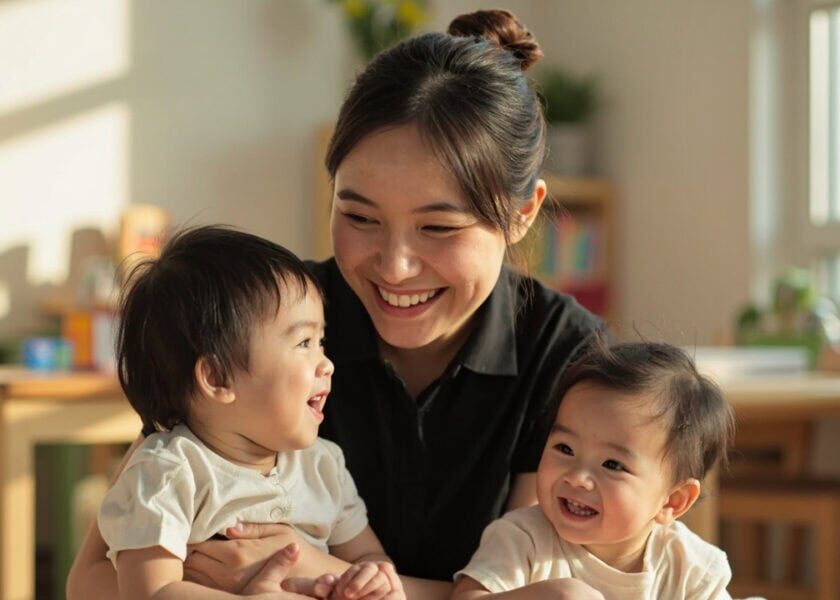
When a child enters a room that meets them—soft light instead of fluorescent glare, natural materials instead of plastic, a temperature that doesn’t require a cardigan but doesn’t invite drowsiness either—their body exhales. Not dramatically. Not visibly to anyone watching casually. But an exhale nonetheless. Shoulders drop a quarter of an inch. The jaw unclenches. The hands, which may have been fisted or gripping your sleeve, begin to open.
In quality care, the environment itself is a form of communication. It says: we expected you. We prepared for you. This is a place designed for small bodies and developing senses.
- The toys are within reach.
- The shelves are at a height that invites choice.
- The textures are varied—smooth wood, rough seagrass, cool stone, warm fabric—not because variety is a curriculum objective, but because a child’s world should be full of things worth touching.
And the sounds. Quality care has a quality of sound. Not silence—that is impossible with young children, and more importantly, it is not what children need. But a particular balance. The low hum of activity without chaos. Voices that rise and fall naturally rather than sharp commands. The sound of a caregiver’s voice in one corner, calm and unhurried, while children nearby work on their own small projects, occasionally glancing up to check that the adult is still there, still attentive, still available.
This is the auditory landscape of security: a world with enough structure to feel contained, enough freedom to feel alive.
Separation and Recalibration
We speak often of separation anxiety, but the language betrays us. It positions the anxiety as a problem to be solved, a phase to be managed, a hurdle to be overcome. What we miss is what separation actually is from the child’s perspective: a recalibration. The child must reorganize their inner world around a new absence. The parent who was their coordinate, their anchor, their first map of the world—that person is no longer in the room. The world must be remapped.
In the presence of a skilled caregiver, this remapping happens. It does not happen instantly. It does not happen the same way twice. But it happens.
Watch a child who is settling well. Watch closely. They will move through a series of micro-adjustments: glancing toward the caregiver, glancing toward the room, touching a familiar object, seeking out another child briefly, then returning to the caregiver’s orbit. It is not clinginess. It is cartography. They are mapping the territory: Where am I? Who is here? Is it safe to move away from the last known point?
The caregiver who understands this—who has been trained not merely to soothe but to hold space for this process—does not rush it. They do not peel the child off with cheerful reassurances that actually communicate: hurry up and be fine. They wait. They remain nearby but not hovering. They narrate gently: I see you looking for Mama. She will come back. I am here, and we have the blue truck to play with while we wait.
This is not distraction. This is accompaniment. And when it is done well, you can see the child’s body begin to relax into the new space. The heart rate steadies. The play, which may have been mechanical and searching, begins to deepen. A block tower is built not because it must be built but because building it is interesting. A song is joined not because an adult is asking but because the melody is worth entering.
The settling is the first evidence. Not the tears, which may or may not come. The settling. Watch for the settling.
The Peer World
At some point in the morning—perhaps after a snack, perhaps after the first free play period—your child will encounter another child. And the encounter will be small, specific, and enormous in meaning.
Perhaps a hand reaches for the same truck. Perhaps a face appears too close, too quickly. Perhaps a child is crying and your child notices, turns, processes, wonders.
This is the peer world. And it is nothing like the adult social world, but it is not lesser. It is a world of immediacy, of full-body response, of emotions that have not yet learned to hide. In quality care, the peer world is not left to chance. It is held—gently, thoughtfully, without over-control—by caregivers who understand that children learn to be social by being social, not by being protected from other children.
When a conflict arises—and it will—a skilled caregiver does not rush in to resolve it. They watch first. They assess. Is this a power struggle that is teaching something about negotiation? Is this a child who is on the verge of tears and needs an adult to step in? Is this a moment of genuine hurt or merely the friction of two strong wills encountering each other?
The caregiver’s intervention, when it comes, is calibrated to the moment. Sometimes it is a question: You both want the truck. What can we do? Sometimes it is a physical redistribution: Let’s see if there is another truck in the shelf. Sometimes it is simply proximity—a quiet presence that reminds both children that an adult is watching, that the social world is safe, that they do not have to manage this alone.
What your child learns in these moments is not conflict resolution in the adult sense. It is something more foundational: I am not alone in this world. Other children are here, and they are like me, and we must find ways to be together. Adults help with this. The world is hard sometimes, but there are people.
This is the beginning of social intelligence. It happens in the peer world. It happens when you are not there.
The Caregiver Bond
We must speak now of the person who holds it all together. Not because the caregiver is the only important element—children are not served by a single point of care, and quality environments have many hands—but because in the early years, the relationship with the primary caregiver is the laboratory of all future relationships.
A child in quality care forms a bond with their caregiver that is specific, deep, and consequential. It is not a replacement for the parent bond. It is an extension of it, a second secure base from which the child can explore.
When the caregiver is warm, consistent, and attuned—when they notice the child who is quietly overwhelmed before the child notices themselves, when they match their energy to the child’s need in that moment—the child learns something essential: I can be known by more than one person. I can be loved by more than one person. Each love is real, and each is enough.
This is not sentiment. This is attachment science. But it is also something more: it is the felt experience of a child who has been met. When you ask a child what they did at childcare today, and they say nothing, or played, or say nothing at all and simply look at you with a face that is settled and open—those moments are the residue of being met.
The child who has been truly seen by their caregiver carries that experience home. It is in their posture. It is in the ease with which they play independently or cling, appropriately, for comfort. It is in the way they can be fully themselves.
You cannot observe this bond directly. But you can see its evidence in your child.
Play: The Child’s Primary Language
In quality care, play is not filler between activities. It is not a reward for completing something more important. It is the activity. It is how children think. It is how they process the world, rehearse the future, and make sense of the present.
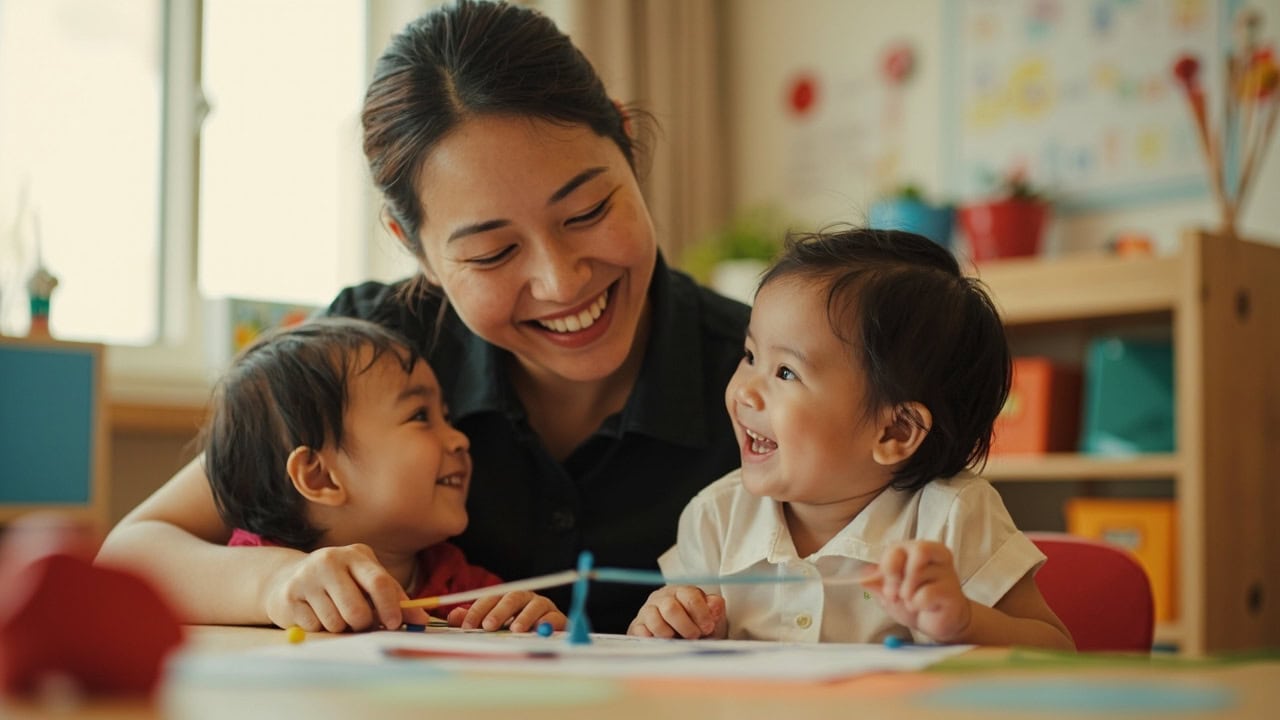
When a child plays alone with blocks, they are not merely stacking. They are experimenting with gravity, with balance, with cause and effect. They are building an internal model of how the physical world works. When the tower falls—a small disaster, a small delight—they learn something about persistence, about rebuilding, about the difference between failure and finality.
When two children play together with figurines, they are not merely moving small plastic animals around a farm. They are working through social scenarios—who gives orders, who follows, who helps, who hurts, who reconciles. The play is a rehearsal. It is preparation for the complex social world they will inhabit as they grow.
When a child is engaged in sensory play—water, sand, clay, shredded paper—they are not merely making a mess. They are exploring texture, temperature, resistance, transformation. They are learning through every sense, building neural pathways that will support all future learning.
In quality care, play is protected. The schedule allows for it. The environment supports it. The caregivers understand it. They do not rush children from one structured activity to another. They allow for the long, drifting, apparently purposeless periods in which the richest learning occurs. They join the play when invited but do not direct it. They introduce materials that spark curiosity but do not prescribe the use.
When your child comes home from a day of quality care, they may be tired in a way that is different from the tiredness of being merely watched. This is productive fatigue. This is the tiredness of a mind and body that has been working—playing—at the most important job they have.
The Reunion: What Your Child Tells You Without Words
Now it is late afternoon. The door opens. You are there.
The child sees you. And something moves across their face that you will not find in any parenting manual, any childcare review, any list of quality indicators. It is recognition. It is relief. It is the release of having been held in two worlds at once—the world of the caregiver, which they have trusted, and the world of you, which they have returned to.
In that moment, everything you could not see rushes forward in your child’s body. The stiffness of the morning drop-off has been replaced by something looser. The clinging that may have marked your morning goodbye has transformed into a reaching that is free—free because it is chosen, free because the child has learned through the day that departures end and reunions happen, free because they trust the pattern now.
We have spoken of the body throughout. But we must be explicit: the child’s body is evidence. Not the child’s words, which are still forming, still unreliable, still filtered through the overwhelming desire to tell parents what they want to hear. Not the photographs, which capture moments but not states. The body. Always the body.
In a child who has spent the day in quality care, you will see certain things:
- The shoulders are not hunched. The jaw is not clenched.
- The hands, if they have been fisted or stiff during the morning drop-off, are now open, relaxed, available.
- The eyes are clear—not glazed with overstimulation, not dulled by boredom, but clear and present and interested.
The walk is different. Not in a dramatic way. But the child who was carried into childcare may walk out on their own. The child who clung may move ahead, then turn, then wait—not with anxiety but with confidence, checking that you are following rather than that you are about to leave.
The play at home is different. A child who has been truly engaged through the day will play differently in the evening—not with frantic energy or dysregulation, but with a settled creativity. They may replay elements of the day. They may work through something that happened with another child, processing it in the safety of the home environment. They may be able to play alone for longer stretches, secure in the knowledge that they have been seen and held elsewhere.
And the language—slowly, over weeks—will grow. Not just in vocabulary but in complexity. In the ability to narrate, to imagine, to ask questions. Because language grows best in environments where there is something worth talking about, and where there are attentive listeners who respond.
This is what quality care looks like from the inside. Not in the facility. Not in the curriculum. In the child.
You take them home. And you watch them. You notice things. You notice the way they move through the house—not as a visitor to their own home but as a resident. The way they reach for what they want without anxiety. The way they play. The way they rest, or do not rest, but carry a kind of quiet contentment that you could not have given them in a single afternoon of your own attention.
What to Look For When Choosing Infant Care
When you find a childcare arrangement that produces this evidence consistently—not on the best days, not when visitors are watching, but day after day—then you have found something rare. You have found a place that understands what children need and has organized itself around that understanding.
In Singapore, the early years of a child’s life are not a waiting period. They are a foundation. The first thousand days—and every day after, through the infant and toddler years—are when the architecture of the brain is built, when the patterns of attachment are laid down, when the relationship between a child and the world is first formed. What happens in these years matters in ways that later years cannot fully reverse.
Quality childminding, when it is truly quality, looks like this:
- A caregiver who notices before responding. Not just when a child cries, but when a child’s shoulders begin to tense, when their play loses its flow, when they need proximity to an adult but cannot yet ask for it.
- An environment that meets the child’s body first. Soft light, natural materials, sounds that are balanced rather than chaotic, temperatures that are comfortable rather than merely compliant.
- Ratios that allow for attunement. In infant care, up to one caregiver to three infants. This is not a convenience ratio. It is a developmental ratio. It is the difference between a caregiver who can attune and one who is merely supervising.
- Play that is protected. Time and space for the long, drifting, apparently purposeless periods in which the richest learning occurs.
- A peer world that is held, not controlled. Children learning to be social by being social, with caregivers who calibrate their intervention to the moment rather than imposing resolution on every conflict.
- A bond that extends rather than replaces. A second secure base from which the child can explore, knowing they can return.
When you visit a potential childcare arrangement, here is what to observe:
- Visit at an unexpected time. The best way to see an environment as it actually operates is to arrive unannounced, during a regular morning, not during a scheduled tour. Observe: How does the space feel in your body? Is the light soft? Are the materials natural? Do the sounds feel balanced?
- Watch the caregivers. Not whether they smile, but whether they are attuned. Do they notice the child who is quietly withdrawing before that child begins to cry? Do they get down to the child’s eye level? Do their responses feel matched to the child’s energy?
- Ask about ratios. In infant care, the ratio matters enormously. Up to 1:3 is the standard in quality settings. Anything higher should prompt questions about how attentiveness is maintained.
- Notice the children. What is the quality of their play? Are they engaged, or merely occupied? Do they move through the space with ease? Do their bodies look settled?
- Ask about the settling process. How does the centre handle the transition? Is there space for recalibration, or is there pressure to “be fine” quickly?
- Trust the reunion. After your child has been enrolled for a few weeks, pay attention to what happens at pickup. Does your child seem settled? Do they show recognition of the caregiver? Does their body tell you something about the hours you could not see?
- Listen to your child. Not their words, which are still forming, but their body. Their ease. Their willingness to go. Their willingness to come home. Over time, the evidence will accumulate. Trust it.
How EduNanny Approaches This
EduNanny has built its practice around a simple conviction: that every child in those hours deserves what you would give them if you could be there yourself. Warmth. Attunement. Safety. Engagement. A caregiver who notices, who responds, who holds space for the child’s development without rushing it.
EduNanny participates in the ECDA Childminding Pilot, which means its programme meets the standards set by Singapore’s Early Childhood Development Agency—not merely the baseline requirements for registration, but the higher standards of a pilot designed to elevate the profession of childminding in Singapore. This reflects a commitment to being part of the solution for Singapore’s families, not merely a service provider in the market.
EduNanny offers pathways through home-based care, where a trained childminder comes to your home or the child is cared for in a carefully selected home environment, and community or centre-based care where children benefit from peer interaction in a quality group setting. Both pathways maintain the ratios that matter for developmental support.
Care is available Monday through Friday, in blocks designed for working parents who need reliability, consistency, and peace of mind. Within the pilot structures, fees are designed to be accessible, and CDA and Baby Bonus funds can be used—meaning the financial architecture of Singapore’s family support system works for you here, in this decision.
EduNanny understands that trust is not won through brochures. It is won through transparency. Where deployed, communication measures and CCTV systems allow parents to feel connected to the environment in which their child spends the day—not to surveil, but to trust. Not to micromanage, but to rest easy.
Addressing What You Are Actually Worried About
Will my child feel abandoned?
Quality care does not replace you. It extends your care into the hours you cannot be there. A skilled caregiver holds space for the child’s attachment, not as a rival to the parent bond, but as a second secure base. The child who has been well cared for learns: I have more than one person who knows me. Each love is real.
How will I know what’s happening?
You will know by what you can observe: the settling, the body, the reunion. Photographs and daily reports have their place, but they cannot capture the inner state of your child. The evidence is in their posture, their ease, their willingness to play, their language over time. Trust the child who comes home to you.
Is my child too young for group care?
In quality infant care, ratios are kept low—one caregiver to three infants—precisely because infants need attunement, not supervision. The question is not whether your child is ready for care, but whether the care is ready for your child.
What if my child cries every day?
Some crying is normal. Separation recalibration takes time, and every child adjusts differently. What matters is what happens after the crying: does your child settle? Does the caregiver hold space without rushing? Does your child begin, over weeks, to show the signs of a body that has learned this new place is safe? Watch the settling. Not the tears.
Can I trust someone else with my child?
You are not entrusting the raising of your child to someone else. You are entrusting the hours of your working day to someone who will hold your child with the same attention you would give them. The relationship with your child—its depth, its character, its meaning—remains yours. Quality care extends your love; it does not replace it.
The Truth You Have Been Looking For
There is a moment, at the end of every good day, when a child who has been well cared for rests in a way that is different from other rest. It is not the sleep of exhaustion. It is not the collapse of dysregulation. It is the settled rest of a child who has grown, that day, by exactly what they needed.
If you have watched this—truly watched it, the way a parent watches, with everything on the line—you know what I mean.
And if you have not yet found it, know that it exists. It is possible. A childcare arrangement that meets your child where they are, that holds them through the hours of your working day, that sends them home to you with shoulders loose and eyes clear and a mind already reaching for the next discovery.
In Singapore, in these early years, you are building something. Not just a career, not just a family, not just a home. You are building a person. And the hours of childcare are not a gap in that building. They are part of the structure. They are hours in which your child’s architecture grows, in ways that will persist.
Choose them wisely. Choose somewhere that understands this. Choose somewhere that sees your child—truly sees them, the way you do—and holds them with that same fierce, tender attention.
EduNanny is a Singapore childcare and childminding service committed to quality care, developmental support, and the kind of attention every child deserves. To learn more about how EduNanny can support your family, visit edunanny.com or speak with our team.