Beyond the Centre Visit: Finding Authentic Childcare in Singapore
Understanding How Centre Visits Work
The first thing to understand is that a childcare centre is a performance space as much as it is a care environment. That is not a cynical statement — it is simply human reality. Centres know that parents are evaluating them. They prepare for visits. Staff are briefed. Children may be engaged in specially arranged activities. The environment is tidied, the best work is displayed, and adult-to-child ratios may be optimistically managed for the duration of your tour.
None of this makes a centre dishonest. But it means that what you see on a tour is not exactly what you will see on an ordinary Tuesday afternoon when no visitor is expected.
Understanding this allows you to look beyond the performance and ask a different question: what does this place look like when no one is watching?
That question will guide everything that follows.
Reading the Physical Environment
The environment speaks before anyone says a word. Walk into a centre and notice what your senses tell you — not just the decorations chosen for you to see, but the texture of the place.
Sound: Is it loud? High ceilings, hard floors, and bare walls amplify noise. Young children and infants are overwhelmed by acoustic chaos, and the best centres invest in solutions — rugs, soft furnishings, acoustic panels, and thoughtful spatial design that creates pockets of quiet within the larger space.
Smell: Is it clean, or merely tidy? Tidy means things are in their places. Clean means surfaces have been sanitised, floors mopped, and corners attended to. In infant rooms especially, you should be able to smell nothing harsher than mild soap. Strong chemical odours suggest over-reliance on masking rather than genuine hygiene.
Light and Space: Notice the quality of light. Is it harsh and artificial, or is natural light thoughtfully integrated? Watch how children move through the space. Is there room for freedom, or does the layout feel cramped and overstimulating?
The small details reveal investment and philosophy. Child-height artwork and mirrors suggest the space was designed with children in mind. Accessible sinks and facilities show understanding of developmental needs. And the condition of toys and materials — whether they are worn but well-maintained, or pristine and untouched — reveals whether the environment is actually used or merely displayed.
Observing Children and Caregivers
Now look at the children themselves. They are your most honest source of information, and most parents do not use them enough.
Children are extraordinarily honest barometers. They cannot sustain performance for long. If children in a room appear engaged, curious, and moving freely, that is meaningful. If they appear passive, listless, or consistently seeking a caregiver’s attention without receiving it, take note.
A child who is genuinely comfortable does not need to perform comfort — they simply are comfortable.
Watch a caregiver entering the room. Do children look up, move toward the adult, reach out? Or do they barely register the arrival? The quality of attachment and trust reveals itself in these small moments.
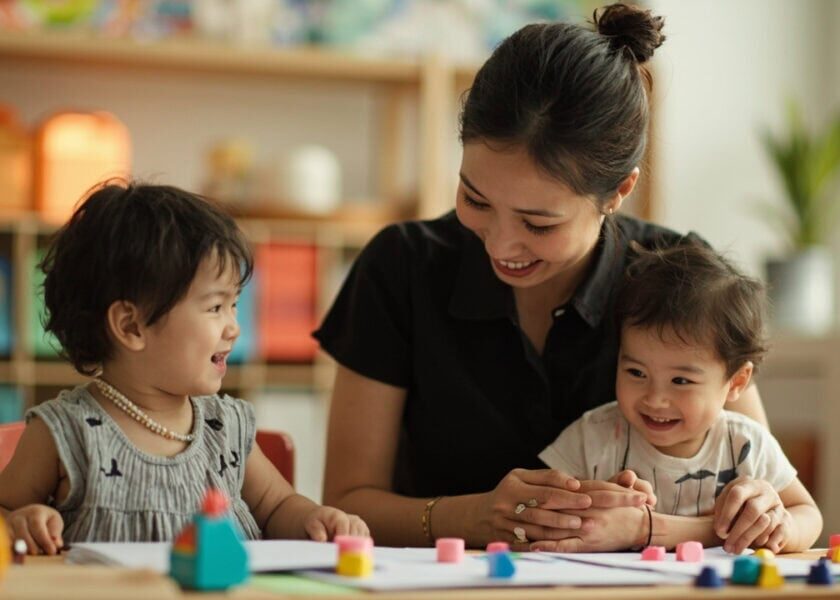
When you observe a caregiver with a child, look for what researchers call attunement — not a vague concept, but something with observable markers:
- Physical level: An attuned caregiver will get down to the child’s level — physically, not just verbally.
- Expression mirroring: She will mirror expressions, reflecting back what she sees in the child’s face.
- Following the child’s lead: When a child points at something, she will look where the child is pointing and name what she sees.
- Specific responsiveness: When a child is distressed, she will respond promptly and specifically — not with generic reassurance but with recognition of the particular need behind the distress.
Ask yourself: when a caregiver speaks to a child, does it sound like conversation or instruction? Genuine attunement sounds like a relationship. Listen for the variety in a caregiver’s voice, the pauses that invite response, and the way she narrates what is happening rather than merely directing it.
Notice what caregivers do when children are not demanding their attention. In high-quality environments, caregivers use these moments to prepare — to observe, to reflect, to set up the next activity — rather than to disengage entirely or socialise with each other. The space between moments of direct interaction is where intentionality reveals itself.
Questions That Reveal the Truth
Ask caregivers questions directly, not just the admissions team or centre director. If policy permits, spend time in a room and simply observe. Ask a caregiver what a typical morning looks like for an infant. Ask how they handle separation anxiety, feeding transitions, and sleep routines.
A caregiver who is genuine will speak from experience — with specifics, with the kind of granularity that only comes from daily practice. She will use children’s names, describe individual temperaments, and explain her reasoning.
A caregiver who is rehearsed will give you frameworks, buzzwords, and generalities. The difference may be subtle, but it matters enormously.
Questions worth asking:
- “What does a typical morning look like for a child in your room?”
- “How do you handle separation anxiety when a parent leaves?”
- “What do you find most challenging about caring for infants?”
- “Tell me about how nap time routines are developed for individual children.”
- “How do you communicate with parents about their child’s day?”
These questions reveal whether care is experienced from the inside or merely performed from the outside.
Safety, Warmth, and Authenticity
Every centre will tell you they prioritise safety. What you need to learn is how to see whether safety is a lived value or a compliance posture.
Regulatory markers matter. Check that the centre is properly licensed with ECDA. Verify staff credentials and training certifications. These are the non-negotiables.
Beyond the paperwork, look for how safety is enacted rather than merely declared:
- Childproofing at eye level: Can you see socket covers, corner guards, and secured furniture?
- Emergency preparedness: Are exits clear and accessible?
- Outdoor space: Is the play area fully enclosed, with surfaces appropriate for fall zones?
- Caregiver awareness: Watch how caregivers move through the environment. Do they scan the room continuously? In quality infant care, a caregiver maintains a running awareness of every child’s location, activity, and state.
If the setting uses CCTV, ask how it is used, who has access, and how it is communicated to parents. Transparency here is a positive signal. A centre that welcomes your questions about monitoring practices has nothing to hide.
Distinguishing Genuine Warmth from Performance
Warmth that is genuine is consistent and contextual. It shows up in the details, in the spaces between scripted moments. Watch a caregiver when she does not know she is being observed — when she is preparing bottles, wiping down a table, or settling a child for a nap. Does her demeanour change?
Genuine warmth is a disposition, not a switch that flips when visitors arrive. Notice whether caregivers seem at ease or tense, whether their interactions feel natural or deliberate.
Ask questions that cannot be rehearsed. Instead of “Do you love the children here?” — which invites a reflexive yes — ask something specific. Ask how a caregiver would describe her favourite moment in a typical day. Ask what she finds most challenging about infant care. Ask what she does when a child is inconsolable.
Notice how the centre responds to your concerns. A defensive reaction to a reasonable question — about ratios, curriculum, or communication practices — is information. A centre confident in its quality welcomes scrutiny. It expects you to look closely. It wants you to leave certain.
Communication, Cost, and Making Your Decision
For Singapore parents navigating the demands of dual-income households, transparency is not a luxury. It is a necessity.
You deserve to know what happens in your child’s day. You deserve to be able to ask — and receive — honest answers. You deserve to feel that you are a partner in your child’s care rather than a customer receiving periodic reports.
Ask about daily communication:
- How are feeding and sleep patterns recorded and shared?
- How quickly can you expect a response if you message the caregiver or coordinator?
- What are the protocols for medical situations, minor injuries, and unexpected moments?
Centres that invest in these communication systems do so because they understand that trust is built through transparency, and transparency requires infrastructure.
Understanding Cost and Value
Singapore parents are savvy. They understand that they are making an investment, and that the most expensive centre is not necessarily the best. Quality care should be accessible to families across Singapore, not just those with the most resources.
Ask about flexible fee structures, Monday to Friday care blocks aligned with working family rhythms, and available subsidies. These are not small considerations. They are the conditions that make quality care sustainable. And they reflect a philosophy: that every child deserves attentive, responsive, developmentally sound care, and that families deserve support structures that make this achievable.
Trusting Your Instincts
You walk into a childcare setting. You are nervous. You are aware that this decision matters. You do not have a background in early childhood education. You are relying on instinct and impression.
Here is what instinct and impression actually are, when you sharpen them: your accumulated wisdom as a parent, your knowledge of your own child, and your capacity to read authenticity — all applied with intention to a specific environment.
You already know how to read warmth. You already know what safety feels like. You already know the difference between someone going through the motions and someone genuinely present. Your nervous system, tuned by months and years of caring for your own child, is exquisitely calibrated for this assessment.
So trust it. When something feels off, take that seriously. When you watch a caregiver interact with your child and feel a quiet click of recognition — that this is right — take that seriously too.
Request a second visit, unannounced if possible. Ask to see a typical morning, not just a curated tour. Give yourself time to process afterward — not in the centre carpark, but later, when you can replay the moments that stood out.
If what you remember is a warm, engaged, calm environment where children are genuinely occupied and caregivers are genuinely present, you have seen something real. If what you remember is a brochure, a presentation, a sales pitch — no matter how polished — you have seen something else.
Considering Home-Based Care and Your Next Steps
If, after all of this, you find yourself considering a different kind of care altogether — not a centre, but a home-based setting, where your child is one of a very small group, where the caregiver-to-child ratio allows for a closeness that larger settings cannot replicate — know that this option exists and is taken seriously in Singapore’s childcare landscape.
Home-based care represents a different philosophy of care. It is not a lesser option, not a compromise. For many families, it is the right answer — a setting where ratios are designed around relationship rather than efficiency, where your child is not a face in a group but an individual known deeply.
At EduNanny, we welcome the close look, the detailed questions, and the conversation about philosophy and practice. We know that quality can withstand scrutiny because it is real, not performed. Our home-based childminding service operates with infant ratios designed to enable genuine attunement, allowing for responsiveness and individual attention that reflects the kind of care you have been observing for throughout this guide.
We believe that choosing childcare should not feel like stepping into fog. It should feel like coming home to clarity. Reach out to start a conversation, or learn more about how our programme works.
Because every family deserves to feel certain — not hopeful, not optimistically reassured, but genuinely certain — that their child is in the right place.