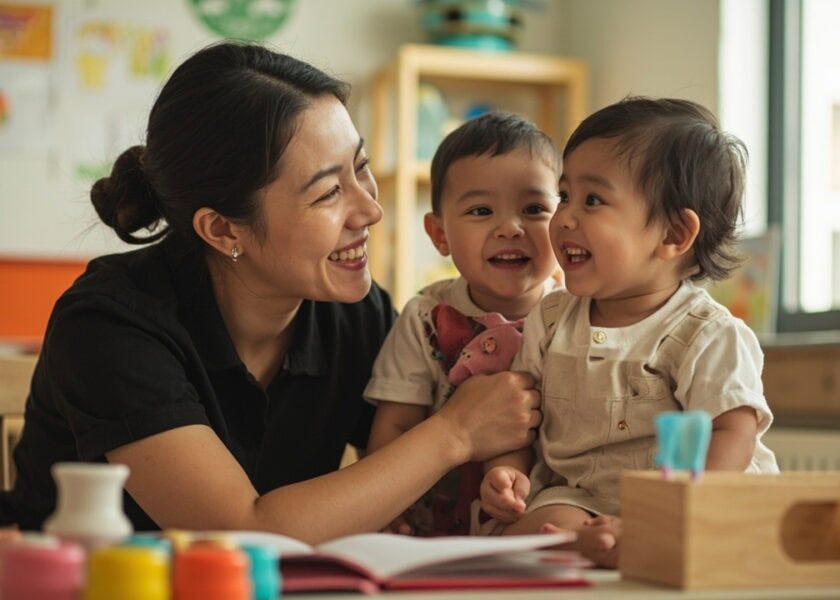
How Secure Caregiver Bonds Transform Your Child’s Development
Quick Summary: What This Article Covers
- Why the caregiver-child relationship is the most important quality indicator in infant care
- How relational security expands your child’s capacity to learn, explore, and grow
- Observable signs that meaningful caregiver-child bonds are forming
- Why consistency and small ratios matter more than most parents realize
- How EduNanny by BUTLER structures care around relationship as a core design principle
- Practical guidance for evaluating childcare options in Singapore
The Quiet Weight Singapore Parents Carry
Singapore parents navigate one of the world’s most demanding urban environments, where the pressure to provide, to plan, to optimize is relentless. In most cases, you are also separated from the extended family networks that once made early childhood a shared endeavor. You are making decisions about who will spend the most waking hours with your child during the years when their brain is building itself at a speed it will never again reach.
The stakes feel enormous. And yet the options, at first glance, can seem interchangeable—a centre here, a home-based arrangement there, ratios and fees and locations that blur together into a spreadsheet of compromises.
What you are really trying to find, beneath all of that, is a person. Someone who will see your child clearly. Who will respond with consistency and warmth. Who will notice when they are tired, when they are hungry, when they are on the verge of a developmental leap that will show up in their play tomorrow and their speech next month.
You are looking for a relationship.
Why the Caregiver-Child Bond Is the Foundation of Quality Care
The relationship your child forms with their caregiver is not incidental to their care. It is not a pleasant side effect of attentive staffing or a nice-to-have that supplements the “real” educational program. The caregiver-child relationship is the developmental architecture through which everything else happens.
To understand why, it helps to reconsider how we usually talk about childcare quality. We talk about ratios—how many children per caregiver—and this matters. We talk about curriculum—whether there is a structured program—and this can matter too. We talk about safety, about cleanliness, about communication apps and daily updates.
All of these are legitimate concerns. But they describe the container, not the contents. They tell you about the environment in which your child’s days unfold. They do not tell you whether your child is actually developing the internal resources that will serve them for decades.
The Science Behind Relational Security
When a child feels genuinely secure with a caregiver—not just familiar, not just comfortable, but genuinely secure—their nervous system registers a message that unlocks everything else:
The world is safe enough. I can explore it. I can venture away and come back. I can be curious because someone is watching me, and their watching feels like care, not surveillance.
Developmental science has mapped the pathways through which early relational experience shapes the architecture of the developing brain—particularly in the areas responsible for emotional regulation, social intuition, and the capacity to sustain attention.
You do not need the research to believe it. You know it from watching your own child. You know it from the way they respond after a weekend apart from a caregiver they have come to trust. You know it from the difference between a child who walks confidently into a room and a child who hangs back, assessing, uncertain.
What This Bond Teaches Your Child
The caregiver-child bond is the first template your child has for what relationships can be. It teaches them whether people are reliable, whether communication works, whether they can trust their own perceptions and feelings.
When a child enters preschool or primary school, they carry with them an internal working model of how relationships function. Do people respond when I reach out? Can I explore without losing connection? Is the world generally safe? These foundational beliefs, formed in the earliest years, shape how children engage with teachers, peers, and new learning environments for years to come.
How to Recognize Quality Relational Care
So what does it look like when this bond is actually forming? The signs are observable, though they are easy to miss if you are not looking for them.
Signs Your Child Has Formed a Genuine Bond
- Your child seeks out their caregiver to share, not just when distressed. A leaf they found. A mark they made. A small accomplishment that requires an audience. This is different from a child who tolerates a caregiver—it is a child who values the relationship.
- Your child is soothed more easily. Because the caregiver has become, through consistent presence and attuned response, a person who represents safety in a neurological sense. When a child knows that a particular adult will respond to their distress in a way that actually helps, they can tolerate more frustration, more novelty, more challenge.
- There is ease in the interaction. The caregiver knows your child’s rhythms—which songs they respond to, which textures they avoid, which moments tend to trigger overwhelm. This comes from consistent, attentive presence.
- Your child mentions the caregiver by name—and the tone carries warmth and recognition. This reflects a specific, valued relationship, not just familiarity.
Why Consistency and Small Ratios Matter
The caregiver-child bond cannot be built in fragments. It requires sustained, predictable presence—the same person, or small team, showing up with continuity over months and years.
When care is fragmented, when a child faces a rotating cast of unfamiliar faces, the developmental opportunity is lost. The child spends energy on adaptation rather than growth. The nervous system remains alert rather than settling into exploration.
This is why ratios matter. A caregiver who is responsible for too many children cannot attune to any of them fully. The capacity to notice, to respond, to remember, to adjust—that capacity is finite.
| Ratio | What It Allows | What It Prevents |
|---|---|---|
| 1 caregiver : 6+ children | Basic supervision, safety compliance | Individual attention, deep attunement |
| 1 caregiver : 3–4 children | More individual interaction | Deep knowledge of each child |
| 1 caregiver : up to 3 children | Real relationship development, emotional security | Nothing—this makes bonds possible |
When EduNanny speaks about ratios of up to one to three in infant care, this is what is behind the number: the recognition that meaningful relationship requires real attention, and real attention requires real time.
Designing Care Around Relationship
The caregiver-child bond is not something that emerges spontaneously from good intentions. It requires a model of care that is designed around relationship as a core principle—not as an aspiration or a marketing claim, but as the organizing logic of how the service is structured.
How EduNanny by BUTLER Approaches Childminding
EduNanny by BUTLER was built on this understanding. As a participant in the ECDA Childminding Pilot, EduNanny has committed to a model of care that treats the caregiver-child bond not as a byproduct of quality staffing, but as the primary mechanism through which infant development unfolds.
This means attending to the conditions that make these bonds possible:
- Consistency and continuity—the same caregiver, or small team, showing up predictably over time
- Small ratios—enough time and attention for genuine attunement
- Caregiver training and support—caregivers who understand their role as developmental partners, not supervisors
- Transparency—where observation measures are in place, they serve as a bridge of trust between caregivers and families
What Singapore Parents Actually Worry About
The costs of quality childcare can feel prohibitive. EduNanny’s participation in the Childminding Pilot means that care is structured to be accessible within pilot fee frameworks. The usability of CDA and Baby Bonus funds further eases the financial dimension of a decision that is, at its core, emotional and developmental.
Many parents carry guilt about returning to work. Here is something important to know: the bond between your child and their caregiver is not a replacement for your bond. It is an addition to it. When your child feels secure with their caregiver, they are actually more available for connection with you, not less. The developmental work that happens in the caregiver-child relationship does not draw away from the parent-child attachment. It extends it.
Your posture toward your child’s caregiver matters. Not in the sense of managing them or overseeing them, but in the sense of welcoming them into a shared endeavor. When you communicate openly about your child’s needs, when you express genuine appreciation for the work they are doing—you are not diminishing your role. You are strengthening the relational system that your child lives in.
The best caregiver-child relationships are embedded within a broader relational ecology that includes the family. When this works well, parents report something unexpected: they feel more competent, not less. They have a partner in the enormous work of raising a child. They have someone who sees their child from a different angle and can reflect back observations that parents, in the intimacy of daily life, sometimes miss.
Practical Guidance: Questions to Ask When Evaluating Childcare
If you are weighing options, visiting centres, asking questions about ratios and curriculum—here is the question that matters most:
Will my child be known here? Not just supervised. Not just occupied. Known. Recognized. Understood as a specific, individual person with their own temperament, their own preferences, their own pace of development.
Here are questions grounded in relational quality that most parents do not think to ask:
- Who will be my child’s primary caregiver, and how often will that person change?
- What is the caregiver-to-child ratio, and how does that translate to individual attention?
- How does the programme handle transitions when caregivers are absent?
- Can I observe how my child interacts with their caregiver before making a commitment?
- How does the caregiver describe my child’s temperament, preferences, and patterns? Can they do this from day one, or only after weeks of observation?
- How does the programme support caregivers’ wellbeing and prevent burnout?
- What does daily communication look like, and how is information shared about my child’s emotional state, not just their meals and naps?
Answering these questions well requires a philosophy of care that places relationship at the centre—not as a talking point, but as a design principle. It requires caregivers who understand their role as developmental partners, not as supervisors. It requires an organisation willing to structure ratios, consistency, training, and communication around the simple but demanding goal of making genuine bonds possible.
The Most Personal and Important Thing Quality Childcare Offers
There is a moment—not dramatic, not announced—that tells you something true has begun. Perhaps you noticed it on a quiet afternoon when you arrived to collect your child, and instead of the expected cry or cling, your little one looked up from the caregiver’s arms with an expression that was almost conspiratorial.
I know her. She knows me. We’re fine here.
Or perhaps it was subtler still. The way your child turned at the sound of a particular voice across the room. The way they reached for one pair of hands over another. The way they mentioned a name—spoken with a toddler’s impossible compression of meaning—that you realized mattered to them in a way you had not expected.
When you watch your child reach for their caregiver with something that looks like trust, you are seeing the result of hundreds of small, intentional interactions. EduNanny by BUTLER was built for this—not because every detail is perfect, but because the central commitment is clear: the caregiver-child relationship is the primary quality indicator in infant care, and everything else is in service of it.
Choosing childcare is ultimately choosing a relationship for your child. It is deciding who will help shape their earliest understanding of what relationships can be. It is trusting someone else with the most important work there is: helping a small human feel safe enough to explore, brave enough to learn, and secure enough to become whoever they are becoming.
You chose this for them. And now you can trust it.
Start a conversation with EduNanny by BUTLER. Learn how our childminding model is designed to make the caregiver-child relationship the foundation of everything we do, and explore how we can support your family.