How Real Conversation Shapes Your Child’s Brain in Singapore
What Science Reveals About Early Language Development
The first three years of a child’s life are not just precious—they are foundational. And the window for language development is narrower and more consequential than most of us realise.
Between birth and age three, a child’s brain builds neural pathways at a rate that will never be matched again. By age three, the brain has reached approximately 80% of its adult size. The pathways that will process language for the rest of their life are being laid down right now.
Researchers have found that vocabulary typically grows from babbling to around 10,000 words during these years. Children move from first sounds to first words to simple sentences to complex, nuanced communication. This is not magic. It is exposure, interaction, and a brain extraordinarily primed to learn.
But here is what often gets missed in conversations about early learning: not all language exposure is equal. A television can pour thousands of words into a room. But your child is not talking back to the television. No one is pausing to hear what they point at. No one is repeating their sound back, wondering if they meant something by it.
Language develops through conversation. Through genuine back-and-forth. Through someone who listens, responds, and builds on what a child says or tries to say.
What Quality Care Looks Like in Practice
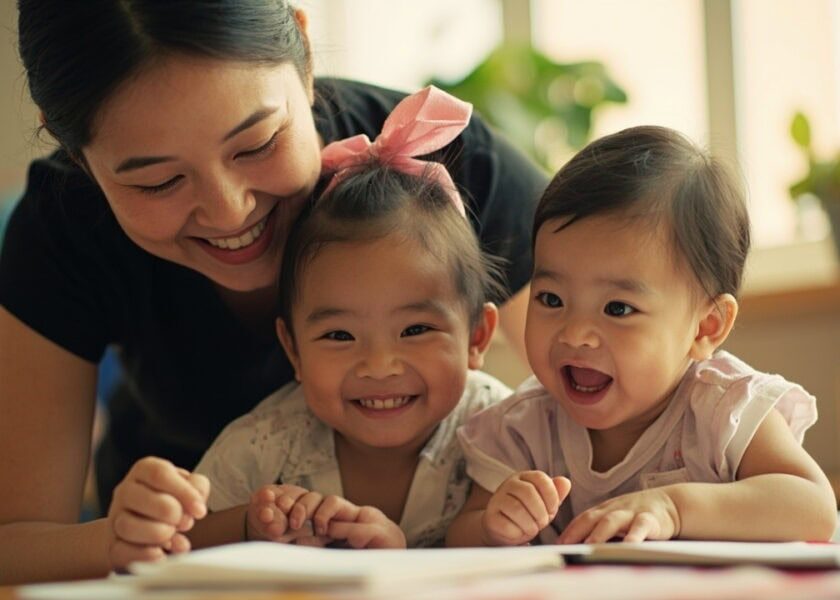
In quality childcare settings, language is not something that happens during circle time and then stops. It is woven throughout the day.
Consider feeding time. A caregiver is talking to an infant—not just directions or labels, but narration. You are eating banana now. It is soft and yellow. Do you want more? The infant may not understand every word. But they are learning that sounds have meaning, that this person is communicating with them, that language is a bridge between two minds.
With an older toddler, the conversations become richer. You are building a tower with the blue blocks. How tall will it go? Would you like to add another block? Look, it fell! Let’s try again. This is language. But it is also thinking. It is problem-solving. It is the scaffolding of a mind, built one sentence at a time.
Something that often surprises parents: a quality childcare setting, with intentional design and small group sizes, can provide more of this kind of conversation per hour than a busy household can. Not because parents do not care. But because life is demanding. Because adults are tired. Because sometimes, in the rush of a morning routine, a look and a point gets met with a quick yes instead of a full sentence.
In a quality childcare environment, that full sentence is the point.
Why Small Groups and Peer Interaction Shape Language Growth
Caregiver ratios at quality childcare centres make language-rich interaction possible. With up to one caregiver for every three infants, there is time. Time to listen. Time to respond. Time to follow the child’s lead and extend the conversation naturally.
In a home where a parent is managing work, meals, and a dozen other tasks, a child’s attempt at communication might be met with a distracted nod. In a childcare setting with deliberate ratios, that same attempt becomes an opportunity for connection. A pause. A response. A conversation that says: What you are trying to say matters.
Children also learn to talk more when surrounded by other children who are learning alongside them. When children play together, they negotiate. They ask questions. They narrate their play aloud. They imitate and expand on what they hear from each other.
The language of peer interaction is different from adult-child interaction. It is more playful. It is more socially complex. And it is extraordinarily valuable for development.
In a quality childcare setting, your child is not just receiving language. They are practicing it—in real time, with real social stakes. Because when your child wants the truck that another child has, they have to use words. They have to ask. They have to listen to the answer.
And in doing so, they are learning something that no vocabulary list can teach: that language is how we connect with each other.
Why This Matters for School and Beyond
Researchers have documented a persistent difference in the number of words children are exposed to before starting school. By some estimates, children from higher-income households hear millions more words by age three than children from lower-income households.
This is not about intelligence. It is not about potential. It is about exposure. About the number of conversations, the quality of attention, the richness of the language environment.
Quality childcare, when it is truly language-rich, is one of the most powerful ways we know to close that gap. Not by drilling vocabulary. Not by testing children. But by surrounding them with attentive, responsive adults who talk with them throughout the day, listen to what they say, and build on it.
When you strip away the anxiety and the checklists, school readiness actually looks like this: a child who can listen, speak, ask questions, and follow the thread of a conversation. These are language skills. And they are the foundation for everything else—the reading comprehension, the written expression, the ability to work with others, to persist with difficult tasks, to think for themselves.
Language is not just one domain among many. It is the infrastructure of learning. And the years before primary school are when that infrastructure is built.
What EduNanny Intentionally Does Every Day
EduNanny was built with these principles in mind. As part of the ECDA Childminding Pilot, EduNanny is designed around recognised standards for infant and toddler care—standards that treat language-rich environments as essential to quality, not optional.
What this looks like in practice:
- Intentional caregiver interaction throughout every routine. Caregivers are trained to recognise the teachable moments in ordinary routines and engage with children in ways that are responsive and rich. Language development at EduNanny is not an accident. It is designed into the programme.
- Low caregiver ratios that allow for real conversation. Small group sizes mean more time to listen, respond, and extend interactions naturally. Every feeding, every transition, every moment of play becomes a language opportunity.
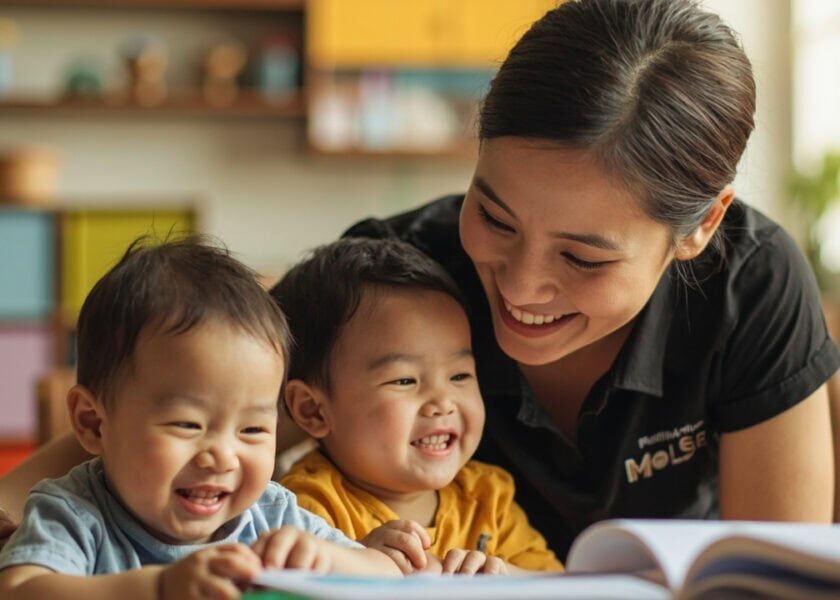
- Storytime that invites engagement. Reading at EduNanny is warm and intentional. Caregivers pause, ask questions, wait for responses, and follow the child’s curiosity. This is how comprehension begins.
- Daily peer interaction built into routines. Children play together, negotiate together, and learn together. The social complexity of peer language adds something that adult-child interaction alone cannot provide.
- Transparent communication with families. Parents receive updates about their child’s day—the moments of discovery, the new words, the conversations that happened over lunch. When CCTV measures are in place, they provide an additional layer of assurance. You are not leaving your child in a black box. You are choosing a partner in their development.
EduNanny offers pathways that include both home-based and centre-based options, because families are different and the right fit matters. Fee structures within the pilot are designed to be accessible. CDA and Baby Bonus can be used to support care arrangements, which means the financial logistics do not have to be a barrier to quality. Care operates on weekday schedules, Monday through Friday, aligning with the rhythms of working families across Singapore.
Addressing Your Real Concerns
But I am their parent. Shouldn’t I be the one doing this?
Yes. You should. You are. And you are doing more than you know. Every time you read that extra story. Every time you answer the fifteenth question of the day. Every time you narrate what you are doing as you cook dinner and let your toddler hand you the spoon.
But here is the honest truth. Most families in Singapore are managing demanding work schedules, long commutes, the practical pressures of raising children in a city that moves fast. The love is there. The intention is there. But the sheer volume of language-rich interaction that a developing brain needs—this is a lot.
Quality childcare is not a substitute for a loving family. It is a complement. It is an extension of the language environment you are already building at home.
Does this mean I am not doing enough?
The fact that you are asking this question means you care deeply. The fact that you are here, thinking about quality, thinking about what your child is absorbing—this matters enormously. Choosing childcare because you want your child to have more conversation, more stimulation, more of the rich language environment that builds minds is not a choice made from failure. It is a choice made from love and from vision.
Finding Care That Invests in Your Child’s Language Development
If you are researching childcare options in Singapore, here are the questions that matter most:
- How do caregivers interact with children throughout the day? Is language woven into routines—feeding, transitions, play—or only during designated activities?
- What are the caregiver-to-child ratios? Smaller ratios mean more time for responsive, individual interaction.
- How is storytime conducted? Is it warm and engaging, with pauses for conversation? Or is it more passive, more broadcast?
- Do children have time to play together? Peer interaction is a crucial—and often overlooked—dimension of language development.
- How does the programme communicate with families? Are parents kept informed about their child’s language milestones and daily experiences?
Your Child’s Language Partnership Begins Here
You are not choosing childcare because you are failing to give your child enough. You are choosing childcare because you want your child to have more—more conversation, more stimulation, more of the rich language environment that builds minds.
And that is something to feel good about. It is a choice made from love and from vision. From wanting the best for your child, not despite what you provide at home, but in addition to it.
Every story your child hears at EduNanny adds to the stories they hear at home. Every conversation they have with a caregiver adds to the conversations they have with you. Every new word they learn to say is a word they will bring home, and you will marvel at, and you will ask: Where did that come from?
And you will know. You chose a place where language is valued. Where your child is heard. Where every day, they are building the foundation for everything that comes next.
That is what EduNanny offers. Not just care. But partnership. In the most important work there is: building the minds and voices of the next generation.
And when you tuck your child in tonight, and they ask for one more story, you can say yes—and mean it—because you know that tomorrow, they will go somewhere that loves words as much as you do.
The language partnership begins with a choice you are already making.
Curious about what EduNanny can offer your family? Get in touch or learn more about our approach.