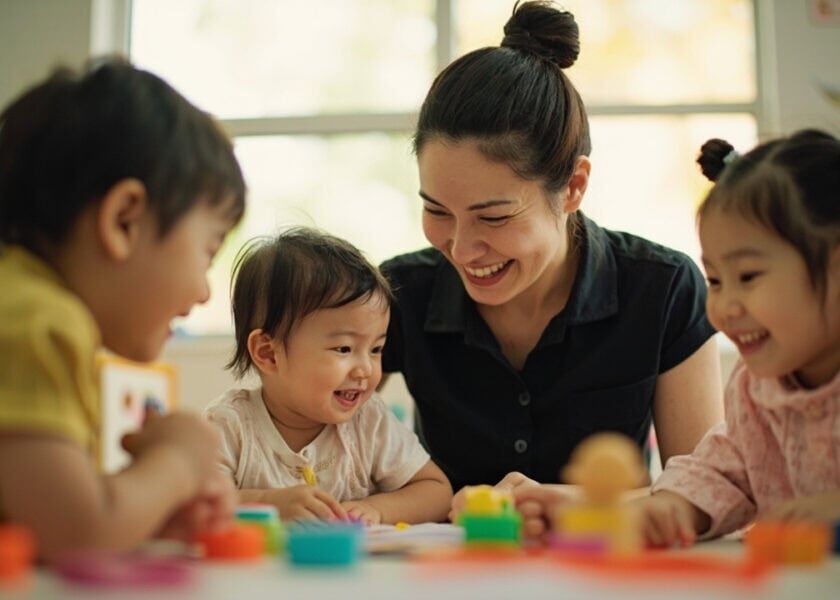
What Your Child Is Building While You Are Not There
The Moment Every Parent Knows
There is a moment at pickup that every parent knows. You arrive at the door, your child in view, and you find yourself searching their face—not for evidence that they were safe, though of course that matters profoundly, but for something else. Something you could not see even if you had been there.
You want to know: what happened today while I was not there? What did they feel? Who did they become in the hours between the morning goodbye and this reunion right now?
It is a question parents carry quietly and rarely say aloud. Because saying it would require admitting that the hours apart matter in ways that go beyond supervision—that your child is living something real during those hours, building something real.
Here is what research and experience consistently show about that building: children in quality care develop social confidence through daily peer interaction, emotional resilience through navigating feelings alongside others, a stronger sense of self as their preferences are noticed and respected, secure foundations from which to explore and discover, and play-based learning that builds neural pathways, language, and imagination. These are not luxuries. They are the foundations of everything that follows.
What Children Actually Build in Quality Care
Begin with the social world, because this is where the most profound and least visible work of early childhood happens.
Your child, in quality childcare, meets other children for the first time as true peers. Not siblings, not cousins, not children seen occasionally at the playground—but children who are there every day, whose presence is consistent and reliable, whose rhythms begin to matter.
Watch what happens. A toddler offers a block to another child and watches their face. A two-year-old navigates their first friendship conflict—the toy pulled away, the cry, the tentative reaching out again. A three-year-old says a name—a real name, someone they have chosen—for the first time.
These are not small moments. These are the first experiments in human connection, the earliest lessons in what it means to matter to someone else, and for someone else to matter to you. Children learn that other people have needs, preferences, and feelings. They learn that kindness produces joy in both giver and receiver. These are skills that no curriculum teaches directly. They are absorbed through lived experience, hour after hour.
Beyond social skills lies something deeper—emotional growth that shapes who your child will become as a person. In the childcare environment, your child encounters the full range of human experience: the joy of inclusion and the sting of waiting, frustration when things do not go their way, and the discovery that frustration is not the end of the story.
A child who can say “I am angry” before they can write their name has a tool that will serve them in every classroom, every workplace, every relationship they will ever have. This is not soft or sentimental. This is the hard work of becoming a person who can navigate complexity.
Watch a caregiver in a quality childcare setting when something goes wrong. They do not rush to fix it or smooth it over. They stay present. They help the child name what they feel. They hold the boundary while also holding the child. And slowly, over days and weeks, something shifts. The child learns that hard feelings are survivable, that they do not have to disappear when things are difficult, that they can be held and still be themselves. This is emotional resilience—not the absence of difficulty but the capacity to move through it.
There is also, in quality childcare, a quiet emergence of selfhood that deserves to be named. At home, a young child is often seen primarily as part of a family. But in the childcare environment, something shifts. They begin to be seen as an individual. Their preferences matter. Their choices are noticed.
A child who chooses the red cup over the blue one is asserting a preference—discovering that they are someone who likes red. A child who runs to a caregiver to be held is learning that they can ask for what they need. A child who says “no, my way” is doing something remarkable. They are becoming a self.
Psychologists have long understood the importance of secure attachment. A child who feels secure—who knows that their caregiver will return, who trusts their environment—can venture further. Can take risks. Can be curious. Can fail and try again. In a quality childcare environment, day after day, your child tests the boundaries of their world and finds them solid. They reach out for connection and find it. They venture into uncertainty and find someone there to catch them. And slowly, this becomes internalized. They carry the security with them. It becomes the foundation for everything else.
When you observe children playing in a quality childcare setting, you might see what appears to be simple amusement. Blocks stacked and knocked over. Sand poured from one container to another. A cardboard box that seems more interesting than the toys that came in it.
But this is not simple. This is the work of early childhood. Play is how children make sense of the world—how they build neural pathways, develop language, practice problem-solving, and exercise imagination. When a child builds a tower and watches it fall, they are learning about gravity. When they negotiate over a toy with another child, they are learning about power, fairness, and communication. When they pretend to cook an elaborate meal, they are developing symbolic thinking that will later enable reading, mathematics, and abstract reasoning.
Play is not a break from learning. Play is learning. And in a quality childcare environment, play is supported, extended, and made meaningful by caregivers who understand what children need.
Why Quality Care Matters in Singapore
Singapore is a remarkable place to raise a family, but it is also a demanding one. The pace of life here is relentless. The expectations placed on parents—to perform, to provide, to balance—are immense.
And children feel this, even when they cannot name it. They feel the urgency. They feel the compressed time. They are growing up in a context that moves fast, and they need more than ever to have spaces where they can grow at their own pace.
This is why the conversation about quality childcare matters so urgently here. Not as a luxury. Not as a convenience for working parents. But as a developmental necessity for children who deserve to have their early years honored.
We know that many families face real constraints. Cost matters. Logistics matter. The choice to place your child in care is not made lightly, and it should not have to be made with guilt. Parents need support. They need options that are genuinely affordable, genuinely accessible, genuinely good.
What Quality Childminding Looks Like
For parents evaluating their options, understanding what separates quality care from adequate care matters enormously. Quality childminding is characterized by:
- Small, consistent groups: Children are known as individuals, not faces in a crowd. Caregivers can attune to each child’s rhythms, needs, and emerging strengths.
- Responsive interaction: Caregivers engage with children, not just supervise them. Conversations, questions, genuine interest in what children are doing and thinking.
- Emotional attunement: Feelings are named and validated. Conflicts are opportunities for learning, not situations to simply end.
- Environments designed for discovery: Spaces arranged to invite exploration, with materials that support the kind of play that builds thinking.
- Partnership with families: Regular, genuine communication about what is happening in your child’s day—not just checkboxes, but real glimpses into their life.
When these elements are present, the transformation described in this article becomes possible. When they are absent, children may be safe and occupied, but they are not building in the ways that matter most.
Will my child be safe?
Safety is the foundation, not the ceiling, of quality care. Beyond meeting regulatory requirements, quality childminders create environments where children can explore confidently because they know the boundaries are solid. Responsive caregivers notice quickly when something is wrong. Small ratios mean your child is not one of many—they are one of a few, known and watched.
Will my child feel abandoned or anxious?
Some separation anxiety is normal and reflects healthy attachment. But quality care actually supports attachment security over time. When children learn that caregivers consistently return, that their environment is reliable, that their needs will be met—they develop the internal security that allows them to venture further, not cling tighter.
Will my child learn anything, or just be “looked after”?
In quality care, learning is happening constantly, though it rarely looks like school. It looks like children negotiating whose turn it is. Like a caregiver naming the emotion a child is feeling. Like a toddler discovering what happens when they mix water and sand. These are not passive experiences—they are active construction of understanding.
How will I know what is happening during the day?
Parents deserve genuine insight, not just perfunctory updates. Regular, meaningful communication allows you to understand your child’s life beyond your direct observation. When you know what is happening, you can stop worrying about what might be going wrong and start noticing what is going right.
If you are currently evaluating your options, here are the questions worth asking: How many children are in the caregiver’s immediate care? What does a typical day look like—is there time for free play, or is the schedule over-structured? How do caregivers handle conflicts or big emotions? What is the communication like with families? How does the environment feel when you visit? Trust your instincts during visits. If something feels off, it probably is. If the environment feels warm and the caregivers seem genuinely engaged with the children present, that is a good sign.
Our Commitment to Quality Childminding
EduNanny by BUTLER was built with a clear conviction: that every family deserves access to quality care, not just those who can afford premium pricing.
Our approach to childminding is rooted in the ECDA Childminding Pilot, which recognizes that childminding is a profession worthy of dignity. The people who care for children are not babysitters but builders of human capacity.
Here is what this means in practice:
- Home-based and centre-based pathways: Families are not all the same, and their needs deserve flexible answers. We offer both options so you can choose what fits your life.
- Infant ratios designed for attention: Every child deserves to be truly seen. Our ratios are structured to make that possible.
- Care blocks aligned with working life: Monday to Friday schedules designed around the rhythms of working parents.
- Financial accessibility: Where it matters most, we have structured things so that CDA and Baby Bonus can be used. Supporting families should not be an afterthought.
Where our services are deployed, we maintain clear communication with families and appropriate transparency measures, including CCTV where applicable. Not because we have anything to hide, but because parents deserve to know what is happening with their children.
We also developed Thomas, our AI chatbot, as a reliable companion for moments when you need a quick, informed answer about your child’s development. Parenting is full of questions that arise at inconvenient times—Thomas draws on best practices in early childhood development and is available whenever you need him.
When families can access quality care without financial strain, everyone benefits. Parents can work with genuine peace of mind. Children can grow in environments designed for their development. And the community as a whole becomes stronger.
What You Will See at Pickup
Now, back to the moment you have been waiting for—the reunion you know so well.
When you arrive and your child runs to you—not reluctantly, not clinging, but with genuine energy and joy—something has happened. When they show you something they made. When they tell you, in whatever way they can, about a friend or a game or a discovery. When they are tired but lit up, full of the day they have had.
This is not just a child who was entertained. This is a child who was engaged, growing, becoming. You can see it in their face. And you can feel it—that quiet pride, that satisfaction, that sense of something good having happened.
Parents often describe this moment as relief. But we think it is more than that. It is recognition. You are seeing evidence that your child is thriving, not just surviving. That they are building something in the hours apart from you. That the choice you made was not just practical but profound.
You are standing there, searching your child’s face, and you realize something has shifted. Your child is not just home. They are coming home to you changed. A little more confident. A little more curious. A little more themselves.
What happened today? You will never know all of it. Some of it will remain invisible to you, happening in the spaces between your attention, in the quiet conversations and small discoveries that make up a child’s inner life. But you will see the evidence. In how they speak. In how they play. In how they look at the world.
And you will know: this was not just time spent. This was time invested.
EduNanny by BUTLER exists to ensure that what your child is building is strong, is valued, and is worthy of them. We are here to stand alongside you in this work of raising the next generation—not as a service you purchase, but as a partnership you enter.
If you are ready to explore what quality childminding can offer your child, we would be glad to hear from you. Whether you are looking for home-based or centre-based care, whether you need full-time support or part-time flexibility, there is a pathway that can work for your family.
The hours matter. Let us make them count.