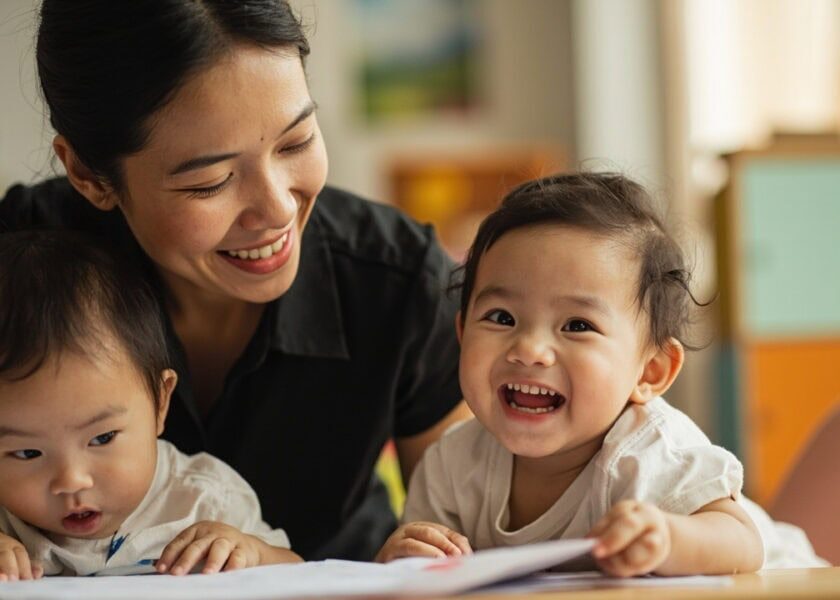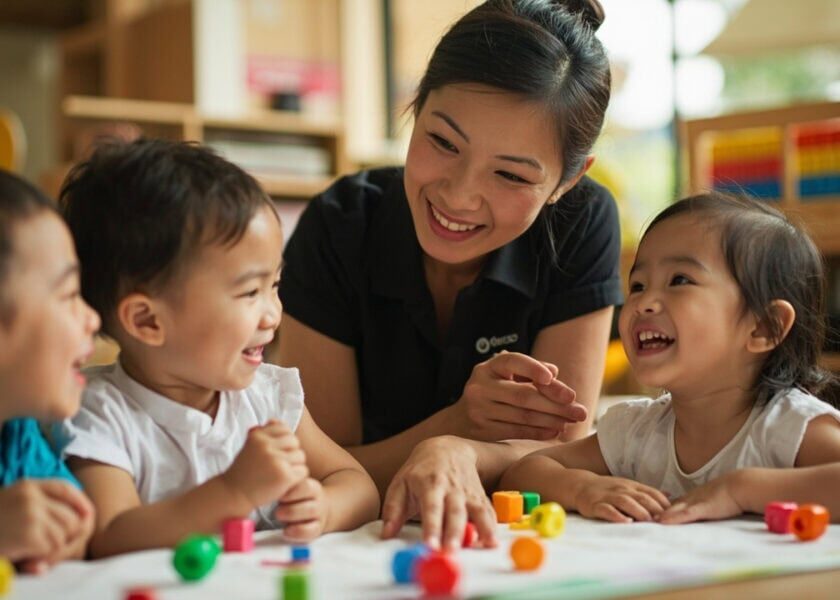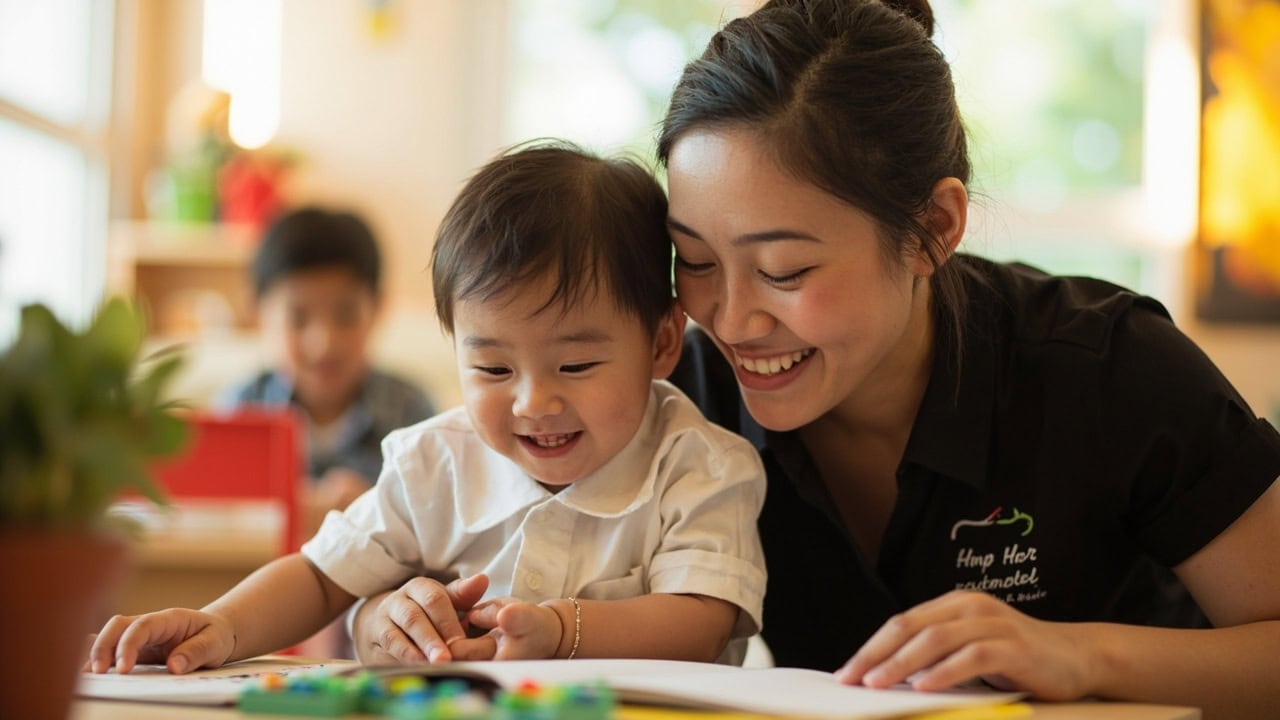
The Five Pillars of True School Readiness Every Singapore Parent Should Know
The Moment Every Singapore Parent Recognizes
There is a moment, and every Singapore parent will recognize it. You look at your child and suddenly see something different. Not a toddler anymore. Not even a preschooler in the way that word once felt. You see the edges of someone new—an emerging school child, someone who will sit in a classroom, navigate friendships on their own terms, and face challenges that no amount of parental shielding can soften.
It might come when you register your child for Primary One. It might come when a friend asks, “Is she ready?” and you realize you do not have a clear answer. That moment is the beginning of a question every parent who has invested in quality childcare will eventually face:
Did I get this right?
The answer, if you have chosen well, is yes. But understanding why requires looking beyond what most Singapore parents believe school readiness means—and that understanding changes everything.
Beyond Academic Readiness: What Primary One Actually Demands
Most parents in Singapore believe school readiness means academic readiness. The ability to read a few words, perhaps write their name, count to twenty. The logic feels intuitive: if they can do the work, they will be fine.
And so begins the quiet anxiety that drives many childcare decisions. Parents find themselves comparing worksheet stacks, wondering if they should enroll their three-year-old in enrichment programmes, questioning whether their childcare centre’s play-based approach is “enough” when the Primary One registration date looms closer each year.
But here is what years of working with thousands of children across Singapore has taught us: the children who truly thrive in Primary One are not necessarily the ones who arrived knowing the most. They are the ones who arrived ready—ready to learn, to relate, to recover from setbacks, to remain available for learning even when learning is hard.
The gap between what parents think school readiness means and what it actually requires is one of the most significant, and least discussed, tensions in early childhood. Understanding this gap is the first step toward preparing your child for something far more important than passing examinations—preparing them to become someone who genuinely loves to learn.
The Academic Misconception
Many parents believe the best way to prepare their child for Primary One is to give them a head start on academics—to teach them to read early, to practice mathematics, to complete worksheets. The logic seems unassailable: if they already know the content, school will be easier.
But this approach is not only unnecessary for school readiness; it can actively undermine it.
Children who are pushed into academic learning before they are developmentally prepared often develop a pattern of performance rather than a love of learning. They may achieve short-term academic results while losing the curiosity and intrinsic motivation that will sustain them through years of education. They may learn to associate learning with pressure and evaluation rather than with joy and discovery.
The academic skills that matter most in Primary One are not the ones that can be drilled in advance. They are the ones that emerge naturally from a foundation of emotional regulation, social confidence, curiosity, physical capability, and language richness. A child who enters Primary One ready in these five ways will learn to read, will grasp mathematical concepts, will meet every academic demand—and will do so with the resilience and enthusiasm that makes learning sustainable.
The Five Pillars of True School Readiness
- Emotional self-regulation — the ability to manage feelings, recover from setbacks, and stay present for learning
- Social confidence — navigating friendships, handling exclusion, and finding your place among peers
- Intrinsic curiosity — the burning desire to learn that no worksheet can teach
- Physical readiness — managing a structured school day with motor skills and stamina
- Language and communication readiness — listening, expressing ideas, and using language as a tool
These five pillars separate children who enter Primary One ready to thrive from those who enter merely ready to attend. Quality childcare builds all of them simultaneously, naturally, through everyday rhythms—not through academic drills or early literacy worksheets.
Emotional Self-Regulation: The Invisible Foundation
In a formal school environment, children are expected to manage their emotions, delay gratification, and recover from disappointment without a parent stepping in.
Consider what Primary One actually demands. Your child will transition between subjects, each with different expectations. They will receive feedback—not always positive. They will experience the natural disappointments of childhood: losing a game, being passed over for a turn, struggling with a concept that does not come easily.
A child who cannot transition between activities without prolonged distress, who struggles to calm themselves after something goes wrong, who falls apart when play does not go their way—this child is not academically behind. They are emotionally unprepared for what school demands.
Quality childcare builds this capacity systematically. It creates environments where children learn to name their feelings, practice patience, and discover that difficult emotions are survivable. When a caregiver responds sensitively to a child’s distress, they are teaching emotional regulation while strengthening the attachment that makes all other learning possible.
The child who leaves such an environment enters Primary One with an invisible but essential advantage: the ability to regulate themselves enough to remain present for learning.
Social Confidence: Finding Your Place Among Peers
School is, among other things, a social arena. Children must navigate friendships, handle exclusion, share space, and resolve conflicts without constant adult mediation.
This sounds simple until you watch a four-year-old try to join a game already in progress, or navigate the complicated emotions when their best friend plays with someone else. These are not trivial social skills. They are the foundational competencies that determine whether your child experiences Primary One as a welcoming place or a hostile one.
The child who can approach a group of peers and find their place in play, who can advocate for themselves when treated unfairly, who can read social cues and adapt—this child has a foundation that no curriculum can replicate in the first weeks of Primary One.
Social confidence is built through rich peer interaction, through guided conflict resolution, through plenty of supervised but not over-managed play. Quality childcare provides this naturally, day after day, year after year. It is in the daily negotiations over toys, the hurt feelings when someone says “you can’t play,” and the joy of finding a friend who shares your interests.
These are not distractions from learning. They are the substance of it.
Intrinsic Curiosity, Physical Readiness, and Language Foundations
Beyond emotional regulation and social confidence, three additional pillars complete the picture of school readiness.
Intrinsic Curiosity
Singapore’s classrooms are evolving, but formal schooling still demands a particular kind of learner—one who can sustain attention, ask questions, and pursue understanding without constant external motivation.
The child who arrives in Primary One already burning with curiosity, already oriented toward discovery, already finding joy in the act of learning itself—this child is not just ready for school. They are ready for the lifelong work of becoming educated.
Intrinsic curiosity is fragile. It can be inadvertently extinguished by the wrong kind of early pressure—by learning that is always about performance, evaluation, and correct answers rather than exploration and discovery. When we push children into academic learning before they are developmentally prepared, we often sacrifice the very motivation that will carry them through years of education.
Quality childcare nurtures curiosity by creating environments rich with wonder, by following the child’s lead, by treating every question as worthy of serious engagement. Why is the sky blue? Where do ants go at night? What happens if we mix these two things together? Each question, pursued genuinely, builds the orientation toward learning that Primary One requires.
Physical Readiness
A child entering Primary One must manage a structured day—sitting for extended periods, navigating between venues, handling meals and hygiene independently, moving through corridors and staircases. For children who have been in a home-based or small-group childcare setting, this can be genuinely demanding.
Physical readiness encompasses fine motor control for writing and drawing, gross motor confidence for playground participation, stamina to sustain attention through a full school day, and independence in managing meals, hygiene, and personal belongings.
Quality childcare builds this through active play, deliberate movement opportunities, and the gradual exposure to physical demands that mirror what school will require. Physical readiness is not about athletic prowess. It is about the quiet confidence that comes from knowing your body can meet the demands of your day.
Language and Communication Readiness
This goes far beyond vocabulary size. Language readiness encompasses the ability to listen and understand complex instructions, to express ideas coherently, to engage in back-and-forth conversation, to follow narrative structure, and to use language as a tool for problem-solving and relationship-building.
Consider what happens in a typical Primary One classroom. Your child receives instructions that involve multiple steps. They must listen to stories and demonstrate comprehension. They must ask for help when they do not understand. They must explain their thinking to teachers and peers. They must navigate social situations through conversation rather than physical cues.
The child who enters Primary One with strong language foundations has an advantage that compounds across every subject. Reading comprehension depends on language. Mathematical reasoning depends on the ability to understand word problems. Science and humanities require the vocabulary and verbal skills to absorb new information.
Quality childcare builds this through rich language environments—conversations at mealtimes, stories read with genuine engagement, songs and rhymes that build phonological awareness, and abundant opportunities for verbal exploration.
The Transition from Childcare to Primary One
The move from childcare to school is not merely a logistical adjustment. It is a profound shift in environment, expectations, relationships, and identity.
For the child, it means moving from a relatively intimate, relationship-centered environment to a larger, more structured, more demanding one. The caregiver who knew their name, their favourite song, and exactly how they took their comfort—this person is left behind. In their place is a teacher with twenty-nine other children, each with their own needs and stories.
For the parent, it means releasing some control over the daily experiences that shape their child’s development and entrusting that shaping to an institution. The transition that once felt far away is suddenly immediate.
Quality childcare prepares children for this transition not by simulating school, but by building the capacities that make the transition manageable. The child who enters Primary One emotionally regulated, socially confident, curious, physically capable, and linguistically ready does not merely survive the transition.
They arrive at its threshold ready to flourish.
What to Watch For in Your Child’s Final Year
- Transitions and frustrations: Can they move between activities without prolonged distress? Can they recover from disappointment and return to play? Can they wait for something they want without falling apart?
- Peer interactions: Do they initiate play with other children? Can they negotiate when they want something another child has? Do they bounce back after a friendship conflict?
- Curiosity: Do they ask questions and pursue answers? Do they persist in exploring something that challenges them? Do they show interest in how things work?
- Physical independence: Can they manage their own meals, hygiene, and belongings? Can they sit for extended periods when needed? Do they have the motor skills required for writing and drawing?
- Language: Can they tell a coherent story about their day? Can they follow complex instructions? Can they express what they need and how they feel?
If you can answer these questions positively, your child is likely developing the foundations of true school readiness.
Addressing Common Concerns
“My child seems behind compared to other kids who already know how to read.”
Reading is a developmental milestone that happens when children have adequate language foundations, phonological awareness, and—importantly—the curiosity and motivation to make sense of written text. A child who enters Primary One without reading skills but with strong language foundations, curiosity, and the ability to regulate their emotions will learn to read. A child who entered Primary One with reading skills but without these foundations may struggle as academic demands increase.
“The childcare I’m considering is play-based. Is that really enough?”
Play is not the opposite of learning. It is, in many ways, the highest form of learning children know. Through play, children develop language, social skills, emotional regulation, physical capability, and cognitive flexibility. The question is not whether play is enough—it is whether the play environment is rich enough, whether caregivers are responsive enough, and whether the childcare is building the five pillars systematically.
“How do I know if my childcare is actually building school readiness?”
Ask to observe. Watch how caregivers respond to children’s emotions. Notice whether children initiate play with each other. Observe whether there is time for child-directed exploration alongside structured activities. Ask the caregiver how they approach transitions, conflicts, and individual children’s needs. These observations will tell you more than any curriculum brochure.
“Is home-based childcare really as good as centre-based for school readiness?”
Research consistently shows that the quality of the caregiver-child relationship and the richness of the environment matter far more than the setting itself. Small ratios, individualized attention, and responsive caregiving can be achieved in both home-based and centre-based settings.
EduNanny Singapore: Built Toward School Readiness
EduNanny Singapore was designed around a simple understanding: the childcare choices you make today are not about today. They are about the child who will one day walk into Primary One ready—not just enrolled, not just prepared academically, but genuinely, deeply ready to thrive.
We build school readiness not as a separate curriculum, but as an integral outcome of everything we do. Through our infant care and childminding services, we create environments that systematically nurture all five pillars:
- Emotional self-regulation through responsive caregiving and consistent, nurturing relationships
- Social confidence through peer-rich settings and guided social experiences
- Intrinsic curiosity by following each child’s lead and treating every question as worthy
- Physical capability through active play and movement opportunities that develop motor skills and stamina
- Language richness through abundant conversation, storytelling, and verbal engagement
We operate within Singapore’s regulatory framework as an ECDA-certified provider, part of the Childminding Pilot, offering both home-based and centre-based pathways to suit your family’s needs. Our small caregiver-to-child ratios mean that every child receives the individualized attention that developmental science tells us is essential in the early years.
Our communication practices—including transparency measures and regular updates—mean that you remain connected to your child’s daily experience and developmental progress. Our fee structures are designed to be accessible within the pilot framework, and we support the use of CDA and Baby Bonus funds, because we believe quality childminding should be within reach for Singapore families who seek it.
If you are reading this while your child is still in infant care, or if you are making decisions about childcare for a child who is still years from Primary One, know this: the foundations of school readiness are built long before the Primary One registration date. They are built in the first year of life, in the quality of attachment your infant forms with their caregiver, in the language-rich environments they experience, in the physical opportunities they are given to explore and move.
When you choose infant care, you are not just choosing who will watch your child while you work. You are choosing the environment that will shape your child’s developing brain, their sense of security, their orientation toward learning and other people.
You did not just buy childcare. You built the foundation for everything that follows.
If you are considering childcare options in Singapore and want to understand how quality care builds toward Primary One readiness, we welcome the conversation. Connect with us to learn more about our ECDA-certified infant care and childminding services, our approach to school readiness, and how we support Singapore families through every stage of early childhood.
Explore more about EduNanny Singapore and our ECDA-certified childminding programme. You can also learn more about us and our commitment to quality care for Singapore families.