The Secure Base: How Your Child Thrives Without You There
What Research Tells Us About Separation and Security
For a long time, the narrative around working parents and childcare was built on a kind of binary thinking: you are either present or absent. Your child feels secure or abandoned. But the science of attachment tells a different story—one that is far more hopeful and far more true to the complexity of human development.
Psychologists have understood for decades that children need what pioneering researcher Mary Ainsworth called a secure base—a place from which to explore, to which to return. What newer research has confirmed is that this secure base can be strengthened, not diluted, by the presence of multiple consistent, warm, responsive adults.
Children do not experience presence and absence as opposites. They experience them as part of a pattern that either holds steady or does not. When care is consistent, warm, and predictable, children internalize security. They carry their parents with them not as a fading memory but as a working model of what it feels like to be loved.
When the pattern holds—consistent routines, warm interactions, predictable responses—children incorporate both their parents and their caregivers into a growing sense of the world as a place where people can be trusted, where needs are met, where love is reliable. This is not a consolation or a rationalisation. This is what happens in the developing brain when care is consistent and responsive.
The bond your child forms with a trusted caregiver does not compete with the bond they have with you. It extends it. It becomes another anchor, another source of that same unconditional availability that you provide.
What Quality Childcare Looks Like
Not all childcare is equal, and this matters enormously. The research on attachment is not a blanket endorsement of any arrangement. It is a call to choose thoughtfully, because what your child experiences during those hours matters deeply.
Quality childcare is not defined by flashy facilities or impressive curricula. It is defined by something simpler and more important: the consistency, warmth, and responsiveness of the adults in your child’s life during the hours you are apart.
Specifically, research points to several conditions that allow the extension of parental presence to happen:
- Consistency of caregivers—Children need to form real attachments to the adults who care for them. When caregivers change frequently, this security cannot take root.
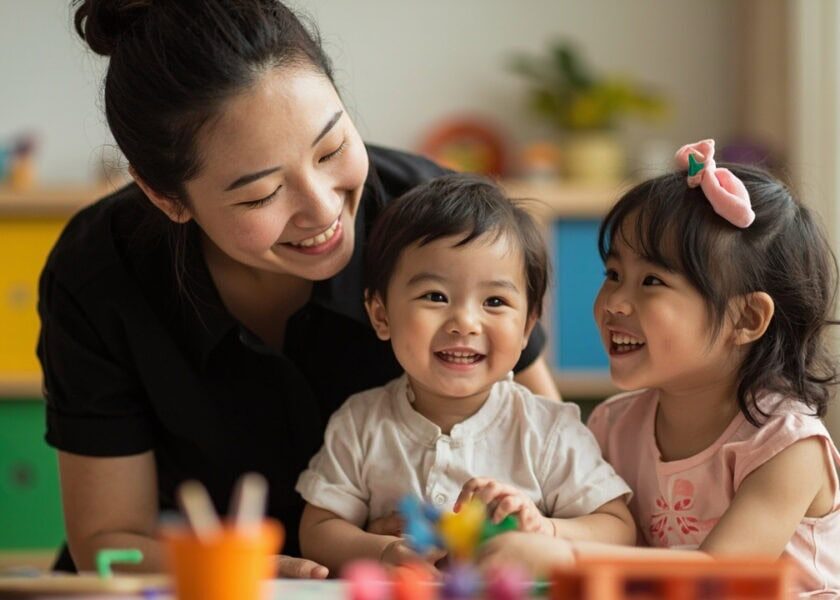
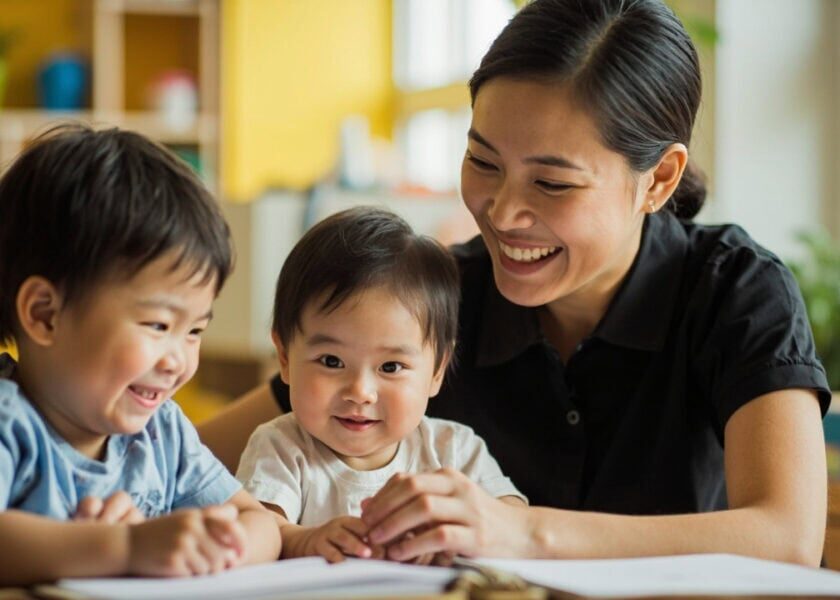
- Warm, responsive interactions—Every gentle response to frustration, every patient moment during feeding, every calm voice during a tantrum is an echo of the security you have built at home.
- Predictable routines—Children thrive on patterns. A consistent daily rhythm allows them to internalize security and anticipate what comes next.
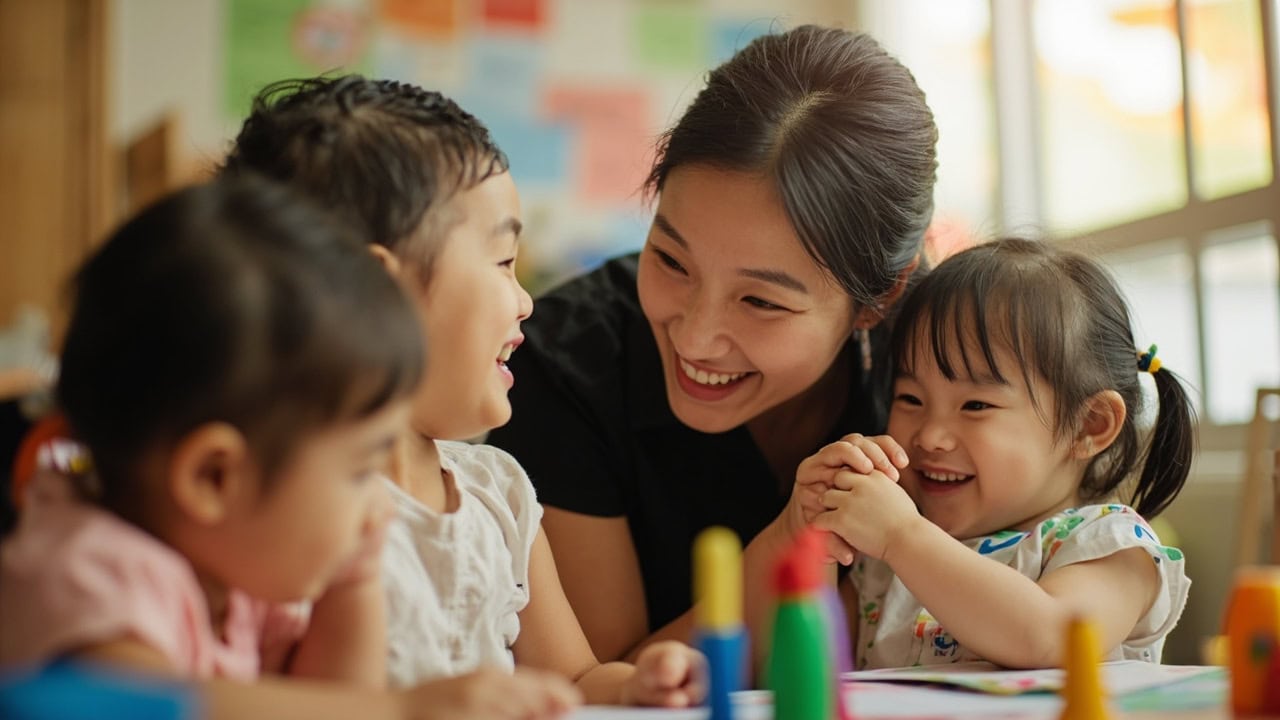
- Individualized attention—In group settings, ratios matter. When caregivers can respond to each child as an individual rather than managing a crowd, the quality of the attachment relationship improves.
- Alignment with parental values—The most effective extension of your presence happens when caregivers understand and embody the same approach to care that you use at home.
When these conditions are present, quality childcare becomes something remarkable: it becomes the space where your parental values live on. It becomes the externalisation of the love you have poured into those first months and years.
For Singapore Parents: The Weight You Carry
Singapore parents carry particular weight when it comes to these decisions. The expectations, the aspirations, the long hours, the cost of living, the pressure to provide, the genuine desire to be present. It can feel like an impossible contradiction you are asked to hold: work hard, provide well, be there fully for your child.
The truth is that no one can be everything all at once, and the parents who acknowledge that honestly—who choose thoughtfully rather than choosing from guilt or desperation—those are the parents who give their children something invaluable. They give them a model of a person who loves deeply, thinks clearly, and acts with intention.
Choosing childcare is not a departure from parenting. It is one of the most consequential decisions you will make in those early years, not because of the logistics or the cost or the convenience, but because of what it communicates to your child about the world and about themselves.
When you choose a place where caregivers are trained and attentive and warm, when you choose ratios that allow for genuine responsiveness, when you choose a model built on transparency and communication, you are telling your child through your actions: I take this seriously. You are worth the care I am choosing for you.
That message goes in. That message shapes them.
EduNanny: Built for This Purpose
EduNanny exists as an answer to the question that thoughtful parents ask themselves every morning: how do I extend my love into the hours I cannot be there? How do I make sure my child carries me with them?
EduNanny was built on a specific understanding: the childcare relationship is not a transaction. It is a continuation of the parental bond, conducted in a different setting, by different hands, but animated by the same values that parents bring home every night.
Operated under the ECDA Childminding Pilot, EduNanny offers Singapore families an alternative to traditional centre-based care. For infants especially, EduNanny maintains ratios of one caregiver to three infants—a standard that allows for the kind of individualized attention that mirrors the attentiveness of a parent. This is not incidental to the model. This is the model.
The small numbers, the consistent caregivers, the home-based pathways available alongside community and centre-based options—these are not features added to make the service appealing. They are the conditions that make genuine extension of the parent-child bond possible.
At EduNanny, every routine, every interaction, every moment of warmth is designed to be an echo of the care that parents provide at home. Not a replacement. An echo. The communication and transparency built into the model offers parents the kind of visibility that eases the natural anxiety of separation—not by surveillance but by reassurance.
Where subsidies and schemes apply—where CDA and Baby Bonus are usable—the financial dimension of this choice becomes something families can navigate without added strain. These are not small things. Practical peace of mind is real. Parents who are not worrying about logistics are parents who arrive home more present, more patient, more available for the evening hours that belong to them and their children.
Your Real Questions, Answered Honestly
Good parents ask questions. Here are the ones that matter most:
“Will my child feel abandoned?”
When care is consistent and warm, children do not experience parental absence as abandonment. They experience it as part of a pattern they trust. Your child knows you will return, not because you promised, but because the pattern has always held. This is what builds security: not continuous presence, but reliable pattern.
“Will my child love me less?”
The attachment bond you have built with your child does not weaken when trusted others care for them. In fact, research suggests that children with multiple secure attachments tend to have stronger, not weaker, bonds with their parents. The caregiver relationship extends rather than competes with your own.
“How do I know the care is good enough?”
Look for consistency, warmth, and communication. Ask about caregiver training and turnover. Observe how your child responds over time. Trust your instincts, but also trust the pattern: when your child settles into a routine, when they show signs of comfort rather than distress, when they reach confidently for the world—this is evidence that the care is working.
“Am I failing my child by working?”
You are not failing. You are making a choice that millions of loving parents make, and making it with care. The question is not whether you work but how you choose. Choosing thoughtfully, choosing well, choosing people and places that extend your values—this is parenting. This is exactly what parenting looks like when you cannot be present for every hour.
If you are researching options for infant care or childminding in Singapore, here is what matters most:
- Caregiver consistency—Ask how often caregivers change. Frequent transitions undermine the security your child is building.
- Ratios and attention—For infants, smaller ratios mean more individual responsiveness. This is not a luxury—it is a condition for quality attachment.
- Communication practices—How does the caregiver share your child’s day with you? Daily updates? Photos? Reports? Transparency is not surveillance—it is partnership.
- Alignment with your values—Visit. Observe. Ask questions. Trust your gut. Does this feel like a place that would echo your care, or contradict it?
- Practical fit for your family—Location, hours, cost, subsidies—these matter because families function better when logistics do not add to stress.
The Story Your Child Will Carry
Somewhere in Singapore right now, a parent is kneeling in a doorway, feeling the weight of that morning goodbye. They are wondering if leaving is the same as failing. They are carrying a quiet fear that their child will somehow feel abandoned.
If that is you, hear this: you are there. Your child knows you are there. Not because of proximity but because of pattern, because of the consistency you have built, because of the love you have poured into those early years, and because of the choices you will make to extend that love forward.
You are not leaving your child. You are staying with them through the hours, through the hands of people who understand what it means to hold a small life with care.
That is what quality childcare can be. It is not a service that steps in when you step out. It is a partner that steps alongside you, extending the presence you have built, holding the continuity of love that your child needs.
The parent does not leave. The parent extends. And in that extension, the bond does not weaken. It deepens. It becomes more resilient. It becomes the kind of bond that carries a child forward through every new room, every new person, every new challenge, because they have internalised something true: they are loved, and that love does not stop at the door.
EduNanny is a trusted developmental childcare and childminding service for families in Singapore. Speak with the EduNanny team to explore what thoughtful, consistent care can look like for your family—or learn more about who we are and the standards we hold ourselves to.