What Your Child Is Really Doing at Childcare in Singapore
The Moment You Hand Your Child to Someone Else
There is a moment, every morning, when you hand your child to someone else. It lasts three seconds. Your fingers release. Your eyes meet. You say goodbye.
And then you leave.
You get into your car or onto the train. You open your laptop. You sit in a meeting. You answer emails. And somewhere in the back of your mind, a question is running—quiet, persistent, sometimes loud: What is my child doing right now?
You are not alone in this. Every parent who entrusts their child to care carries this question. It is not doubt. It is love made visible. It is the price of modern parenthood, where the hours you cannot see are the hours you worry about most.
Today, we want to answer that question. Not with philosophy. Not with promises. We want to walk you through what actually happens in the hours between drop-off and pickup—every transition, every interaction, every deliberate choice—because when you see what quality looks like, you stop wondering and start trusting.
Inside a Quality Childcare Day in Singapore
Before Your Child Arrives
The caregiver arrives first. She enters the space—home-based or centre-based, the architecture of care is the same in what matters. She opens the windows. She lets in the light. She checks the room temperature, the floor surfaces, the corners where little hands will explore.
She sets out the morning’s materials: a sensory bin with water beads for the older infants, soft fabric squares for the younger ones, a mirror at floor level so the newest walkers can see their own surprised faces.
This is not decoration. This is preparation. The environment is the first teacher, and before any child arrives, it has already been designed.
Arrival: Your Child Comes Through the Door
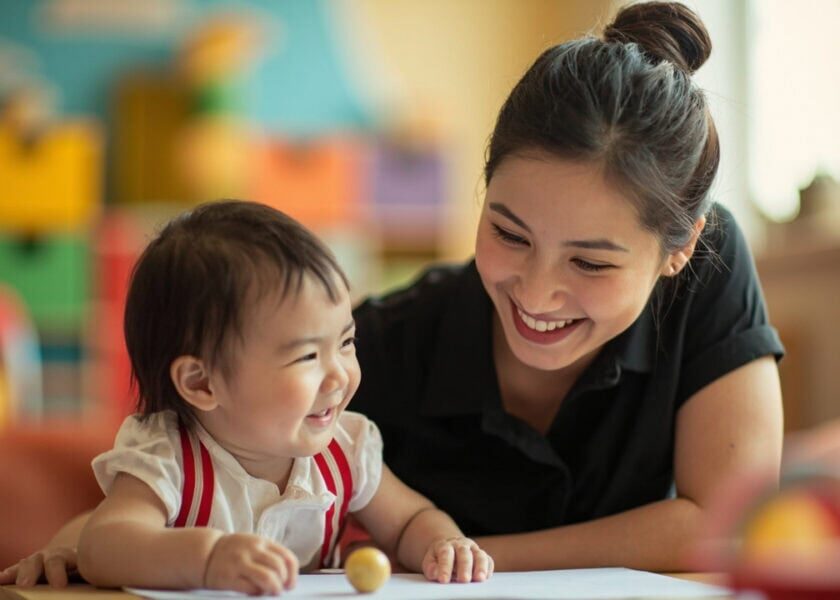
It might be 7:30 in the morning, or 8:15. The caregiver kneels—she never stands above a child at arrival—and she says good morning. By name. She notices the new shoes, the hair clip, the way your child is holding a small toy from home. She receives this information like a gift, because it is one.
Your child, still anchored by the memory of you, begins the slow process of separating. In a quality environment, this is not ignored. It is not rushed. The caregiver holds that space alongside the child, neither dismissing the emotion nor amplifying it.
“I see you’re feeling unsure. Your dinosaur is here with you. Let’s bring him to meet the others.”
This is the first hour. It is unhurried. It is attentive. And it is already doing work that will compound across the day.
The Rhythm of the Morning
Singapore’s childcare days have a shape, and that shape is not accidental. Rhythm is not rigidity—it is predictability. For a young child, knowing what comes next is a form of safety. It is the difference between chaos and security.
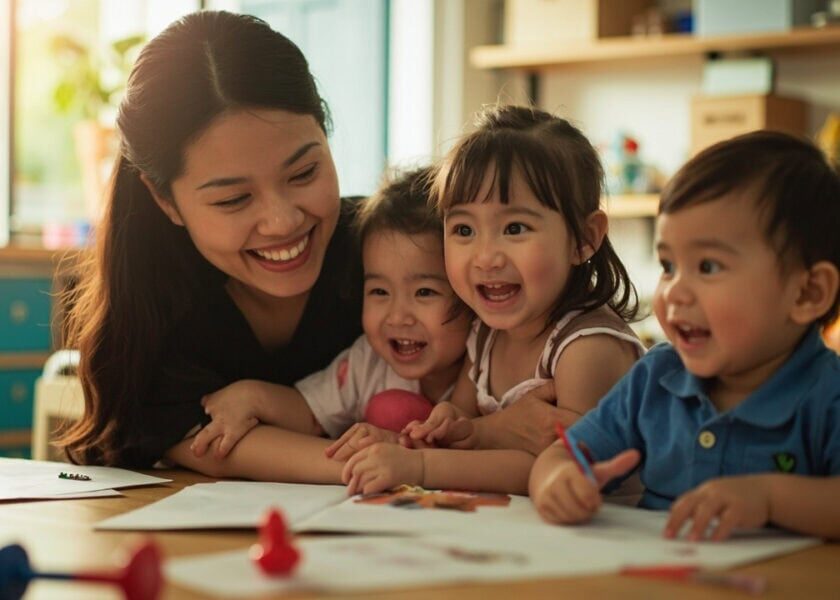
The morning unfolds with intentional structure. There is a window for free exploration, where children move through the space according to their own impulses, choosing the block corner or the book basket or the play dough table. The caregiver circulates—not directing, but present. She narrates what she sees.
“You’re stacking the blue ones tall. That took balance.”
She extends. She mirrors. She asks questions that invite thinking.
“What do you think will happen if we put this one on top?”
This is what intentional engagement looks like. It is not an activity imposed. It is an interaction co-constructed between child and caregiver, and in those small exchanges, language is built, curiosity is fed, and trust is deepened.
For infants in a one-to-three ratio environment, this looks different. Smaller hands need different materials. Smaller bodies need different rhythms. But the principle is identical: every moment is an opportunity for connection, and connection is the architecture of development.
Transitions, Meals, and Rest
Transitions are not logistical hurdles. They are developmental moments. When the caregiver rings a small bell to signal cleanup, she is not just managing time. She is teaching the child to regulate, to transition, to let go of one thing in trust that something else is coming.
“It can be hard to stop when you’re having fun. The play dough will be here after lunch.”
Food in quality childcare is not just sustenance. It is language development, social learning, and motor skill building, all served on a small plastic plate. Children sit together—side by side, not facing each other, because young children eat better without the distraction of faces—and the caregiver sits with them. She models. She names. She does not quiz. She converses.
Then comes nap time, where quality care reveals itself most honestly. The room is quieter. The lights are dimmer. Sleep is not forced. It is invited. The caregiver reads a story on a low couch, her voice unhurried, her body a warm boundary beside the children who need it. When a child resists, she does not threaten or withdraw comfort. She offers proximity. She offers the small rituals that signal safety—white noise, a sleep blanket, a song that means you are held.
Parents who worry about nap time—who wonder if their child is crying, alone, afraid—can find reassurance in this: quality care does not use sleep as a convenience. It protects it as a right.
The Afternoon: Where Learning Reveals Itself
After lunch and a second rest period, the children return to activity, and this is where you might see something remarkable if you were watching: the children who arrived uncertain are now navigating. They move toward other children with intention. They negotiate.
“My turn first, then yours.”
They experiment with materials in new ways, building on the morning’s discoveries. This is not spontaneous. It is the product of hours of consistent care, of a caregiver who has learned each child’s rhythms and preferences, who has responded reliably to their needs, who has given them the security that is the prerequisite for exploration.
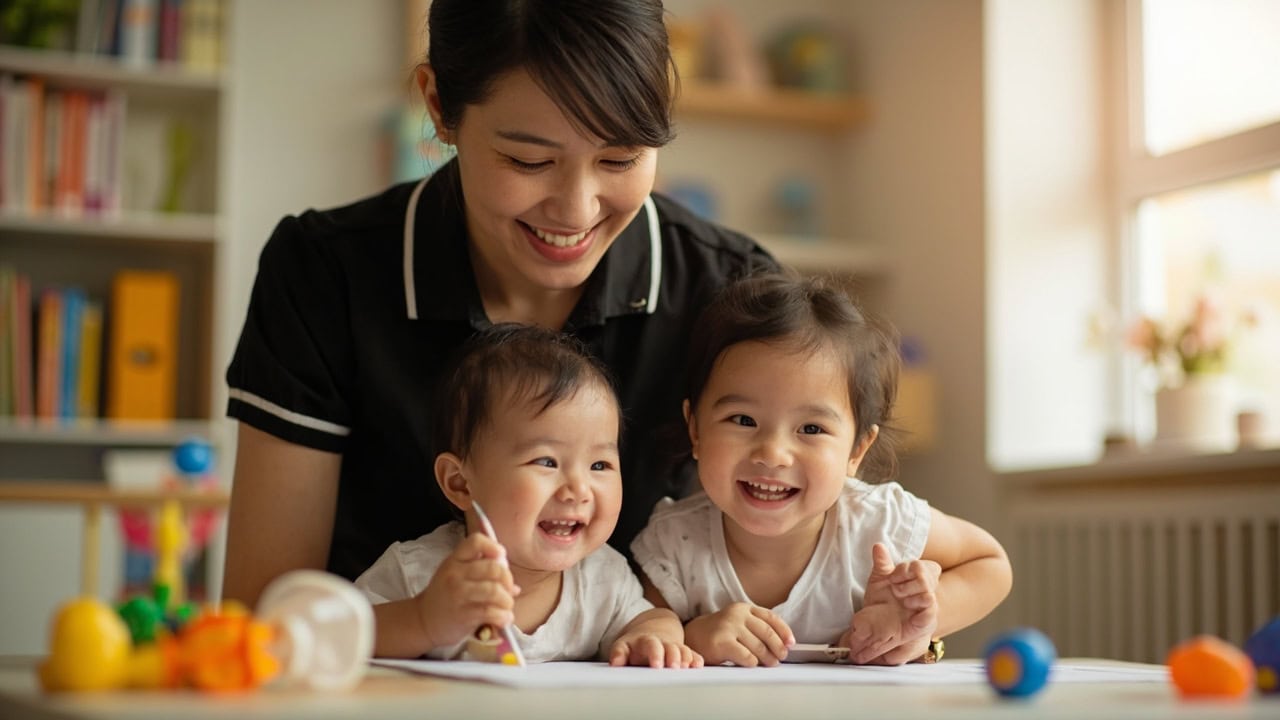
In the afternoon, there is often a more structured activity—not because children need to be taught, but because they enjoy the satisfaction of mastery. A simple sensory exercise with rice and scoops. A painting activity where the focus is the experience, not the product. A music session where children move to rhythm and learn, without being taught, that their bodies can respond to sound.
These are not fillers. They are the curriculum of early childhood, which is not reading or mathematics but the ability to concentrate, to cooperate, to persist, to create.
Pickup: The Outcome You Can See
You walk through the door. You see your child—maybe playing quietly, maybe running toward you with the whole-body joy that never gets old. The caregiver meets your eyes. She gives you a summary. The day is handed back to you in words.
“She ate well. She slept from 12:30 to 2:15. She loved the painting today—there’s a piece coming home in her bag. She had a moment of frustration around sharing the red truck, but we worked through it.”
You look around. You see the room. You see your child’s face. You see the caregiver’s face. And you notice something that was not there this morning.
Ease.
Your child is at ease. Not performing, not managed, not merely safe but settled. There is a difference between a child who has been kept occupied and a child who has been cared for, and you can see it in the way they move, the way they breathe, the way they look at the caregiver as they say goodbye—not with anxiety, but with the casual trust of someone who knows they will return.
This is what you see at pickup. This is what confirms quality. Not the certificates on the wall, though they matter. Not the curriculum documents, though they matter. But the child’s face. The child’s ease. The knowledge that the hours you could not see were hours your child was growing, not just waiting.
What Quality Childminding Looks Like in Singapore
The day we have just walked through is not special. This is not a showcase. It is a Tuesday. It is the ordinary architecture of quality care—every transition managed, every interaction intentional, every hour designed not for convenience but for development.
The caregiver who did this work was trained, yes. She holds certifications. She participates in ongoing development because quality is not a destination but a practice. She is compensated fairly, because respect for the work is respect for the children. She works within ratios that allow her to actually see—really see—each child in her care, not as a group to be managed but as individuals to be known.
How Different Age Groups Experience the Same Day
| Age Group | Key Adaptations | Caregiver Ratio |
|---|---|---|
| Infants (3–18 months) | Individualized routines, responsive feeding, sensory materials, one-to-one moments | 1:3 |
| Toddlers (18–36 months) | Group routines beginning, parallel play, language explosion support | 1:4 to 1:8 |
| Playgroup (3–6 years) | Structured activities, social negotiation, pre-literacy experiences | 1:12 to 1:15 |
The Sensory Environment: Space, Light, Sound
Quality childcare environments are deliberately designed:
- Light: Natural light is preferred; windows are opened each morning to invite the day
- Sound: Background noise is managed—neither silent nor chaotic; white noise may support nap time
- Space: Clean sightlines so caregivers can see all children; safe corners for private moments when needed
- Materials: Purposefully selected for developmental appropriateness and sensory engagement
What Parents in Singapore Are Really Asking
“How do I know if my child is really safe?”
Safety is the foundation, not the ceiling of quality care. Beyond licensing compliance, look for: caregiver attunement to individual children, warm but professional boundaries, a space designed for small bodies, and honest communication when incidents occur. The question is not just “Is my child supervised?” but “Is my child seen?”
“Will my child’s routine be respected?”
In quality care, routines are frameworks, not scripts. A good caregiver holds the rhythm of the day while remaining responsive to each child’s needs on that particular day. Your child’s nap time may shift by 15 minutes based on their morning; that flexibility is not chaos, it is attunement.
“What if something happens and I don’t know about it?”
Ask about communication protocols. Quality providers share not just milestones but challenges—moments of frustration, developmental leaps, unusual behaviour that might signal something worth watching at home. Transparency is the antidote to worry.
“Is home-based or centre-based care better?”
Both can be excellent. Both have different textures. Centre-based care offers structured environments and peer interaction. Home-based care often provides smaller ratios and a domestic warmth. The question is not which is objectively better, but which environment is quality, and which quality environment suits your child and family.
Practical Advice for Choosing Infant Care in Singapore
- Visit at different times. Morning arrival tells you one story; afternoon pickup tells you another. Ask to observe both if possible.
- Watch the caregivers, not just the space. A beautiful room means nothing if the adults inside it are disengaged. Look for narration, kneeling to children’s level, warm but professional interactions.
- Ask about ratios. In infant care, one caregiver to three infants is a standard of attunement. Ask how this plays out during transitions, mealtimes, and nap time.
- Ask about communication. What does a daily update look like? How quickly will you hear about incidents? How are milestones shared?
- Notice the children. Are they at ease? Do they move through the space with confidence? Do they look toward caregivers with trust, not fear?
- Trust your instincts. If something feels off, it might be. If something feels warm and right, that matters too.
- Ask about training and continuity. Caregivers who grow with children—through ongoing development and consistent presence—build relationships that compound over time.
The Answer to Your Question
You came here with a question.
What is my child doing right now?
Now you know. They are not being babysat. They are not filling time. They are being held in a rhythm that teaches them to trust the world. They are being spoken to in full sentences that build the architecture of language. They are being allowed to fail at stacking blocks until they succeed, learning that persistence is possible. They are being fed and rested and changed and noticed. They are being loved by someone who chose this work.
And you know something else now: you are not giving up your child when you drop them at childcare. You are joining a partnership. A community of care that works alongside you, not instead of you. The hours are not lost. They are filled—deliberately, intentionally, professionally—with the things your child needs to grow.
EduNanny exists because we believe parents deserve to leave their children somewhere that is worthy of their trust. Our approach is built on the principles we have walked through in this article: intentional care, small ratios, honest communication, and caregivers who choose this work and grow in it.
Through pathways like the ECDA Childminding Pilot, we work to extend quality care into the neighbourhoods where Singapore families live—in both childcare centres and home-based environments where children are often most comfortable. This commitment to accessible, development-oriented care reflects what we believe childcare should always be: a space where children are not just minded, but truly seen.
When you pick up your child tonight, and you see that ease on their face, you will know the answer to your question.
Your child is growing.
And so are you—through the knowledge that they are safe, they are seen, they are loved. And so is the person who cares for them, building with her own hands the foundation that will carry your child through school, through life, through every room they will one day enter with the quiet confidence that comes from having been held well.
That is what happens in the hours you cannot see.
That is what we do.
If you are looking for childcare that holds these standards—thoughtful, development-oriented, and built on genuine trust—we would welcome the chance to speak with you. Learn more about who we are and what we offer for families across Singapore.