How Singapore Parents Read Their Childcare Before Learning to Trust It
Reading the Room Before You Know You Are Reading It
There is a particular weight to the morning you bring your child to someone else’s care. You feel it before you even leave home. The diaper bag seems heavier than it did yesterday. The checklist in your mind runs faster: nappy changed, bottle packed, spare clothes accounted for, lovey tucked in.
And beneath all of that, quieter but no less present, a question you may not have named until now: How will they know my child today? How will my child know them?
This is the question every parent in Singapore carries into those first minutes at childcare. Not because they don’t want to trust, but because trust, when it concerns your infant, your toddler, your whole heart walking on small legs into someone else’s room, is not an abstraction. It is something you feel in your hands. It is something you read in a caregiver’s face before she says a single word.
Here is what we want you to understand: you are already perceiving more than you know. Those five minutes you spend at drop-off each morning are not a ritual of anxious separation but a window into something real. And what you sense in those moments, if you know how to trust it, tells you almost everything you need to know.
The Environment Speaks Before Anyone Does
You arrive. Perhaps the corridor is narrow, lined with children’s drawings, the colours still bright against walls that have been freshly painted. Perhaps the room opens up and there is warmth in it — not just temperature but feeling, the kind of atmosphere that does not announce itself but settles around you like a familiar hand.
The light matters. Whether the room smells of cleaning product or of something living — bread, maybe, or cedar blocks and clean cotton. Whether the sound that reaches you is a television’s flat murmur or children’s voices in active conversation with a caregiver. Whether the space feels organized in a way that serves children or organized in a way that serves inspection.
The smell of a room is not accidental. The sound of a room is not neutral. The way light falls on a play area tells you something about whether children are meant to move freely or sit still. You are reading the room the way you would read a person, and your instincts, when you slow down enough to trust them, are rarely wrong.
The Caregiver’s Gaze: Your First Signal
She looks up when you enter. In that first second, before she speaks, before she performs warmth or efficiency or professional courtesy, there is just her face and what it reveals.
Is she pleased to see you? Not politely pleased. Not professionally pleased. Is she genuinely pleased to see your child?
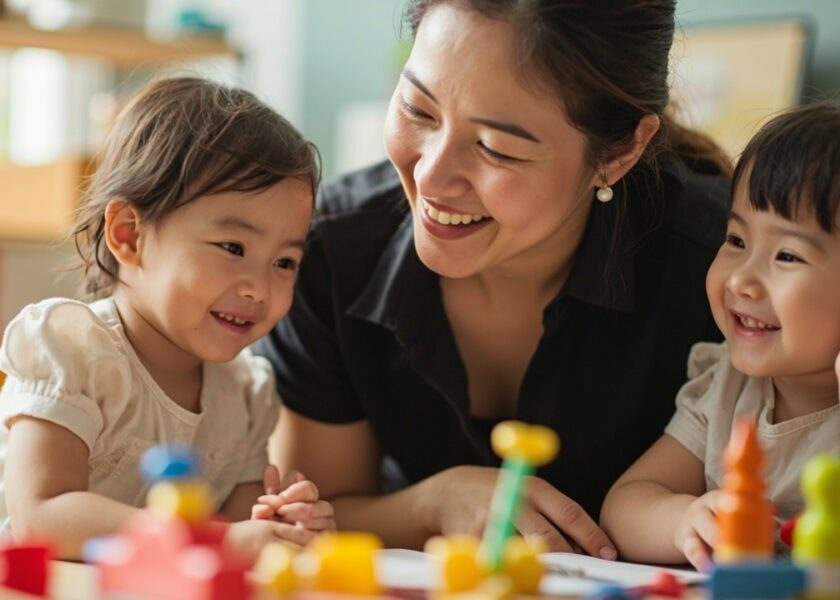
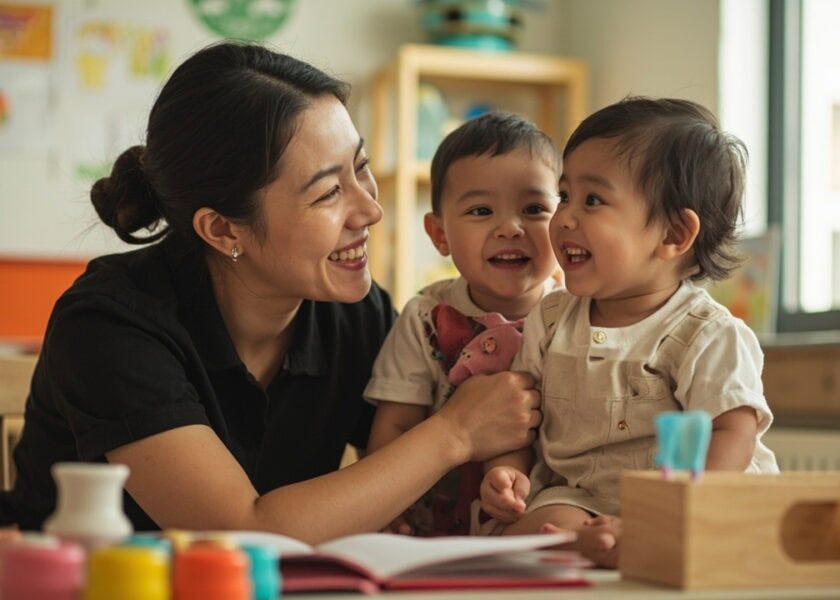
Does her attention land on your child first, before the paperwork, before the handover of information, before anything else? This matters more than most parents realize. A caregiver who is genuinely relationship-oriented will orient first toward the child. Her gaze will follow, not precede, her words. She will kneel or bend or crouch — not to be theatrical about it, but because she understands that a child at eye level is a child who can be truly seen.
Ask yourself this: in those first seconds, does she reach for the tablet in one hand while gesturing with the other? Or does she bring both hands, and both eyes, to this moment?
- Does she acknowledge my child before she acknowledges me?
- Does her body position change when my child enters — does she come down to their level?
- Does her face register genuine recognition of my child as a specific person, not just a task?
What Your Child Is Telling You in Those First Moments
And your child. What does your child do in those first seconds? This is perhaps the most important thing you will observe all morning, and it is the thing most likely to be dismissed as unreliable.
“Oh, children cry all the time.”
“Oh, she’s just tired today.”
“Oh, he always does this at drop-off.”
But listen. Not to the crying. To what the crying sounds like. There are distinct registers, and each one communicates something different.
The Three Types of Drop-Off Crying
| Type | What It Sounds Like | What It May Communicate |
|---|---|---|
| Panicky | High-pitched, escalating, without pause. The child does not seem to be processing; they are in distress. | The child may have learned to expect abandonment or inconsistency. Worth raising directly with the caregiver. |
| Performative | Loud at first, then tapering quickly the moment you turn the corner. The child seems to be making a point. | A ritual protest, not a rupture. The child has learned that drop-off is hard but temporary. |
| Ordinary Transition | Distressed but not escalating. Fading as the child settles into the room’s rhythm over several minutes. | Healthy and expected. The child is learning to trust a new environment — and doing so. |
Beyond the Crying: Reading Your Child’s Movement
What is your child’s posture when she walks in? Does she move toward something, someone? Does she pause at the door as if orienting herself, searching for a familiar face, a beloved toy, a consistent structure? Or does she move directly to a caregiver she seems to know?
That movement, or its absence, tells you something real about what the weeks and months of enrollment have built. You have been reading body language since before you became a parent. Now you are reading it about the most important person in your life, and so the reading feels high-stakes. But it is still reading. It is still observation. And you are better at it than you think.
The Handover: Where Trust Is Transferred or Not
This is where many parents feel the most uncertain. What should the handover feel like? What should be exchanged?
The practical information, yes: sleep times, feeding, any notes from home. But beyond the logistics, there is an emotional transfer that either happens or does not.
A quality caregiver receives your child the way she would receive a gift. Not casually. Not with one hand while the other reaches for the tablet. With her whole attention, even if just for those thirty seconds. She receives your child, and in doing so, she receives you. She acknowledges that this moment is significant. She does not rush it.
What a Quality Handover Should Include
- A moment of genuine eye contact and warm acknowledgment of your child
- Space for you to share any relevant information about how your child is feeling that morning
- A reciprocal question from the caregiver — not just “did she sleep well?” but “is there anything we should know today? Anything she’s working through?”
- A brief but unhurried transition where your child is guided into the room’s rhythm before you’re encouraged to leave
This question — is there anything I should know today? — asked genuinely, is a window into the culture of the programme. Because a caregiver who asks is a caregiver who understands that she is not caring for your child in isolation. She is caring for your child in relationship with you. And the quality of that relationship is inseparable from the quality of care your child receives.
The Art of Leaving: Knowing When You Are Ready
Now comes the settling. And here, perhaps, is where patience is most required from you.
You do not need to see immediate happiness. You do not need to see your child laughing and running into a caregiver’s arms. That kind of drop-off is rare and, honestly, somewhat suspicious. What you need to see is something quieter and more durable.
You need to see your child begin to settle into the rhythm of the room.
Maybe she joins an activity already in progress. Maybe a caregiver sits beside her and does not demand engagement but simply offers presence — the way a warm body beside you makes the room feel safe even before you fall asleep. Maybe the room itself is structured in a way that guides your child toward comfort without forcing it, the way a well-designed space invites rest rather than prescribing it.
And eventually — not immediately, but eventually — your child is engaged. Not perfectly. Not without some residue of the morning’s transition. But engaged. And that is when you know it is safe to leave.
Not because a caregiver waved goodbye and smiled. Not because your child did not cry. But because your child is there, in that room, and the room is holding her. You can feel it. You have been watching it. And your trust, which has been accumulating observation by observation, moment by moment, is now solid enough to carry you out the door and into your day.
Addressing the Concerns You May Still Have
How do I know if my child is truly comfortable and not just temporarily distracted?
Watch for the quality of settling, not the speed of it. A child who is genuinely comfortable will not necessarily run to a caregiver with joy — that expectation is unfair to both child and caregiver. What you want to see is unhurried engagement: your child joining an activity, accepting comfort from a caregiver, moving through the room with the ease of someone who feels held rather than supervised.
What if I sense something is off but I can’t explain it?
Your unexplained discomfort is data. You may not yet have the language to articulate what you are perceiving, but the fact that you are perceiving it means something is registering. Do not dismiss it. Ask a question. Request a longer observation. A quality programme will welcome your curiosity. If a centre is defensive when you raise questions, that defensiveness is itself information.
Is it normal to feel anxious every morning?
Yes. The anxiety is not a sign that something is wrong with you or your childcare. It is a sign that you care enormously about your child’s wellbeing. The goal is not to eliminate this feeling but to let it become a form of attention — the same attentiveness that helps you read your child’s cues at home. Over time, as your observations accumulate and the drop-off consistently goes well, the anxiety softens into something more like vigilance: purposeful, calm, and informed.
What Quality Childminding Actually Looks Like in Singapore
In a city with no shortage of childcare options, where almost every centre can present itself well in photographs and pitch documents, the honest question for any parent is: how do I tell the difference between quality and performance?
Notice Whether the Warmth Is Directed at You or at Your Child
A centre that is performing quality will invest in making parents feel impressed — polished lobbies, articulate staff, comprehensive orientation packs. These are not wrong signals, but they are not the deepest ones.
A centre that is living quality will invest in what happens after you leave. In the ratio of caregivers to children. In the sound of the room at midmorning. In whether your child is known by name, by temperament, by current fascination. The warmth in a quality centre is not for your benefit. It is for your child’s.
Notice What Happens in the Unobserved Moments
If you arrive early or linger at the window, do the caregivers’ demeanour and interactions with children change? A programme built on authentic warmth does not need an audience to be warm.
Ratios That Allow Genuine Attention
A caregiver who holds one infant differently than she holds three is not a caregiver who is performing. She is a caregiver who is genuinely present. Low ratios mean that when your infant cries, someone responds — not out of protocol, but out of attunement. The research on infant responsiveness is consistent: children who experience consistent, attuned caregiving in the first three years develop stronger emotional regulation, more secure attachment, and better language outcomes.
Consistency as a Foundation
Children, especially in the first thousand days, need predictability. The same caregivers in the same room on the same days, with rhythms that feel reliable. When your child can predict the sequence of the morning, when they know that drop-off leads to the same room with the same faces, the transition from home to childcare becomes something the body learns to trust.
Communication That Keeps You Connected
Quality programmes do not leave parents guessing. They offer regular, meaningful updates — not just “napped well, ate well” but observations that show your child was known today. A photo that captures your child’s concentration. A note that mentions a new word or a moment of generosity. These details are not extras. They are evidence that your child was held in mind while you were apart.
Five Things You Can Do Today to Read Your Childcare More Confidently
- Arrive five minutes early and simply observe. Before you hand over your child, stand at the edge of the room and listen. What do you hear? Whose voice do you hear most? What are the children doing?
- Notice the caregiver’s face before she notices you. What is her expression when she is not yet greeting a parent? Is she engaged with the children or with the administration?
- Pay attention to how your child responds to the room itself. Does she move toward a familiar space, a specific toy, a consistent routine she recognizes?
- Ask one specific question at handover. Not “how was her day?” but “did anything happen today that I should know about?” Specific questions invite specific answers.
- Notice how you feel when you leave. Not just relief — but the quality of that relief. Is it the lightness of genuine confidence, or the tension of something suppressed? Your emotional state after drop-off is one of the most honest indicators of whether the arrangement is working.
The Moment You Look Back: Partnership in the First Thousand Days
There is a moment, toward the end of the drop-off, when you look back.
You have handed over your child. You have received a brief report, a warm acknowledgment, a genuine smile. Your child has begun to settle, is reaching for a toy or following a caregiver’s voice, and the room has absorbed you both into its rhythm. And you turn toward the door.
This is the moment we want for you. Not the moment of leaving despite worry. The moment of leaving because you are ready. Because you have seen enough. Because your observation has given you data, and the data has given you confidence, and the confidence has given you the ability to walk out that door and go to work or to appointments or simply to breathe, knowing that your child is in a place that deserves your trust.
That feeling, if it recurs, day after day, is not a lucky accident. It is the product of a programme that has been designed to be trustworthy, observed, and genuinely good. And it is the feeling that compounds into something even more valuable than reassurance: partnership.
Because when you trust your childcare, truly trust it, you stop being a client and become a partner. You start sharing observations from home. You start receiving insights from caregivers that enrich your understanding of your child. You start feeling that the people caring for your child are not strangers with credentials but collaborators in the most important work of your life.
This is what EduNanny by BUTLER represents. Not just care. Not just education. Partnership. In the first thousand days. In the daily ritual of drop-off. In the long, extraordinary, terrifying, beautiful project of raising a human being.
We believe that parents deserve to witness what they are trusting. We believe in small ratios, because a caregiver who can be genuinely present to your infant is doing something that shapes the developing brain — not metaphorically, but literally. The early years are not preparation for learning. They are learning itself.
We believe in what we call the transfer of relationship. That moment at the door when your child goes from your arms to another’s — it should not feel like a rupture. It should feel like a bridge. And a bridge requires both sides to be held steady.
Our programme is part of the ECDA Childminding Pilot, which means we are committed to standards that go beyond regulatory minimums. We work with the tools you already have — CDA and Baby Bonus — so that quality care is genuinely within reach for families across Singapore.
The Door Is Always Open
You are already paying attention. You are already reading the room, the face, the body language. You are already perceiving more than you know.
Trust that. Trust yourself.
And know that when you bring your child to EduNanny, we are paying attention too. We are reading your child the way you read the room. We are noticing. We are receiving your child as a gift. And we are holding that gift with everything we have.
Come in. Look around. Watch.
And when you leave, we want you to leave lighter than you came. Because that lightness is not just your feeling. It is the evidence. It is the proof that what you sense is real.
To arrange a visit to an EduNanny by BUTLER centre, or to learn more about our infant care and childminding programme, we welcome you to reach out. We would be glad to walk through the programme with you — and to show you exactly what we mean when we say the door is always open.