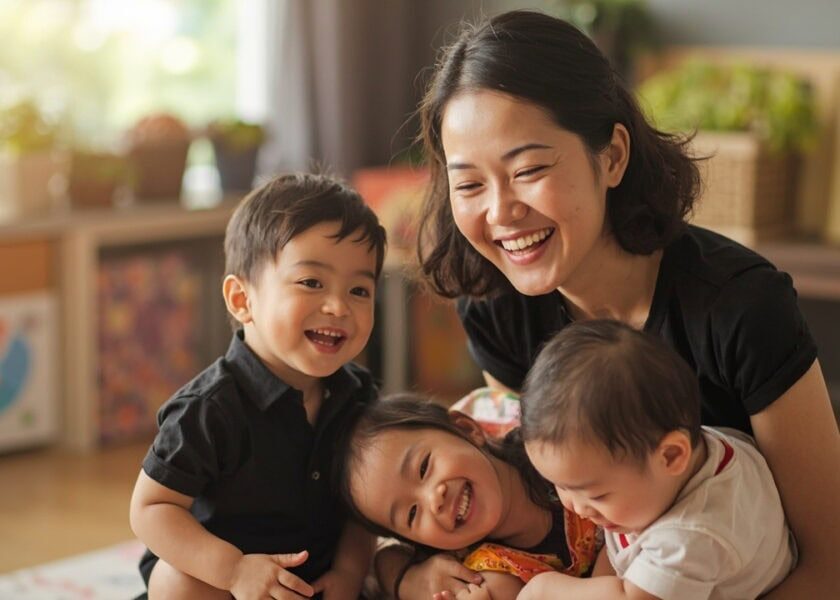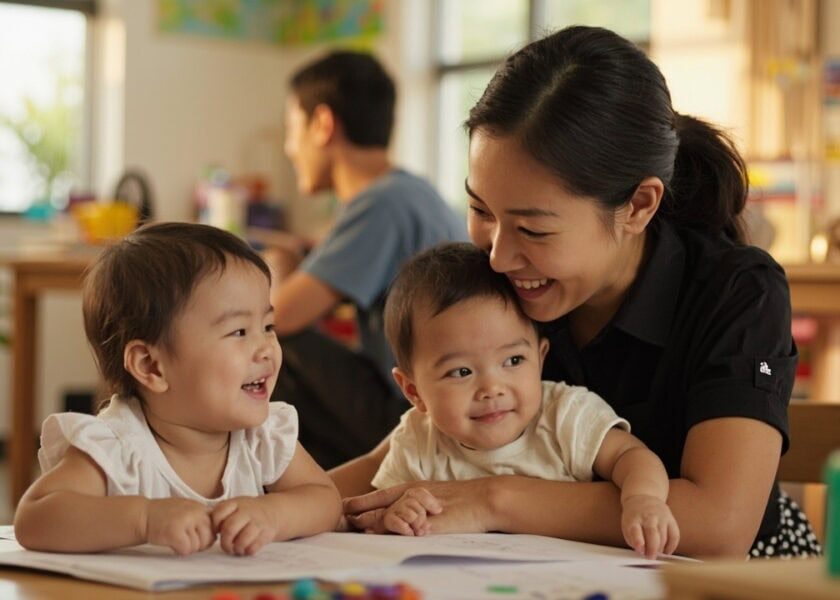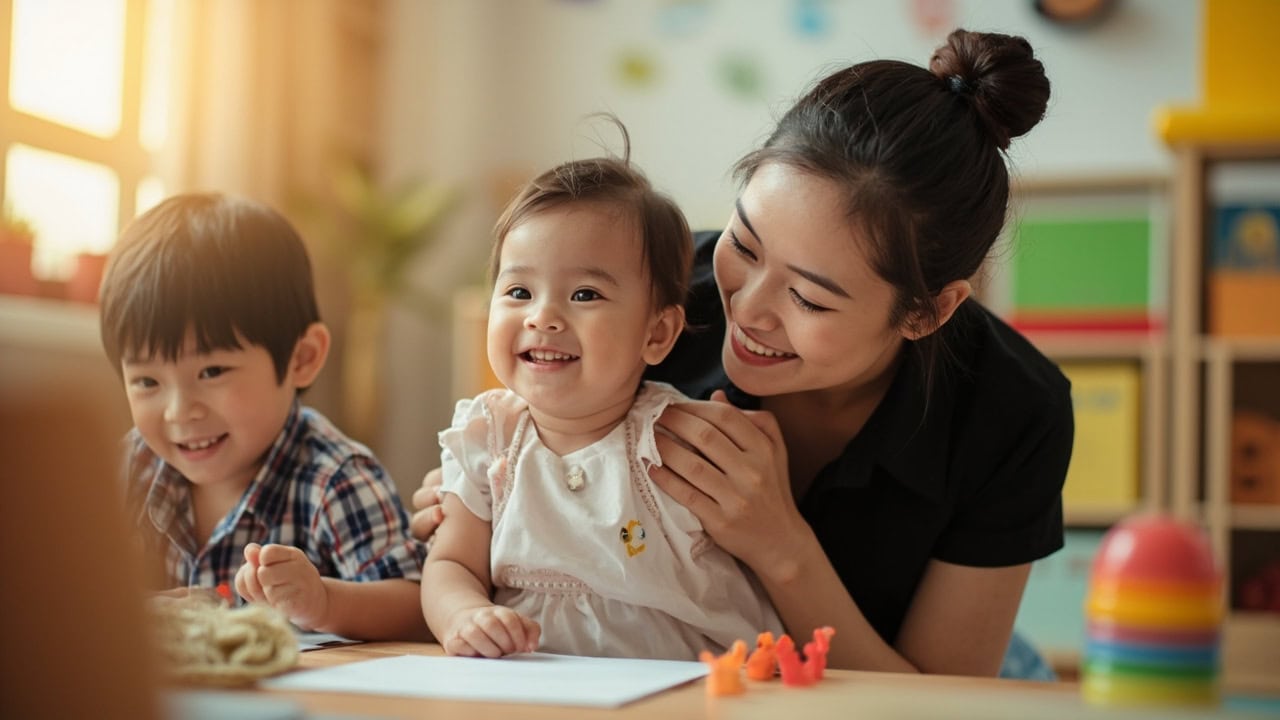
What Your Child Is Really Telling You After Childcare in Singapore
The Hours Between Drop-Off and Pick-Up: What Singapore Parents Actually Experience
There is a particular kind of quiet that settles over a Singapore morning after drop-off. You have handed your child to someone else, walked back to the car or the MRT, and now there is this strange, inhabited silence — the mental space between the school gate and the dinner table.
It is not empty time. It is the most charged time in a parent’s day.
We talk so often about what happens before drop-off — the morning negotiations, the packed lunches, the quiet dread of the parting — and we talk about what happens after, the reunion, the questions, the dinner conversation. But the hours between? That is where most Singapore parents actually live. That is where doubt finds room to breathe. It is also, if we are willing to see it differently, where something valuable is always happening — for your child and for you.
What Singapore Parents Actually Wrestle With
When EduNanny began developing its approach, we spent a great deal of time listening. Not to policies or frameworks, but to parents — real parents in Singapore navigating infant care and childminding with the same mix of love, worry, pragmatism, and pride that defines modern parenthood here.
And what we heard, again and again, was not a question about quality. Singapore parents, by and large, know quality when they see it. They have done their research. They have visited centres, spoken to caregivers, read reviews.
What they wrestled with was something else entirely.
They said: I know my child is safe. I know she is being cared for. But I don’t know what her day actually looks like. I don’t know what she is feeling. I don’t know what she is learning about the world without me there.
That gap — between knowing something intellectually and feeling it in your body — is the quiet tension that most parenting content in Singapore does not address. It is not the guilt of leaving your child, because most parents have moved past that, or at least made peace with its inevitability. It is not a crisis of trust, because they chose their childcare arrangement carefully.
It is something more subtle. It is the uncertainty of not being able to witness what matters most to you.
Here is what we have come to believe, after hundreds of these conversations: that uncertainty is not a weakness to be managed. It is an invitation — an invitation to become a more attentive, more confident observer of your child, of yourself, and of the relationship between you.
There is a particular kind of pressure that comes with doing everything right — the research, the school visits, the decision between centre-based and home-based care, the endless weighing of ratios and curricula and costs. Singapore parents are some of the most diligent consumers of childcare information in the world, and they carry that diligence into the hours between drop-off and pick-up.
And when they cannot decode every signal or manage their uncertainty with grace, they feel like they are falling short.
We want to say clearly: you are not falling short. The uncertainty you feel is not a failure of parenting. It is evidence of how much you care.
What Your Child Is Actually Telling You After Childcare
Every parent in Singapore knows this feeling. Your child comes home from childcare and something is different. Maybe it is small — a new way of holding a spoon, a song you have not taught them, a word that appeared overnight. Maybe it is harder to name — a particular tiredness, a clinginess that lingers past the usual wind-down, an unusual quietness at the dinner table.
Your child is telling you something. The question is whether you have the framework to hear it.
Children, especially in those critical early years, communicate through behaviour the way adults communicate through language — with urgency, with subtlety, and sometimes with a logic that only makes sense from inside their world. Here is what that communication often looks like:
- A child who comes home ravenous may have had a day of focused, engaged exploration that burned through every calorie. This is not a sign of neglect — it is a sign of meaningful work.
- A child who is unusually tender, who wants to be held and held again, may be processing the most significant emotional experience of their week: the discovery that they can love someone else, and be loved in return, outside of home.
- A child who is bursting with stories, jumping from topic to topic, may have been waiting all day to share the richness of what they witnessed. They are not being difficult. They are bursting.
- A child who is unusually quiet or clingy is not necessarily struggling. They may be processing a social shift — a new child in the group, a change in routine — in their own body-first way.
These are not problems. These are signals. And the parents who learn to read them — not perfectly, not exhaustively, but with growing confidence — become the most attuned partners their children could have. Not because they are monitoring every moment, but because they have learned to trust their own observation.
The Singapore Context: Why Play Is Not a Gap in Learning
There is something important about the Singapore context here, because it shapes what parents notice and how they interpret what they see. We are a culture that values achievement, that takes education seriously from the earliest possible age, and that carries expectations about what a productive day should look like. These are not bad things. They are part of what makes Singapore families so extraordinary in their dedication to their children’s futures.
But they can also create a lens that narrows what parents see. When your child comes home from childcare, the first question is often: What did you learn today? And when the answer is play, or songs, or free time with blocks, it can feel, for just a moment, like not enough. It can feel like a day unaccounted for.
Here is a different lens — not to replace your instincts but to sit alongside them:
- The child who has spent an afternoon building a tower and knocking it down, over and over, is learning about gravity, persistence, cause and effect, and the sheer pleasure of mastery.
- The child who has been singing the same verse of a nursery rhyme all morning is building the neural pathways for language in a way that no flashcard can replicate.
- The child who has been playing near other children — not with them yet, but near — watching, absorbing, gathering the courage — is doing some of the most important social work a human being can do in the first three years of life.
This is not about lowering expectations. It is about widening the frame. Singapore parents are extraordinarily attentive. That attention is a gift. But when it is directed only at measurable outcomes, it can miss the quiet, profound learning that happens in the spaces between structured activity.
From Guesswork to Informed Reading: A Real Example
What does this look like in practice? Consider the shift we have seen in families we work with — it captures the movement from anxiety to informed observation.
There is a mother in the east of Singapore whose son, just over two years old, started attending a childminding arrangement three mornings a week. In the early weeks, she described the hours between as a kind of low-grade anxiety — she would check her phone for updates, wonder if he was crying, imagine worst-case scenarios. She loved the arrangement. She trusted her childminder. But she felt, as she put it, untethered from knowing.
What changed was not the arrangement. It was her approach to the return.
Instead of waiting for her son to tell her about his day — which he could not, not in the way she was asking — she began to observe. She noticed that on Tuesdays he came home with paint on his sleeves, and those Tuesdays, he was the most relaxed and creative he had been all week. She noticed that on Thursdays he was more clingy, and after a few weeks she realised Thursday was the day a new child joined the group, and her son was processing that social shift in his own, body-first way. She noticed that he had started saying thank you without prompting, and that the word sounded like it belonged to someone else, someone kind, and she knew immediately whose voice it came from.
This is what we mean by moving from guesswork to informed reading. She was not decoding her child like a cipher. She was paying attention to the evidence her child was already offering — in his body, his moods, his language, his play — and building a picture that was rich enough to act on.
The result was not just that she felt more confident. It was that she became a better parent in those hours she had with him, because she knew what he needed, and she could give it to him.
The Partnership That Closes the Gap
This is where the partnership between your observation and the insight of your childcare team becomes essential. No one knows your child the way you do. But no one else spends the day with your child the way a committed caregiver does. And when these two streams of knowledge flow toward each other, something remarkable happens: the picture becomes complete.
When you are part of a childminding arrangement through the ECDA Childminding Pilot — whether in a home-based or community setting — there is an ongoing conversation between you and your childminder that goes beyond the daily update. It is a conversation built on mutual respect for the knowledge each of you holds:
- Your childminder sees your child in the context of a group, in a structured but flexible environment, with routines and rhythms that you may not see at home.
- You see your child in the evening, on weekends, in the unfiltered space of family life.
- When these perspectives meet honestly and regularly, neither one is complete without the other.
There are practical markers that signal quality in this partnership. Low caregiver-to-child ratios mean every child is seen, not just managed. Consistent, familiar caregivers allow your child to build attachment and trust over time. Transparent communication practices mean you know what the day looks like without micromanaging. A play-rich, unhurried environment recognises that learning happens in the spaces between activities.
In Singapore, where safety is not an abstraction but a lived priority, parents deserve to know that the door they are walking away from is one they can feel genuinely confident about.
Moving Forward With Confidence
There is a woman we know who told us that the hours between drop-off and pick-up were, for her, the loneliest hours of her week. Not because she was without support — she had a wonderful husband, close family, a network of other mothers. But because in those hours, she had to sit with her own uncertainty, and in Singapore, where we are so good at solving problems and so good at being busy, sitting with uncertainty can feel like a failure.
What she learned, gradually, is that those hours were not empty. They were full of her child’s life — of small adventures and small triumphs and small struggles that were happening without her, and that were making her child more capable, more curious, more whole.
And when her child came home, full of the day he had lived without her, she found that she was not less connected to him. She was differently connected — with greater respect for his autonomy, with sharper eyes for what he was becoming, and with a confidence that was earned rather than given.
That is what the hours between are for. Not to be endured, but to be understood. Not as separation, but as the space where your child grows toward the person they are becoming, and where you grow into the parent who can see them clearly.
The answer to that uncertainty is not more anxiety management or more detailed daily reports. It is the gradual, patient building of your own observational confidence — the knowledge that you know your child better than anyone, and that the pieces of information your child gives you after childcare, however small, are real data, worthy of your trust.
This is what EduNanny is designed to support. Not by doing the observation for you, but by creating the conditions in which you can observe with greater clarity:
- Clear communication from your childminder about the rhythm and texture of the day
- A ratio that allows for genuine attention — up to one to three infants in our pilot arrangements, which means every child is seen
- A consistent rhythm of care that you can depend on, Monday through Friday, with blocks that work for real family life
- The practical architecture that makes quality care accessible — CDA and Baby Bonus usability, pilot fee structures that remove financial barriers without removing quality
These are not just features. They are the conditions under which a parent can sit in that quiet car after drop-off and breathe, because they know their child is in a place that meets them — with patience, with skill, with genuine care.
EduNanny is proud to walk this path with Singapore families. In home-based settings and community environments, through the ECDA Childminding Pilot and beyond, we are building something that understands this tension — that knows parents need both practical reassurance and emotional permission, that knows children need both safety and space, and that knows the relationship between a family and a childminder is one of the most important, and most undervalued, partnerships in a child’s early life.
The hours between are not lost time. They are where the work happens — for your child, and for you. And if you have the eyes to see it, and the courage to trust what you see, you will find that the distance between drop-off and pick-up was never as wide as it felt.
Your child is showing you everything. All you have to do is come home and pay attention.
If you are ready to explore childminding arrangements through the ECDA Childminding Pilot — with ratios that allow for genuine attention, communication that builds confidence, and a team who understands what Singapore parents actually need — we would welcome the conversation.
Connect with EduNanny Singapore to learn more about our childminding arrangements, pilot fees, and how we support families in the hours between and beyond.