From Supervision to Partnership: The Childcare Relationship Singapore Parents Actually Need
The Difference Between Being Updated and Being Informed
We live in an age of notifications. Daily photographs arrive on our phones. Brief notes tell us what was eaten, how long was slept, whether there was a meltdown at pickup. These updates are not meaningless. They are small reassurances, and reassurance matters when you are separated from your child by walls, schedules, and the demands of work.
But here is something worth sitting with: those updates, those photographs, those perfunctory daily reports, are not the same as being genuinely informed about your child’s development.
There is a vast difference between being updated and being informed.
Being updated tells you what happened. Being informed tells you what it means.
Being updated says: “Mia had a good day.”
Being informed says: “Mia has been working on something this week. She is becoming increasingly persistent with the shape-sorter, and we have noticed she is starting to prefer the more complex shapes rather than the ones she could manage easily before. She has also been more exploratory at the sand table. I think she may be entering a phase where she wants to master things.”
That second kind of information changes how you see your child. It connects what happens in your home to what happens in their care environment. It gives you a thread to follow, a development to celebrate, a window into who they are becoming when you are not in the room.
The Two Kinds of Care
This distinction—between passive supervision and active developmental partnership—is the line that separates childcare as a service from childcare as an alliance.
Passive supervision keeps children safe. It ensures they are fed, rested, entertained, and protected from harm. This is baseline necessary. No one is suggesting it is unimportant. But passive supervision, however competent, is ultimately a transaction. You leave, and your child is supervised. You return, and the ledger is balanced.
Active developmental partnership is something different. It is the commitment to understanding your child as a whole person, tracking their growth across multiple domains, noticing the signals they send when they are frustrated or curious or on the verge of a breakthrough, and weaving that understanding into daily care. It is the difference between a mirror that reflects and a lens that focuses.
The question for every parent is not whether you can find someone who will supervise your child competently. That, frankly, is the floor. The question is whether you have found someone who will partner with you in reading your child, who will help you understand what you are seeing at home by offering what they see when you are apart.
What Quality Childminding Looks Like in Practice
Not all childcare arrangements are created equal, and it is worth being clear about what distinguishes genuine developmental partnership from competent supervision.
Small ratios. When caregivers are responsible for too many children, individual observation becomes impossible. There is simply not enough attention available for the kind of reading and tracking that makes developmental partnership possible.
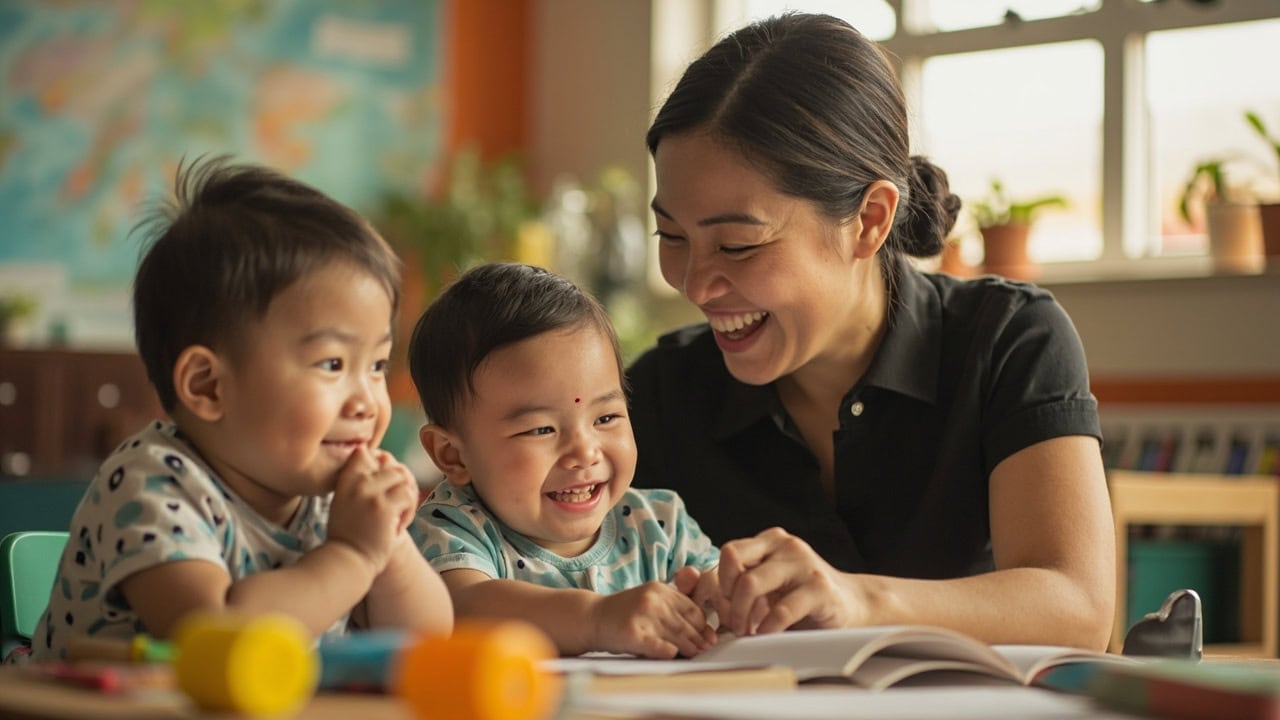
Trained caregivers. Professional development in early childhood means caregivers understand the sequences of development, know what to look for, and can articulate what they see in ways that are meaningful to parents. When a trained caregiver watches a child, they are not simply watching. They are reading—trained to notice the subtle sequences of development: how a twelve-month-old experiments with releasing objects versus grasping them, how an eighteen-month-old navigates frustration when a tower of blocks falls, how a two-year-old begins to use language to negotiate rather than merely request.
Consistent relationships. Caregiver continuity makes deep, longitudinal understanding possible. When a caregiver stays with your child over months and years, they develop a knowledge of your child’s rhythms, temperament, and particular way of being in the world that cannot be rushed or improvised.
Reciprocal communication. Updates flow both ways. The caregiver shares what they observe; the parent shares what they notice at home. Together, they build a richer picture of who the child is becoming.
Developmentally supportive environment. For infants in their first thousand days, when sensory processing and attachment patterns are being laid down at extraordinary speed, the quality of the care environment matters enormously.
Frequently Asked Questions
Will I feel disconnected from my child’s development if someone else is caring for them?
This is one of the most common fears, and it is understandable. But the evidence runs counter to the assumption. Parents in genuine developmental partnerships consistently report feeling more connected to their child, not less. The caregiver’s observations become your observations. The patterns they notice become patterns you can support at home. The communication loop makes you a more active, informed participant in your child’s growth.
How do I know if my caregiver is actually trained, or just experienced?
Experience matters, but it is not the same as training. Professional training in early childhood development means caregivers understand the sequences and milestones of development, know how to observe without projecting, and can articulate what they see in ways that are meaningful. Ask potential arrangements about their training programmes, their approach to observation, and how they communicate with parents. The quality of the answer will tell you a great deal.
Is home-based care as structured as a centre?
Structure and environment are different things. Home-based care can be highly professional and structured while offering a different kind of environment. What matters is the quality of the caregiving, the training of the caregivers, and the intentionality of the programme—not the setting alone.
What if my child has a difficult transition?
Difficult transitions are common, and they are not a sign that the arrangement is wrong. A skilled caregiver understands separation anxiety, understands the adjustment process, and can work with parents to make transitions as smooth as possible. The key is communication: parents who can talk openly with their caregiver about transitions, and caregivers who can offer insights about what is working and what is not.
The EduNanny Approach: Where Philosophy Meets Practice
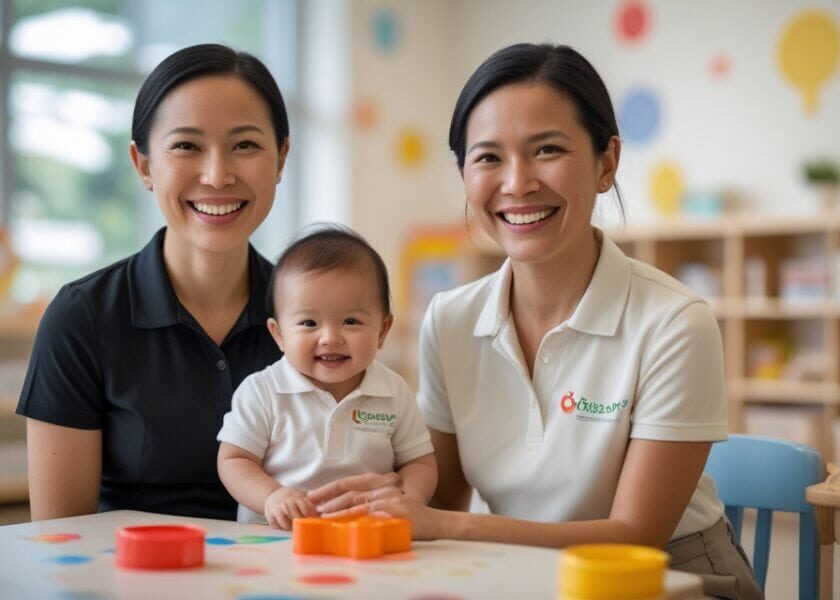
Understanding what good care looks like is one thing. Finding it is another. And this is where EduNanny Singapore enters the picture—not as a theoretical ideal but as a working model designed with these very questions in mind.
EduNanny operates within the ECDA Childminding Pilot, which is part of Singapore’s carefully structured approach to home-based and community-based childcare. The pilot structure enables something crucial: a ratio of up to one caregiver to three infants, which means that caregivers are not stretched across so many children that genuine observation becomes impossible. This small ratio is not a technicality. It is the precondition for everything described above.
The pilot also makes this care affordable and accessible for families who need it. Monday to Friday care blocks are structured within fee frameworks that do not require parents to choose between quality and sustainability. Where applicable, parents can access CDA funds and Baby Bonus payments, which means the financial architecture of childcare is designed to support families rather than create additional stress.
There is also something significant to be said for the environment itself. Home-based care, when delivered with professionalism and structure, offers a different quality of experience for infants. It is smaller, often quieter, more like an extended family than an institution. For children in their first thousand days, this kind of environment offers fewer transitions, fewer crowds, less overwhelm. It offers the kind of care that feels more like being held.
And when that home-based care is staffed by trained caregivers who understand child development, who practice professional observation, who communicate with parents as partners rather than service recipients, it becomes something remarkable. It becomes the kind of arrangement that parents look back on years later and say, “That was such an important relationship for our family. Our child really grew through it.”
How Meaningful Communication Transforms Parenting
Parents in Singapore have often been underserved in one area above all: meaningful communication about their child’s development.
What we are describing is not the daily photograph or the perfunctory log. What we are describing is regular, substantive exchanges about what your child is experiencing, what they are working on developmentally, what patterns are emerging, what you might try at home to support what the caregiver is seeing in care. This is the kind of communication that actually informs parenting, rather than merely reassuring it.
One practical element that extends this communication loop is Thomas, an AI-powered support tool designed to help parents between interactions with their caregiver. Thomas answers questions, offers guidance, and helps parents process what they are observing at home and connect it to what they are hearing from care. In this sense, Thomas keeps the partnership continuous rather than episodic, handling logistical and informational questions so that human interactions can be deeper and more focused on what actually matters: your child.
EduNanny also maintains communication and transparency measures, including CCTV where deployed, which offers an additional layer of trust for parents who need it.
When the parent-caregiver exchange happens consistently over months, something builds. The parent begins to have a more complete picture of their child. The caregiver’s insights begin to complement the parent’s own observations. The two developmental lenses start to align, and the picture that emerges is more coherent, more nuanced, more trustworthy than anything either could construct alone.
Think of the caregiver as writing a parallel chapter in your child’s story. Not a competing narrative. Not a version that supersedes yours. A parallel chapter, one that you can read and learn from and integrate into your own understanding. And when you meet your child’s caregiver for a check-in, you are not receiving a report. You are receiving an offering—a professional’s perspective on a person you love more than anything in the world.
The best childcare relationships do not diminish the parent’s role. They expand it.
The Questions That Reveal the Difference
If you are in the process of researching options in Singapore, here are questions that will help you distinguish between passive supervision and active developmental partnership:
- What is the caregiver-to-child ratio, and why does that ratio matter for observation?
- What training do caregivers have in child development, not just childcare?
- How does the arrangement communicate with parents about development, not just logistics?
- How long does a caregiver typically stay with the same children?
- What does a typical day look like in terms of observation and intentional care?
- How are developmental milestones tracked and shared with parents?
- What happens when a caregiver notices something significant about a child’s development?
- How does the arrangement support the parent as well as the child?
The answers to these questions will tell you whether you are looking at a service or an alliance.
Making the Choice That Shapes These Early Years
When you are researching childcare, it is easy to default to logistics: location, cost, hours, facilities. These things matter. But they are the frame around the picture, not the picture itself.
The picture is this: you are choosing someone who will spend significant hours with your child during the most formative period of their life. You are choosing a relationship that will shape how your child experiences being understood, being responded to, being seen. You are choosing a partner in your own parenting journey, someone who will offer you windows into who your child is becoming.
That is not a small decision. It is one of the most significant decisions you will make in these early years.
The question is not whether you can find someone to watch your child. You can. There are many options. The question is whether you can find someone who will truly see your child, who will grow with them and with you, who will be the second ally in their story.
When you are in the right arrangement, you will know it. You will not have to guess whether your child is understood. You will hear it in the updates that are actually informative. You will see it in the way your child’s caregiver speaks about them, with specificity and warmth and professional knowledge. You will feel it in your own growing confidence as a parent.
That is what the right childcare relationship gives you. Not a service. An alliance. A second set of eyes, yes, but also a second set of insights, a second perspective, a second ally in the most important work you will ever do: raising a human being.
Your child has a story, and you are the primary author of it. But you do not have to write it alone. There is space, in that story, for the trained caregiver who has watched your child grow, who has noticed what you have noticed and seen what you could not yet see. There is space for the professional perspective that enriches your own. There is space for a partnership that makes you a better parent, that makes your child more understood, that makes the early years something you can look back on with gratitude rather than anxiety.
If you are ready to explore what that kind of partnership looks like in practice, EduNanny Singapore welcomes the conversation. Not every arrangement is the right fit for every family, and we believe parents deserve honest information and genuine clarity as they make this decision.
Your child’s story is being written. The question is who you want helping you read it.
Key Takeaways
| Being Updated | Being Informed |
|---|---|
| Tells you what happened | Tells you what it means |
| “Mia had a good day.” | Patterns, milestones, and developmental observations |
| Reassurance at the door | Insight you can act on at home |
- The caregiver is a second lens, not just a second set of eyes
- The best childcare makes parents more confident, not dependent
- Small ratios, trained caregivers, and continuity are the preconditions for genuine developmental partnership
- Communication is not surveillance—it is companionship in observation
- The right childcare choice is an alliance, not a service transaction
At EduNanny Singapore, we believe that every family deserves a childcare relationship built on trust, professional care, and genuine developmental partnership. Learn more about our approach or reach out to start a conversation about what works for your family.