What Your Child Learns From Another Trusted Adult
The Honest Tension Singapore Parents Carry
There is a moment—and perhaps you have noticed it—when you pick up your child at the end of the day and they do not immediately reach for you. They are content. They are calm. They are in the middle of something: a wave goodbye, a final word to the person who has been with them through the morning. And in that small, ordinary instant, you feel something unexpected.
It is not quite relief, though relief is there. It is something more complicated. A flicker of being displaced. A quiet question: Do they need me the way I need them?
If you have felt this, I want you to know that you are not wrong to feel it. And you are not alone in feeling it.
We live in a city that moves quickly, where grandparents may live across the causeway, where both parents often work, where the village that once surrounded a new family exists mostly in memory. Singapore parents are navigating something that previous generations did not face in quite the same way: the practical necessity of professional care, coexisting with a profound cultural and emotional belief that the parent-child bond is singular—sacred, even—and must be protected from dilution.
I want to sit with that belief for a moment, because it is not wrong. The parent-child bond is singular. It is sacred. It shapes a child’s earliest sense of security, their first understanding of what love looks like, the foundation upon which every other relationship will rest. No one who loves their child doubts this.
But here is what we have come to misunderstand, and what the evidence and the experience of generations of caregiving actually tell us: the human child does not form one meaningful relationship. The human child forms many. And the quality of those many relationships—not the quantity, not the hierarchy, but the quality of each one—is what builds the full architecture of their emotional and social world.
How Children Build Trust: The Secondary Secure Base
Consider what developmental psychologists sometimes call a secondary secure base. The primary secure base—the parent’s arms, the parent’s voice, the parent’s scent—remains central. It remains home. But the secondary secure base allows the child to venture out from that center, to learn and grow and be held in another person’s attention, and to return to the primary base not changed by replacement but enriched by experience.
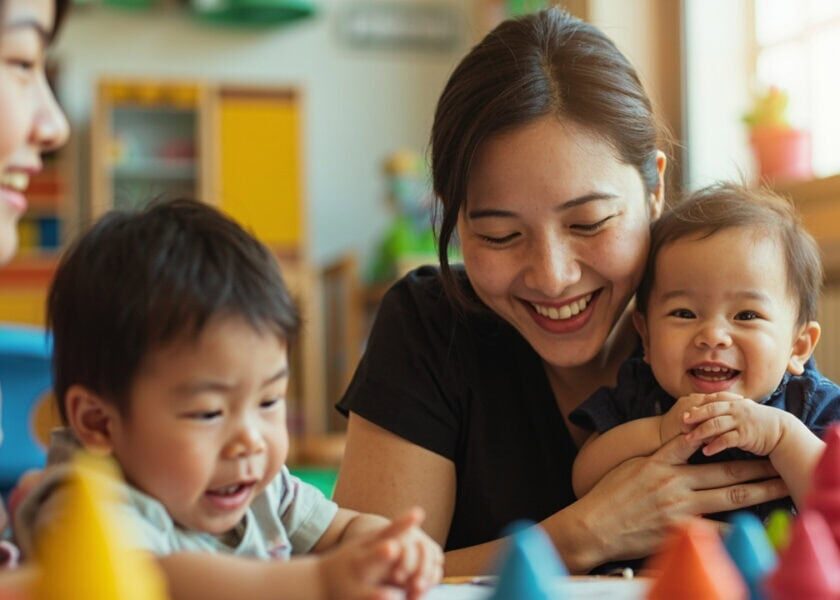
When your child shows comfort with their caregiver, when they reach for that person, when they smile upon seeing them in the morning, they are not replacing you. They are expanding. They are building something that you, alone, cannot build for them.
Consider what happens in those hours when your child is with a professional caregiver. They are learning that the world contains other people who can be trusted. They are learning that warmth is not only found at home. They are learning that they can explore, be curious, test their voice and their will, and still be met with patience and care—even from someone who is not their mother or father.
This is not a small thing. This is the beginning of social competence. This is the beginning of the ability to navigate a world beyond the family.
The Difference Between Expansion and Replacement
Am I enough?
The answer is yes. And the answer is also that your child is designed for more than one person’s love.
There is a version of parenting that believes its job is to be everything to the child—every comfort, every teacher, every source of security and joy and learning. Parents who believe this carry an extraordinary burden, because it is an impossible standard. No one can be everything.
The child who is raised to believe that all of their needs must be met by one person, that other people are either competitors for that one person’s attention or strangers who cannot be trusted, is not being protected. They are being limited.
This is not emotional outsourcing. This is emotional expansion. And it is one of the greatest gifts you can give your child: the experience of being loved well, in different ways, by different people who have your child’s flourishing at heart.
What Healthy Caregiver-Child Bonding Looks Like
So what does a healthy caregiver-child bond look like? What should you be noticing, not as a checklist, but as a sign that something good is happening?
- Familiar comfort: Your child has developed a particular ease with their caregiver—not the same as the comfort they have with you, but real comfort nonetheless. A familiarity in how they move around each other. An ease in communication, even before words are fully formed.
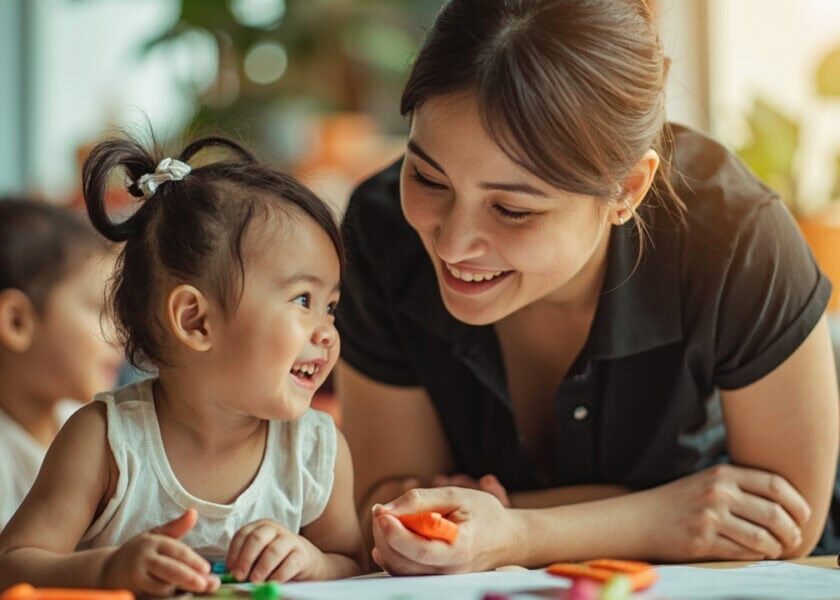
- Learning through attuned care: Your child seems to have learned something in care that they could only have learned through the experience of being with another attuned adult—how to wait, how to share attention, how to be soothed by a voice that is not yours but that carries warmth in the same frequencies.
- Professional attunement: The caregiver knows your child. Not just their schedule and their preferences, but something of their temperament, their rhythms, what makes them light up and what makes them withdraw. This knowledge—the professional attunement that comes from dedicated attention—is not incidental. It is the substance of the bond.
- Happy reunions: When you arrive, your child is happy to see you. Not conflicted, not upset that the day is ending with the caregiver, not torn. Simply glad. Because the primary bond remains strong. Because you are home.
Why Consistency Matters More Than You Might Think
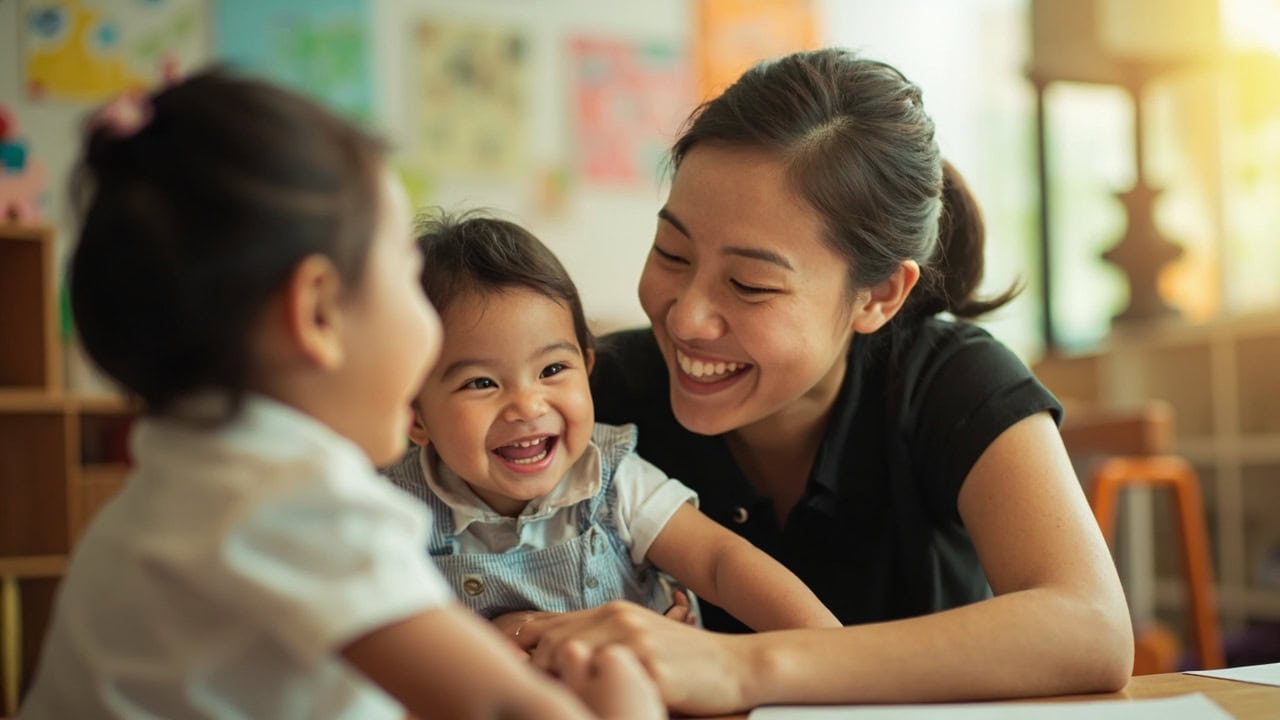
A child who sees the same caregiver day after day, who builds familiarity through repetition, who learns that this person will be there in the morning and the next morning and the morning after—that child is learning something profound about reliability. About trust as something that can be extended beyond the family. About the world as a place where consistent care is possible.
The caregiver-child bond, when it is a healthy one, functions as a meaningful developmental relationship in its own right—one that serves your child’s capacity for connection, resilience, and emotional intelligence in ways that complement what you are already giving them.
Evaluating Quality Infant Care in Singapore
When evaluating care options, it helps to understand what distinguishes developmental care from mere supervision. The setting matters less than you might think—home-based care and centre-based pathways each offer distinct advantages—but the quality of the relationship within any setting matters enormously.
Supervision vs. Developmental Care
| Aspect | Supervision Mindset | Developmental Care Mindset |
|---|---|---|
| Caregiver role | Keeping child safe and fed | Building a meaningful, attuned relationship |
| Child’s experience | Time spent waiting for parents | Growth in trust, exploration, and social confidence |
| Caregiver knowledge | Schedule and basic preferences | Child’s temperament, rhythms, and developmental stage |
| Parent relationship | Transactional handoff | Partners in the child’s development |
Questions to Ask When Visiting an Infant Care Provider
- How long has my child been—or will they be—with the same caregiver?
- What is the caregiver-to-infant ratio in this setting?
- How do caregivers communicate with parents about the child’s day?
- What does a typical day look like for an infant here?
- How do you handle transitions and separation anxiety?
How EduNanny Singapore Approaches Caregiver-Child Bonds
At EduNanny by BUTLER, this understanding shapes everything we do. We are part of the ECDA Childminding Pilot, which means we are committed to a model of care that takes the developmental purpose of professional caregiving seriously—not as a service that fills time, but as a relationship that builds capacity.
- Our caregivers are not randomly assigned. They are matched with families in a way that honors the importance of consistency.
- Our care is available across Monday to Friday, in both home-based and centre-based pathways, with ratios that allow for genuine attunement rather than just oversight.
- A ratio of up to three infants to one caregiver is not a logistical detail. It is a structural commitment to the kind of attunement that builds bonds.
- We know that affordability matters, which is why our pilot fee structures are designed to be accessible, and why CDA and Baby Bonus funds can be used to support families in this choice.
- Communication with parents is built into our model, and wherever CCTV measures are deployed, families have access and clarity.
But beyond the structures, beyond the policies and the ratios and the pilot frameworks, there is something simpler at the center of what we believe: that your child deserves to be known. That their caregiver deserves to be recognized as more than a supervisor. That the bond your child builds in care is not a threat to your bond—it is a complement to it.
The Peace That Comes from Understanding
When this is understood, when it is named and honored, parents find something they often did not expect to find.
Peace.
Not the peace of having solved every worry, but the deeper peace of knowing that your child is building something essential, something that will serve them throughout their life, and that you are not diminished by it. You are part of it. You are the reason it works.
The first thousand days of your child’s life are remarkable, and they do not belong only to you. They belong to the person who holds your child with patience when you are not there to hold them. They belong to the person who watches them discover their hands, who names the world with them in those early uncertain words, who is present and warm and professionally devoted to their flourishing.
This is not a lesser relationship. It is a different one. And different is not less.
What you are building with your child—the primary bond, the family bond, the one that calls you mother and father—is irreplaceable. Nothing can take its place. But it is not a finite resource that gets used up when someone else loves your child. It is a foundation. And foundations are meant for buildings, not for walls.
Let your child be built upon it. Let them go out into the world of warm, attentive care and come back to you richer for it. And know that the person who holds them in those hours is not a replacement. They are a companion in the work of raising your child—a companion whose presence does not diminish your role. It clarifies it.
You are the home they return to. You are the center from which they can venture and to which they will always come back, more capable, more connected, more fully themselves than before.
That is what healthy caregiving does. That is what the caregiver-child bond is for.
And that is what EduNanny Singapore is here to honor.
If you are exploring infant care or childminding in Singapore and would like to learn more about how EduNanny’s ECDA Childminding Pilot supports healthy caregiver-child bonds, you are warmly invited to start a conversation with us.
Learn more about our approach to developmental childminding or read about who we are.