Beyond the Lunch Box: Singapore Childcare Food Safety and Mealtime Culture
The Hidden Complexity of Food Safety in Singapore Childcare
In Singapore, approximately one in ten children will experience a food allergy before they reach school age. Some will outgrow it. Some will not. Some will carry EpiPens in small bags too big for their arms. This is woven into the daily calculations of families across the island, from HDB flats in Jurong to condominiums in the city.
And yet, when parents tour childcare centres, they rarely know what questions to ask about food safety. They ask about curriculum. They ask about teacher qualifications. They ask about operating hours. But when it comes to how their child’s lunch is prepared, how allergens are documented, and what happens in the minutes between exposure and emergency response, silence falls.
This silence is understandable. Food allergy management sounds clinical. It conjures images of hospital wards and legal waivers, not the warm, nurturing environment every parent wants for their child. But this is precisely why the conversation matters. Because the absence of that conversation does not make the risk disappear. It only makes trust more fragile.
What Genuine Allergen Management Actually Involves
Consider what is involved in feeding a child with allergies in a childcare setting. It begins with identification. A quality childcare provider does not simply ask parents to list their child’s allergens on an enrollment form. It establishes a rigorous documentation system, one that is cross-referenced at every meal, reviewed regularly, and updated the moment anything changes.
This documentation lives not just in a folder that staff consult occasionally. It lives in the daily operational rhythm of the centre. It informs menu planning. It dictates kitchen procedures. It shapes staff briefings.
Which brings us to the people doing the feeding. In any childcare environment, the relationship between caregiver and child is intimate. But mealtimes are a particular kind of intimacy. The caregiver sits at the table, passes the bowl, watches the child take a bite, and responds to what unfolds.
For a child with allergies, that caregiver is also the first line of defence. They must know the signs of an allergic reaction. They must know how to administer an EpiPen. They must know what to do in the minutes before medical help arrives. This is not optional knowledge. It is non-negotiable. In a high-quality programme, it is reinforced regularly, not just during onboarding but as an ongoing part of professional development.
When you visit your child’s current or prospective childcare, it is worth asking whether anyone has described their anaphylaxis protocols. Whether they have walked you through a scenario in which a child reacted to food and explained their response. If they have, that centre is operating at a level of transparency that deserves recognition. If they have not, that silence is worth examining.
From Menu Planning to Positive Food Relationships
Food safety in quality childcare extends beyond the dramatic and the emergency. It lives in the ordinary. It lives in the menu.
A thoughtfully designed menu is not simply a list of foods that children will eat. It is a carefully constructed plan that balances nutritional completeness with safety, that accounts for common allergens across all meals and snacks, and that is flexible enough to accommodate individual needs without singling a child out.
In centres that take food seriously, menu planning is a professional discipline. It involves understanding portion sizes for different age groups. It involves sourcing ingredients from suppliers with clear allergen labelling. It involves knowing which foods carry hidden risks, cross-contamination possibilities, and preparation complexities.
But safety alone is an incomplete vision of what quality childcare can offer at the table. There is something deeper happening during mealtimes, something that shapes a child’s relationship with food for years to come.
In those early years, a child’s relationship with eating is being formed. Is food a source of joy or anxiety? Is the table a place of exploration or restriction? Does a child learn to trust their own hunger cues?
Children who experience mealtimes as stressful or chaotic often carry those associations into later childhood and adulthood. Children who experience mealtimes as safe, engaging, and responsive tend to develop healthier relationships with food that last.
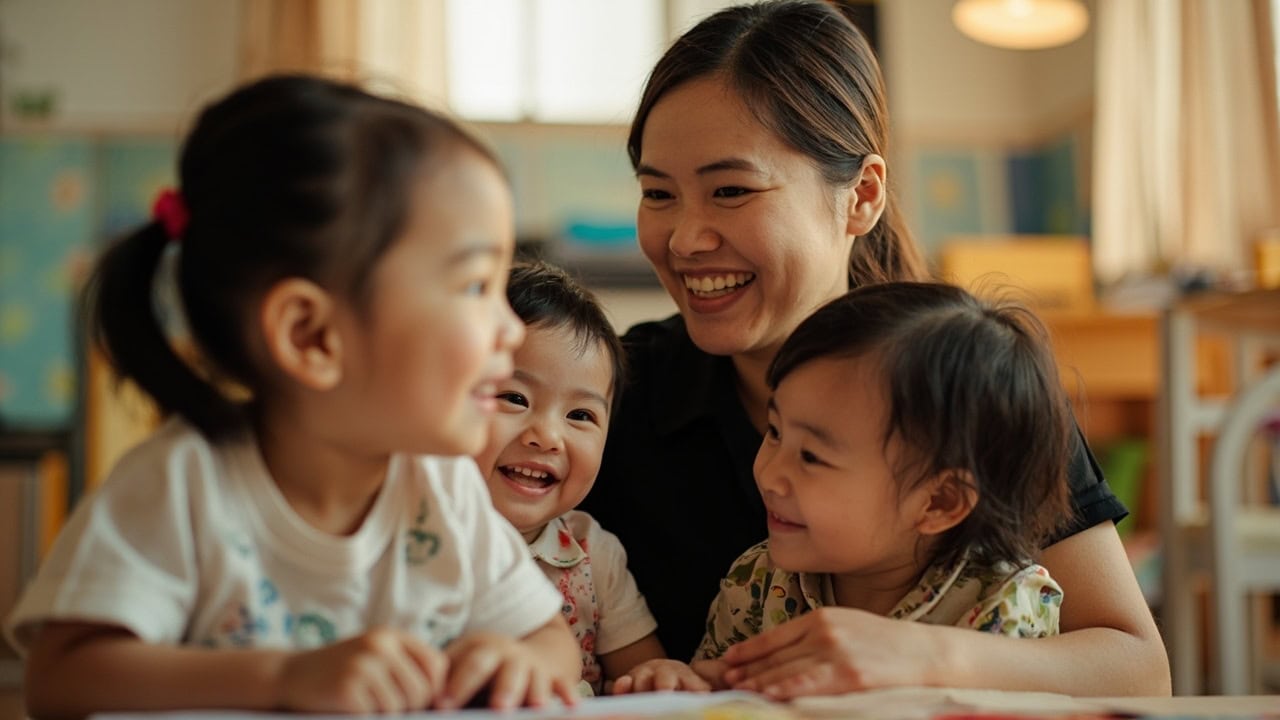
A childcare centre that truly understands its role does not simply prevent allergic reactions. It actively builds positive food relationships. It creates an environment where children are encouraged to try new foods without pressure. Where a child’s natural appetite rhythms are respected. Where a caregiver might say, “You do not have to eat it, but you can smell it if you like,” and mean it. Where children learn to feed themselves with age-appropriate independence, where the mess is expected and the learning is valued.
This is what distinguishes a childcare that merely accommodates allergies from one that thrives on inclusive food culture. Accommodating allergies means keeping your child safe. Thriving on inclusive food culture means welcoming your child into a community where their needs are not an exception but a natural part of a richer whole.
What to Look For: Adequate vs. Excellent Food Care
Before evaluating any centre, it helps to know what excellent food care actually entails. Here is a breakdown of the key components:
| Dimension | Adequate | Excellent |
|---|---|---|
| Documentation | Parent fills in an allergen form at enrollment | Allergen records are cross-referenced daily, updated in real time, and accessible to all relevant staff |
| Training | One-off onboarding session on allergies | Ongoing refresher training including simulated emergency scenarios |
| Menu Planning | Standard menu with occasional substitutions | Professionally designed menu balancing nutrition, safety, and developmental goals |
| Mealtime Culture | Children fed efficiently and on schedule | Children supported in developing feeding independence and positive food associations |
| Communication | Daily report of meals eaten | Transparent updates on food intake, reactions, and overall wellbeing, with space for two-way dialogue |
Questions Worth Asking Any Provider
- Allergen documentation: Who has access to my child’s allergen records, and how are updates managed in real time?
- Staff training: How often do caregivers practice emergency response for anaphylaxis? What about mild reactions or accidental exposures?
- Kitchen standards: Is food prepared on-site or sourced externally, and what are the supplier standards for allergen labelling?
- Communication: How do you inform me about what my child ate, how much, and how they responded to food?
- Mealtime philosophy: How do you handle children who are reluctant to eat, or who need more time at the table?
These are not confrontational questions. They are responsible ones. And a quality provider will welcome them.
The Weight You Carry—and Why It Matters
The guilt of entrusting your child’s nutrition to someone else is real. It is not irrational or exaggerated. It is the natural response to loving someone completely and knowing you cannot be everywhere at once.
The parent who feels that tension is not a parent who is failing. They are a parent who is paying attention. And they deserve a childcare partner who respects that attention, who does not dismiss it, and who earns trust through transparency rather than reassurance alone.
How EduNanny Approaches Food and Nutrition
EduNanny by BUTLER is part of the ECDA Childminding Pilot, a government-supported initiative representing Singapore’s commitment to expanding quality care options for families. Our programme offers both home-based and centre-based pathways, each designed to meet families where they are, in environments that feel safe, personal, and purposeful.
Our infant ratios are designed to ensure that no child is just a number. In our care settings, the ratio of caregivers to infants is never higher than one to three. This means your child is not just supervised. They are known. Their preferences, their rhythms, their faces, their fears. These things are held by the people who care for them.
Our food protocols reflect the seriousness with which we approach this responsibility. Allergen documentation is integrated into every step of our operational process. Staff are trained not only in food safety standards but in the art of responsive feeding, understanding mealtimes as developmental opportunities rather than tasks to be completed. We communicate with families regularly and clearly, because trust is built through information, not silence.
Where deployed, our communication tools provide transparency into your child’s day, so you know not just that they were fed but what they ate, how they responded, and how they were feeling. These measures are not surveillance. They are partnership.
For those navigating financial considerations, we work within pilot fee structures designed to make quality care accessible. CDA and Baby Bonus funds are usable within our programme, because excellent infant care should not be a privilege reserved for those with substantial means.
A Philosophy, Not Just a Service
What we offer is not a service that begins and ends with supervision. It is a philosophy of care in which food is not an afterthought. It is a daily practice of trust-building, where every meal is an opportunity to nourish not just a body but a sense of security, belonging, and well-being.
We know that choosing childcare is one of the most consequential decisions a family makes. It is a decision that should feel informed, confident, and aligned with your values. Not every childcare centre will be the right fit for your family. But for those who prioritise food safety without sacrificing warmth, who want professional standards without clinical distance, who understand that what their child eats matters not just for their body but for their relationship with the world, we offer something worth considering.
You have trusted us to speak honestly today. Thank you for that trust. And if you take nothing else from this conversation, let it be this: you are right to ask the hard questions. You are right to demand more than promises. And you are right to believe that somewhere, in this city, there are people who take feeding your child as seriously as you do.
Because we do.
We are not just feeding them. We are teaching them that food is safe, that the world can be trusted, that meals are moments of connection, and that they are known and valued at every table they sit at.
That is what quality childcare looks like when it gets food right.
That is what we are building.
If you would like to learn more about how EduNanny approaches food safety, nutrition, and developmental care for young children in Singapore, we invite you to connect with our team. We welcome your questions, your concerns, and your story.