What Singapore Parents Notice When Choosing Infant Care
The Physical Space: What Walls Cannot Tell You
It is the first thing you encounter, and most parents give it more weight than it deserves — and also less attention than it needs. What you want to notice is not whether the space is attractive. You want to notice how children move through it.
Watch. Is there enough room for a toddler to walk without being redirected every few steps? Do the children seem free to explore, or are they constantly managed into stillness?
A centre that understands child development will design its environment with the understanding that infants and toddlers learn through movement. Walkways are not just aesthetic features — they are infrastructure for a child’s sense of autonomy. When you see a space where children can move purposefully, where shelves are within a child’s reach, and the layout invites exploration rather than restricts it, you are looking at a place that has thought carefully about what children actually need, not just what the space should look like to an adult visitor.
What the Materials Reveal
Look at the materials. Are they varied? Are they reflective of real life — wooden spoons, fabric squares, natural objects alongside more structured toys?
This matters because a child’s environment is not decoration. It is curriculum. When a centre fills its shelves with only the most expensive or the most colourful items, it is often performing development rather than practising it. The best environments feel a little lived-in. They feel like a place where real children are doing real things.
Listen to the Noise
And here is something most parents miss: look at the noise level. Not just whether it is too loud — that is obvious — but what kind of noise it is.
Is it the noise of children engaged in play, talking, problem-solving, making discoveries? Or is it the noise of children being managed, redirected, or kept quiet?
A vibrant room is not a chaotic one, but a genuinely well-run space rarely feels silent. Children at play are noisy in the best possible way.
What a Day Actually Looks Like
Ask. What does the morning look like? How long is free play versus structured activity? When and how do children transition between spaces? What does rest time look like, and how is it handled for children at different developmental stages?
What you are listening for is coherence. The responses should not feel scripted or generic. They should feel specific, thoughtful, and aligned with a philosophy that the centre can articulate in plain language.
When a staff member can tell you why they schedule the day a certain way — why they allow long stretches of uninterrupted play before a group activity, why they value outdoor time, how they support children who are not yet verbal in making choices — you are hearing evidence of intentional practice, not just a rehearsed sales pitch.
Ask about flexibility, too. A rigid schedule is not inherently better or worse than a flexible one. But a centre that cannot explain its structure at all, or that treats the schedule as more important than the children, should give you pause. The best programmes breathe. They are responsive. They know when to follow the plan and when to follow the child.
The People: Reading Staff-Child Interactions
Which brings us to the most important thing you will observe in any childcare visit: the people.
Staff-child interactions are not a checkbox. They are the entire answer. Everything else — the environment, the curriculum, the ratios — exists to support what happens in the moments between a child and the adult who is caring for them.
Here is what makes reading interactions so difficult for parents on a visit: the staff know you are watching. That is an unavoidable reality. The moment you enter, the performance begins — not out of dishonesty, but out of professionalism. Staff are trained to be at their best in front of visitors.
So how do you see past the performance?
Look for Consistency
You look for the same quality of interaction across multiple staff members, not just the one who is guiding your tour. Notice whether a teacher who is not speaking to you still engages warmly with the children near them. Notice whether a child who approaches a staff member unprompted is acknowledged — not immediately picked up or solved, but acknowledged, spoken to, included in whatever the adult is doing.
These small moments of inclusion, offered without fanfare, are the real signature of a centre’s culture.
Notice Responsiveness
When a child signals a need — verbal or otherwise — how quickly does a staff member respond? And how do they respond? Is it efficient but brief and somewhat dismissive? Or is it present, engaged, warm?
Watch for the child’s reaction after the interaction. Does the child settle, or do they signal again, louder? A child who needs to repeat a signal is a child who is not being fully heard. A child who is genuinely responded to will often return to play with confidence.
Why Ratios Matter — But Not in the Way You Think
And this is where ratios matter, though not in the way many parents expect. Yes, lower ratios mean fewer children per adult. But ratios alone do not tell the whole story. What matters is how those ratios are lived.
In a home-based setting or a programme with a one-to-one or one-to-two ratio, for instance, the closeness of the relationship between caregiver and child is immediately visible. You are not looking at a group; you are looking at a connection. And that connection, when it is genuine, produces children who are curious, calm, and confident — not because they are being taught to be, but because they are being seen.
The Unguarded Moment and the Questions That Matter
There is one category of observation that separates the merely competent from the genuinely excellent, and it is this: the unguarded moment.
Every centre will perform well during a scheduled visit. That is not cynicism — it is human reality. The staff who greet you are at their most polished. The children in the rooms have been prepared — not in any deceptive way, but simply because visits generate energy, and energy changes behaviour.
So your job is not to catch anyone doing something wrong. Your job is to look for what happens in the moments when no one is performing.
What to Watch For
- When the tour guide steps away for a moment, what do you see?
- When two staff members think no parent is within earshot, how do they speak about the children in their care?
- When a child has a meltdown — because children do, and they will — how does the room handle it? Is there a staff member who moves in with calm purpose, or do several adults converge in a way that escalates rather than soothes?
These moments reveal culture. And culture cannot be faked for long. A centre that is genuinely warm, respectful, and professional will show it in the spaces between the polished interactions. A centre that is merely well-managed will not — because well-management is about the surface. Culture is about what happens when no one is keeping score.
The Questions to Bring
You are also going to ask questions. The questions you ask — and how their answers are received — are as important as anything you observe.
- How do you handle a child who is adjusting to the centre?
- What is your approach to feeding and sleep?
- How do you communicate with parents, and how often?
- What happens if my child is unwell?
- What is your staff turnover rate, and why does it matter?
These are not confrontational questions. They are the questions of a parent who cares deeply about the decision they are making, and any centre worth your child’s time will welcome them.
Notice the Response, Not Just the Answer
Notice how the response is given. Does the staff member become defensive, or do they lean in? Do they give you a textbook answer, or do they speak from experience? Do they seem proud of their practices, or merely rehearsed in them?
A confident, quality centre does not just have good answers. It has answers that feel real, specific, and grounded in the daily lived experience of caring for children. When someone answers your question about communication and says, We send a daily update with photos and notes, and you can also message us directly through our app — that is an answer you can verify, a practice you can expect.
When someone answers by describing a philosophy without a practice, take note. Philosophy without practice is where gaps live.
Red Flags and What Quality Actually Looks Like
Let me address something directly, because it is the thing that keeps most Singapore parents up at night: the red flags. You need to know which ones actually matter, because some of the things that look alarming are not, and some of the things that seem harmless absolutely are.
Walk Away If You See These
- A centre that will not let you see the full space — that guides you away from certain rooms, or that schedules your visit at a time when the children are not present — is a centre that is hiding something.
- A staff member who speaks about children in generalities rather than about the children in their room right now may not be deeply connected to the children in their care.
- A room where you notice the same few children being held or comforted while others are not is a room where your child may or may not be one of the chosen few. That is not acceptable.
Do Not Overlook These — They Are Good Signs
A centre that is warm but slightly disorganised is far better than a centre that is polished but cold. Messiness in a room full of engaged children is a sign of active learning. A rushed, perfectly orchestrated environment where children are always seated and always quiet is a sign of control, not care.
You are not looking for perfection. You are looking for warmth, intention, and responsiveness — and you can find those things even in imperfect environments.
What Quality Looks Like When You Find It
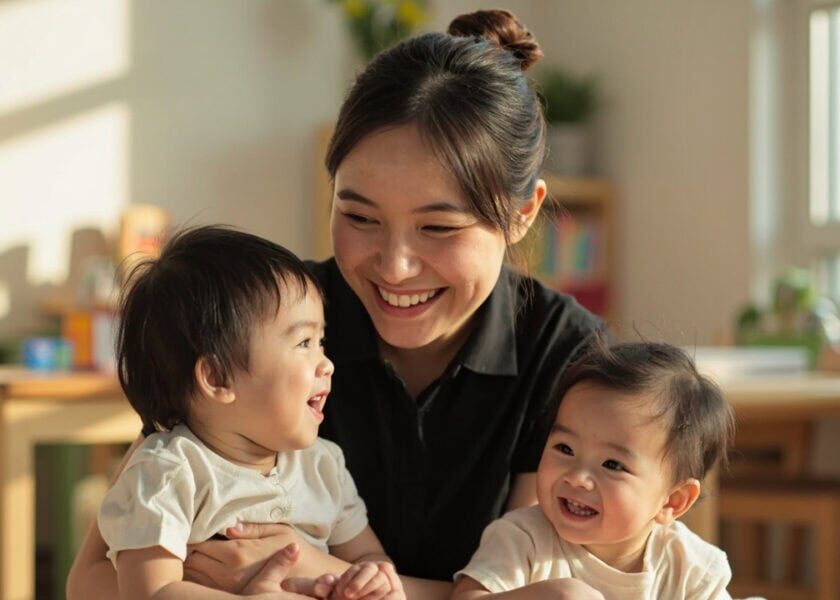
Quality looks like caregivers who kneel to meet a child’s eye instead of bending down from above. It looks like a toddler being guided through a frustration without the moment being taken over. It looks like a baby who has just woken from a nap being greeted with soft words before anything is done to or for them.
Quality infant care looks like a place where the pace feels slower than you might expect, where there is no rush to the next activity, where a child’s need for sameness and routine is understood as a developmental need, not a preference.
It looks like teachers who can tell you about each child’s individual rhythms — when they sleep best, which textures they prefer, what makes them laugh. That knowledge does not come from observation alone. It comes from sustained, attentive presence over time.
In Singapore’s childcare landscape, ratios vary significantly between settings. A centre with many infants per caregiver may manage well on the surface but cannot provide the individual attention that the youngest children need. When a caregiver is responsible for fewer children, each infant is known more fully. Each need is met more quickly. Each moment of wonder is noticed.
This is not a technical specification. It is arithmetic, and it is also something deeper — a philosophy that says every infant deserves not just supervision, but attention.
Choosing Infant Care in Singapore: Why the Landscape Matters
Singapore parents have more childcare options than ever before — and more confusion about what each option actually means for their child’s daily experience. Centre-based care, home-based care, infant care programmes, childminding pilots — the landscape is varied, and the differences matter.
When evaluating options, remember that the youngest infants have fundamentally different needs from toddlers or preschoolers. They need consistency, small group sizes, and caregivers who are not juggling competing demands across age groups. An infant programme that is truly designed for infants — not a scaled-down version of a toddler curriculum — will reflect this understanding in its structure, its ratios, and its staff training.
Ask specifically about how the centre or programme approaches the zero-to-eighteen-month age group. If the answer does not feel distinct from how they describe care for older children, ask why.
Our Approach at EduNanny
If I may speak directly for a moment about how we have built EduNanny — not as a sales pitch, but as a reflection on why this evaluation framework matters to us.
We are part of the ECDA Childminding Pilot. We operate in a space where the ratio of caregiver to infant is, at most, one to three — and in many settings, it is even closer. That closeness is not incidental. It is the foundation of everything we do.
We offer home-based and centre-based pathways alongside community options, because Singapore families are not all the same. Some parents need care in their own home, where their child is most comfortable. Others need the community environment of a centre, where their child learns alongside others. Both are valid. Both are excellent when they are done with genuine intention. And both are part of what we have built, within the pilot framework, to serve families across this city.
Our fees are structured within the pilot framework to be affordable. CDA and Baby Bonus funds are usable, where applicable. Our care operates in structured weekday blocks, because consistency matters enormously to infants, and we know Singapore parents need reliable, dependable schedules they can plan around.
And we communicate — actively, transparently, and with the understanding that you are not just leaving your child with us for the day. You are trusting us with the most important person in your life, during the most rapid and sensitive phase of human development. That trust is not taken lightly.
Your Next Steps
Here is what we have learned: a centre that is genuinely excellent does not fear evaluation. It welcomes it.
The moment a childcare provider becomes defensive about questions, uncomfortable with observation, or vague about its practices — that is the moment you know the performance is more important than the substance.
We are not interested in performing for you. We are interested in being good enough that your scrutiny confirms what your instincts already sensed: that this is a place where your child will be safe, seen, and nurtured. Where a caregiver is not just a supervisor but a true companion in your child’s earliest, most formative years. Where infant care is not an afterthought or a service tier, but the foundational work that everything else is built on.
You are not just choosing a childcare centre. You are choosing the first community your child will belong to outside of your home. That is enormous.
And you are capable of making that choice with clarity and confidence, because now you know what to look for.
When you walk through a door — ours or anyone else’s — you know how to observe. You know what to ask. You know the difference between a centre that looks good and one that is good. You know how to watch for the unguarded moments, how to read the quality of an interaction, how to notice whether children are being managed into stillness or invited into movement.
Trust what you see. Trust what you feel — not blindly, but informed by all of this.
Walk through that door. Look around. Ask your questions. Notice the unguarded moments. And if what you find here, at EduNanny, matches the kind of care you want for your child — not the perfect kind, but the genuine kind — then we would be honoured to walk alongside you.
Because here is the truth that sits at the heart of everything we do: the first years are not rehearsal. They are the years.
Every warm interaction, every responsive moment, every instance of a caregiver who kneels to meet a child’s eye instead of bending down from above — these are not small things. They are the architecture of a person’s sense of the world, of trust, of self.
This is not a decision you make once. It is a relationship you build over time.
We are ready for it.
When you are ready to learn more about what EduNanny offers, we invite you to connect with our team or read more about our approach. We have nothing to hide — and everything to show you.