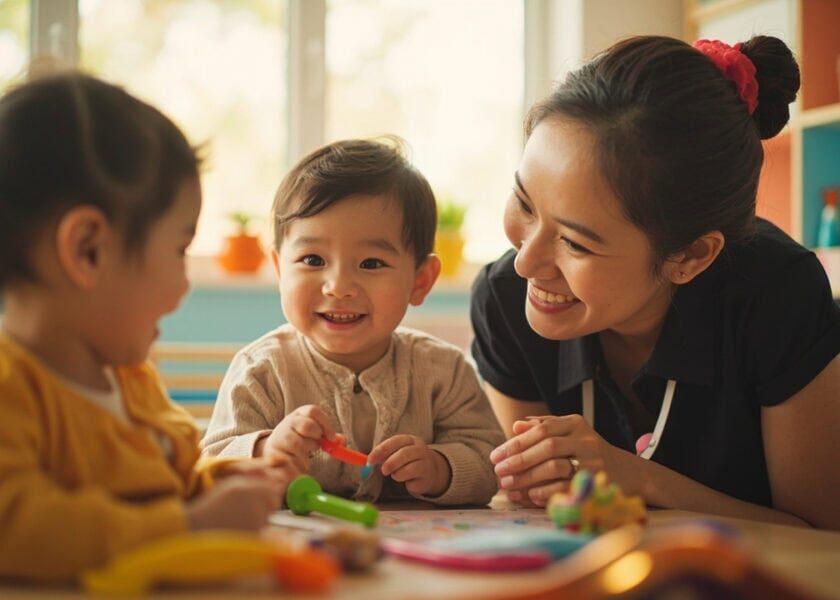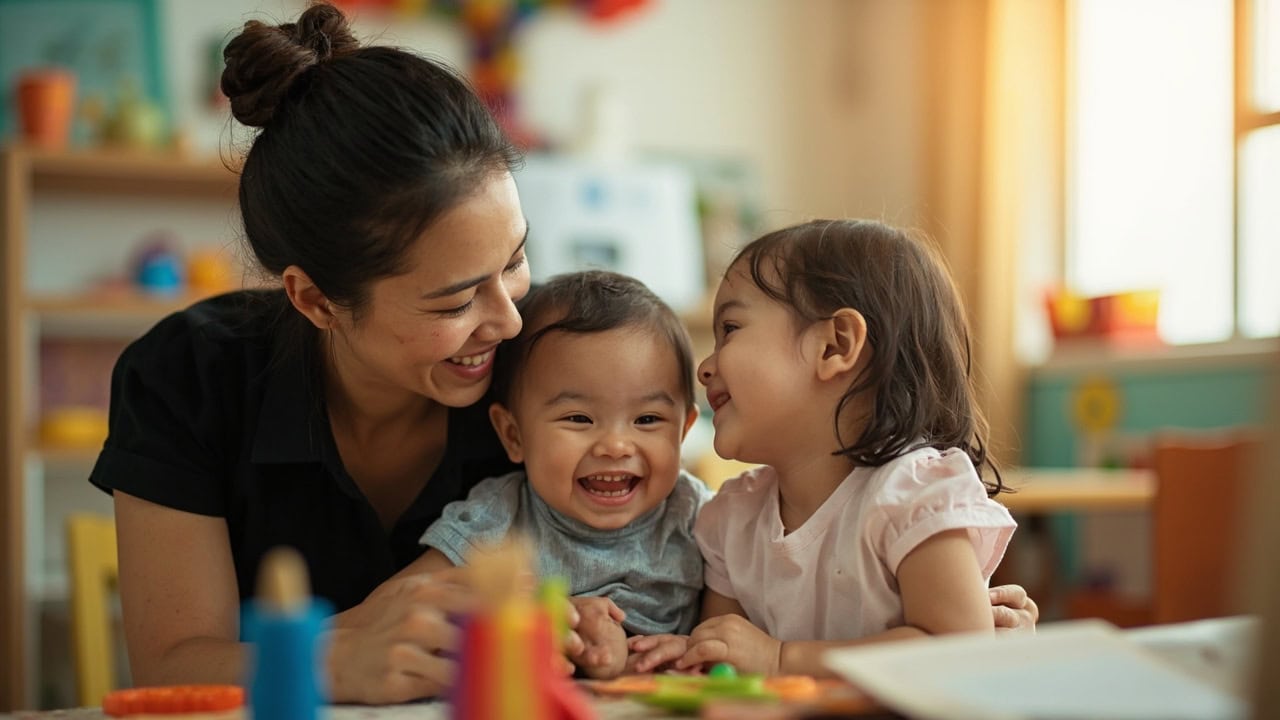
What Your Child Brings Home After Childcare Reveals Everything
What You Are Actually Looking For
Most of the conversation around childcare in Singapore focuses on the decision. The choosing. Parents spend weeks researching, visiting, comparing, asking friends, reading reviews, touring facilities. They weigh ratios and curricula and proximity to MRT stations, searching for the right answer to a question they have phrased carefully: Where should my child go?
But something important happens in the hours and days after that decision is made. The choosing ends. The wondering begins. And this is where most of the available guidance simply stops.
You have enrolled your child. You have made the choice. Now what?
Now you are living in the gap between the morning handover and the evening return. You drop off a three-year-old who is not yet fluent in describing their inner life. You pick up the same child six or seven or eight hours later, and in between, you have been somewhere else entirely — at work, in meetings, answering emails, performing the professional version of yourself.
You have had no window into those hours. You have relied on updates: a photo sent at lunch, a brief note from a caregiver, a summary at pickup. But updates, however thoughtful, are curated. They are the official story. And the official story is not the whole story.
The whole story is what your child brings home.
This is not a metaphor. This is data — raw, behavioral, unfiltered data that your child carries in their body, their voice, their play, their questions, their silences. And if you know how to read it, it tells you something profound: whether your child spent their day in a place that nurtured them or merely occupied them. Whether they were seen as a person or processed as a task. Whether they are thriving in the way that matters — socially, emotionally, somatically — or whether something is quietly not right, long before it becomes a problem you can name.
Reading the Signals Your Child Brings Home
A child who has had a genuinely good day in quality care arrives with a particular quality of presence. They are not manic, not frenzied, not the overstimulated child who has been without adequate rest. They are also not shut down, not compliant in a hollow way, not moving through the world like someone who has learned to be small and unnoticed.
A thriving child after a good day tends to be available. Available for connection. Available to be held, or not held, but at least available to be present.
They may be tired — genuinely tired, the kind of tired that comes from a full and purposeful day — but it is a warm tired. A satisfied tired. They may be hungry, because children in good care are kept active and engaged and often too busy to eat everything on their plates.
They may want to tell you things, or they may be quiet, but the quiet has a different quality. It is not the quiet of withdrawal. It is the quiet of processing, of integration. A child who has been in a safe, stimulating environment all day has absorbed a great deal, and part of coming home is beginning to make sense of it all.
What Play Reveals
Watch them when they are not performing for you. Watch them play.
Play is not a break from learning. Play is learning made visible. When your child comes home and begins to play — alone, with you, with siblings, with whatever materials are at hand — they are often replaying the most significant moments of their day. A child who has been in quality care may act out scenarios from their classroom, replicate relationships with caregivers, recreate the rhythms of their morning circle time or their lunch routine.
This is not regression. This is processing. They are making meaning out of their day, and they are doing so in the language they know best: the language of imaginative play.
A child who has had a difficult or disconnected day may not play at all, or they may play in ways that reveal anxiety. They may be hypervigilant. They may not be able to sustain play without adult direction. They may seek constant reassurance, or they may seem oddly passive, as if they have learned that their preferences do not matter. These are not diagnoses. They are signals. And signals, when read early, give you time to act.
What Social Language Reveals
The quality of your child’s peer interactions does not only happen at childcare. It comes home with them.
Children who are navigating healthy peer relationships — relationships supervised by attuned adults who intervene with skill and calm — bring home evidence of social learning. They may use new words or phrases that came from friends. They may reference games you have never taught them. They may show you a new way of solving a problem, a new interest, a new question.
This is social language, and it is one of the clearest indicators that your child is not merely being cared for but being included. A child who is socially thriving is a child who has found their footing in a community of peers, and that is no small thing. Making friends, keeping friends, navigating the small conflicts and large joys of peer life — this is the work of early childhood, and it happens mostly outside the view of parents.
When your child comes home showing you a social world that is developing, you are seeing evidence that they have had the right kind of exposure, the right kind of scaffolding, the right kind of supervision. When your child comes home with no social language at all — no references to friends, no interest in peers, no evidence of connection — that is also a signal, and it deserves your attention.
What the Body Reveals
We do not always think of the body as a communicator, but for young children, the body often speaks before words do.
A child who is genuinely thriving in care often shows it in their physical presentation. They are tired in a clean way. Their clothes may have the ordinary marks of active play, not distress. They may have a physical ease about them, a willingness to move, to explore, to engage their body in the world. They may sleep well that night — not necessarily immediately, but eventually, deeply, with the kind of rest that comes from a day that has asked something of them but not too much.
A child who is struggling may show it physically. They may be unusually fatigued, but in a way that suggests depletion rather than healthy tiredness. They may have physical tension they did not have before, clenching their jaw, holding their shoulders high, seeming braced. They may resist sleep in ways that feel like anxiety rather than normal resistance. They may eat differently — refusing food they usually love, or conversely, eating in a way that suggests emotional eating rather than genuine hunger.
Children who have spent the day in spaces that are overcrowded, overstimulating, or simply not attuned to their sensory needs often come home dysregulated. They may be unable to calm down. They may be hypersensitive to sensory input. They may seem both exhausted and wired, as if their nervous systems have been running on high alert all day.
Quality care pays attention to sensory environments — to noise levels, to visual stimulation, to the rhythm of activity and rest. When this is done well, children come home regulated. When it is not, the body knows.
What Attachment Reveals
Children who are in quality care environments develop what researchers call secondary attachment — not replacing the primary attachment to you, but extending it outward to caregivers who have earned their trust.
You can often see evidence of this in the handover. Does your child move toward their caregiver with some measure of ease? Not excitement necessarily — young children do not always show effusive joy at separation — but with a kind of acceptance, a willingness to engage? Or do they resist? Not resist in the ordinary way children resist transitions, but resist in a way that suggests genuine distress?
These are different things. A child who resists being handed over because they want to stay with you is one child. A child who resists because they do not trust the environment they are being handed into is another.
At the evening return, attachment signals can show up in unexpected ways. A child who runs to you with open arms after a day apart is expressing reunion joy — the pleasure of seeing you again, which is real and important and beautiful.
But so is the child who does not immediately run, who takes a moment, who seems to be checking something internally before they lean into you. This child may simply be processing a full day of experience before they are ready to fully let down their guard. Context matters. Your knowledge of your child matters.
What you are looking for is change — a significant departure from your child’s baseline behavior — because change is where signals become visible.
From Observation to Action
You may be wondering at this point: what do I do with all of this? How do I translate observation into action?
The first step is to trust what you are already noticing. Most parents notice more than they give themselves credit for. You may have pushed aside certain observations because they seemed too small, too subjective, too uncertain. But your noticing matters. You know your child in a way no caregiver, no matter how dedicated, can know them. You have the longitudinal view. You know their history, their temperament, their patterns, their fears, their joys. When you notice a change, that change is real.
Asking Better Questions
The second step is to develop the habit of asking better questions. Not “How was your day?” That question, asked to a three-year-old, is almost unanswerable. They may say “Good” or “Fine” or simply stare at you with an expression that suggests the question has not quite landed.
Instead, try questions that narrow the aperture:
- “What did you play with today?” invites a concrete, specific memory.
- “Who did you sit next to at lunch?” brings in the social world.
- “What was the funniest thing that happened?” invites them to select a highlight.
- “What was the hardest part?” invites vulnerability.
- “What did [caregiver’s name] do today?” brings the adult relationship into focus.
These questions do not guarantee answers — young children are not always verbal, and some days they simply will not tell you much — but over time, they build a practice of communication that matters.
Listening to Their Questions
You can also learn to listen to the questions your child asks you. Children often process their experiences through questions that seem unrelated to childcare.
A child who asks about another child’s birthday party may be processing inclusion and exclusion. A child who asks about what happens when people are sick may be processing health anxiety. A child who suddenly asks about a grandparent who lives far away may be missing something about connection and may be using the question to tell you something about their need for closeness.
These questions, even when they seem like non-sequiturs, often have a thread running back to something that happened during the day.
When Something Is Not Right
What you are building, if you choose to build it, is a practice of co-reading. You are becoming a partner in your child’s childcare story, not an outsider waiting for reports.
Here is what this practice is not. It is not surveillance. It is not the constant interrogation of your child, searching for evidence that something is wrong. It is not an anxious hovering that transmits your own worry to them. It is an attentive presence, a willingness to notice, a readiness to act when noticing tells you something important.
And when noticing tells you something is not right — when the signals you are reading suggest that your child is struggling, or disconnecting, or simply not thriving — it is also not something to wait out indefinitely. Singapore parents are often patient to a fault. We tell ourselves that children adapt, that things take time, that we should not be reactive.
And sometimes we are right. Transitions are hard, and some initial adjustment is normal. But chronic signals — signals that persist week after week, month after month — deserve a response. The evening homecoming is a daily report card, and a daily report card that keeps showing the same concerning patterns is telling you something.
The Childcare Partner That Makes Observation Possible
This is where the quality of your childcare partner matters enormously.
The best childcare arrangements are not those where parents and caregivers operate in separate worlds. They are those where there is a flow of information, a shared attention to the child, a willingness to communicate about what is being seen and noticed and wondered about.
When a caregiver knows that you are paying attention — that you are reading your child’s evening homecoming, that you are noticing changes, that you are an active partner in understanding your child — that caregiver tends to communicate differently. The updates become richer. The handover conversations become more substantive. The relationship becomes collaborative.
Why Ratios Matter for Observation
EduNanny was built on this understanding. When you choose a childminding arrangement through the ECDA Childminding Pilot, you are not simply choosing a service. You are choosing a partner who understands that observation is not a checkbox. It is a practice. It is the way we know a child, the way we respond to a child, the way we build the kind of daily evidence that lets you read what is happening when you are not in the room.
This is why EduNanny maintains the ratios it does. When care is offered at a ratio of up to one caregiver to three infants, something becomes possible that is not possible at higher ratios. The caregiver can truly see. Not just manage, not just supervise, but see. They notice the child who is pulling away from group play when they usually engage. They notice the child who is not eating their lunch in the usual way. They notice the small changes, the micro-shifts, the early signals that something is moving in one direction or another. And when they notice, they can respond. They can document. They can communicate.
That communication is not a luxury. For Singapore parents who spend their working days away from their children, uncertain about what happens in the hours of separation, it is oxygen. It is the thing that lets you breathe.
Transparency as Trust-Building
EduNanny’s approach to transparency — through the communication measures and documentation practices that are part of the pilot — is designed with this parent experience in mind. You do not have to guess. You do not have to wonder alone. The evening homecoming is richer when the day has been observed well, and the day has been observed well when the conditions allow for observation.
Those conditions include small ratios. They include trained caregivers who understand developmental norms. They include a culture that treats daily reporting not as a formality but as a responsibility. And where deployed, they include measures like CCTV that some parents find reassuring and others find unnecessary.
What matters is that the program is designed around the reality of the parent experience: the anxiety of separation, the need for trust, the hunger for evidence. EduNanny does not pretend that trust alone is sufficient. Trust is built on evidence, and evidence requires attention.
Pathways Designed for Singapore Family Life
The ECDA Childminding Pilot offers pathways that recognize the diversity of Singapore family life.
| Pathway | Setting | Best For |
|---|---|---|
| Home-Based | Child’s home or childminder’s home | Infants, very young toddlers, families wanting consistency and reduced exposure to large groups |
| Community / Centre-Based | Small group settings in community spaces or dedicated centres | Families seeking social exposure in supervised, small-ratio environments |
Both pathways operate within the pilot framework, both are supported by ECDA oversight, and both offer the ratios and trained observation that make quality visible.
The pilot fee structures are designed to be accessible. For many Singapore families, affordability is not a nice-to-have consideration — it is the thing that determines whether quality care is even a possibility. The use of CDA and Baby Bonus funds where applicable means that the financial architecture of childcare is not separate from its quality architecture. These are not competing priorities. They are connected. A program that is excellent but only accessible to the wealthy is not solving Singapore’s childminding challenge. EduNanny is built with this in mind.
And the program is available across Singapore. The geography of childcare in this country is not simple. Parents commute from Bishan to the CBD, from Tampines to Jurong, from Woodlands to the city. The home-based pathway can follow families in ways that centre-based care cannot always accommodate. The community pathways are growing, with partnerships that bring small-group care into neighborhoods rather than requiring families to travel to it. The goal is not a single model for all families but a range of pathways that serve the actual landscape of Singapore family life.
You Are Not Alone in This
I want to return to something I said earlier: that you are not a passive observer of your child’s childcare experience. I meant this. But I want to add something to it now.
You are not passive, but you are also not alone. This is the thing that quality childcare understands, and this is the thing that the evening homecoming reveals most clearly.
When your child comes home carrying something worth noticing — something that tells you they had a day of real engagement, real care, real learning — that is not a message about the childcare. It is a message about your child. It is a message about the life you are building together. It is evidence that the choices you are making, the sacrifices you are navigating, the complex negotiation between your professional self and your parenting self, are not in vain.
When your child comes home carrying something that concerns you, it is also not a message that you have failed. It is a message that something needs adjusting. And that is exactly what the evening homecoming is for.
It is not a test you pass or fail. It is a daily conversation. It is the most honest report card you will ever receive, because it comes directly from the source, without intermediary, without curation, without the filters that can make even the most well-meaning updates incomplete.
Your child is telling you something every evening. If you are listening — really listening, with attention and care and the willingness to notice what is hard to see — you will hear it.
And when you hear it, you will know what to do.
Quick Reference: Evening Homecoming Signs Worth Noticing
- Changes in physical presentation — tension, fatigue patterns, clumsiness
- Shifts in play behavior — withdrawal, aggression, inability to self-direct
- Changes in social language — new words, friend references, peer interest
- Sleep and eating patterns — disruption that persists beyond normal adjustment
- Attachment behaviors at handover — ease or distress, trust or resistance
You know your child. Trust that knowledge. It is your most important tool.
EduNanny exists to make that knowing possible. Not by removing the parent from the equation, but by becoming a reliable, skilled, attentive partner in it. The evening homecoming is the moment when the day’s work becomes visible. EduNanny’s work is to make sure that what your child brings home is worth the bringing.
Every Singapore parent deserves to pick up their child at the end of the day and see something worth noticing. Every child deserves to come home carrying evidence of a day that mattered.
The evening homecoming is not the end of the childcare story. It is where the story becomes readable. And when you learn to read it — with patience, with attention, with the right partner beside you — you will find that the story has been there all along, waiting to be heard.
Ready to explore how EduNanny’s approach can give your child something worth bringing home every evening?
Learn more about the ECDA Childminding Pilot