The Social Skills Your Child Is Building Before Primary One
The Question Every Singapore Parent Carries About Childcare
There is a question you hold in the back of your mind, often unspoken at playdates and parenting forums. It surfaces when you watch your child interact with other toddlers at the library, or when relatives ask what you are doing to prepare them for Primary One.
It is not the question about letters or numbers. It is the question beneath the question: will my child be okay? Will they make friends? Will they be happy? Will they know how to be with other children when the real social world opens up to them?
You chose childcare because you needed reliable support. You chose it because you believe in early development, in structured environments where your child can grow. But beneath all the practical reasons, there is a hope you may not have fully articulated even to yourself.
You hope that every hour your child spends in this environment is quietly, invisibly teaching them how to belong.
That hope is not misplaced. And today, we want to show you exactly why.
Why School Readiness Is Really About Social Readiness
We spend so much time as parents preparing our children for school that we forget something fundamental. School success, at its deepest level, is not primarily about literacy or numeracy. It is about social readiness.
Consider what Primary One actually requires of a five-year-old. They must navigate a room full of children they have just met. They must share attention with a teacher who cannot give every child individual focus. They must manage the disappointment of not being chosen, the frustration of a long wait, the complexity of making friends with someone whose personality may be very different from their own.
A child who can walk into a classroom feeling comfortable with other children—who knows how to share space and attention, who can navigate a disagreement without falling apart, who has some experience of what friendship feels like—is building on a foundation that no workbook can lay.
That foundation is most often built not at home, not at enrichment classes, but in the daily, ordinary, extraordinary world of quality childcare.
The Invisible Curriculum of a Morning
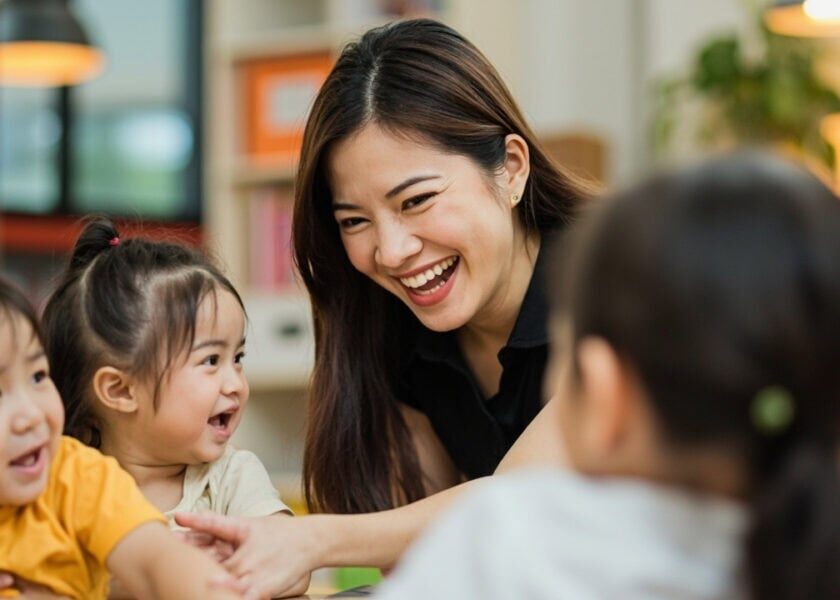
When you drop your child off in the morning, you see the room, the toys, the friendly face greeting you. What you do not see is the social curriculum that begins the moment your child walks through the door.
You do not see them learning to register another child’s presence. You do not see the moment one toddler reaches for the same block another is holding and discovers, for the first time in a structured way, what it means when desire meets desire. You do not see the caregiver who is watching, not just for safety, but for the lesson unfolding.
The social world of quality childcare is not accidental. It is not a byproduct of children being in the same room. It is a carefully observed, thoughtfully facilitated developmental curriculum that operates alongside everything else your child is learning.
Consider what happens in a single morning. A child wants a toy another child is playing with. At home, with a doting parent, that toy is often surrendered within seconds. The parent intervenes, redirects, resolves. It is an act of love, but it is also an act of protection that, over time, leaves a gap in a child’s experience.
In childcare, with a trained caregiver holding space, the child must wait. Or negotiate. Or find something else. Or learn, gradually, that the toy will come back to them.
These are not small things. These are the first, primitive exercises in a skill set that will govern every relationship your child ever has: patience, negotiation, the understanding that other people have needs too, and the discovery that one can cope with temporary disappointment and still be okay.
The Relational Skills Your Child Builds in Childcare
Multiply these small moments across a week, a month, a year. Your child is not just playing. They are building.
Sharing and Turn-Taking
Your child has been on both sides of sharing. They have felt the frustration of not having the toy, and they have felt the strange, new pleasure of giving it away and seeing another child’s joy. They are building a library of social experiences that will inform how they move through the world for decades to come.
Turn-taking looks simple. One child uses the tricycle, then another. But inside that simple exchange is a complex cognitive and emotional negotiation. The child must hold in mind the understanding that it is not their turn yet, that the turn will come, that the waiting is survivable.
A child who has practiced turn-taking in a safe, supported environment carries something with them into Primary One that cannot be taught in a workbook. They carry the experience of managing a difficult impulse in the presence of others and surviving it intact.
Cooperation and Conflict Navigation
When two children decide to build a tower together, something remarkable happens. They must coordinate, communicate, adapt. One wants the blue block on top, the other wants the red one. They must find a way to agree.
This is the earliest form of teamwork, of collaborative problem-solving, of understanding that individual vision must sometimes bend for a shared goal. A child who has built towers with other children has built something far more important than architecture. They have built the capacity for collaboration.
And then there is conflict. Conflict between young children is not a failure of the environment. It is the curriculum. When two children reach for the same toy, when feelings collide and escalate, there is an opportunity for learning that no amount of guided instruction can replicate.
The caregiver in a quality environment is trained to observe, to allow the conflict to breathe, to give children the chance to find their own resolution if possible, and to step in not as a judge or a rescuer but as a guide.
A trained caregiver does not simply say stop or share. They model. They narrate. They help children name what they are feeling. They offer scripts: can I have a turn when you are done? They validate the child’s frustration while holding the boundary.
Friendship Formation
Friendship formation in these early years is often dismissed as parallel play—toddlers playing near each other, not truly together. But even parallel play is social preparation.
Your child is watching other children. They are noticing how other children move, react, express joy or frustration. They are building a mental model of what other people are like, which is the earliest groundwork for empathy.
And then, gradually, something shifts. Two children begin to seek each other out. They look for each other when they arrive. They learn each other’s names. They discover that being near someone who knows you feels different from being near a stranger.
This is friendship beginning. It is fragile and simple and utterly profound. A child who has experienced this in childcare has a reference point for belonging that will shape how they approach every social environment after.
Why Peers and Trained Caregivers Matter More Than You Think
Quality childcare provides something parents, however loving, cannot replicate alone. It provides peers.
Siblings are invaluable, but peers offer something distinct. Peers are equals in the social hierarchy, however small. They have no obligation to give way. They have no parental authority to defer to.
The social negotiations that happen between peers are uniquely formative because they happen between people on the same level. A child who has navigated the social world with peers has a different kind of social confidence than a child who has only ever been in adult-mediated interactions.
They know, in their body, that they can hold their own among other children. They know how to signal, to negotiate, to connect. This is the confidence that will carry them into Primary One, into CCA, into the complex social ecosystems of adolescence and beyond.
The Trained Caregiver as Social Architect
None of this happens by accident. The quality of your child’s social learning depends fundamentally on the quality of the adults holding the space.
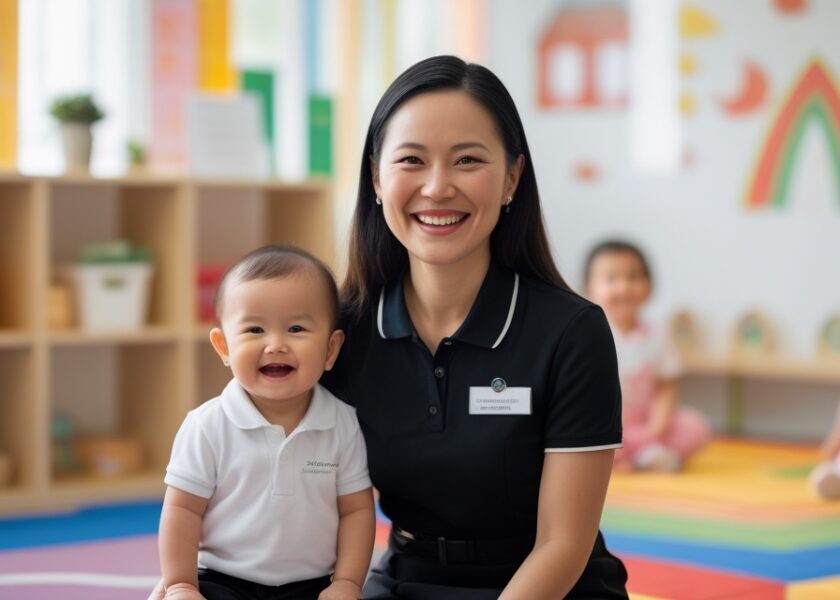
A trained caregiver in a quality childcare environment is not simply supervising. They are observing, watching for the social moments unfolding. They are scaffolding, offering just enough support to help a child stretch without rescuing them. They are modeling, demonstrating the language and strategies of emotional regulation in real time.
When a caregiver can truly watch, truly listen, truly respond, the social curriculum becomes possible. When there are too many children and too few adults, that curriculum collapses into mere crowd control.
Caregiver training and ratios are not bureaucratic details. They are the conditions that make your child’s relational development possible.
What to Look For When Choosing Childcare in Singapore
For families researching childcare options, here are the questions that matter most for your child’s social development:
- Caregiver training: Are caregivers trained in child development, not just safety protocols? Do they understand social facilitation?
- Ratio matters: Fewer children per caregiver means more space for observation and intentional facilitation of social moments.
- Daily rhythm: Consistent routines create the predictability that allows social skills to deepen over time.
- Peer exposure: Is your child regularly interacting with peers in facilitated social moments, not just parallel play?
- Communication: Do you receive genuine insight into your child’s relational development, not just log updates?
- Conflict philosophy: How do caregivers approach conflict between children? Look for facilitation, not just resolution.
Common Questions Answered
Is quality childcare really worth the investment?
For families navigating financial considerations, structures like the ECDA Childminding Pilot bring meaningful childcare within reach. CDA and Baby Bonus usability means that the resources Singapore has set aside to support your child’s early years can flow toward exactly this kind of development.
What if my child is shy or struggles socially?
Quality childcare environments are designed precisely for this. With trained caregivers who observe, scaffold, and support, children who are naturally more reserved have the space to grow at their own pace while being gently challenged to engage. The peer environment provides natural motivation that adult coaxing cannot replicate.
EduNanny by BUTLER: Designed Around Social Development
EduNanny’s ECDA Childminding Pilot reflects a straightforward recognition: childcare is not merely supervision. It is a developmental environment, and the quality of that environment shapes what children take from it.
With meaningful caregiver-to-child ratios in certain settings, there is space for genuine observation, individual attention, and the kind of intentional facilitation described above. EduNanny understands that families are not uniform, which is why they offer different pathways.
- Home-based environments offer intimacy and consistency within a caregiver’s home.
- Centre-based environments offer a broader social ecosystem with more peers.
Both pathways, when staffed by trained, supported caregivers, offer access to the peer world that children need. Monday to Friday care blocks create the regularity, the rhythm of repeated social experience, that makes learning cumulative.
It is not the occasional playdate that builds social competence. It is the daily, predictable, structured exposure to peers that allows skills to deepen and consolidate.
EduNanny also values transparency. Parents deserve to know what is happening in those unseen hours—not just photographs and updates, but genuine insight into their child’s social development: who they are playing with, how they are navigating conflicts, which relational skills they are practicing.
This kind of communication reflects a deeper respect for parents. Because childcare is not simply about keeping children safe and occupied. It is about building human beings.
Your Child Is Building the Foundation for Everything
Let us come back to you now, and to the question you carry.
You are preparing your child for school in the ways that everyone tells you to prepare. You are thinking about assessments and interviews. You are wondering if they know their colors, their shapes, their letters. These things have their place.
But beneath all of that, the preparation that will matter most is the one that is happening right now—in the hours you have entrusted to someone else, in the room where your child is learning to be with other children.
- Every time your child waits for a turn, they are preparing for school.
- Every time they navigate a conflict with a caregiver nearby, they are preparing for school.
- Every time they look for a friend, find a friend, build something with a friend, they are preparing for school.
This is not speculative. This is not aspirational. This is what decades of developmental research tells us about school readiness. Children who enter Primary One with social confidence, with experience of peer relationships, with some facility for managing disappointment and celebrating collaboration—these children do not merely survive the school transition.
They arrive ready to learn, because learning is a social act. It requires the ability to be with others, to ask for help, to collaborate, to regulate one’s own emotions in a group setting.
The child who learns, in these early years, that they can negotiate, that they can wait, that they can disagree and still be okay, that they can belong, that they can be found by a friend and find a friend—that child carries something forward.
They carry it into Primary One, into secondary school, into the workplace, into marriage, into parenthood. The social capacities built in quality childcare are not a prelude to life. They are life.
You made a choice. You chose childcare. Maybe because you had to, maybe because you wanted to, maybe because it was the best option available to your family.
But here is what that choice also was. It was an investment in your child’s relational future. It was an act of faith in the invisible curriculum. It was a quiet, confident declaration that you understand what matters most.
Your child is learning to be a friend right now. They are learning to share, to wait, to resolve, to belong. They are learning that the world contains other people and that being with other people can be wonderful and hard and wonderful again.
They are building, in these ordinary, extraordinary days, the relational foundation that will hold them for a lifetime.
That is not a small thing. That is everything.
At EduNanny by BUTLER, we believe that quality childcare is one of the most meaningful investments you can make in your child’s future. Our ECDA-registered childminding programme is designed around the recognition that every interaction, every shared moment, every gently navigated conflict is quietly building the person your child will become.
If you would like to learn more about how EduNanny supports your child’s social and developmental journey, we welcome you to get in touch or read more about who we are.