Beyond Literacy: The Readiness Your Singapore Child Actually Needs
The Hidden Readiness Gap
Singapore’s primary schools are excellent. The system produces students who are numerate, literate, and globally competitive. But even the best primary schools operate within structural constraints. Class sizes are large. The syllabus is wide. Teachers are skilled, but they are not magicians. They receive your child for six hours a day and are expected to deliver a curriculum that assumes a certain baseline of readiness — a baseline that your child’s teacher has no hand in building.
That baseline is not academic. Not really.
The syllabus will teach your child to read. What it cannot teach them is how to sit still long enough to listen. The syllabus will introduce mathematics. What it cannot cultivate is the self-regulation to stay with a problem when it gets hard, to not give up, to try another way. The syllabus will place your child in a group of thirty and expect them to navigate friendships, share, take turns, manage small disappointments, and recover.
These are not academic skills. They are the invisible architecture beneath every academic skill.
This is the Primary One readiness gap. It is the space between what your child knows and who your child is. And it is the space that quality childcare — not academic drilling, not flash cards, not pushing literacy before the child is neurologically ready — builds with intention, patience, and daily practice.
What Primary One Actually Requires
When Singapore parents think about preparing their child for Primary One, the mind goes naturally to literacy and numeracy. Can my child recognise words? Count to twenty? Write their name?
These are visible skills. They are easy to measure and easy to worry about. But the children who struggle in Primary One are rarely the ones who arrived knowing less. They are the ones who arrived knowing how to learn — or not.
The Capacities That Matter Most
Ask any experienced Primary One teacher what they wish incoming students brought with them, and the answers rarely involve academics. They involve capacities:
- Self-regulation: The ability to sit, listen, wait, and manage mild frustration without falling apart
- Language fluency: Not just vocabulary, but the ability to follow multi-step instructions, express ideas in sentences, and engage in back-and-forth conversation
- Social confidence: The willingness to be in a group, to share, to navigate small conflicts, to ask for help
- Motor coordination: Fine motor control for holding a pencil, gross motor regulation for sitting upright in a chair for extended periods
- Curiosity: The internal drive to engage, to ask questions, to lean forward rather than shut down
None of these are taught in the Primary One syllabus. They are developed in the years before — in environments where children are seen, responded to, and given the right kind of challenge at the right moment.
How Quality Childcare Builds Readiness
Let me be specific, because specificity is what separates insight from sentiment.
Language: Built in Everyday Moments
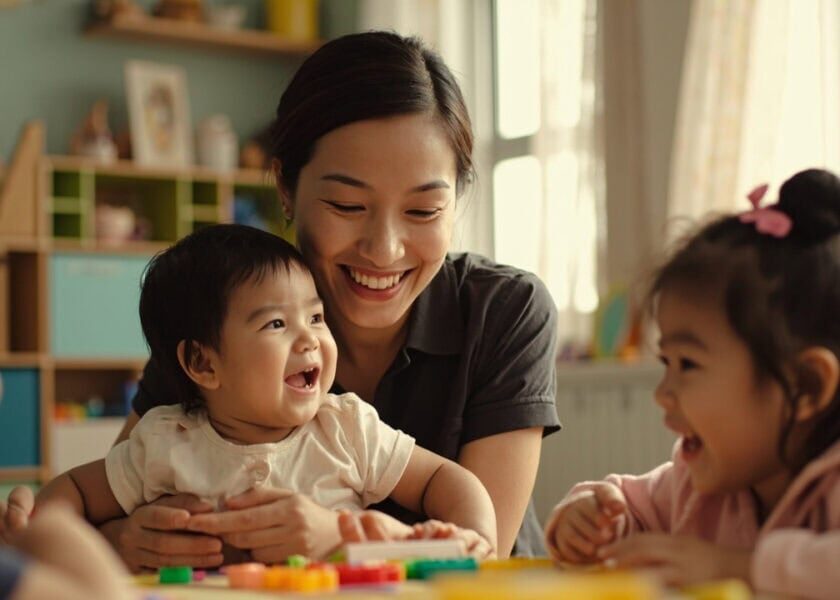
When a trained caregiver sits with your infant during feeding and narrates the moment — “You are reaching for the spoon now, your hand is opening” — that is not small talk. That is language input at a critical window of neural development.
The infant brain is extraordinarily receptive to language in the first three years. Every caregiving moment is an opportunity to build the vocabulary, the syntax, the conversational turn-taking that will later show up as reading comprehension, as the ability to follow multi-step instructions, as the confidence to raise your hand in class and say something coherent.
This is not enrichment added on top of care. It is care itself — responsive, warm, language-rich caregiving that builds the neural pathways for everything that follows.
Executive Function: Built Through Supported Challenge
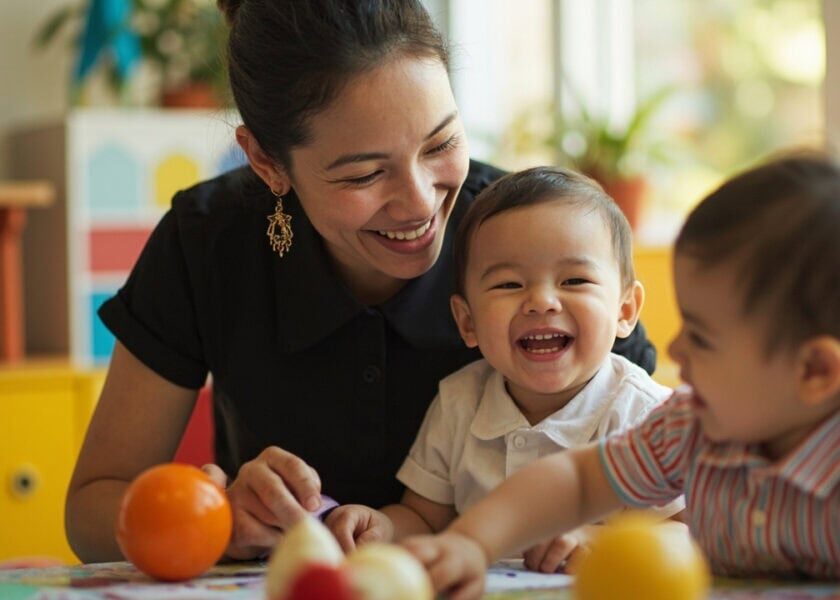
When a childminder notices that a toddler is growing frustrated during a puzzle and gently intervenes not by doing it for them but by asking, “What do you think goes here?” — that is executive function in the making.
That child is learning impulse control. Delay of gratification. Problem-solving under mild pressure. They are learning that effort leads to resolution. By the time that child sits in a Primary One classroom and encounters a word problem they do not immediately understand, they will have the internal resources to pause, think, and try again.
Not because someone taught them resilience as a concept. Because they experienced it, daily, in a thousand small moments with someone who was paying attention.
Social-Emotional Competence: Built in Real Conflicts
When a caregiver manages a conflict between two three-year-olds over a toy train — listening to both sides, naming emotions, guiding a compromise — that child is learning social competence at a depth that no classroom lecture can replicate.
Social-emotional readiness is the invisible foundation of academic participation. The child who can manage mild social friction is the child who can focus. The child who feels securely attached to the adults around them is the child who can take intellectual risks — who will raise their hand when they are not sure, who will ask a question even if it makes them feel vulnerable.
Motor Development: Built Through Play, Not Worksheets
Gross motor play is not a break from learning. It is learning. Climbing, running, tumbling, and balancing build the proprioception and vestibular development that directly supports classroom posture, handwriting, and focused attention.
Fine motor activities — pouring, threading, manipulating small objects, working with playdough — are not busywork. They are neurological construction. They build the hand strength and coordination that will later allow your child to hold a pencil correctly, write for extended periods, and complete timed assessments without fatigue.
Why Training and Intentionality Matter
I have used the word “trained” deliberately, because it matters.
Not every childcare arrangement is the same. Anyone who has spent time with young children knows that children are extraordinarily adaptive — they will attach, they will learn, they will grow in almost any environment. But adaptive is not optimal.
The developing brain is not equally shaped by all experiences. It is shaped most deeply by responsive, informed, intentional care. And that kind of care requires knowledge — not just warmth, not just intention, but genuine understanding of developmental stages, neural development, and how to read a child’s signals accurately.
This is why EduNanny operates as an ECDA Childminding Pilot partner. The pilot exists because Singapore’s regulators understand, as serious educators do, that who cares for your child and how they do it has measurable, lasting consequences. It is not bureaucratic infrastructure. It is recognition that childminding is a skilled practice — one that requires training, observation, reflection, and genuine understanding of developmental science.
In quality programmes, infant ratios of up to one to three mean that every child is known. Not managed. Not supervised. Known. The caregiver can observe because they have the bandwidth to observe. They can respond because they are not overwhelmed by numbers. They can build the relational trust that becomes the child’s emotional scaffold for everything that comes after.
EduNanny’s Approach to Building Readiness
At EduNanny, childminders are part of a programme that takes the science of early development seriously.
Care happens in environments where language is abundant — where caregivers talk, narrate, read, sing, and respond. Where gross motor play is not a break from learning but is learning. Where fine motor activities are not busywork but neurological construction. Where social play is facilitated, not just tolerated. Where a child’s natural curiosity is met with invitations, not directives.
And critically, where parents are not bystanders.
We know that the childcare-parent partnership is where durable results are built. Communication is active and transparent. Daily updates, developmental observations, and genuine two-way dialogue between caregiver and family mean that you are always connected to what your child is experiencing and building. This is not a convenience feature. It is the extension of trust — the trust your child feels in their caregiver, reflected in the trust you feel as a parent.
EduNanny operates within pilot fee structures designed to make quality care accessible. Where Community Development Council arrangements and Baby Bonus provisions apply, they apply. Parents can use their Child Development Account. These are not marketing sweeteners. They are structural realities of the pilot that make this kind of care feasible for families who want it.
Questions to Ask When Choosing Infant Care
If you are researching childcare in Singapore, here are the questions that matter most — beyond licensing, beyond reviews, beyond convenience:
- What is the caregiver-to-child ratio, and does it allow for genuine observation and responsive interaction?
- How do caregivers interact with children during routine moments — feeding, diaper changes, transitions — not just during structured activities?
- What does a typical day look like? Is there time for child-directed play and free exploration, not just scheduled tasks?
- How is language used throughout the day? Are caregivers narrating, responding, and engaging in back-and-forth conversation with children of all ages?
- How are conflicts and frustrations handled? Is the approach developmental — guiding children through their emotions — or punitive?
- How does the programme communicate with parents? Is there transparency, regular updates, and genuine two-way dialogue?
- What training do caregivers have? Is ongoing professional development supported and valued?
The answers to these questions will tell you far more than a centre’s marketing materials ever could.
The Choice That Echoes Forward
Let me paint a picture of what readiness built the right way looks like.
A child arrives at Primary One. They may not know more words than the child next to them. But they sit relatively comfortably in their seat. They can listen when the teacher speaks. When they encounter something they do not understand, they do not shut down or act out — they pause, they try a different approach, they may even raise their hand.
When there is a small conflict on the playground, they have the social vocabulary to express what happened and the emotional regulation to stay regulated while it is sorted. They are curious. They want to know things. They lean forward when the teacher reads a story. They ask questions.
And here is the picture of readiness built the wrong way.
A child who has been drilled into performance without genuine understanding arrives at Primary One hollow. They can recite but not comprehend. They can answer but not question. And somewhere around Primary Three, when the curriculum stops being about compliance and starts requiring genuine thinking, the hollow fills with something that looks like a sudden regression.
It is not sudden. It is the long tail of a readiness that was performed but not built.
Quality childcare builds differently. It builds from the inside out. It builds the capacities that make all future learning possible — because they are not learned, they are developed. Self-regulation is not taught in a worksheet. Language fluency is not drilled into a three-year-old. Social confidence is not scripted. These are biological and relational achievements that happen in the presence of consistent, responsive, informed care.
So where does this leave you? It leaves you with a choice that is more consequential than it appears. The childcare decision you make today — the environment your child spends their waking hours in, the ratio of caregivers to children, the training and intentionality of those caregivers, the quality of the language and social and motor experiences they encounter every single day — this decision echoes forward into Primary One, into Primary Three, into the kind of learner and person your child becomes.
You will not remember the centre you chose when your child is fifteen. Your child will.
They will not remember the worksheets or the drilling. They will remember how they felt in that first classroom. Whether they felt safe enough to raise their hand. Whether they felt capable enough to try. Whether they felt curious enough to lean forward.
And the reason they felt any of those things will be because someone, years before, paid attention to the kind of readiness that cannot be rushed, cannot be purchased on a syllabus, and cannot be faked.
Begin With Confidence
EduNanny Singapore is not here because we believe childcare is the only thing that matters in early development. Families matter. Communities matter. The love and intention you bring to your home every day matters enormously.
But we are here because we know that the hours your child spends in care are not filler between your working day and the evening pickup. They are developmental time. They are brain-building time. And they deserve to be treated with the seriousness, the skill, and the care that they actually are.
We are here because Singapore’s children deserve to arrive at Primary One not just prepared in the way the system measures, but ready in the way that matters most — ready to learn, ready to belong, ready to grow. Ready to walk into that classroom and recognise, in some wordless, bone-deep way, that they are exactly where they should be.
That readiness begins with you. And it begins now.
If you are ready to explore what quality childminding looks like for your family, we invite you to connect with EduNanny Singapore. Let us walk this path together — from the first years, all the way to Primary One and beyond.
#PrimaryOneReadiness #SingaporeChildcare #EarlyChildhoodDevelopment #InfantCareSingapore #ChildmindingSG