Why Singapore Families Need More Than Just Childcare
That Quiet Morning Goodbye: Understanding the Caregiver-Parent Relationship
There is a moment—quiet, often unspoken—when a parent first leaves their child in someone else’s arms. It is not dramatic. There are no sirens, no flashing lights. But inside that parent, something significant shifts. A door opens to a new kind of relationship, one that most parenting guides never quite prepare you for: the relationship with the person who will spend their days with your child while you are not there.
If you are that parent—if you are reading these words—you already know what I am describing. You know the weight of that morning goodbye. The careful way you choose your words before leaving. The questions that loop through your mind on the commute to work: Will she feel secure? Will he sleep? Will the caregiver understand what that particular cry means, the one that only you have learned to read?
Here is what I want you to hear: that tension you feel is not weakness. It is evidence of something beautiful and true. It means you understand that your child’s emotional world is real and consequential. It means you are paying attention to what your child needs at the level that matters most.
And here is what this article offers: not just reassurance, but a framework for building something genuine with the professional caregiver who has entered your family’s life. A partnership that treats this relationship as the serious, consequential, beautiful thing that it is.
What Professional Care Actually Means
When we speak about professional caregivers, it is easy to slip into transactional language. We talk about services rendered and outcomes delivered. We speak of childcare as infrastructure, as support, as a checkbox on the list of modern parenting necessities.
And yes, professional care is all of those things. But it is also something more—a relationship that exists alongside and in conversation with your own.
The Secondary Attachment Figure
Developmental scientists call this a secondary attachment figure. The term can feel clinical when what it describes is profoundly human: your child can have more than one deep, meaningful relationship in their life, and every one of those relationships can contribute to their sense of security rather than competing with it.
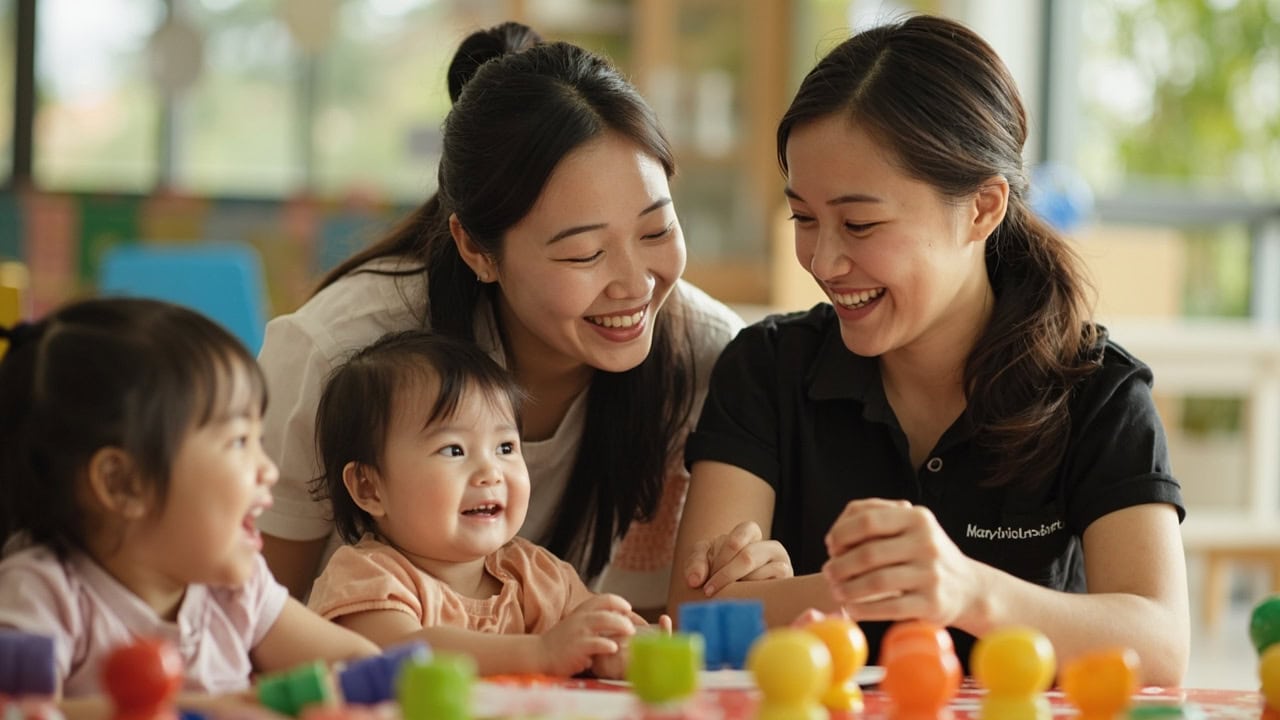
A professional caregiver who is truly excellent does not merely mind your child. She enters into a relationship with your child—one that complements, extends, and strengthens what you are doing at home. She learns your child’s rhythms, your child’s thresholds, your child’s particular way of expressing joy and frustration and wonder.
What Boundaries Actually Protect
Some parents worry that building a warm, genuine relationship with their child’s caregiver will somehow diminish their own role. They fear that the caregiver will become too close, that the child will prefer the caregiver, that something essential will be lost.
Here is a thoughtful answer to those fears: professional boundaries protect the caregiver-parent relationship, and in doing so, they protect your child’s security.
What does that mean in practice? It means the caregiver understands that she is a secondary figure in your child’s life, not a primary one. It means she will never try to replace you or undermine your authority. It means she will speak of you with respect and warmth in your child’s presence, will maintain appropriate professional distance, and will never ask your child to keep secrets from you.
But—and this is crucial—it does not mean she cannot love your child. It does not mean she cannot form a genuine, deep attachment. The professional boundary is not a wall. It is a frame. It holds the relationship in a shape that serves your child, your family, and the caregiver herself.
The Power of Selective Vulnerability
When you are building a relationship with your child’s caregiver, you will eventually face a choice. Do you share the things that are hard? The ways your child struggles, the fears you have as a parent, the family dynamics that are complicated?
The instinct is to protect yourself. To keep things professional. To maintain a surface-level pleasantness that feels safe.
But here is where strategic vulnerability becomes a strength. Your child’s caregiver can only help your child to the extent that she understands your child. And your child cannot be truly understood without understanding the family context in which they live. The fears your toddler shows at drop-off may be connected to a recent move, or a new sibling, or a change in your work schedule. The sleep struggles may be tied to a family illness.
When you share selectively—with wisdom, with discernment, with trust that has been earned—you give your child’s caregiver the context she needs to do her best work. You invite her into a fuller understanding of your child. And in doing so, you model something important: that adults can work together, can be honest with each other, and can prioritize the child’s wellbeing above their own discomfort.
Co-Regulation: The Foundation of Emotional Development
Let me tell you what that partnership looks like in practice, because this is where the abstract becomes real.
Co-regulation. It is one of the most important concepts in early childhood development, and one of the least discussed outside of professional circles. When a child is overwhelmed—when they are crying, or hitting, or frozen in fear—they cannot self-soothe. Their prefrontal cortex, the part of the brain responsible for calm reasoning, is not yet developed enough to take control. What they need is a regulated adult to help them find their way back to balance.
A trained caregiver does this throughout the day. She notices when a child is moving toward dysregulation and intervenes with calm presence. She gets down to the child’s level. She uses her voice, her touch, her steadiness to help the child feel held. This is co-regulation, and it is foundational to emotional development.
But here is what many parents do not realize: you are doing this too, at home. When you hold your crying infant and breathe slowly until their breathing matches yours, you are co-regulating. When you sit with your toddler after a meltdown and help them name what they are feeling, you are co-regulating. You and your child’s caregiver are both practicing this skill throughout the day, in your respective spaces.
When you are true partners, something remarkable happens. You begin to share your understanding of the child. You learn that at school, she calms fastest when given space to move her body, while at home she needs quiet cuddling first. You discover that he is more regulated in the mornings when he has had protein for breakfast, and that the caregiver has noticed the same pattern.
The two of you are building a shared map of your child’s emotional landscape, and that shared map makes both of you more effective. Your child benefits from the consistency, yes, but more than that—they benefit from the richness. They are learning that relationships can be many and varied and still secure. They are learning that love is not a limited resource.
Cultural Alignment and Partnership in Singapore
There is another layer to this partnership, one that is particularly important in Singapore’s context: the layer of cultural alignment and genuine family-level rapport.
Family Rhythm in Singapore
In many parts of the world, childcare is understood primarily as a service. Parents hire care, providers deliver care, and the relationship is defined by clear professional boundaries and mutual expectations. There is nothing wrong with this model. It works for many families.
But Singapore is different. Singapore families, across all backgrounds and generations, tend to want something deeper. They want the person caring for their child to understand their family. They want someone who will notice when it is Grandmother’s birthday and mark it appropriately. They want someone who understands why certain foods matter, why certain routines are sacred, why Sunday dinners at grandmother’s house are non-negotiable.
They want someone who is not just watching their child but who is, in some meaningful sense, part of their village.
Professional excellence and genuine warmth are not opposites. Getting to know a family—truly knowing them—is part of the work. And building those relationships in ways that are sustainable, respectful, and aligned with the family’s values is what makes care feel like an extension of home rather than a departure from it.
Structure That Sustains Trust
Structure matters. A genuine partnership cannot survive on good intentions alone—it needs systems, standards, and support.
Caregivers trained within structured programs operate to standards that exceed basic regulatory requirements. They understand infant development. They know how to observe and document in ways that are meaningful, not merely procedural. They are trained in co-regulation techniques, in responsive caregiving, in the art of communicating with parents in ways that build rather than undermine trust.
The ECDA Childminding Pilot offers both home-based and community or centre-based pathways, which means families can choose the arrangement that best fits their circumstances. With up to one to three infants per caregiver, your child receives attentive, responsive care—not the divided attention that comes from larger ratios.
Pilot fee structures are designed to be accessible, and CDA and Baby Bonus funds can be used in many arrangements, which removes some of the financial strain that makes quality care feel out of reach. Monday to Friday care blocks provide the consistency that children need to build trust and attachment.
And there are the communication measures that modern parents rightly expect. Daily updates, structured handoff conversations, and regular touchpoints ensure that parents are never left wondering what happened during the day.
What Good Childminding Actually Looks Like
If you are evaluating childcare options in Singapore, here is what to look for beyond the surface checklist:
- Responsive observation: A good caregiver notices not just what your child is doing, but what your child is communicating through their behavior, tone, and body language. She notices patterns and can articulate them to you.
- Calm regulation: When your child is upset, a good caregiver does not ignore the behavior or suppress it—she helps your child move through it with steadiness and warmth.
- Cultural attunement: She asks about your family’s rhythms, traditions, and values. She treats these as essential information, not background noise.
- Transparent communication: She shares observations honestly, including the difficult ones. She welcomes questions and sees parent involvement as partnership, not interference.
- Boundary clarity: She speaks of you with respect in your child’s presence, maintains appropriate professional distance, and never asks your child to keep secrets or position herself as an alternative to you.
- Documentation with purpose: She keeps records not for compliance, but because understanding your child over time requires attention to patterns, changes, and development.
Your Real Concerns, Addressed Honestly
“Will my child feel secure with someone else?”
Your child can develop multiple secure attachments. What matters is that each relationship is consistent, warm, and responsive. A professional caregiver does not replace you—she complements your relationship with your child.
“What if my child becomes more attached to the caregiver?”
Attachment is not a competition. Your child is attached to you as their primary figure. A secondary attachment figure adds to their sense of security rather than subtracting from it. The goal is not one relationship; it is a web of reliable, loving adults.
“How do I know if the caregiver is actually good at co-regulation?”
Ask questions about how she handles meltdowns. Listen to how she describes your child’s emotional states. A trained caregiver will use nuanced language—words like “dysregulated,” “threshold,” and “co-regulation”—and will describe specific strategies she uses to help your child find balance.
“Is it appropriate to share personal family information?”
Yes, selectively. The caregiver needs context to do her best work. Share what is relevant to your child’s daily experience and wellbeing. Trust your judgment about what feels appropriate. The relationship deepens over time as trust is built.
“How do I maintain my role as the primary parent?”
By staying involved. By communicating regularly. By treating the caregiver relationship as a partnership, not a handoff. Your presence in your child’s life is not threatened by professional care—it is reinforced by it, especially when both parties are aligned in their approach.
The Partnership Worth Building
When a caregiver and a parent are genuine partners—when they communicate with honesty and regularity, when they share observations and insights, when they trust each other’s competence and good faith, when they coordinate their efforts on behalf of the child—something shifts. The family dynamic changes. The child’s development accelerates. The parents feel less alone.
Your child does not have to choose between you and their caregiver. Your child does not have to split their world into two unrelated halves. Your child can experience the continuity of being known, loved, and supported by multiple attuned adults who talk to each other, who respect each other, and who are working toward the same end: raising a secure, curious, emotionally healthy human being.
The child who grows up with this kind of security—multiple bonds, all of them reliable, all of them warm, all of them coordinated in their care—enters the world with something irreplaceable. Not just skills. Not just knowledge. But the deep-down knowledge that they are loved, that people show up for them, that relationships can be trusted.
That is what you are building, every morning when you hand your child over and say, “Take care of my baby.” That is what your caregiver is building, every day when she greets your child with presence and attention. And that is what thoughtful, structured childcare support is here to nurture: not just the infrastructure of care, but the sacred human work of raising children together.
If you are a parent who is considering this path, I want you to know that you are not surrendering your role. You are not outsourcing your most important work. You are extending your village. You are inviting another skilled, caring adult into the circle of people who will help your child flourish.
And if you are already on this path—if you have already found a caregiver who feels like family—nurture it. Communicate with honesty. Show up with trust. Remember that you and your child’s caregiver are both doing the most important work there is.
That is the partnership worth building. That is the village worth creating. And that is the future worth walking toward, one morning goodbye at a time.
Ready to Explore Your Options?
If you are searching for infant care or childminding in Singapore and want to understand how a genuine caregiver-parent partnership could work for your family, take the next step. Ask questions. Visit settings. Trust your instincts.
You are not looking for someone to replace you. You are looking for someone who will stand alongside you. Your child is counting on it.
At EduNanny, we believe that great childcare is built on trust, developmental warmth, and the kind of partnership described in this article. If our approach resonates with you, we would welcome the opportunity to learn about your family. Learn more about who we are and what we stand for.