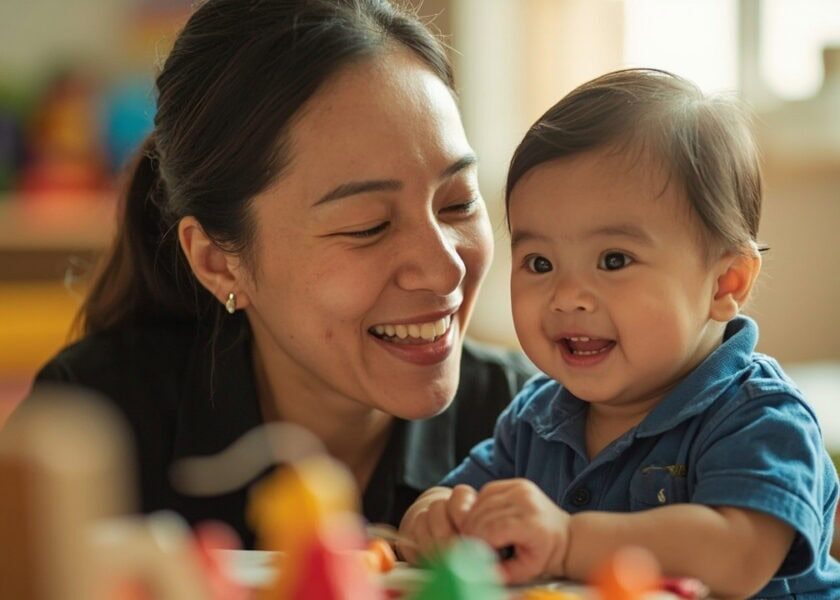
Decoding Your Child’s Emotional Signals After Childcare
A Quick Summary for Busy Parents
Young children communicate their emotional experience through behavior, not words. Every evening behavior, every shift in temperament, every regression and breakthrough is a sentence in a language that has been waiting for you to learn.
Here’s what this article covers:
- How children express their childcare experience without using words
- Five key emotional signals to watch: security, engagement, social confidence, autonomy, and stress responses
- Why your child’s evening behavior is often the clearest window into their daytime experience
- What quality childcare looks like when you know what to observe
- Questions worth asking as you evaluate your options in Singapore
The Question That Matters Most
When Singapore parents research infant care, we ask about certifications and teacher qualifications. We ask about curriculum structure and facility cleanliness. We ask about meal provisions and nap schedules.
These are reasonable questions, and they matter.
But underneath them is a question that rarely gets asked out loud—perhaps because it feels too vulnerable to articulate: Is my child happy? Are they safe in the way that matters most—not just physically, but emotionally? Are they becoming more themselves, or less?
Here is what years of observation and research have taught us: children are always communicating. They are communicating constantly, in every moment, through every behavior. The challenge is not that they are silent. The challenge is that we have not yet learned their language.
When a child cannot yet form sentences, when words remain distant and abstract, behavior becomes everything. It becomes the report card, the diary, the conversation. Your child’s emotional experience of their childcare does not arrive in your inbox. It arrives in how they play when they come home. In how they cling or how they wave goodbye. In the quality of their appetite, the depth of their sleep, the texture of their crying.
These are not random. These are a child speaking the only way they know how, telling you what their day felt like from the inside.
The Five Emotional Languages Children Speak
Every child’s emotional vocabulary in childcare can be understood through five interconnected domains. Learning to recognize them does not require clinical training. It requires the same attentiveness you already bring to parenting—now directed with a little more structure.
1. Security: The Foundation Beneath Everything
In the first years of life, emotional security is not an abstract concept. It is a felt experience, a bodily state, a quiet background hum that tells a child the world is trustworthy.
When a child feels secure in their care environment, you will see it—not in grand gestures, but in small, consistent behaviors:
- They settle when a caregiver picks them up
- They orient toward familiar faces without freezing or withdrawing
- Their play has a quality of absorption, a willingness to explore because safety feels solid beneath them
Conversely, when emotional security is not yet established, children speak a different language. They may be clingy in the mornings, unable to separate even after weeks of routine. They may be unusually watchful, eyes tracking every movement in the room. They may cry in a way that carries a deeper, more desperate quality—the crying of a child who does not yet believe that parting will be followed by return.
These are not behavioral problems. These are children telling you something important about their inner state.
2. Engagement: How Alive Is Your Child to Their World?
A child’s engagement with their environment is one of the clearest barometers of how they are experiencing their care. When children are engaged, they are not just present—they are alive to the world around them.
You will see this in their play: the way they invest meaning in objects, the way they create narratives, the way they test and experiment and discover. Engaged children are curious children, and curiosity is only possible when a child feels they have the cognitive and emotional space to be interested rather than simply overwhelmed.
But engagement has layers. There is the engagement of a child who is passively entertained, going through motions without deep investment. And there is the engagement of a child who is genuinely thriving—one who is building something, solving something, creating something, connecting with someone.
Signs of genuine engagement include sustained attention on meaningful activities, initiative in directing their own play, openness to new stimuli rather than withdrawal or aggression, and investment of meaning in objects and relationships.
3. Social Confidence: The Quiet Revolution
Social confidence in a young child does not look like extroversion. It does not look like boldness or noisiness or taking up space in obvious ways. Social confidence in a young child often looks quite small, quite gentle.
It looks like:
- A child who can hand a toy to another child without looking away
- A child who can sit near peers and feel comforted by proximity rather than threatened by it
- A child who can move toward a caregiver—not hide behind a parent’s leg, but actually approach, make eye contact, and say something, or try to
These are developmental milestones that happen quietly, in the margins of play and routine and everyday interaction. They happen because a caregiver noticed the first glimmer of social interest and responded to it. When a child reaches out and someone reaches back, something grows.
4. Autonomy: Sensing Their Own Competence
Autonomy in early childhood is not about children doing everything alone. It is about children beginning to sense their own competence, their own capacity to affect the world around them.
You see it in the toddler who insists on putting on their own shoe, even though it takes three times as long. You see it in the child who wants to carry their own bag, open their own door, choose their own plate at mealtimes. These are not power plays. They are children practicing the fundamental human need for agency.
In childcare environments, autonomy shows up in ways that might surprise you:
- A child who asks for a drink rather than waiting to be given one
- A child who tries to climb something new, checking over their shoulder to see if an adult is watching—not to be rescued, but to know the safety net exists
- A child who says “I do it” and means it
5. Stress Responses: When the Unspoken Becomes Visible
We must be honest about this: not every day in childcare is a good day. Children get overwhelmed. They get sick. They get into conflicts they do not know how to resolve. They encounter transitions, disruptions, the ordinary frustrations of being a small person in a world designed for bigger ones.
The question is not whether stress happens. The question is how a child’s stress manifests and how quickly they are supported in moving through it.
Children express stress differently than adults. They do not say “I am feeling overwhelmed by the sensory load in this environment.” They have a meltdown over a spilled cup of water. They regress—suddenly unable to do something they did easily last week, like potty training or sleeping alone. They become hyperactive, manic, unable to settle, or they become withdrawn, flat, disengaged.
They may develop new habits—hair twirling, thumb-sucking, repetitive phrases—that were not there before.
These are not behavioral failures. These are stress signals, and they are gifts because they tell us something is wrong before a child has the words to explain it.
Reading Your Child: Evening Behavior and Quality Care
Here is something remarkable that every parent should know: what happens at home in the evening is often the clearest window into your child’s daytime experience.
This does not mean every difficult evening means something is wrong at childcare. Children process the events of their day in the safety of their own homes, in their own time, in their own way:
- A child who is unraveling at 6 PM may be processing a challenging interaction from the morning
- A child who is waking multiple times in the night may be working through a day that felt overwhelming
- A child who is unusually clingy on weekends may be showing you the residue of a week that asked too much of their still-developing coping systems
This does not mean you should interpret every behavior as a symptom. It means you should trust your observations enough to take them seriously. When patterns emerge—consistent evening distress, sustained regression, a change in social approach that persists day after day—these are worth noticing.
These are your child speaking. And when you bring these observations to your child’s caregiver, when you create a two-way conversation about what you see at home and what they see during the day, something powerful happens: you become partners in understanding your child.
What Quality Childcare Looks Like When You Know What to Observe
When you know what to look for, you begin to see childcare differently. It is no longer just about supervision. It is about the subtle architecture of a child’s felt security, the quality of their engagement, the growth of their social confidence.
What attentive caregivers are trained to observe includes:
- The moment a child stops checking whether their caregiver is still in the room
- When play becomes exploratory rather than anxious
- The progression from clinging to engagement, from watchfulness to relaxed presence
- The quality of a child’s sustained attention and the initiative they take in directing their own play
- The first glimmer of social interest and how it is responded to
- Whether a child tests a social boundary and is met with patience rather than impatience
- Signals of growing autonomy: Is this child ready for the frustration of trying? Is the safety risk real or perceived?
This is not about tolerating distress until it disappears. It is about reading the signals and responding in ways that gradually build the neural pathways of trust and safety.
Caregivers trained in attunement understand that a child who bites is not a “biter.” They understand that a child who cries at every transition is not “dramatic.” They understand that behind every behavioral change is a child trying to communicate something about their inner experience—and they respond not by labeling or punishing, but by investigating, adjusting, and supporting.
Questions Worth Asking as You Choose Infant Care in Singapore
If you are currently evaluating childcare options, here are the questions worth bringing—not instead of the practical ones, but alongside them.
Emotional observation
- How do caregivers read and respond to a child’s signals of distress versus calm?
- What does the progression from separation anxiety to engagement look like here?
- How is autonomy supported in daily routines?
Communication
- How is information shared between caregivers and parents daily?
- Is there time built in for two-way conversation about patterns and observations?
- How are behavioral changes communicated and discussed?
Ratios and training
- What is the caregiver-to-child ratio, especially for infants?
- What training do caregivers receive in child emotional development and observation?
- How is caregiver attunement supported and developed?
The environment
- How does the physical space support both security and exploration?
- What does a typical day look like in terms of routine and flexibility?
- How are transitions handled, especially in the mornings and evenings?
Common concerns parents raise
“How will I know my child is really okay?”
You will know by learning to read what your child is already showing you. Quality childcare does not promise to eliminate your uncertainty—it teaches you to understand your child’s signals so that uncertainty becomes curiosity rather than anxiety.
“What if my child is struggling and I can’t tell?”
This is precisely why a genuine two-way relationship with your caregiver matters. When you share what you observe at home and your caregiver shares what they observe during the day, patterns emerge that neither of you would see alone.
“Is childcare going to affect our attachment?”
Quality childcare supports rather than replaces secure attachment. When your child’s caregiver operates within ratios that allow for genuine attunement, they become an extension of the secure base you have established at home—not a replacement for it. Children with secure attachments at home can and do form healthy secondary attachments that support their development.
The EduNanny Approach: Partnership in Understanding
EduNanny exists to walk this path with parents. Not to replace your role as your child’s first and most important translator, but to support it. To bring trained eyes and warm hearts and genuine commitment to the daily work of seeing your child.
EduNanny operates within the ECDA Childminding Pilot, a framework designed around what Singapore families actually need: flexible, high-quality, emotionally intelligent care for children in their earliest and most critical years of development.
Whether through home-based pathways that bring care into the familiar environment of a child’s own home, or through community and centre-based settings that offer structured learning alongside emotional support, EduNanny is designed to meet families where they are.
What this means in practice:
- Ratios that allow for genuine attunement—up to one caregiver for every three infants in the earliest stages, giving caregivers the space to observe, to respond, to truly see each child in their care
- Fee structures designed to make quality care accessible, with CDA and Baby Bonus funds able to be utilized
- Monday to Friday care blocks providing the consistency that young children need to build trust, to form attachments, to develop the emotional security that will serve as the foundation for everything that comes after
- CCTV measures where deployed, providing transparency because trust must be earned and maintained, not assumed
- Daily updates and genuine two-way dialogue—the kind of open relationship that allows you to share what you see at home and receive what caregivers see during the day
But none of this operational detail matters if the emotional core is missing.
The emotional core is this: every child in EduNanny’s care is seen. Not supervised. Not managed. Not evaluated against developmental checklists. Seen.
Their signals are noticed. Their distress is met with curiosity, not dismissal. Their joy is celebrated. Their quiet moments of growth—the ones no one else would notice—are observed and honored.
The Gift of Understanding: Begin the Conversation
When you begin to read what your child is saying, something shifts. The uncertainty softens. The worry becomes curiosity. You stop feeling like a passive participant in your child’s day and start feeling like someone who truly understands them.
You no longer need to pretend that your child is a mystery to be solved. You start recognizing them as a person to be understood—and that understanding, real and deep and attunement-based, is the greatest gift you can give a child in those first thousand days of life.
Your child is already telling you everything about their childcare experience. Every evening behavior, every shift in temperament, every regression and every breakthrough is a sentence in a language that has been waiting for you to learn it.
You do not need to become a child development expert. You do not need to observe every moment with clinical precision. You simply need to begin paying attention—not with anxiety, but with curiosity. With the same openhearted attentiveness you bring to every other part of loving your child.
EduNanny exists to help you hear what your child has been trying to tell you. To notice what you cannot see when you are not there. To share observations in a way that builds your own fluency rather than creating dependence on external assessment. To be the partner who takes the emotional lives of children as seriously as parents do.
Your child is speaking. They have always been speaking. The question was never whether they were communicating. The question was whether we were ready to listen.
We believe you are. We believe you have been ready all along. And we believe that, together, we can help you understand what your child has been trying to tell you.
To learn more about EduNanny and how we support families in Singapore, visit our about page or get in touch to begin a conversation.