Singapore Fathers Redefining Childcare Partnerships in Modern Families
The Silence Fathers Know
Let us be honest about what is happening in Singapore right now. We have one of the highest female workforce participation rates in Asia. This is a fact often celebrated in economic reports and government statements, and rightly so. But there is a consequence to that reality that we rarely name with the same clarity: when both parents are working, fathers are not peripheral to childcare decisions. They are central to them.
And yet, walk into almost any parenting space in this country and you will find a landscape almost entirely designed around the mother’s experience, the mother’s guilt, the mother’s journey. Fathers appear in these spaces the way they appear in many modern Singapore households: present, involved, doing the work, but somehow still feeling like guests in a conversation that was not quite built for them.
What many Singapore fathers face is what I call the presence paradox. You want to be there. You know you want to be there. You see your child reaching for you at the door and you feel it physically, the pull toward home, toward them. And yet the structure of working life in Singapore makes this complicated in ways that are not simply about time. They are about identity. They are about the stories we tell ourselves about what it means to be a man who provides, a man who works, a man who is succeeding.
Many Singapore fathers carry this tension quietly. They do not speak about it in the office. They do not bring it to the playground, where they might still feel the quiet pressure to be the capable one, the steady one, the one who has it figured out. They carry it home. They carry it into the bedtime routine and the morning drop-off and the weekends when they try so hard to be fully present that they exhaust themselves trying to fill a gap that is structural, not personal.
Here is what I want you to hear: the gap you feel is real, but it is not your failure. It is the residue of a childcare landscape that has not yet caught up to the reality of modern Singapore fatherhood.
And in that gap, there is an invitation. An invitation to step more fully into a role that is already yours, not by doing more or trying harder in the ways you have already been trying, but by bringing a different kind of strength to the table. Your strength. The one that belongs to you as a father, not as a second mother, not as a helper, not as someone filling in when schedules allow.
What Fathers Bring: Naming the Strength
Fathers bring observational clarity. There is something about the tendency toward observation without immediate intervention that is a genuine developmental gift. Children with fathers who observe carefully learn that they are being watched, but not frantically. They learn that their actions are significant, worthy of attention, but that the world does not collapse when they explore, when they test, when they fall.
This is not a small thing. This is the beginning of security.
Fathers bring a different relationship to uncertainty. Singapore mothers often carry the burden of appearing certain, of having answers, of being the keeper of the child’s emotional and physical state. Fathers can afford, in ways that mothers often cannot, to sit with not knowing. To say, “I am not sure what you need right now, but I am here.” This tolerance for ambiguity, this willingness to be present without having to fix everything immediately, teaches children something profound about emotional resilience.
Fathers bring their own sense of the world. The way they move through spaces, the things they notice, the topics they are drawn to, the physicality they model. When fathers are genuinely engaged in early childhood, children develop a broader sense of what is possible in the world and in themselves.
The father who reads to his daughter and then talks about what might happen next, who asks her what she thinks, who takes her curiosity seriously, is giving her something that no curriculum can replicate. He is showing her that her thinking matters to a man, that her voice is worth waiting for.
The Childcare Choice as an Act of Love
Let me bring this closer to the practical question that probably brought you here. The question of childcare. The question of who will care for your child while you work, and what that choice means, and how you are supposed to navigate a landscape that feels like it was designed without you in mind.
Here is what I want you to understand about choosing childcare as a father: this is not a logistical decision. This is not an administrative task to be outsourced or delegated. This is one of the most consequential acts of parenting you will perform in the early years of your child’s life.
The choice of who holds your child while you cannot be there is an act of love. It is an act of trust. It is, if you will permit me to say so, one of the most filial things a man can do.
When you engage with this choice as a father, as a full partner, as someone with legitimate perspective and authority, you do something that goes beyond the decision itself. You model for your child that their care is worthy of serious attention. You model that fathers are not peripheral to the important things. You model that choosing well is a form of love.
I know that for many fathers, the financial question is real. Singapore is expensive. Childcare costs are significant. And fathers often carry the unspoken expectation that they will figure this out, that they will provide, that they will make it work. This is not a small weight to carry, and it is worth acknowledging it directly.
When the financial dimension of childcare is thoughtfully managed, fathers can focus on what actually matters: being present, being engaged, being a genuine partner in their child’s early years. Look for arrangements that integrate with government support structures. The CDA and Baby Bonus schemes exist precisely to ease this burden.
When these are properly leveraged, quality care becomes more accessible, and fathers can direct their energy toward what only they can provide: their time, their attention, their father’s voice at the end of a long day.
Daily Involvement: What Genuine Engagement Looks Like
But I also want to be practical, because Singapore fathers are often practical people, and the abstract case for involvement is only half the conversation. What does daily involvement actually look like?
It begins before the drop-off. It begins with knowing what you are looking for, which means knowing what matters to you.
Every father has something that matters more than other things. For some it is communication—knowing at the end of the day what their child did, how they were, what moments stood out. For others it is the physical environment—wanting to know that their child is in a space that is safe, warm, conducive to their development. For others it is the caregiver’s philosophy—their warmth, their responsiveness, their alignment with how you hope your child will be held.
Whatever matters most to you, own that. Do not apologize for it. That clarity is not selfishness. It is good parenting.
At the drop-off, be present. Not just physically present but engaged. Watch how your child moves into the space. Notice their body language. Ask questions not to interrogate but to understand. A simple “what was your favorite part of yesterday?” often opens a window into your child’s experience that is worth more than any daily report.
When you speak to the caregiver, speak as a partner. Share something. A new word your son said this morning. A change in routine that seems to affect him. This is not small talk. This is the beginning of a collaboration.
Here is something that many fathers overlook: your relationship with your child’s caregiver is not a transaction. It is a partnership. You are both holding your child. You are both witnesses to their development. You both have knowledge that the other needs.
When a father approaches this relationship with respect, with genuine curiosity, with the willingness to share what he observes at home, something remarkable happens. The child feels the coherence. They sense that the adults in their life are aligned, that their world is stable, that there is continuity between home and care.
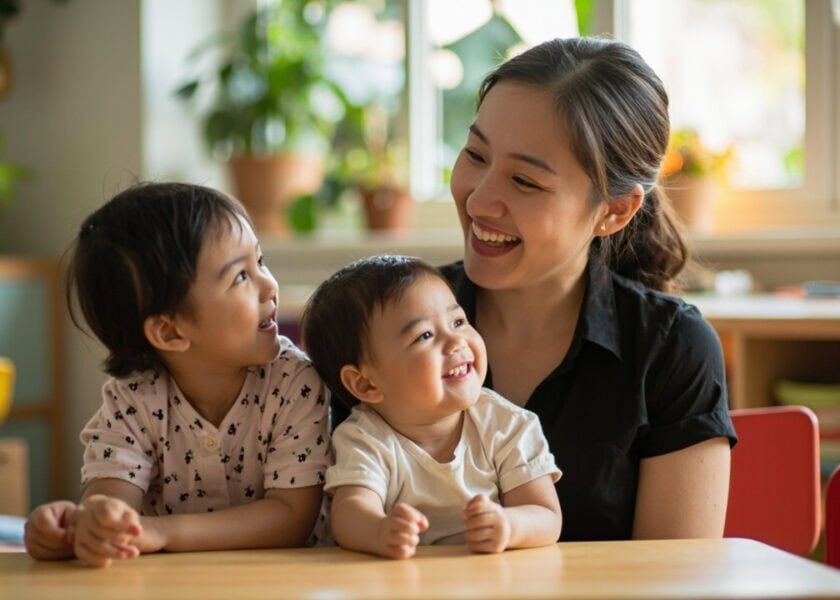
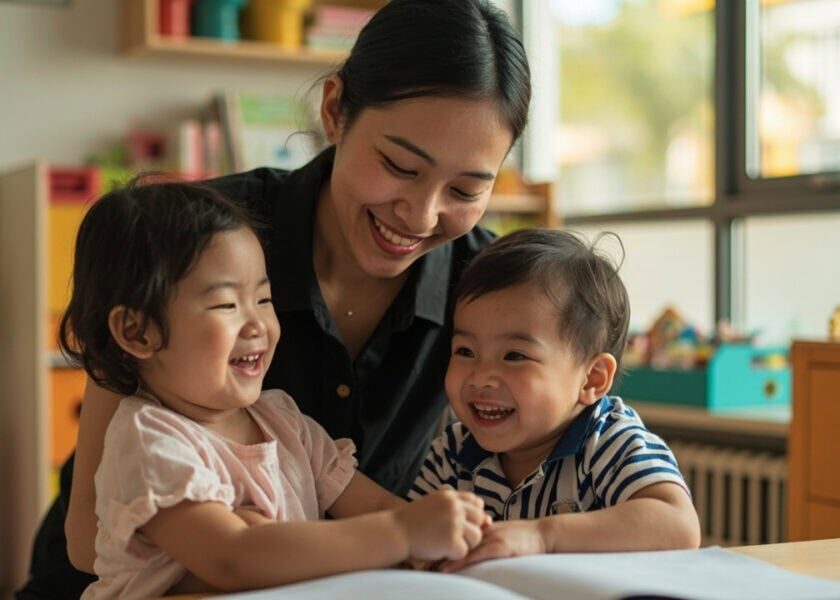
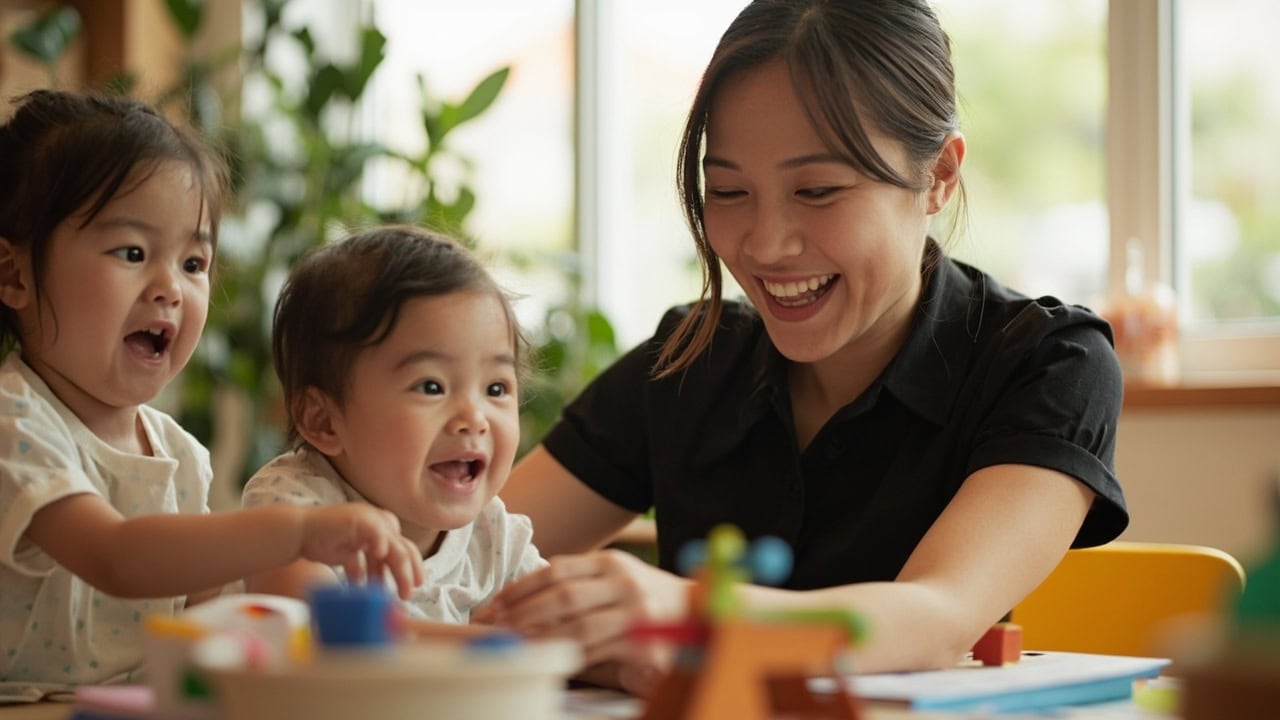
For fathers who want to engage meaningfully with their child’s care, understanding what quality actually looks like matters. In home-based childminding arrangements with small ratios, your child is not one of fifteen. They are one of three, perhaps two. This means that when the caregiver reports on your child’s day, she is speaking from real observation, from real relationship.
Look for arrangements where communication is genuine rather than ritualistic. Where the caregiver knows your child’s rhythms, their preferences, the small things that make them feel secure. Where you receive updates that actually tell you something about your child’s experience, not just a checklist of meals and naps.
Ask about transparency measures. Not because you expect problems, but because transparency allows you to engage with confidence. When you know what is happening during the day, you can build on it. You can ask your daughter about the painting her caregiver mentioned. You can follow up on the storytime moment your son described. This continuity between what happens in care and what happens at home is what children thrive on.
The Long Game: Why the Early Years Matter
Let me speak now to something that sits deeper than strategy, deeper than ratios and communication apps and daily reports. The early years are not preparation for later. They are not a stepping stone to something more important. They are, in themselves, the foundation of everything.
The child’s sense of security, their trust in the world, their willingness to explore, their capacity for relationship, their emerging sense of self. These are not abstract developmental milestones. These are the building blocks of who your child will become.
And here is what I want you to understand about your role in this: you are not an accessory to this process. You are not a secondary figure, showing up when you can, helping where there is space. You are a primary figure.
Your presence, your attention, your choices, your patience, your way of being in the world. These are irreplaceable gifts to your child. Not in a sentimental way. In a concrete, developmental way. Your child needs you. Not just your time. You.
There is a way that quality childcare and active fatherhood work together that is almost invisible. The father who has peace of mind can engage more deeply. The child who has consistent, quality care brings a more regulated self to the time spent with father. The caregiver who feels respected and included by a father who is genuinely engaged becomes a more committed partner in the child’s development.
These are not separate spheres. They are a system. And fathers are not peripheral to that system. They are architects of it.
I want to speak directly to the quiet question that many Singapore fathers carry but rarely voice. The question of whether they are doing enough. Whether they are present enough. Whether their child will remember them the way they want to be remembered. Whether their contribution matters in the long run.
Here is the answer: your child will not remember every moment you were there. They will not keep a tally. But they will remember the texture of your presence. The quality of your attention when you were with them. The feeling of being truly seen by you. The security of knowing that you chose carefully for them, that you took their care seriously, that you showed up not because you had to but because you wanted to.
They will carry that feeling into their lives, into their relationships, into their own capacity to trust and explore and love.
That is what you are building. Not through grand gestures, not through heroic acts of parenting, but through the accumulation of daily choices, daily presence, daily commitment to being the father your child needs you to be.
An Invitation to Step In
The childcare conversation in Singapore is changing. It is slowly, quietly recognizing that fathers are not an afterthought in this story. That the modern Singapore family looks like both parents working, both parents deciding, both parents engaged.
Trusted, quality-focused childcare arrangements understand this too. They build their services around the reality of partnership—with small ratios that allow for genuine attention, communication that keeps fathers informed and involved, and the professional respect that childminders and caregivers deserve.
At EduNanny, this means structured support for the CDA and Baby Bonus schemes, so the financial weight of quality care is thoughtfully managed. It means treating your relationship with your child’s caregiver as a true partnership, where your observations at home and their observations in care create something whole for your child.
This is not about convenience. This is about partnership. And fathers deserve a seat at that table. Not by demanding it, but by recognizing that they have always belonged there.
So here is my invitation to you. Step into that seat. Ask the questions. Show up at the drop-off and the pickup and engage fully in between. Share what you observe at home. Listen to what is observed in care. Build the partnership. Trust your instincts and also trust the process.
And know that in doing so, you are not just choosing a childcare arrangement. You are choosing your child. You are choosing to be the kind of father who shows up, who pays attention, who chooses with clarity.
That is the father your child needs. And that is the father you already are.
For families exploring quality childcare options in Singapore, learn more about EduNanny’s approach to home-based childminding and early childhood support. You may also wish to explore the ECDA Childminding Pilot programme or read more about the EduNanny team. To begin a conversation about your family’s needs, contact EduNanny directly.