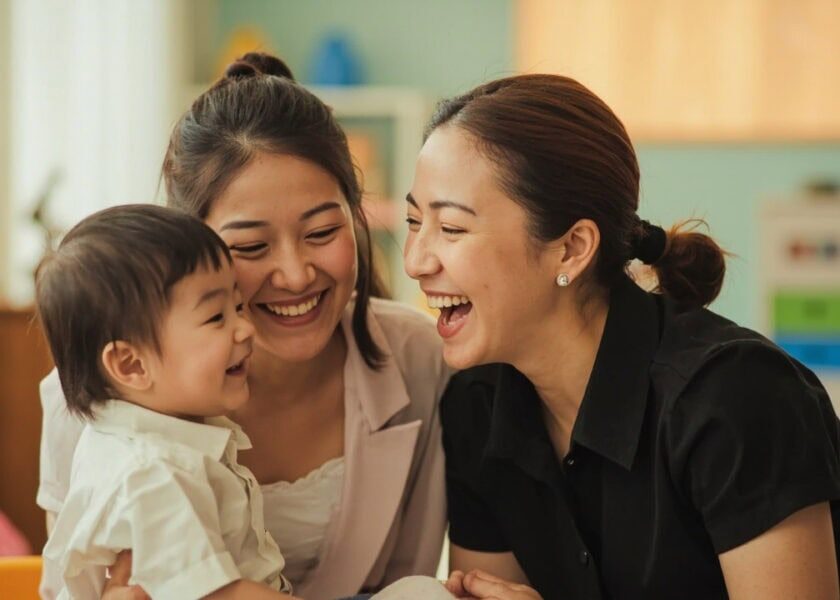
The Morning Handover Is Where Great Childcare Partnerships Begin
What the Daily Handover Really Is
Most of us never stop to examine the handover closely enough. We treat it as a passage of time, a brief interlude between home and elsewhere. But the handover is doing far more work than we realise.
When you hand your child to their caregiver in the morning, you are giving them not just a small human being but a world of information that lives only inside you. Your child’s moods. Their sleep the night before. The new word they said at breakfast. The bruise on their knee from yesterday that you are still quietly worrying about. All of that information must travel from your hands to theirs in the span of a few minutes, or sometimes just a few seconds.
And then, in the evening, it travels back. The caregiver hands your child to you and begins, if she is the right caregiver, to give you the day. Not a summary. Not a checklist. The day.
What happened. What they noticed. What made them pause and pay attention. The way your child laughed at something. The moment in the afternoon when they needed extra comfort and why. The small victory of them eating the vegetables they usually refuse.
This is not small talk. This is the currency of trust.
A great caregiver does not simply supervise your child. She holds the thread of your child’s day and hands it to you intact at the end. She has been watching, listening, noticing, and recording in her mind the shape of those hours. And she gives that back to you in a way that makes you feel, for just a moment, as though you were there too.
You are not just looking for someone to watch your child. You are looking for someone who will come to know your child the way you know your child. And that knowledge is not built in a single grand gesture. It is built in a thousand small ones, across months and years, in the daily practice of handover.
What Quality Handover Looks Like
At pickup, a meaningful caregiver observation goes beyond the logistics of meals and naps. It sounds like this:
“She was very social this morning during free play. She spent a long time building with the blocks and got quite frustrated when they fell, so we sat together and rebuilt them together, and by the end she was laughing about it. She ate well at lunch, particularly the soup, and she fell asleep easily for her nap after we read two books, the way you mentioned she likes.”
That sentence contains information about your child’s emotional landscape, their social development, their relationship with frustration and how it is being gently supported, their eating, their sleep preferences. It tells you that your child was not just occupied today. They were seen.
A great caregiver also asks questions. She asks about the night before if your child seemed tired. She asks about a new word you mentioned last week and whether your child has been saying it here. She remembers that your child does not like loud noises and has quietly adjusted the environment accordingly. She is building a complete picture of your child from both sides, yours and hers, and she understands that this picture becomes more accurate and more useful the more she knows.
Your Role in the Partnership
The handover is relational, not transactional. A transaction is one-directional: I drop off, you watch, I pick up. A relationship is bidirectional: I tell you what I know, you tell me what you observed, and together we build a richer understanding of the child we both love.
It is not only the caregiver who contributes to this relationship. You do too. The quality of the handover is something that parents can actively improve.
At Pickup: Ask Specific Questions
Not just how was her day but was she interested in the books today? Did she play with the other children, or did she prefer to play alone? Did she seem tired in the afternoon?
These questions signal to the caregiver that you are paying attention too, that this is a two-way relationship, that you are both invested in the same project. They also give the caregiver permission to share more, to go deeper, to tell you the small things that she might otherwise have kept to herself.
At Drop-Off: Offer Information Freely
Tell the caregiver about the morning so far. Tell her if your child did not sleep well, if they are teething, if there was a change at home that might affect their mood. Tell her if you are worried about something.
This is not oversharing. This is the raw material of good care. The caregiver who knows more about your child’s morning can make better decisions about their afternoon. The caregiver who knows about the new baby arriving next month can begin, gently, to prepare your toddler for that transition.
Information is the fuel of this relationship, and it flows both ways.
Building Confidence Over Time
There is no version of this that is easy. Placing your infant or young child in someone else’s care for the first time is one of the most emotionally complex acts of parenthood. You love your child. You want to be with them. And yet you have work, responsibilities, a life that requires your physical presence elsewhere.
You are not abandoning them. You are making a choice that thousands of parents in Singapore make every single day, a choice that is practical and necessary and still, somehow, feels like leaving a piece of yourself behind.
What to Watch For in the Early Days
In those early days, the handover can feel awkward and uncertain. You do not know the caregiver well yet. Your child may cry, or go quiet, or look at you with an expression that you will think about for the rest of the morning.
Here is what to watch: how does the caregiver receive your child? Does she make eye contact with you? Does she listen when you share information? Does she acknowledge your child’s emotions with warmth and patience? Does she offer you something at the end of the day, even if it is just a brief update?
These are the signals that tell you whether this relationship has the potential to become what you need it to become.
Watch your child too. Not just at handover but throughout the weeks. Does your child seem comfortable? Do they move toward the caregiver with some degree of ease? Do they resist less each morning? These are signs, not of perfection, but of a relationship that is taking root.
The Three-Month Shift
There is a moment, usually around the three-month mark, when something changes. You will not notice it at first. It will happen gradually, and then one day you will realise that the morning goodbye has become almost easy.
Your child runs toward the caregiver now instead of clinging to your leg. The caregiver greets your child by name before she even sees you. She sends a photo during the day without you asking. She remembers the small things, the particular preferences and aversions, the songs that always work.
That moment is the handover relationship becoming what it is meant to become. It does not happen by accident. It happens because of consistency. Because of attention. Because of the daily practice of handover, repeated and refined, until it becomes a language that you and your caregiver share fluently.
Navigating Difficult Days
There will be difficult days. Not every handover will be smooth. Not every pickup will bring good news. Your child will have a difficult day. The caregiver will have to manage a conflict or a tantrum or a fever. A child will fall and bruise their knee. A toddler will refuse to eat for most of the morning.
These things happen, and they will happen regardless of the quality of your childcare arrangement, because children are unpredictable and full of hard moments.
What matters is how those difficult days are handled. What matters is whether the caregiver tells you honestly, without minimising or exaggerating, what happened and how she responded. What matters is whether she follows up the next day with an update, showing you that she is still thinking about it, still attending to it.
What matters is whether you, as the parent, are able to ask your questions without feeling like you are being interrogated or judged. A parent who feels they cannot ask their caregiver about a difficult day has a problem. A caregiver who becomes defensive when a parent raises a concern has a problem. But a parent and caregiver who have built trust over months of consistent, open handover can navigate a difficult conversation the same way they navigate everything else: together, with goodwill on both sides.
You must learn to ask without accusing, to express concern without hostility, to trust that the caregiver has your child’s best interests at heart even on days when things do not go smoothly. The handover relationship is a training ground for this kind of communication. The more you practice it at pickup and drop-off, the easier it becomes to navigate the more challenging moments when they arise.
What Great Care Looks Like When You Are Not Watching
When you pick up your child and they are content, well-rested, fed, and happy, you are seeing the result. What you do not see is what makes that possible.
You do not see the twelve conversations the caregiver had with your child throughout the day. The observation she made at ten in the morning when she noticed your child was getting overstimulated and quietly adjusted the environment. The moment she saw your child reaching for a toy and anticipated the frustration that was coming and moved closer to offer help before it escalated.
You do not see the gentle adjustment of nap time by twenty minutes because she recognised the early signs of tiredness in a way that only someone who knows your child deeply could recognise. The way she sat with your child during a moment of distress and offered comfort without rushing to fix it, understanding that sometimes the most important thing is simply to be present with a child’s emotions.
This is what great childcare looks like when you are not watching. It looks like a caregiver who is paying attention at a level that most people do not even know to expect. It looks like a professional who has been trained to observe, to interpret, and to respond with both skill and warmth.
It also looks like an arrangement in which the ratio of caregivers to children allows for this kind of individual attention. Quality infant care means your child receives not just supervision but genuine, individualised care. You cannot see it from outside. But you can feel it.
You feel it in the handover. You feel it in the quality of the observation your caregiver shares with you at the end of each day. You feel it in the way your child responds to her, in the comfort they draw from her presence, in the security they project when they are with her.
Trust that evidence. It is built on something real.
What to Look For When Choosing Infant Care in Singapore
Beyond the tour and the facilities checklist, here is what truly matters when you are researching childcare options.
Questions to Ask at Your First Visit
- How do you handle the morning handover? What information do you share?
- What does a typical end-of-day update include?
- How do you communicate between parents and caregivers during the day?
- What is your infant-to-caregiver ratio?
- How do you support a child who is having a difficult adjustment?
Signs of a Quality Handover Relationship
- The caregiver makes eye contact with you and your child during handover.
- She asks questions about your child’s morning, preferences, or recent developments.
- She remembers details from previous conversations.
- At pickup, she offers specific observations rather than generic reassurances.
- She invites your questions and responds to concerns without defensiveness.
- Your child shows some degree of comfort or familiarity with her over time.
The Ratio Question
While ratios alone do not guarantee quality, they do create the conditions for it. More infants per caregiver means less individual attention, fewer observations, and less capacity for the kind of responsive care that makes handover meaningful. Ask about ratios. Ask how they affect what your child receives during the day.
The Partnership You Are Already Looking For
More than any specific service feature, what quality childcare offers is this: an understanding that the relationship between your family and your caregiver is the most important thing.
Trust is not declared. It is built, in the daily practice of handover, in the accumulation of small observations, in the quiet consistency of a caregiver who shows up and pays attention and gives your child back to you at the end of each day a little bit more known than before.
You already know, in your heart, what you are looking for. You have felt it every morning when you hand your child over and every evening when you pick them up.
You are looking for someone who will love your child the way you do, even if differently. Someone who will notice what you notice. Someone who will tell you the truth, gently, every single day. Someone who will be your partner in this long, beautiful, exhausting, extraordinary act of raising a human being.
That person is out there. And we believe that the daily handover is where you will find them. That is where the relationship begins. That is where it deepens. That is where it becomes what it is meant to be. Not someday, not eventually, but today, tomorrow, and every day after.
The next time you stand at the gate, at the door, at the handover moment, pause for just one second longer. Not because you are worried. But because you are about to do something that matters enormously.
You are about to transfer your child, your love, your trust, your hope, into the hands of another person. And then, later, you are about to get it back, enriched, expanded, and returned to you with interest.
That is the daily ritual that holds everything together. That is the partnership we are building at EduNanny Singapore: to honour that trust, to protect that relationship, and to walk beside you every step of the way.
Ready to find a childcare partner who will truly know your child?
Connect with EduNanny Singapore to learn more about our approach to infant care, our caregiver training standards, and how we support the daily handover relationship from the very first morning.