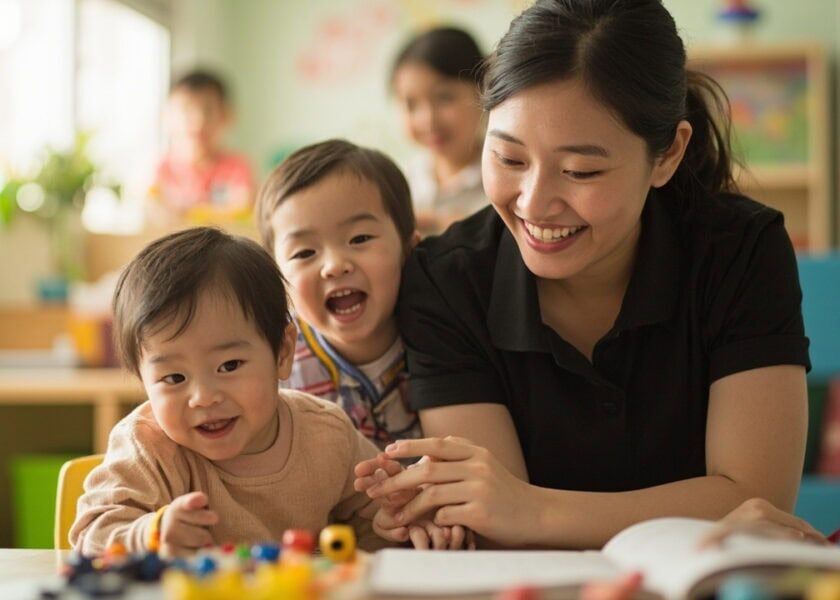
Your Child’s Second Nature Is Waiting to Be Discovered
The Central Tension Every Working Parent Carries
This is not a failure of parenting. This is the central tension of modern parenthood in Singapore — one no childcare tour, brochure, or orientation session can fully resolve.
You can ask the right questions. You can read the reviews. You can check the ratios and verify the certifications. But what you are really searching for, beneath all of that diligence, is a place where your child can show you who they are — and where you can learn to recognize it.
The most honest thing we can tell you is this: that place exists. But it requires something more than safety protocols and qualified staff. It requires an environment built on security — not just structure. On warmth, not routine alone. On the kind of consistent presence that allows a child to stop performing and start being.
What We Mean by “Second Nature”
When a child enters a new environment — any new environment — there is a period of calibration. They watch. They assess. They take the temperature of the room, the voice of the caregiver, the reactions of other children.
This is not conscious. It is instinct. And for a certain span of time, the child you see in that environment is a child performing safety, performing adaptation, performing the version of themselves they believe is expected.
This is true of adults too, if we are honest. We all calibrate. We all present the version of ourselves most likely to be accepted. A child in a new classroom, a new home, a new care arrangement — they are doing exactly what we would do in an unfamiliar workplace. They are watching. They are waiting. They are not yet themselves.
But here is what becomes possible in a different kind of environment: when a child feels genuinely safe — not just temporarily comfortable but deeply, neurologically safe — something shifts. The performance drops. The calibration ends. And what emerges is something truer and more revealing than any checklist or report card could capture.
We call this your child’s second nature.
First Nature vs. Second Nature
Your child’s first nature is what you know at home — their preferences, their quirks, their temperament in familiar spaces with familiar faces.
But their second nature is who they become in relation to the world. It is their social style, their emotional architecture, the way they reach for connection or hold back from it.
It is:
- The leader who waits before acting, or the observer who speaks with precision
- The child who needs movement to think, or the one who thinks best in stillness
- The child who gravitates toward conflict resolution, or the one who quietly notices when another child is struggling
- The child who thrives in group dynamics but seemed withdrawn in the smaller world of family
These are not behaviors to be managed. They are signals — the truest signals — of who your child is becoming.
The Foundation: Why Security Reveals Who Your Child Really Is
There is a difference, and it matters, between a child who is safe and a child who is secure.
A child can be safe in a room — safe from harm, safe from danger, safe in the way that checklists and ratios and certifications describe.
But a child is only secure when they feel it in their body. In the quality of the voice that speaks to them. In the face that appears when they wake from a nap. In the small consistent rhythms that tell them: you are held here. You are known here. You can be yourself here.
The Science of Early Security
In the first thousand days of life, a child’s brain is building at a rate that will never be matched again. Neural connections are forming at extraordinary speed. And the architecture of that development is not built by curriculum. It is built by relationships. By the quality of attention a child receives. By the consistency of the presence around them.
This is not a soft claim. It is the consensus of developmental science, confirmed by decades of longitudinal research across cultures. A child who experiences consistent, warm, responsive caregiving in their earliest years develops a different kind of internal foundation — one that allows them to explore, to take social risks, to express their preferences, to form attachments with confidence.
That foundation is not built in a month. It is built over time, through thousands of small interactions, through the accumulation of trust.
What Security Makes Possible
When a child reaches this kind of security — and it takes time, it is not immediate — something remarkable happens. They begin to reveal themselves in ways that would not happen at home, in familiar spaces with familiar faces.
Not because home is wrong, but because home is loaded. At home, there is history. There are patterns already established. There is the child you already know, and the child who already knows how to be for you.
But in an environment of genuine security, a child will sometimes show you something new:
- A preference you never noticed because the context never arose
- A sensitivity that was always there but found no space to emerge
- A social instinct — diplomatic, leadership-oriented, reflective, playful — that was forming beneath the surface all along
These are not revelations that a report card captures. They are not found in developmental milestones or academic readiness assessments. They are the kind of knowing that changes how you see your child — and therefore how you parent them, support them, and advocate for them for years to come.
What Quality Childcare Actually Looks Like
For many parents, the idea of quality childcare remains abstract — something that feels important but resists clear definition. Let us make it more concrete.
Quality infant care is not primarily about the toys on the shelves or the curriculum on paper. It is about what happens in the spaces between planned activities. It is about:
- How caregivers respond when a child is frustrated, not just when they are happy
- Whether a child’s communication style — verbal or otherwise — is noticed and respected
- The pace of the day — whether it serves the child’s rhythms or forces the child to serve it
- The caregiver-to-child ratios that allow for genuine individual attention
- How transitions are handled — the moments when children are most vulnerable and most revealing
Quality care is also about observation without intrusion. It is caregivers who are paying attention — not to surveil, but to understand. Who notice not just what a child does, but how they do it.
The Questions Caregivers Learn to Ask
In environments built on security, caregivers learn to observe with intention. They begin to notice:
- The pace at which a child approaches new experiences — do they dive in or hang back?
- The way a child seeks comfort — quickly, slowly, indirectly, directly?
- The relationships they form first — with children their age, older children, or adults?
- The activities that absorb them completely versus the ones they tolerate?
- The social role they naturally assume, or the one they quietly resist?
These observations are not collected for documentation alone. They are collected because they are meaningful. They tell us who this child is in the world. And when shared genuinely with parents — through regular updates, through honest dialogue, through the kind of transparency that lets you feel connected even in your absence — they become the bridge between who your child is at home and who they are becoming beyond it.
How EduNanny Creates Space for Your Child to Be Known
We have seen this at EduNanny, and we want to tell you honestly what we have observed.
When a child arrives with us — whether through our home-based pathways or our community and centre-based options — our caregivers are not simply providing care in the conventional sense. They are paying attention.
They are noticing not just what a child does, but how they do it. The pace, the style, the preference, the instinct. And these observations are shared with you — not as clinical reports, but as genuine insights into who your child is becoming.
We know that this matters to you. We know that handing your child to someone else for the day creates a vulnerability that is not theoretical. You need to trust the environment. You need to know what is happening. And so we have built communication into the foundation of what we do — not as an add-on feature, but as a core principle of care.
Whether through daily check-ins, caregiver notes, or the transparency measures we maintain in our spaces, we want you to feel that you are not disconnected. You are still in the loop. Your child is still yours to know.
Our Care Structure
Our care blocks run Monday to Friday, because we know how Singapore families work. And our ratios — with up to one to three infants in our home-based settings — mean that the kind of individual attention we are describing is not a promise. It is a structural reality.
There is space here for your child to be known as an individual, not managed as a number.
Addressing the Concerns Singapore Parents Hesitate to Raise
On Affordability
We are aware that for many families in Singapore, the question of affordability shapes the entire conversation about quality care. It should not have to.
Through our participation in the ECDA Childminding Pilot, we have worked to ensure that access to this kind of attentive, relationship-centered care is not only available to those with significant resources.
Our pilot fee structures are designed to be accessible. Your Child Development Account can be utilized. Your Baby Bonus can be applied. These are not marketing concessions — they are deliberate design choices, because we believe that every child deserves to be seen, and every parent deserves to know who their child is becoming.
On Trust
We understand that trusting someone else with your child’s early years is deeply personal. You are not looking for a replacement for your care — you are looking for a supplement that is worthy of your trust.
We earn that trust through consistency. Through honesty. Through the small, daily evidence that your child is not just safe, but secure. Not just supervised, but seen.
We will tell you when your child had a difficult morning. We will tell you when they surprised us with something unexpected. We will tell you what we noticed — and we will welcome you asking what we noticed, because that is the whole point.
On Whether You Are “Missing Out”
Here is what we have come to understand, through years of working with children and families across Singapore: the most valuable thing a childcare environment can give you is not preparation for school. It is not a curriculum, however excellent. It is not even safety, though safety is the foundation without which nothing else exists.
The most valuable thing it can give you is visibility.
Visibility into who your child is. Not the child you have always assumed them to be, not the child shaped by your hopes and anxieties, but the child who exists in the world — in relation to others, in social contexts, in the hours you are not there to see.
The child with preferences you did not know they had. The child with instincts you have never had the occasion to observe. The child who is, in their second nature, something both familiar and surprising.
This knowledge does not diminish you as a parent. It does not suggest that you have been doing it wrong, or that someone else knows your child better than you do. What it does is complete the picture. It adds a dimension to your understanding that home alone cannot provide — because home is one context, and your child has many.
Practical Guidance: Choosing Care That Lets Your Child’s Nature Emerge
If you are in the process of evaluating childcare options in Singapore, here are some questions worth asking — not just at the tour, but in your own quiet reflection.
Questions to Ask Yourself
- After speaking with the caregivers, do I feel they are interested in my child as an individual — or in filling a slot?
- Do the communication practices suggest genuine observation, or perfunctory reporting?
- Do the caregiver-to-child ratios allow for the kind of individual attention that lets a child feel secure enough to be themselves?
- Does the environment feel warm, or merely clean and organized?
- Can I imagine my child being fully themselves in this space — not performing, but being?
Questions to Ask the Caregiver
- How do you approach a child who is struggling to settle in?
- What does a typical day look like — and who sets the pace?
- How do you communicate with parents about their child’s day?
- What do you observe about how children form relationships with each other and with caregivers?
- How do you handle moments when a child is expressing a preference or instinct that is different from what you expected?
The answers to these questions will not be found in brochures. They will be felt in the tone of the conversation, in the specificity of the responses, in whether the people you are speaking with seem to be watching your child or simply managing them.
Two Kinds of Parenting — and the Knowledge That Changes Everything
There is a kind of parenting that operates from the outside in — from schedules, from expectations, from the desire to shape your child into the person you imagined before they arrived.
And then there is a kind of parenting that operates from the inside out — from genuine understanding of who this particular human being is, in all their specificity, in all their unrepeatable combination of instincts and preferences and ways of being.
The first kind of parenting is not wrong. It comes from love. But it is incomplete. Because a child who is only seen from the outside — only shaped, only measured against milestones — will grow up less certain of who they are. They will have been managed, but not known.
The second kind of parenting — the kind made possible by understanding your child’s second nature — is not about letting go of guidance. It is about making guidance meaningful. It is about nurturing what is actually there rather than what you hoped would be there. It is about trust: in your child, in the environment you have chosen for them, and in the process of growth itself.
When you begin to see your child’s social-emotional self — their temperament in groups, their style of connection, their way of navigating the world — you begin to make every subsequent decision with greater clarity. The school you choose. The way you respond to their struggles. The strengths you nurture rather than the anxieties you amplify. You begin to parent not from assumption, but from insight.
And that insight, gathered over time, becomes the most powerful tool you have as a parent. It guides every choice from preschool to secondary school to the choices they will one day make for themselves.
What Trust Makes Possible
That trust is not easy to build. It takes time. It takes consistent presence, consistent warmth, consistent attention — from the caregivers in your child’s life and from you, in the hours you have together.
But when it exists — when your child feels secure enough to show you who they are, and when you as a parent are open enough to see it — something extraordinary happens.
- You stop managing your child and start knowing them
- You stop worrying about whether you are doing enough and start trusting that what you are doing is right
- You see your child — the whole child — for the first time
This is what we offer at EduNanny. Not just care. Not just safety. Not just a service to fill the hours you are at work.
We offer a space where your child can be themselves. Where their temperament is not managed but noticed. Where their social style is not shaped away but understood. Where the caregiver who holds them each day knows them as a person, not just a schedule.
And we offer you, the parent, something that no checklist can provide and no tour can guarantee: the opportunity to know your child more fully than you thought possible. To see them as they are, not as you assumed they would be. To parent with insight rather than anxiety, with understanding rather than assumption.
Your child’s second nature is not hidden. It is waiting. It has been waiting, in every interaction, in every social moment, in every environment that felt safe enough to let it emerge.
We are here to help you find it. And we believe — with the quiet confidence of people who have seen thousands of children grow — that once you do, everything else falls into place.
Ready to Explore Your Options?
If this approach resonates with you — if you are looking for childcare that sees your child as an individual and helps you see them too — we invite you to learn more about what EduNanny offers.
Speak with our team, visit our spaces, and ask the questions that matter to you. We believe the right fit is not about credentials alone — it is about whether the environment feels like a place where your child can be fully themselves.
Your child’s second nature is waiting. Let us help you find it.