What Singapore Parents Notice When Choosing Childcare
Layer One: The Sensory Atmosphere
When you arrive at a childcare environment, your first task is to take in the atmosphere — not with judgment, but with your senses fully open. Before you look at the curriculum board or the teacher-to-child ratio, notice what you hear, smell, and feel.
Sound
Not the official sounds — the planned activities, the recorded music — but the ambient texture of the room. What is the general sound level? Is there a constant hum of managed noise, or does the space allow for natural quiet?
High-quality infant and toddler environments are not silent. Children this age are not meant to be silent. But there is a difference between productive noise — the sound of children engaged, problem-solving, expressing themselves — and chaotic noise that overwhelms and agitates.
Listen for whether the noise in the room feels purposeful or restless. Listen for whether there are moments of calm interspersed with activity, or whether the room is in a constant state of stimulation.
Smell
Notice what you smell. A clean space should smell like nothing in particular — neutral, well-ventilated, maintained. A space that smells strongly of air freshener may be masking something. A space that smells of damp or mildew is telling you about its infrastructure.
A space that smells of food — particularly during meal or snack times — suggests that the children are eating together, in a social, communal way. These are not trivial details. They reveal the daily texture of a child’s life in care.
Light and Pace
Consider the light. Is the space bright and artificial, or does it make use of natural light? Research in early childhood environments consistently points to the importance of natural lighting for children’s regulation, mood, and circadian health.
When you walk into a room washed in daylight, you can feel it. The children often feel it too — there is a calm alertness that differs from the slightly heightened, fluorescent edge of a space that relies entirely on artificial light.
Then there is the pace — harder to articulate but easier to feel. When you observe a room for ten or fifteen minutes, can you sense the rhythm of the day? Is there a predictable flow to the activities — transitions that are prepared for, expectations that are clear? Or does the room feel rushed, reactive, managed by urgency rather than intention?
Quality infant and toddler care has a heartbeat. It has a tempo. You will not find it written on the wall. You will feel it in how the children move, how the caregivers respond, how the day unfolds.
Layer Two: The Invisible Architecture of Care
The second layer is what you might call the invisible architecture of care: the micro-interactions between caregivers and children that happen in the margins of the day. The moments that no tour is designed to showcase. The moments that reveal who the caregivers really are when they think no one important is watching.
Presence in Distress
Watch a caregiver kneel — or lower herself to a child’s level — to speak with a toddler who is upset. Notice what she does with her hands. Does she touch the child in a way that is intentional, grounding, present? Or does she reach for the child while her eyes and attention are already somewhere else?
Watch how she speaks. Is her tone modulated — calm, warm, unhurried — even when the child is crying? Or does her voice tighten, speed up, become impatient?
These are not moral judgments about the caregiver as a person. They are observations about presence. Presence, in infant and toddler care, is not a soft ideal. It is a functional necessity.
A child who is emotionally dysregulated needs a caregiver who can co-regulate with them — whose own nervous system can serve as an anchor. That anchor is built through physical presence, through attuned touch, through vocal tone that communicates safety. When you see it, you will know. It has a quality that cannot be faked for long.
The Ordinary, Unremarkable Moments
Now watch what happens in the ordinary, unremarkable moments. A caregiver is changing a diaper. She narrates what she is doing — “I am going to lift your legs now, here we go” — in a voice that suggests she genuinely believes this matters. She makes brief eye contact. She smiles. The baby on the changing table watches her face with the kind of focus that suggests something is being received, registered, felt.
This is not performance. This is the texture of a relationship. And it is happening throughout the room, in dozens of small moments, throughout the day.
Contrast this with a room where children are being cared for competently but without attunement. The tasks get done. The children are clean, fed, safe. But the caregivers’ attention is not fully present. They are managing, not connecting.
The children in this room may appear fine on the surface — compliant, occupied — but something in their bodies is different. There is a vigilance, a self-reliance, that should not be present in children this young. They have learned, already, to manage themselves because the adults around them are not quite managing alongside them.
Ask to Stay and Watch
When you visit a childcare environment, ask to be allowed to observe for longer than the official tour allows. Ask if you can sit in a corner for thirty minutes and simply watch.
If the answer is uncomfortable — if you are redirected, if the observation is tightly scripted, if the children are moved into a special performance — that itself is information. A high-quality environment is not afraid of observation. It invites it.
Layer Three: Language and Children’s Ease
The third layer is language — specifically, the language caregivers use with infants and toddlers who do not yet have words. This is one of the most underappreciated quality signals in early childhood care.
Speaking to Non-Verbal Children
Listen to how caregivers speak to children who cannot yet respond verbally. Do they use full sentences? Do they narrate the world? “You are reaching for that blue block. It feels smooth, doesn’t it?” Or is communication limited to directives and corrections? “No. Don’t touch that. Sit down.”
Both are languages. One builds cognitive and linguistic architecture. The other merely manages.
More importantly, listen to the tone. There is a quality of warmth in the voice of a caregiver who genuinely enjoys and respects the children in her care. It is audible even when the words are simple. It communicates: I see you. You are real to me. You matter.
Speaking About Children
Listen to how caregivers speak about children when they are not speaking to them. Do they refer to children with affection and accuracy — “Marcus has been working so hard on his puzzle this morning” — or with vague generality?
Do they notice individual differences, individual rhythms, individual needs? Or are children treated as a category — “the babies,” “the toddlers” — with interchangeable care?
The language caregivers use reveals their mental model of the children in their care. A caregiver who speaks about a child as a person — with nuance, with attention, with genuine interest — is a caregiver who is engaged in a real relationship. A caregiver who speaks about children generically is a caregiver who may be providing competent care without real connection.
What Children’s Ease Tells You
The fourth quality signal is perhaps the most counterintuitive: the ease of the children themselves. Not their activity, not their engagement, not their performance — but their ease. The quality of being at rest within their bodies, in the presence of the adults around them.
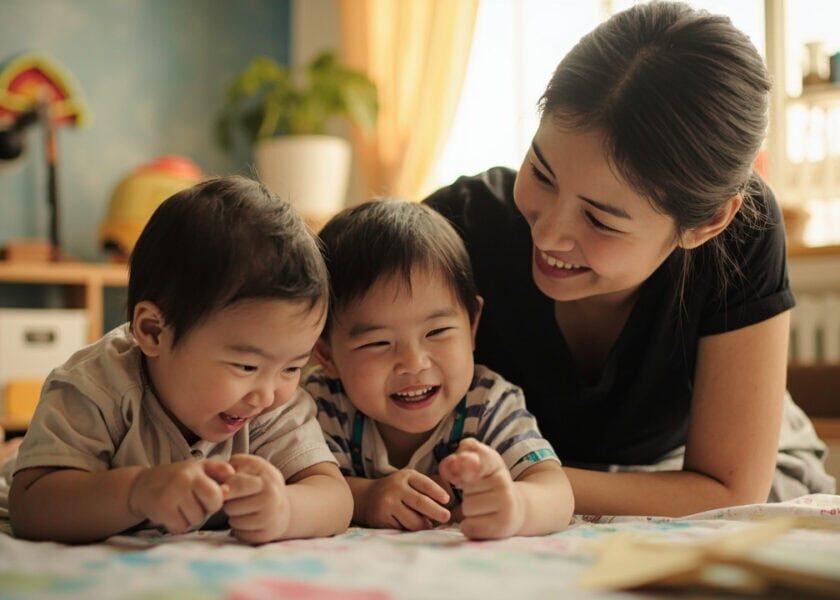
Children in high-quality care are not constantly performing. They are not constantly engaged with activities. They are often simply present — playing in a loose, unforced way, resting against a caregiver’s leg while they watch others, exploring a material with the unhurried attention that comes from feeling safe.
This kind of ease is only possible when the environment is genuinely trustworthy. It is a physiological state. When a child feels safe — when their nervous system has registered that this place, these people, are reliable — they relax. They can focus. They can play deeply. They can be themselves.
Now look for the children who are not at ease. Not the children who are crying — children cry for many reasons, and crying alone is not a quality indicator. Look for the children who are watchful. Who seem to be monitoring the adults in the room rather than being absorbed in their play. Who are unusually compliant, unusually quiet, unusually self-contained.
These children may appear fine. They may be described as “good” or “easy.” But the quality of their watchfulness is telling you something. It may be telling you that these children have learned, somewhere in their short lives, to keep an eye on the adults. To be prepared. To manage themselves so that the adults do not have to.
This is one of the most important things observation can reveal: the difference between a child who is quiet because they are content, and a child who is quiet because they have learned to be careful. The first is a sign of safety. The second is a warning sign that something in the relational environment has taught the child to be self-reliant before they are ready.
Red Flags That Look Minor
You will also learn to notice the red flags that look minor. These are the small details that seem insignificant in isolation but, accumulated, tell you something about the culture of care.
After naptime: Notice how the room smells. A room that smells of diapers or bodies after a rest period suggests that children are not being attended to during or after sleep — that hygiene is not being managed proactively. It is a window into how attentively children are being cared for in the most vulnerable moments of their day.
Transitions: Notice how transitions are handled — from activity to activity, from indoor to outdoor, from eating to playing. These are the moments when children most need scaffolding.
Watch whether caregivers prepare children for transitions (“In five minutes, we will clean up and get ready for lunch”) or whether children are simply told to stop what they are doing and move. The first approach respects the child’s process. The second manages them efficiently.
Maintenance over design: Notice the physical condition of the space. Not the design — the maintenance. Are the high surfaces dusty? Are the toys clean? Are the changing tables sanitised between children? Is there a clear protocol for hygiene, and is it being followed?
These details are easy to overlook in a tour. They are easy to manage for a single visit. They are much harder to sustain as a culture. When you notice them, ask yourself: is this the care I want for my child every day, over months and years?
The culture between adults: Notice how the caregivers treat each other. The culture of an early childhood environment is often visible in the relationships between the adults.
Do the caregivers seem to respect each other? Do they collaborate, communicate, support each other? Or is there a hierarchy, a tension, a sense that the team is not functioning well?
The quality of the adult relationships in a childcare environment matters because children are always watching. They are learning, from everything they observe, how people relate. An environment where adults treat each other with care and professionalism is an environment that is likely to treat your child with care and professionalism.
What Matters Most: The Caregiver Relationship
There is one more lesson that parents often learn the hard way: a great facility with the wrong caregivers still fails. Conversely, a modest facility with extraordinary caregivers can exceed expectations.
The physical environment matters. It sets the stage. A well-designed space with appropriate materials, safe infrastructure, and thoughtful layout creates conditions for quality. But it does not guarantee quality.
What guarantees quality is the relationship between the caregiver and the child. That relationship is built in moments — in micro-interactions, in attunement, in the daily accumulation of small acts of seeing and being seen.
No amount of beautiful design replaces a caregiver who is genuinely present. No amount of sophisticated programming replaces a caregiver who responds to your child as a person.
This is why the observation skills we have been discussing matter so much. When you learn to read an environment — to notice atmosphere, interaction, language, ease — you are learning to find the caregivers who will actually shape your child’s early experience. You are learning to look past the things that are easy to present and find the things that are hard to fake.
Preparing Your Eye
There are ways to prepare your eye before you set foot in a childcare environment. Read about early childhood development — not just to know what to look for, but to understand why it matters. Understanding the research behind infant-caregiver attunement, about the importance of responsive interaction for language development, about the role of co-regulation in emotional development — this knowledge will help you recognise quality when you see it.
Visit more than one environment. The first childcare visit is always disorienting. You have no baseline for comparison. By the third or fourth visit, you will begin to notice differences more clearly. You will start to feel what distinguishes a room that is merely well-managed from a room that is genuinely warm.
And trust your body. Before you have the language for what you noticed, you may have a physical response — a feeling of ease or tension, a sense of warmth or coldness in the room. Many parents dismiss this as intuition, but it is often the sum total of observations your conscious mind has not yet organised. Pay attention to it. Ask yourself: what is my body telling me about this place?
What EduNanny Singapore Looks Like Through an Informed Eye
This is what EduNanny Singapore is designed to be, seen through the eyes of an informed observer.
EduNanny is part of the ECDA Childminding Pilot — a government-supported initiative that reflects a growing recognition that infant and toddler care in Singapore needs to be understood differently, provided differently, valued differently. The pilot creates pathways for both home-based and centre-based care, giving families options that suit their lives while maintaining rigorous standards.
In an infant programme with ratios of up to one caregiver to three children, there is space for the kind of individual attention that infants need — not just for safety, but for relationship. The pilot fee structures are designed to make quality care accessible. CDA and Baby Bonus funds can be used, which means the financial architecture of care is thoughtfully considered. Monday through Friday care blocks provide the regularity that young children thrive on.
Across its environments — whether home-based or centre-based — EduNanny maintains standards of communication and transparency that invite, rather than resist, close observation.
What you would notice, walking into an EduNanny environment, is the same thing an experienced observer notices in any high-quality space: a sense of calm purpose. The children would not be performing for you. They would simply be present — engaged in their play, settled in their bodies, secure in the knowledge that the adults around them are attentive and reliable.
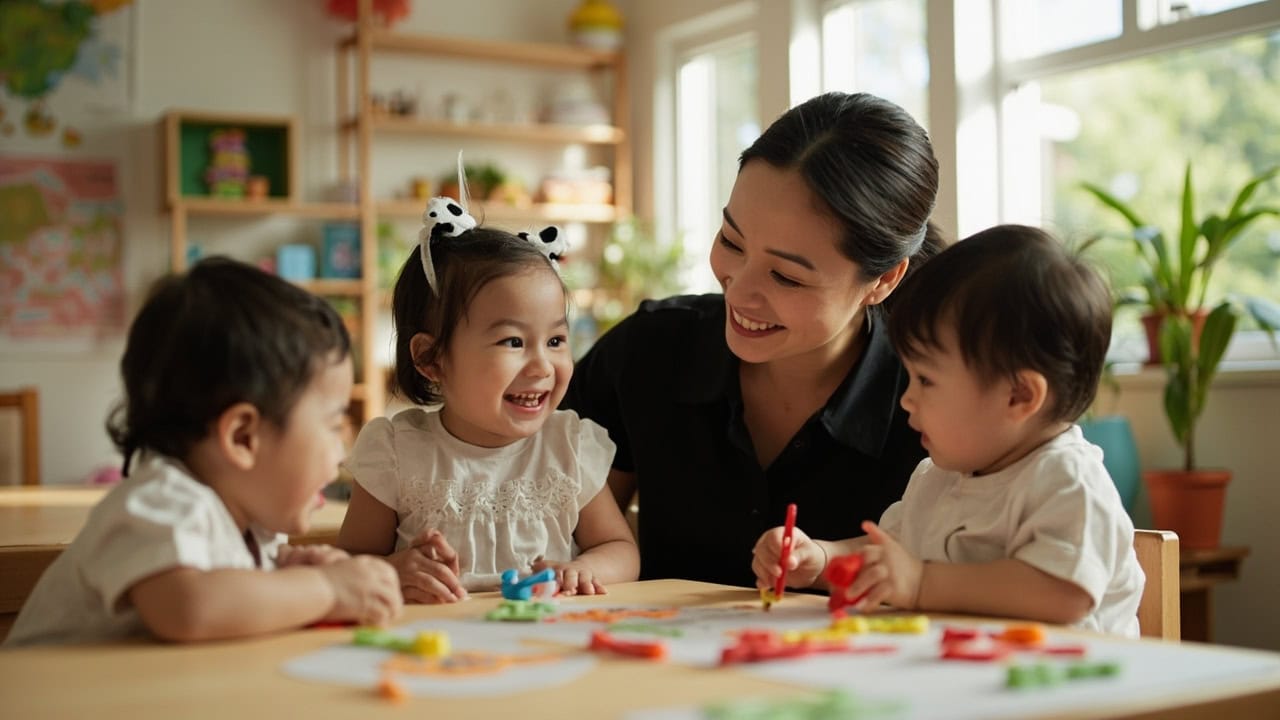
The caregivers would be present too — kneeling to children’s level, narrating the world in warm and unhurried voices, responding to distress with regulated calm. The atmosphere would be clean and natural, well-lit, unhurried. The room would have the quality of a space where real care is happening.
And if you asked to observe — to sit quietly, to watch the margins of the day, to see what happens when you are not the focus of attention — you would find an environment that welcomes it.
Because EduNanny has nothing to hide. It is built on the belief that quality care can withstand scrutiny, that transparency is not a risk but an invitation, that parents who learn to observe become better partners in their children’s care.
Common Questions Singapore Parents Ask
“How do I know if I’m evaluating the right things?”
Most parents worry they lack the expertise to assess childcare properly. But evaluation in this context is not about knowing pedagogy — it is about noticing human quality. You already know what warmth feels like. You already know when attention is present versus performative. The skill is not in acquiring expertise; it is in trusting the observations you are already capable of making and learning to sharpen them.
“What if the centre seems great but something is still wrong?”
This is precisely why observation across multiple layers matters. A beautiful facility can mask relational distance. A warm caregiver can hide inconsistency. But when you learn to read atmosphere, micro-interactions, language, and children’s ease together, you create a composite picture that is much harder to fake. No single detail is decisive. The pattern is everything.
“Is it rude to ask to observe for longer?”
Ask anyway. A confident, quality environment will not only permit this — it will appreciate it. The request to observe is itself a signal of engaged parenting. Any environment that discourages you from watching closely is telling you something important about how it operates when parents are not present.
“I don’t have time to visit multiple centres.”
That is understandable, particularly for working parents. But even a single extended visit — one where you ask to observe rather than simply tour — can yield more insight than three quick walkthroughs. Stay long enough to see transitions, to watch the children settle after an activity, to hear how caregivers speak to each other and to the children. Quality, if it is genuine, reveals itself fairly quickly.
A Practical Framework for Your Next Visit
Before you go, keep this structure in mind. You are not trying to assess everything at once. You are learning to notice across these layers, one at a time.
| Layer | What to Notice |
|---|---|
| Sensory Atmosphere | Sound, smell, light, pace — the room’s texture before anything is pointed out to you |
| Micro-Interactions | How caregivers kneel, touch, and speak to children — distressed or content alike |
| Language | Whether caregivers narrate, attune, and speak about children as individuals |
| Children’s Ease | Are children performing, watching, or genuinely at rest within themselves? |
| Culture in the Margins | Hygiene after naptime, transition handling, caregiver-to-caregiver relationships |
Choosing with Confidence, Not Guesswork
There is a way of choosing childcare that is rooted in trust — trust in yourself, in your ability to see clearly, in your right to evaluate what is being offered to your child.
This is not the trust that comes from feeling comfortable. It is not the trust that comes from a polished presentation or a reassuring smile. It is the trust that comes from knowledge: from the skill of observation, from the willingness to look closely, from the confidence that comes when you know what you are seeing.
The childcare visit you take should not be an exercise in passive assessment — in checking boxes and hoping you make the right call. It should be an act of informed discernment. You are not a guest being shown around. You are a parent exercising your right to understand exactly what kind of care your child will receive.
You are not looking for perfection. You are looking for something more important: genuine quality. The kind that is visible not in what is performed, but in what is real.
EduNanny Singapore exists for parents who want to choose with clarity. For parents who understand that the first thousand days matter — that the relationships formed in infancy become the template for all relationships that follow. For parents who are willing to look closely, to ask hard questions, to trust their growing ability to read what they are seeing.
Your child deserves to be known. To be seen clearly, as a full and real person, by the adults who care for them. That is what EduNanny is here to provide. And that is what you, as a parent, are learning to find.
The visit you take is not the end of the process. It is the beginning of a relationship. Go into it with open eyes. Trust what you learn to notice. And choose with the confidence that comes from knowing — truly knowing — what you are choosing.