What Singapore Parents Actually Notice When Choosing Childcare
What to Look For: A Quick Observational Framework
- Listen during transitions, not during activities. The real sound of a room shows up when no one is performing.
- Notice the smell. Genuinely clean smells like laundry and food, not air freshener.
- Watch where the children actually are. Is the space designed for them to move through it, or just to sit and be arranged?
- Find the children who are playing without an adult beside them. How they move tells you everything.
- Observe what happens when a child initiates. Does the adult give full attention, or a distracted one?
- Pay attention to the unplanned moments. How a place handles conflict or a big feeling reveals its true values.
Keep reading for the full framework—and discover what to do when you find a place that gets it right.
The Sensory Truth Nobody Tells You About
The most meaningful signals in a childcare environment are sensory. They are not on the brochure. They are not in the promotional video. They are in the air, in the ambient noise, in the way the space feels under your feet when you walk through it.
Because they are sensory, they bypass the polished performance that institutions are designed to deliver. A director can tell you about their curriculum. A tour guide can describe their philosophy. But they cannot control what your ears hear when no one is narrating.
What Does the Environment Actually Sound Like?
Not during an organised activity when everything is scripted and the children are directed. Listen during a transition—the moment between activities when the teacher has not yet called the children to the rug. Listen to what the room does on its own.
A room full of genuine quality will have a particular quality of sound. It will not be silent—children are not meant to be silent—but it will have a texture of purposeful activity.
- Children talking to each other at a natural volume
- Adults speaking at children’s height, not projecting across the room
- Occasional laughter, occasional friction
- The ordinary music of children negotiating the world together
What you want to hear is the sound of a real environment, not a performance designed to impress visitors. If the room feels unnaturally quiet during a transition, ask yourself what that silence means. Sometimes it means excellent control. Sometimes it means children have learned not to speak unless directed. Knowing the difference matters.
The Smell That Tells the Real Story
Now consider the smell. This one makes people uncomfortable, but it matters more than most parents in Singapore realise.
A childcare environment should smell like clean laundry and soap and food and the ordinary life of children. It should not smell of heavy air freshener, which is often used to mask odours that deserve attention.
A place that smells genuinely clean and lived-in tells you something about how the space is maintained when no one is touring. A place that smells aggressively neutral should raise a quiet question: what are they neutralising?
Reading the Space Beyond the Decorations
Walk further. Notice the spatial arrangement. Not the decorations—anyone can hang a mobile or frame a photo. Notice where the children actually are.
Are they clustered in one corner while the rest of the room sits unused? Or is the space arranged so that children can move through it with some degree of choice?
A genuinely well-designed environment for young children will invite movement. It will offer nooks and surfaces at different heights. It will feel, to an adult eye, slightly chaotic, because children do not live in orderly rows. If the room feels too clean, too arranged, too pristine, ask yourself: where do the children actually play in it?
What Children’s Behaviour Tells You
And then watch the children themselves.
Child behaviour is the most honest thing you will observe during any visit. Children do not perform for visitors. They do not sustain good behaviour for the duration of a tour. What they show you in those unguarded moments is the truest picture of how a space affects them.
So look past the children who are directed to wave at you or show you their artwork. Find the children who are playing without an adult beside them. Notice how they move through the room.
Do they move with a kind of ease, or do they seem to be waiting—waiting for direction, waiting for permission, waiting for something to happen to them?
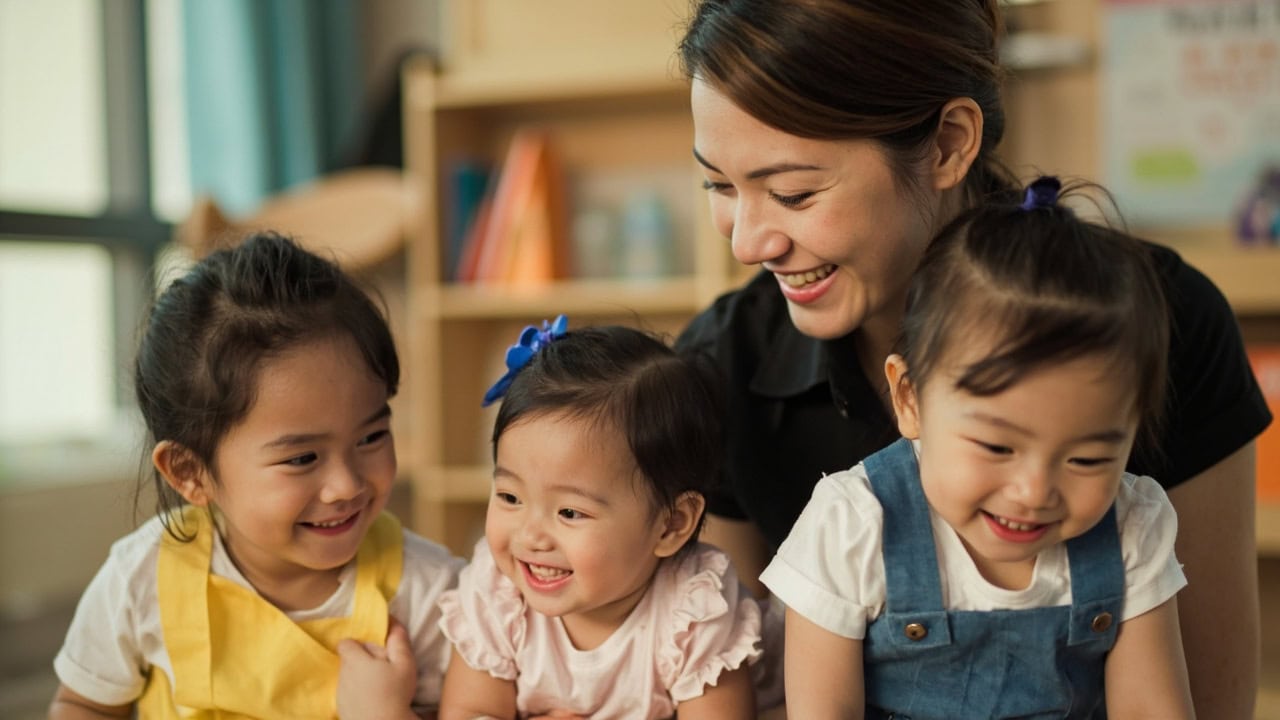
Children who feel safe and engaged in an environment do not wait. They investigate. They solve small problems. They move from one activity to another with the unhurried confidence of children who trust that their environment will support them.
Watch how children speak to each other, and how the adults around them respond to that speech.
One of the most reliable indicators of quality is what happens when a child initiates. When a child approaches an adult with a question, a problem, a discovery—not in a structured circle time, but in the ordinary flow of the morning—what happens?
- Does the adult stop what they are doing?
- Do they kneel or sit to the child’s level?
- Do they listen as though what the child has to say matters?
The difference sounds small. It is not small. It is the entire foundation of how a child learns to trust that their voice matters in the world.
The Moments That Reveal Everything
Every childcare environment can manage a scheduled activity. Every childcare environment can get through circle time, serve a meal, and conduct a tour. What separates good from excellent is what happens in the gaps—in the unplanned moments when something goes slightly wrong.
When two children collide over a toy. When a child has a big feeling that does not fit neatly into the schedule. When an activity runs over and the room has to improvise.
These are the moments when you see what a place really believes about children.
- Does the adult intervene with control, or with curiosity?
- Do they solve the problem for the children, or do they stay close enough to ensure safety while giving the children the chance to find their own resolution?
- Do they comfort the child who is upset with genuine warmth, or do they move quickly to restore order because someone is watching?
This is what we mean when we talk about responsive caregiving. It is not a curriculum item. It is not something you can put on a wall. It is a quality of presence that you will feel when it is there and feel the absence of when it is not.
And you do not need special training to recognise it. You have been responding to your own child’s needs since birth. You know what attentive care looks like. The question is whether you trust yourself enough to recognise it when you see it in someone else.
What Quality Childminding Actually Looks Like
For parents in Singapore researching infant care specifically, the stakes feel even higher. Your infant cannot tell you what their day was like. They cannot describe whether they felt safe, whether they were held, whether someone noticed when they were tired or hungry or grizzly.
Which means your observational skills matter more, not less, when choosing care for a baby.
Here is what to look for in an infant care setting:
- Ratios that allow for real attention. In infant care, the caregiver-to-child ratio is not a bureaucratic number. It is a description of how much noticing is possible. When one caregiver is responsible for three infants, each baby has a realistic chance of being known—their rhythms, their cues, their preferences.
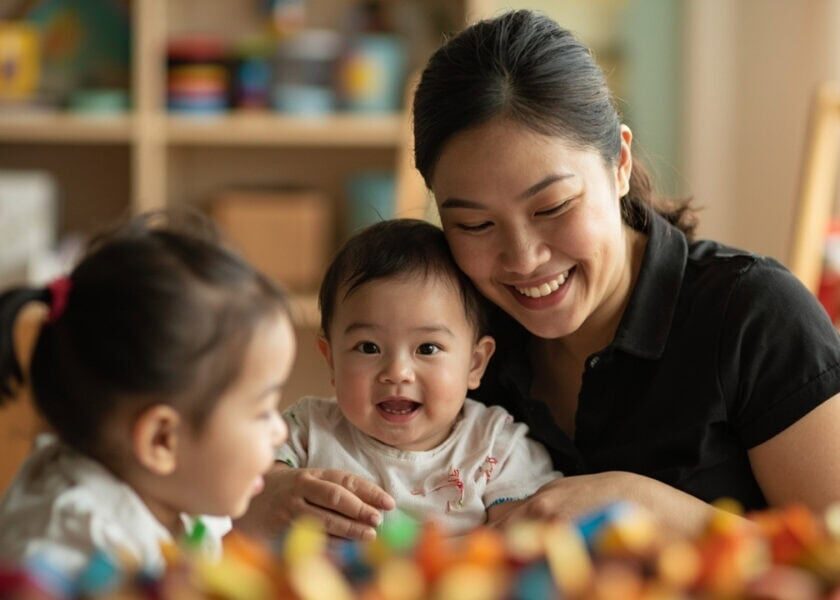
- Warm, unhurried physical interaction. Watch how caregivers hold and move the infants in their care. Do they hold eye contact during feeding? Is there gentle talking and cooing, or is it task-focused and silent?
- A predictable but flexible rhythm. Infants thrive on routine, but the best care adapts to the individual child’s day rather than enforcing a rigid schedule against the child’s needs.
- Responsive crying. When an infant cries, does the caregiver respond promptly and with calm warmth? Or does crying go unaddressed for extended periods while tasks are completed?
Centre-Based vs Home-Based: Choosing the Right Model
Many Singapore parents find themselves choosing between home-based childminding and centre-based care. The observation framework works for both—but what you are looking for shifts slightly.
| Dimension | Centre-Based Care | Home-Based Childminding |
|---|---|---|
| Environment | Designed for groups; watch for how space invites movement and choice | Domestic setting; notice whether it has been thoughtfully adapted for children |
| Ratio | Depends on licensing; ask specifically for infant ratios | Typically smaller groups, allowing for closer individual attention |
| Social exposure | More children; watch for whether interactions feel supervised and warm | Smaller group; watch for whether the child still has space to develop social skills |
| Familiarity | Your child’s primary caregivers may be different from the owner or director | One or two consistent caregivers who build deep familiarity with your child |
Neither model is inherently better. What matters is which environment, when observed through the framework above, feels like a place where your child would be seen, safe, and engaged.
Common Questions Singapore Parents Ask
“How do I know if a place is genuinely good or just good at tours?”
The sensory and behavioural signals we have discussed—sound, smell, spatial arrangement, child movement, adult responsiveness—are specifically the things that cannot be faked for the duration of a visit. A place that sounds chaotic in a good way, where children move with ease and adults respond with full attention, is not performing for you. It is simply operating the way it always does.
“I don’t have time for deep observation. I just need to make a decision.”
Singapore parents are busy, and the decision often has to be made quickly because of work commitments or waiting lists. The good news is that you do not need hours of observation.
Thirty minutes of attentive watching during the right moments—particularly during a transition, and watching what happens when a child initiates—can tell you more than an entire guided tour. You do not need to see everything. You need to see the right things.
“What if I second-guess my observations?”
This is where most parents stop themselves. They look outward for permission to trust what they saw. They search for corroboration in reviews, in ratings, in the opinions of other parents.
Reviews have their place—they can alert you to serious problems. But they cannot tell you what a place feels like. They cannot tell you whether your child would thrive there. A glowing review may come from a parent whose temperament matches the centre’s style. A lukewarm review may reflect a personality mismatch, not a quality issue.
What reviews capture best is satisfaction—but satisfaction is not the same as quality, and quality is not the same as fit. The only person who can truly evaluate whether a childcare environment is right for your child is you, informed by careful observation.
“What if I choose wrong?”
No framework eliminates all risk. But the risk you are managing when you choose childcare is not the risk of finding a place that looks perfect. It is the risk of choosing blindly and hoping.
What this framework does is shift you from blind hope to informed awareness. You will know—better than you did before—what quality looks like. And if you find a place that shows the signs, you can choose it with real confidence, not just optimism.
Your Confidence, Not Just Reassurance
What EduNanny offers is not just a service. It is a different way of approaching the question of who will care for your child.
We are not asking you to trust us blindly. We are asking you to look, to observe, to ask questions, and to find in us the qualities that you now know how to recognise.
We are not here to perform. We are here to be seen.
Here is what we have learned from hundreds of conversations with Singapore parents: you are not inadequate. You are not under-equipped as a parent. You simply have not been given a framework for this particular task. Instincts are powerful. But instincts sharpened by knowledge are more powerful still.
When you walk into a childcare environment with both your heart and your eyes open, you will see things that no brochure can hide and no review can capture. You will see whether the children there are calm, engaged, and free to be themselves. You will see whether the adults are present, warm, and responsive. You will see whether the environment smells like life and sounds like purpose.
You will see whether this is a place that cares about children, or a place that cares about appearing to care about children.
And when you see it, you will know. Not because someone told you what to look for. Because you looked, and you learned to see.
Explore EduNanny
EduNanny is part of the ECDA Childminding Pilot, which means our approach is grounded in standards that go beyond what you might find in a standard centre tour.
We offer pathways that work for your life: home-based care, where your child is supported in familiar surroundings, and community or centre-based options where a broader social environment serves them well. For infants, we maintain a ratio of up to one to three, because quality at this age is not about programs or curriculum. It is about the consistent, attentive presence of a caregiver who knows your child.
We know that affordability matters. The pilot fee structure is designed to make quality care accessible, and CDA funds and Baby Bonus are both applicable—so the financial logistics do not become another source of stress.
Trust is built through transparency. Where CCTV measures are deployed, you have eyes on the environment. Communication is ongoing, not just at pickup. These are not add-ons. They are part of how we think about the relationship between a parent and a childcare provider—as a partnership built on information, not on trust alone.
If you are ready to take the next step—to tour a space built around the principles described here, or simply ask the questions that matter to you—we welcome that conversation.
Because your child deserves to be seen. And so do you.
Speak with our team to explore infant care and childminding options that hold up to honest observation.