What Your Child Learns in Singapore Quality Childcare
The Moment Your Child Came Home Changed
There is a moment, familiar to every working parent in Singapore, that arrives quietly at the end of the day. Your child comes through the door, and something is different.
She waited her turn at the water table without being asked. She used a word you do not remember teaching her — a real word, placed in a real sentence, about a real feeling. She looked at another child’s tears and walked toward her, not away.
You stand there, still holding your bag, and you think: where did that come from?
The honest answer is: from the hours you were not there.
That is not a cause for guilt. It is, if you let it be, a cause for wonder.
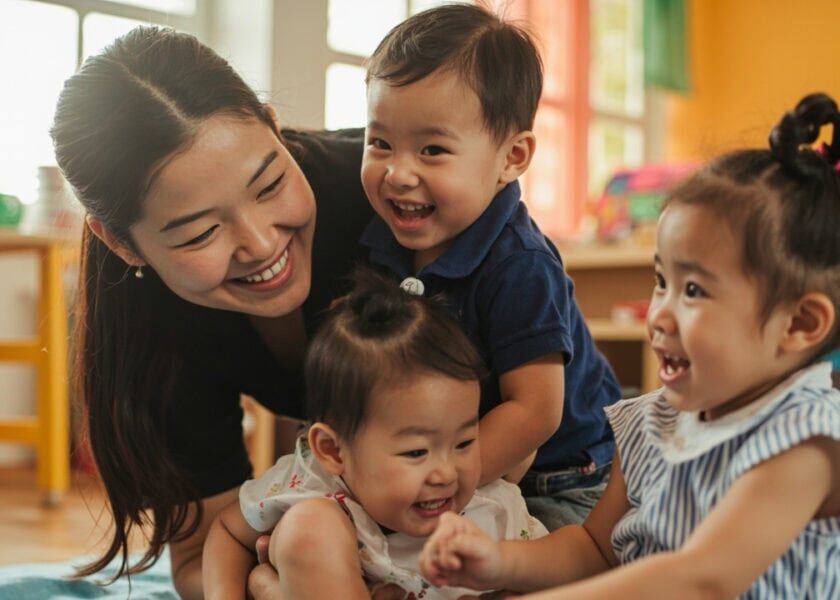
Because the hours your child spends in quality care are not empty hours. They are dense with learning — learning so textured and ongoing that it rarely fits neatly into a daily update or a photograph. It happens in the negotiation over a red truck. It happens when a caregiver crouches beside a crying toddler and names, slowly and clearly, what he is feeling. It happens at the lunch table, where sharing is not a rule imposed from above but a practice worked out, daily, between small people who must find a way to be together.
This is what quality childcare actually teaches. Not the decision you made to return to work — that has been made, and you made it with care. Not the goodbye at the door — that moment has passed, and you both survived it, as you always do.
We want to talk about what happens after. What is actually being built, hour by hour, inside the environment you chose. The curriculum that has no name on a timetable. The learning that leaves no neat report card. The invisible curriculum of quality childcare.
What Quality Childcare Actually Teaches: Five Areas of Learning
Social Problem-Solving
Most parents sense that their child is growing in childcare, but they rarely have the language to name exactly what is changing. Let us start with something fundamental: children in good childcare settings are solving social problems all day long, and they are getting remarkably good at it.
Consider what a morning actually contains, in a quality home-based or centre-based setting with a high ratio of adults to children. Two children reach for the same toy. One grabs. One cries. What happens next — between the two of them, and between them and the caregiver — is not trivial.
It is one of the most complex cognitive exercises a young child can undertake. There are emotions to manage, messages to send, responses to interpret, outcomes to negotiate.
A skilled caregiver does not simply intervene and resolve the conflict. She creates the conditions for the children to experience the problem, feel the weight of it, and discover — with gentle, calibrated support — what a solution looks like when you are two years old and have not yet learned the word “compromise.”
Children who practice this daily develop what developmental psychologists sometimes call social cognition — the ability to read a situation, understand another person’s perspective, and act in a way that accounts for both. You will not see this on a daily report. You will see it when your child comes home and, without prompting, offers to split a biscuit with her sister.
Emotional Regulation
Now let us talk about something that is harder to witness but more important still: emotional regulation.
Every parent wants a child who can manage big feelings. Every parent discovers, within the first two years, that this is one of the most demanding capacities a human being can develop — and that it cannot be taught through explanation alone.
A child learns to regulate her emotions by being regulated alongside. By experiencing, again and again, what it feels like when a calm, attentive adult sits with her in the middle of her distress and does not panic, does not dismiss, does not fix — but stays, steady and present, until the storm passes.
This is called co-regulation, and it is one of the most powerful processes that happens inside quality infant care. A caregiver who can meet a screaming toddler with quiet attentiveness — who can name the feeling out loud, reflect it back, and wait — is doing something that reshapes a child’s nervous system.
Over months, over a year, the child begins to internalize that steadiness. She learns that big feelings do not destroy the world, that they can be survived, that someone will stay close through them. A developing child benefits from multiple sources of regulatory support — a village, as the saying goes, except this village has been trained and vetted and structured to do this work with intention and skill.
Language Development
Language development is the third area where the invisible curriculum works with extraordinary depth. The child who comes home using full sentences. The child who narrates her day in sequence, with cause and effect. The child who asks a question you have to stop and think about before you can answer.
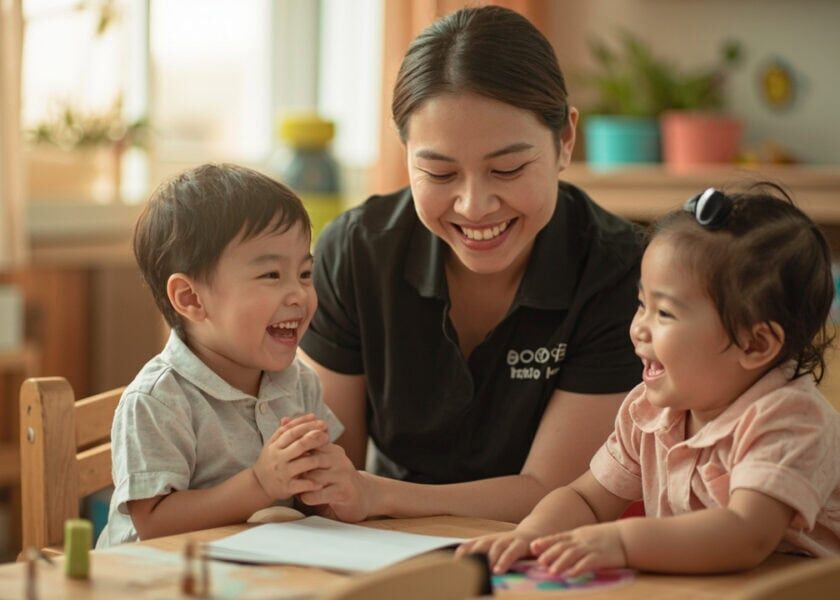
What parents rarely see is how this language is built. It is not built through flash cards or vocabulary drills. It is built through authentic conversation — the kind of back-and-forth that happens when a caregiver sits beside a child at play and responds to what the child is doing with real words, real questions, real engagement.
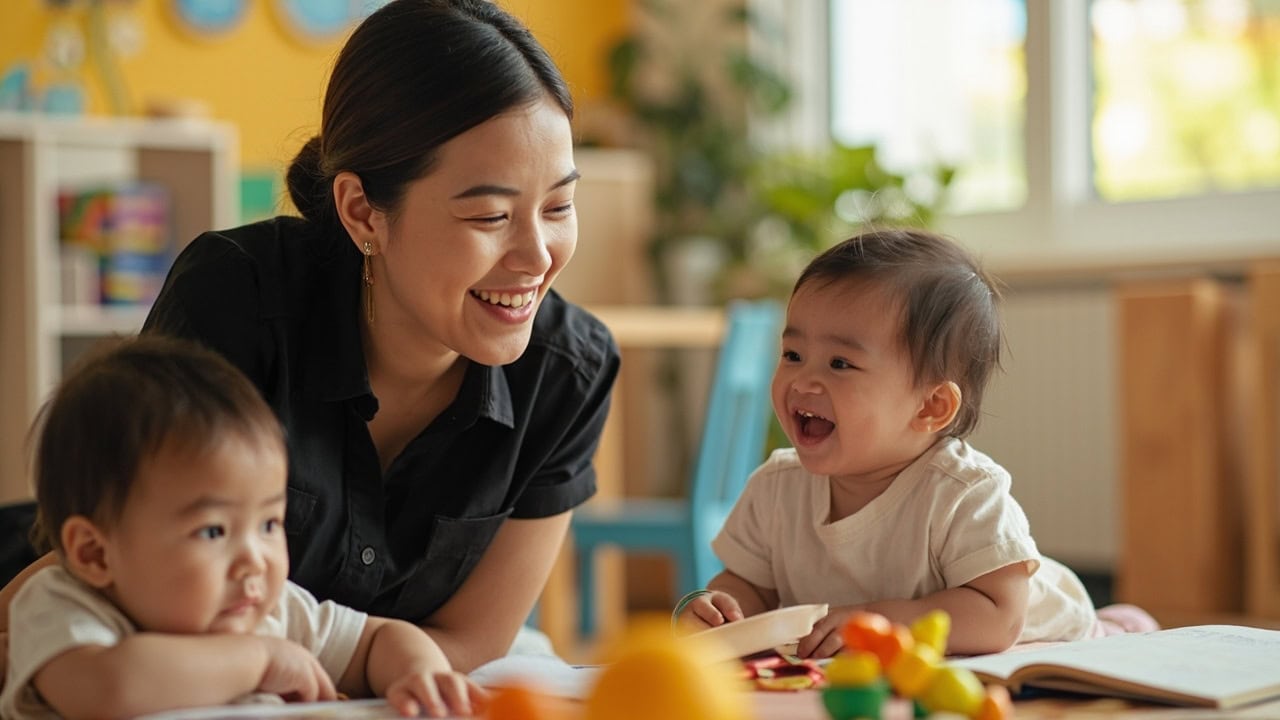
When a caregiver narrates a child’s actions back to her — “You are stacking the blocks so carefully. The blue one is on the bottom. Now it is wobbling” — she is giving that child a model of language in context. She is showing her that words describe the world, that they connect people, that they make thoughts visible.
Children in enriched care environments hear a significantly greater variety and complexity of language than children in less responsive settings. They are addressed as conversational partners, not just recipients of instruction. They learn not just words but the music of language — rhythm, tone, the way meaning shifts when you raise your voice versus when you whisper.
Independence and Resilience
Singapore parents are ambitious for their children. That is not a criticism — it is a cultural reality, shaped by a city-state that has built its prosperity on human capability, and by parents who want their children to be not just safe but strong.
What quality childcare builds, alongside safety and warmth, is the particular kind of strength that comes from learning to manage uncertainty. Think about what a typical morning in quality care actually asks of a child. There are transitions — from free play to circle time. There are expectations — to sit, to listen, to wait. There are small frustrations that cannot be avoided — the book she wanted is already being read, the friend she wanted to sit beside chose a different spot. And there are small victories — she climbed the ladder to the slide, she poured her own water, she put on her own shoes with only a little help.
Each of these moments is an opportunity for a child to learn something that will serve her for the rest of her life: that the world does not always arrange itself to her preference, and that she has the capacity to adapt, to cope, to try again.
A caregiver who allows a child to experience manageable frustration — who resists the urge to smooth every obstacle from her path — is teaching her something no amount of praise or protection can teach. She is teaching her that she is capable. This is supported risk-taking — the calibrated, safe, adult-attended risk that lets a child discover what she can do before she is afraid of trying.
Cultural Fluency
Singapore is one of the most diverse cities on earth, and quality childcare often places a child in direct, daily contact with peers and caregivers whose backgrounds, languages, and ways of being are different from her own.
In a small group setting, your child will encounter playstyles that are not her family’s playstyles. Routines that are not her family’s routines. Languages she hears on the margins of her own. She will learn, simply by living alongside difference, that people are various — and that variety is normal, not strange.
This is not a lesson that can be taught through a textbook. It is absorbed through the body, through daily experience, through the ordinary friction and warmth of playing with someone who does not look exactly like you or speak exactly like you.
A child who learns this early — who learns that she can feel safe and curious in the presence of difference — carries that capacity with her into school, into friendships, into a career, into a city and a world that will demand it of her.
How to Read the Invisible Curriculum: A Practical Guide for Parents
The invisible curriculum is not, by definition, invisible. You can learn to read it. And learning to read it is one of the most powerful things you can do — both for your confidence as a parent and for your ability to evaluate whether a setting is truly delivering what your child needs.
What to Look For During Visits
- Observe caregiver communication: Look at how the caregivers speak to the children. Not just what they say, but how — the tone, the pace, the degree to which each child seems to be addressed as a person with thoughts worth hearing.
- Notice conflict moments: Watch how disagreements between children are handled. Does a caregiver rush in and resolve, or does she create space for the children to try?
- Assess the physical environment: Ask whether it invites movement, exploration, quiet, and social interaction — whether it seems designed around the actual needs of a developing child.
- Check the ratio: The number of children per trained adult determines whether your child can receive the individualized attention that makes the invisible curriculum possible.
Questions to Ask During Your Visit
- What does a typical morning look like?
- How do you handle a child who is struggling emotionally?
- How do you support children who are at different developmental stages?
- How does communication flow between caregivers and families?
- Can I observe a typical session before enrolling?
What to Notice When Your Child Comes Home
Notice what you see when your child comes home. Not just that she is fed and rested, though that matters too. Notice whether she seems settled. Notice whether she is more verbal than she was last week. Notice whether she plays differently after a day with other children — whether she seems to be carrying something new in the way she relates, negotiates, persists, or recovers from a small setback.
These are the footprints of the invisible curriculum. They are your evidence that the hours you were not looking were not empty.
Reassurance for Common Concerns
“Am I missing out on precious time with my child?”
You are not missing time with your child. You are giving your child something additional and essential: daily practice in being a person among people. Quality childcare does not replace what you give your child. It gives your child experiences and skills that complement and enhance your own parenting.
“How do I know the care is actually good?”
Good care produces observable results over time. Watch for these indicators: your child seems settled after care, not distressed; she is more verbal, more socially aware, more confident over time; she handles minor frustrations with increasing maturity; she talks about her caregivers and friends with warmth. The best evidence of quality care is a child who is visibly growing — not just being supervised, but being developed.
“Is this just childcare or is it actually educational?”
Quality childcare is not either-or. It is both. It provides the practical support working families need, and it delivers genuine developmental outcomes that serve your child for years to come. The learning that happens in quality childcare — the social cognition, the emotional regulation, the language, the resilience — is real education. It just happens to be invisible on a daily report, and profoundly visible over time.
What Makes EduNanny Different
EduNanny by BUTLER was built for this moment — for the Singapore parent who has already made the pragmatic choice to return to work, who has navigated the logistics and the emotions of that decision, and who now deserves to understand, with clarity and confidence, what her child is gaining in the hours apart.
A Structured, Quality-Assured Model
We operate within the ECDA Childminding Pilot, which means our model is structured, quality-assured, and designed to be genuinely accessible. Our fee structures are intended to keep quality care within reach, with CDA and Baby Bonus funding usability so that the financial architecture of Singapore’s family support system works for you, not against you.
The Ratio That Makes Everything Possible
The infant ratio at EduNanny — up to one to three, depending on the setting and age — means that each child receives the kind of individual attentiveness that makes co-regulation possible at the level it actually needs to happen. Not as an afterthought, but as a practice woven through every interaction.
Transparency and Trust
You cannot be expected to place your child in an environment you are not permitted to understand. EduNanny’s communication and transparency measures, including deployed CCTV access for parents, are built on the understanding that trust and visibility go together.
Knowledge at Your Fingertips
Our Thomas AI Chatbot — available to parents navigating questions about child development, routine, feeding, sleep, or simply the daily uncertainties of early childhood — is an extension of what EduNanny stands for: the belief that parents deserve not just care for their child, but knowledge about their child. The invisible curriculum should not remain invisible to the people who love these children most.
Choosing a Developmental Environment
Choosing childcare is not a compromise. It is not a reluctant concession made between the demands of work and the demands of family.
It is a decision to place your child in a developmental environment — a place with a curriculum, a rhythm, and a quality of human attention that can do things for your child that no single adult, however devoted, can do alone. This is not to diminish your role as a parent. It is to name the truth that children develop best when they have multiple sources of good, consistent, developmentally appropriate care.
The invisible curriculum is invisible only because it happens in the spaces between the moments we can photograph and report. It is happening in the negotiation over the red truck, in the caregiver who stays close while your child cries, in the circle time where your daughter first raises her hand and waits her turn, in the moment your son looks at a classmate who is hurt and goes toward her instead of away.
You chose this. Not by accident, not by default. You chose it when you looked at your child’s future and decided she deserved more than supervision. She deserved a place that would teach her, quietly and daily, how to be human.
At EduNanny by BUTLER, we invite you to learn more about our approach, ask questions, and see for yourself what the invisible curriculum looks like when it is made visible.
Because when you watch your child come home changed — more patient, more verbal, more socially aware — you should know exactly where that came from. And you should feel proud of the choice you made.
And she is learning.
EduNanny by BUTLER is a Singapore-based childcare and childminding service built on warmth, trust, and developmental care. Learn more about us or get in touch to explore how we support working families across Singapore.
#InvisibleCurriculum #QualityChildcareSG #EduNannySG #ChildmindingSingapore #InfantCareSG