The Quiet Architecture of Quality Childcare for Singapore Families
What Quality Childcare Actually Does
When you drop your child at quality childcare, here is what is happening beneath the surface:
- Sensory-rich environments are building your child’s understanding of how the world works — through textures, sounds, light, movement, and smell
- A predictable rhythm creates emotional security, which is the foundation for curiosity and learning
- Responsive caregivers are having dozens of micro-interactions every hour that build social-emotional architecture
- Five developmental domains — cognitive, language, social-emotional, motor, and identity — are all active simultaneously
- Your child is not being supervised. They are feeling, exploring, and becoming
If you have made the choice to place your child in warm, attentive, developmentally alive care — you have not simply solved a logistics problem. You have made a decision that matters.
At the Door: The Sensory World Your Child Enters
Let us begin at the beginning. At the moment your child steps inside.
There is light in a good childcare space. Not fluorescent, clinical light — but light that has been considered. Light that falls across a mat in a way that invites a child to notice it.
There is warmth in the sounds. A caregiver’s voice, not performing but speaking — narrating what is happening, naming objects, greeting your child by name, noticing their shoes, asking about the morning.
There is smell. Food, perhaps. Fabric. The faint, ordinary scent of a space that is lived in.
There is texture — smooth wooden toys, cool water in a tray, the particular softness of a storybook page turned by small fingers.
All of this is not decoration. All of this is curriculum.
The First Language of Quality Care
The sensory environment of quality childcare is the first language your child encounters in those hours, and it is a language spoken in feeling, not in words.
Children build their understanding of the world through their senses before they build it through language. They learn that round things roll and square things stack. They learn that a voice that sounds calm sounds safe. They learn that the smell of the room means their caregiver is near, and that near means they can explore a little further, reach a little higher, try something new.
Every texture touched, every sound attended to, every visual pattern followed — these are not distractions or entertainment. These are the building blocks of neural pathways. Each sensory experience is a message sent along a wire in the brain that says: this is how the world works. This is how I relate to it. This is what I can do here.
You cannot see this happening. That is the thing about sensory development — it is invisible by nature. It operates beneath the surface of behaviour, in the architecture of a child’s growing nervous system. But it is happening. Every morning. Every hour. In a space where the environment has been thoughtfully, deliberately shaped to offer that kind of richness.
The Difference That Looks Like Nothing
This is where the difference between supervision and genuine developmental engagement becomes important — because they look identical from the outside.
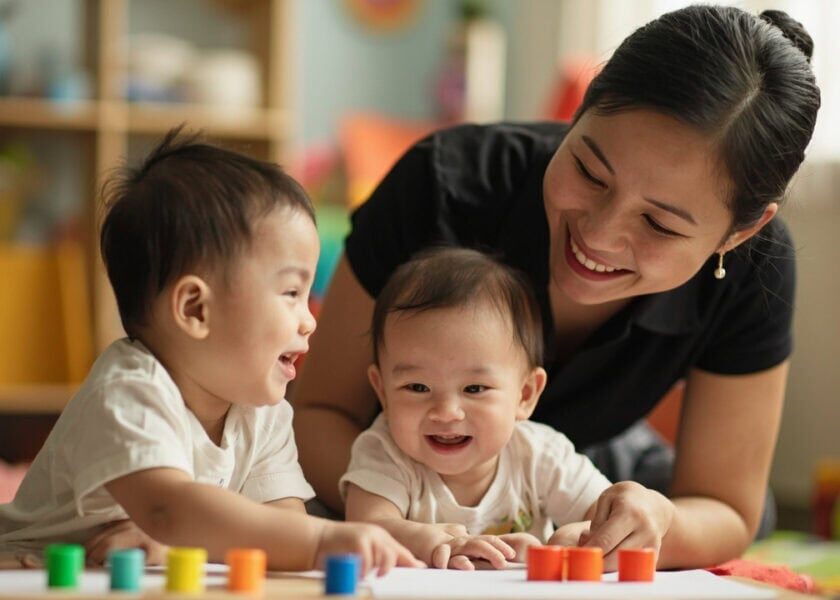
A child sitting on a mat can be passively supervised. Or they can be in a sensory-rich environment where a caregiver has noticed the child’s current interest in dropping objects through holes, and quietly offered a new container and a new material to explore.
Both scenes look like a child playing. One of them is building neural pathways. One of them is killing time.
The distinction lives in the intentionality of the environment and the responsiveness of the adult, and it is the distinction that matters enormously — even though you cannot always see it.
Through the Day: Rhythm as the Foundation for Learning
Follow your child through the day. Not the schedule on paper — the actual rhythm of feeling and experience that a quality childcare environment creates.
There is something profoundly important about rhythm in a young child’s life. Not rigid routine — rhythm. A pattern that becomes predictable enough to be trusted.
- Morning circle, then free exploration
- Snack time, with its particular social texture — the passing of a cup, the negotiation of sharing, the experience of hunger answered by food
- Outdoor time or movement time, where the body learns what it can do — balance, climb, run, fall, get up
- Story time, where language pours in — new words, new sounds, the particular music of someone reading aloud with attention and pleasure
These rhythms are not bureaucratic. They are the scaffolding of emotional security. When a child knows what comes next, they do not need to waste energy anticipating and worrying. They can relax into the present moment.
A relaxed child is a curious child. A curious child is a learning child.
This is why the daily rhythm of quality childcare is not a logistical detail. It is a developmental tool. It is the structure within which a child feels safe enough to let go of your hand, to engage with a caregiver, to approach another child, to reach for something just slightly out of reach.
Security and exploration are not opposites. In quality care, security is the prerequisite for exploration. Your child can only venture out because somewhere inside them, they know the rhythm will hold. The snack comes after play. The story comes after lunch. You are coming back at the end of the day.
The Five Developmental Domains Active in Quality Care
And so they play. And what happens in play is extraordinary, and it happens quietly, and it happens without an audience most of the time.
A child builds a tower. The tower falls. The child looks at the caregiver. The caregiver looks back and says, simply, “That was a big crash.” The child goes back and builds again.
That exchange — that single moment of being seen in the middle of a small disappointment and having it named — is not incidental. It is the micro-moment through which a child learns that their feelings are noticed. That the world is responsive. That they are not alone in it.
This is how social-emotional architecture is built. Not in grand lessons, but in dozens of these tiny, ordinary, profoundly important moments every single day.
Multiply that across the five domains of development that are active during childcare hours, and you begin to understand the scope of what is happening.
1. Cognitive Development
Your child is sorting, comparing, problem-solving. Where does this piece fit? What happens if I push it? What does this caregiver mean when she says “gentle hands”?
Every question a child asks — even the questions asked through action rather than words — is a neuron firing. Every experiment, every cause-and-effect discovery, every moment of “I figured it out” is building the architecture of a thinking mind.
2. Language Development
Your child is absorbing the music of conversation, the rhythm of stories, the names of things.
A rich language environment — where a caregiver speaks in full sentences, introduces vocabulary naturally, responds to a child’s sounds with words — is one of the most powerful gifts a childcare space can offer.
In Singapore, where many children are growing up bilingual or multilingual, quality care nurtures both languages without confusion. Research consistently shows that children learning two or more languages are enriched by the exposure, not hindered by it — provided the language environments are rich and responsive.
3. Social-Emotional Development
Your child is learning what it means to be near others. To wait. To want. To see someone else’s sadness and feel something. To be comforted. To offer comfort.
These are not skills that arrive on the first day of school. They are built, slowly, in the company of peers and warm, attentive adults, over months.
The child who can wait for their turn, who can name a feeling, who can approach a group of children and join in — that child has been built by hundreds of small moments of social experience, many of them happening while you were at work.
4. Motor Development
Your child is reaching, grasping, crawling, walking, climbing, scribbling, pouring, tearing, pasting.
Every physical action is a message to the brain that says: my body works. My body is capable. I trust this body to try things.
Fine motor skills — the small movements of fingers and hands — develop alongside cognitive growth. Gross motor skills — running, climbing, balancing — develop spatial awareness and confidence. Both are happening simultaneously in a quality childcare environment.
5. Identity Formation
The deepest and most quiet domain of all: your child is answering the question, “Who am I when I am not with my family?”
Am I brave here? Am I seen? Do I belong?
The answer to that question, built day after day in a quality care environment, becomes part of the foundation of who your child understands themselves to be.
The Five Domains at a Glance
| Domain | What It Looks Like in Practice |
|---|---|
| Cognitive | Sorting, comparing, problem-solving, cause-and-effect discovery |
| Language | Absorbing conversation, learning new words, responding to stories |
| Social-Emotional | Learning to wait, share, notice others’ feelings, feel noticed |
| Motor | Reaching, grasping, climbing, scribbling, pouring, balancing |
| Identity | Discovering “Who am I here?” “Am I brave?” “Do I belong?” |
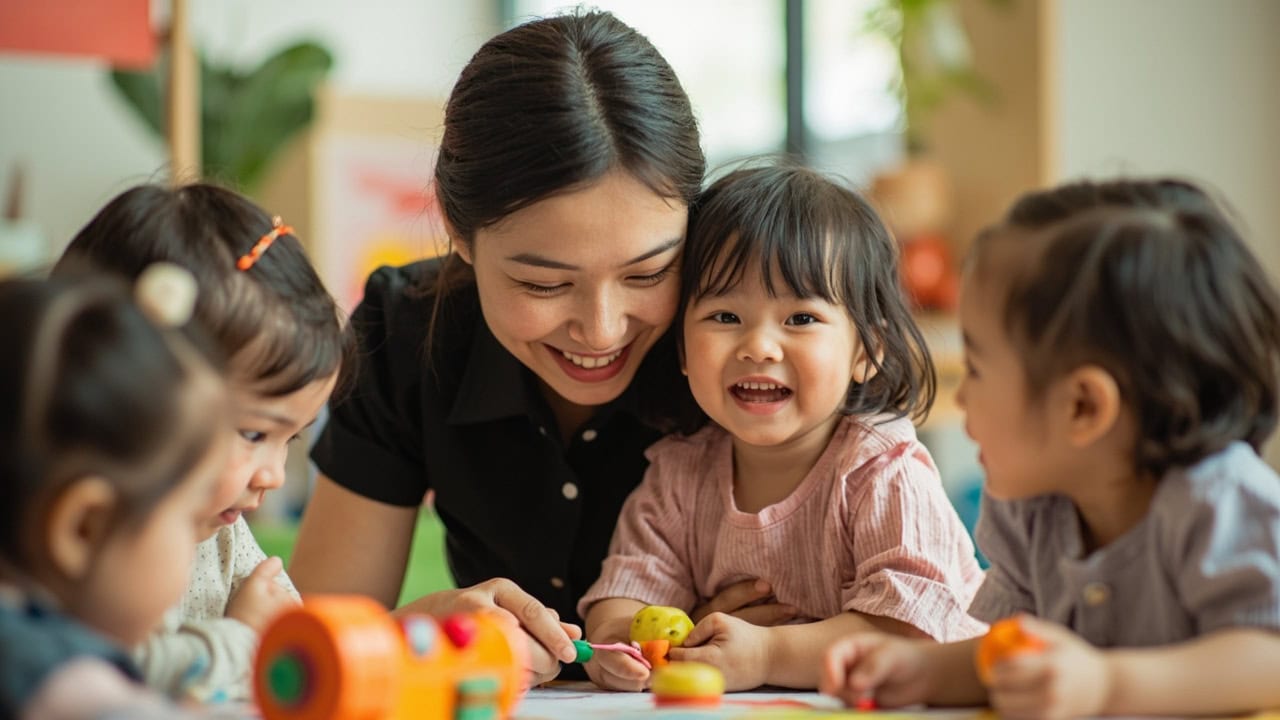
These five domains are not separate boxes. They are woven together in every moment of quality care — a child pouring water (motor), noticing what happens (cognitive), hearing the word “pour” (language), watching a friend pour too (social), and feeling proud of what their hands can do (identity).
What Pickup Tells You
Return, for a moment, to that threshold. The one you cross separately in the afternoon, when you come to pick your child up.
You arrive. You see your child.
And here is what you notice, if you look closely enough: the posture is different from the one they had when they left home in the morning. There is a looseness in the shoulders. The eyes are calm. There may be a story — told in fragments, in the way of three-year-olds everywhere — about what happened. Who was there. What the caregiver said. What they built.
There is something in the way your child moves toward you that tells you: I was okay. I was more than okay. I was engaged, and interested, and held.
You are looking at the visible surface of an invisible architecture.
Beneath that calm posture, beneath the half-formed story, beneath the easy reach for your hand, is a day full of textures touched and sounds heard and words absorbed and friendships begun and small disappointments weathered and discoveries made — and a growing, deepening, private sense that the world is a place where interesting things happen and where people notice you and where you can be yourself.
That is what quality childcare makes possible. Not supervision. Not babysitting. Not the absence of parents. But an environment that works alongside you — that extends the warmth and security of your family into a space where your child is feeling, learning, and becoming.
What to Look For: A Practical Guide for Singapore Parents
Most of us, when we choose childcare, are handed frameworks. We learn to check ratios, inspect environments, read credentials. We become amateur auditors of safety and cleanliness.
And those things matter — they matter enormously. But they do not answer the question that keeps turning over in your chest when your child is away from you.
The question is not whether your child is safe. The question is whether your child is feeling something. Learning something. Whether the hours apart from you are, in some real and meaningful way, still building the person they are becoming.
When You Visit a Childcare Space, Notice:
- What does the light feel like? Is it warm and considered, or harsh and fluorescent?
- What can you hear? Is there a calm, unhurried soundscape — or chaos?
- What does it smell like? A space that smells like food and fabric and life is a space that is lived in.
- How do the caregivers speak to children? Do they narrate? Name? Respond?
- Do the children seem at ease in their bodies? Loose shoulders, focused play, unhurried movement.
- Can you sense a rhythm? Not a rigid schedule — but a felt sense that this space knows what comes next.
Questions Worth Asking:
- How do you communicate with parents about the child’s day?
- What does a typical day feel like for a child?
- How do you support children who are adjusting to separation?
- How do you handle moments when a child is upset?
- How do you support bilingual or multilingual development?
The Honest Checklist:
- Ratios that allow responsiveness. In Singapore’s ECDA-regulated settings, caregiver-to-child ratios are a baseline. But the question is not just compliance — it is whether those ratios allow a caregiver to actually notice your child.
- A sensory environment that has been considered. Light, sound, smell, texture — not by accident, but by design.
- A rhythm that is predictable without being rigid. Children need to know what comes next to feel safe enough to explore.
- Caregivers who narrate and name. “You found the blue one.” “That was a big splash.” These are not filler words — they are the building blocks of language and emotional attunement.
- Space for play that is unhurried. Quality care does not rush children from activity to activity. It allows them to persist, to return, to go deeper.
- Communication that goes beyond safety reports. You deserve to know not just that your child is safe, but what their day looked and felt like.
The truest measure of quality is not a certificate on the wall or a ratio on a form. The truest measure of quality is what you see when you pick up your child and look at their face and read the story in their body.
Where These Principles Come Together: EduNanny Singapore
What EduNanny Singapore offers — through its home-based and community-based pathways under the ECDA Childminding Pilot — is a model of care built around the conditions that allow this kind of developmental engagement to happen.
With ratios that allow caregivers to truly see your child — not just watch them, but see them — EduNanny creates the conditions for the kind of responsive, sensory-rich, developmentally engaged care described throughout this article.
What This Means for Your Family:
- Accessible fee structures designed to make quality care available to more families across Singapore
- CDA and Baby Bonus can be used, so financial logistics do not become an additional source of stress
- Open, ongoing communication with families — because you deserve to understand what is happening during the hours you cannot see
- Where CCTV measures are in place, that transparency extends to the physical environment of care as well
There is also something here for the parent who is sitting at their desk at 11am, wondering how the morning went. The Thomas AI Chatbot available through EduNanny by BUTLER offers a quiet, always-present layer of support for the questions that arise between visits, between pickups, in the middle of a workday when you need reassurance. This is not a replacement for human care. It is a bridge — a small tool that eases the very real anxiety of not knowing, so that both you and your child can move through your days with greater calm.
One Threshold at a Time
There is a moment, every morning, when a small hand lets go of yours. It happens at the threshold of a door — a centre, a home, a space where someone else will hold your child for the hours you cannot be there.
I want to speak directly to the feeling you may carry with you on the days when this is hardest — the days when dropping your child at childcare costs something inside you that you cannot quite name.
That feeling is not a sign that something is wrong.
It is a sign that you love your child with a depth that makes separation feel significant. And it is also, if you let it, a sign that something meaningful is happening — because the reason it is hard is the same reason it matters.
You are not leaving your child in a void. You are entrusting them to an environment that is actively, attentively, purposefully shaping the person they are becoming.
That is not a small thing. That is an act of trust, and it deserves to be made with confidence, not anxiety.
If you have made the choice to place your child in quality care — in any form that is warm, attentive, responsive, and developmentally alive — then you have not simply solved a logistics problem. You have chosen an environment where your child’s senses are alive and their mind is at work and their heart is held.
That is not a compromise. That is not a necessity. That is, in every real sense, an act of love and faith and trust in your child’s capacity to flourish.
EduNanny Singapore stands in that space with you — not as a service alone, but as a partner in the earliest and most important work there is. The work of helping a small person become who they are.
One sensation at a time. One moment at a time. One day at a time.
And every morning, at the threshold, when that small hand lets go of yours — know that on the other side of that door, something meaningful is happening. Something that matters. Something that is building your child into who they are becoming.
You chose that. With your eyes open, your heart full, and your trust placed somewhere you believe is worthy of it.
That is not small. That is everything.
Learn more about EduNanny’s childminding pathways or connect with the team to explore what quality care can look like for your family.