How Singapore Parents Find Childcare That Feels Right
What This Guide Offers
If you are short on time, here is what this article will help you understand:
- Your nervous system already knows how to read a childcare environment—learn to trust that signal
- The difference between what a centre shows you and what it actually is
- Why watching children, not just adults, reveals the truest information
- How to distinguish professional warmth from genuine caregiver warmth
- Questions that expose philosophy rather than rehearsed scripts
- Why the visit matters more than any brochure or star rating
But this is not a checklist. It is an invitation to show up at a childcare visit with your eyes open, your instincts awake, and your attention pointed at what actually matters.
The Visit Itself: Where Hope Meets Uncertainty
You have done the research. You have read the reviews. You have compared curricula, ratios, and fee frameworks. You have probably joined parent forums where strangers disagree violently about every centre in your neighbourhood. And now, after all of that preparation, you are about to walk through a door and make a decision based on something that feels maddeningly intangible.
That feeling is not a weakness. It is the appropriate response to a consequential choice.
Here is what I want to offer you: not a methodology, not a scoring system, but a quality of presence. The willingness to be fully inside the visit itself, with your senses open and your awareness tuned to what is actually happening rather than what you have been told should be happening.
Reading the Atmosphere Before Anyone Speaks
You arrive, and the first thing you notice is not a person. It is an atmosphere. The light in the room. The way sound moves through it. Whether the space feels regulated, like a well-run office, or alive, like a place where children actually spend their days.
You might not name it in those terms. You might just notice that you feel a little more relaxed, or a little more tense. That is your nervous system doing its work—it reads the room before your thinking mind has a chance to catch up.
This is important. Do not override this reading with logic. If a space makes you feel unsettled before you have spoken to a single person, that feeling is data. It is not the whole story, but it is not nothing either.
Ask yourself what specifically is creating that response:
- Is it the noise level—too chaotic or unnervingly quiet?
- Is it the way the children are moving through the space?
- Is it the temperature, the smell, the amount of natural light?
- Is it something you can articulate, or a texture beneath conscious thought?
In Singapore’s climate, where centres are often enclosed buildings with air-conditioning running throughout, notice whether the air feels stale or whether there is genuine ventilation. Notice whether the space feels clinical or warm. These details matter, not because they are definitive, but because they tell you something about how a centre thinks about the children in its care.
What a Centre Shows You—and What It Hides
The tour begins. Or perhaps you have been invited to observe. Your guide walks you through the corridors, pointing out the learning corners, the bathroom facilities, the kitchen where meals are prepared. They speak with enthusiasm about the curriculum, the enrichment programmes, the ratio of teachers to children.
Here is where the first real challenge emerges: distinguishing between what a centre shows you and what it actually is.
Every centre, by the time they invite you through their doors, has prepared a version of itself. They have rehearsed the highlights. They have anticipated the questions they know parents ask. They have, whether consciously or not, arranged the room, positioned the children, timed the activities to create a particular impression.
This is not uniquely cynical. It is simply what institutions do. The question is not whether a centre is performing. The question is what lies beneath the performance.
When you are being shown something, pause. Ask yourself what you are not being shown.
- The tour moves quickly through the infant room. But what happens in that room during naptime, when the visitors have gone home and the schedule becomes more flexible?
- The guided reading session you observe is polished and intentional. But what does free play look like when no one is evaluating it?
- The transition from activity to snack is smooth and managed. But what does a difficult transition look like? When a child is protesting, when the room is getting loud, when something has gone slightly off script?
You do not need to interrogate your guide aggressively. You simply need to hold these questions lightly in the back of your mind. Observation without suspicion. Awareness without accusation. You are not looking for perfection. You are looking for reality.
The Children as Truth-Tellers
Watch the children. Not as a catalogue of behaviour to evaluate, but as the most honest source of information in the room.
A child in a new, unfamiliar, potentially anxious environment will show you something true about how that environment makes them feel.
- A child who runs confidently to a caregiver, who settles into play with visible ease, who moves through the space without the tight, watchful body language of a child bracing for something—that child is telling you something.
- A child who hangs back at the edge of the room, who clusters close to the door, who looks frequently toward adults for reassurance—that child is telling you something different.
This is not about judging a centre from a single observation. Children have bad days. First visits are strange for everyone. First-time visitors see an environment that has been prepared, not an environment at rest. But when you see multiple children displaying the same pattern of response, when the general atmosphere of the room feels secure and connected rather than merely managed, that is information worth holding.
The Moment When No One Is Performing
Watch how children respond to their caregivers when those caregivers are not performing for visitors.
A caregiver in the middle of a routine task, speaking to a colleague, handling a diaper change or bottle preparation—that is a moment of ordinary reality. In that ordinary reality, you can often see what is genuinely present and what is merely situational.
Ask your guide if you might simply sit and watch for a few minutes, without commentary. Sometimes the most revealing part of the visit is the part where no one is talking to you. In those minutes, you see the culture that exists beneath the tour.
Assessing Caregiver Warmth and Asking the Right Questions
Caregiver warmth is one of the most important and most easily misread elements of a visit. There is warmth that is professional and there is warmth that is personal, and they feel very different, even when the expressions that carry them might look similar on the surface.
Professional Warmth vs. Personal Warmth
| Professional Warmth | Personal Warmth |
|---|---|
| Trained and scripted | Authentic and consistent |
| Switches on during evaluations, off after | Present whether or not anyone is watching |
| Speaks to parents in evaluation mode | Speaks to children as individuals |
| Warmth as performance of care | Warmth as expression of genuine investment |
Professional warmth is trained. It is the warmth of someone who has been taught to smile, to make eye contact, to crouch down to a child’s level, to speak in gentle tones. It is not fake, exactly. It is simply scripted. And when you leave the room, or when the visit ends, it closes like a door.
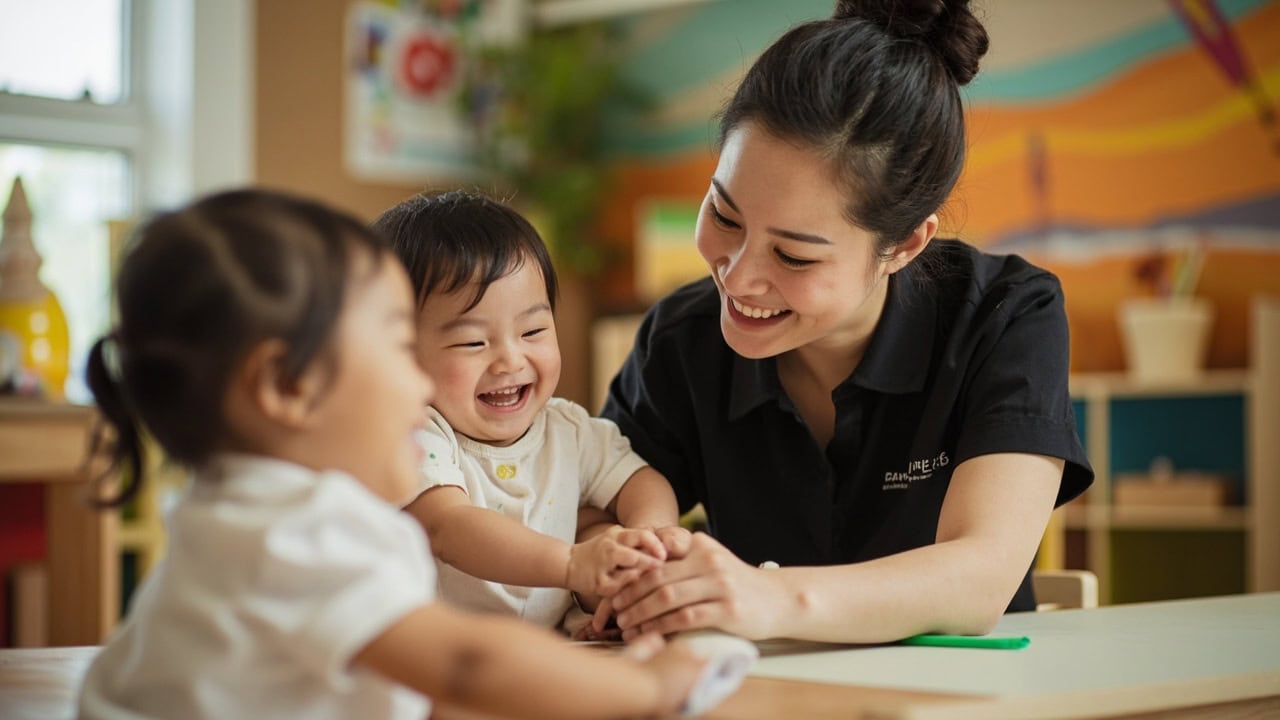
Personal warmth is different. It is the warmth of someone who genuinely loves what they do, who finds meaning in the work, who is present in a way that does not switch on and off with the audience.
You can often sense it in moments of transition, when the caregiver thinks no one is paying close attention:
- The way they speak to a child who is struggling
- The patience in their body when a toddler is moving slowly, resisting a routine
- The ease with which they handle a mess, a conflict, a moment of chaos
- Whether their face lights up when a child reaches a small milestone
Questions That Reveal Philosophy
Not the questions you are supposed to ask—those are on every guide sheet and parent forum. What questions should you actually be asking?
Ask about the caregiver team. Not just their qualifications, but their tenure. How long have the primary caregivers in the infant room been working here? High turnover is a signal, not a disaster, but it matters. Ask what the centre does to support their staff, because a centre that invests in its people tends to have people who stay.
Ask about the day from the caregiver’s perspective. How do they handle a colicky infant, a toddler who is struggling with separation, a child who has not yet learned to self-soothe? Listen not for the answer but for the tone in which the answer is given. Whether it reflects genuine problem-solving and compassion, or a desire to reassure you quickly and move on.
Ask about flexibility. Ask about the routine. But ask what happens when the routine does not work. When a child is sick, or overtired, or simply having a hard day—what flexibility exists? A centre with rigid routines may be well-organised, but a centre with responsive routines is one that is actually watching your child.
Ask the question that rarely gets asked: What would you do if my child was crying and could not be comforted? Listen carefully to the answer. Not for the words, but for what lies beneath them. Is there patience? Understanding? A willingness to try multiple approaches? Or is there a hint of frustration, a desire to move through the moment efficiently?
The Singapore Context and What Quality Actually Looks Like
Singapore parents are navigating a childcare landscape that is genuinely complex. The ECDA Childminding Pilot, the choices between home-based and centre-based care, the Baby Bonus structures, the CDA accounts, the fee frameworks that vary widely and do not always reflect the quality of what is offered.
You are making decisions about care for your infant at a time when the word infant itself carries weight. A child under eighteen months. A child who cannot tell you in words how they felt in a room. A child whose development in those first years is not merely a phase to pass through but a foundation that is being laid, for everything that comes after.
In Singapore, where both parents often work full-time out of necessity as much as choice, the search for quality infant care is not a luxury. It is a practical necessity that carries enormous emotional weight. You are not being precious or overprotective. You are being a parent. And the care you are searching for is not a luxury service. It is the place where your child will spend their waking hours during a window of neurological development that will not come again.
Signs That Children Feel Safe, Not Merely Supervised
- Children are engaged in play, not just occupied
- Caregivers respond to distress quickly and calmly, without visible frustration
- The environment is organized but not rigid—children can move, explore, make choices
- Caregivers speak to children, not at them
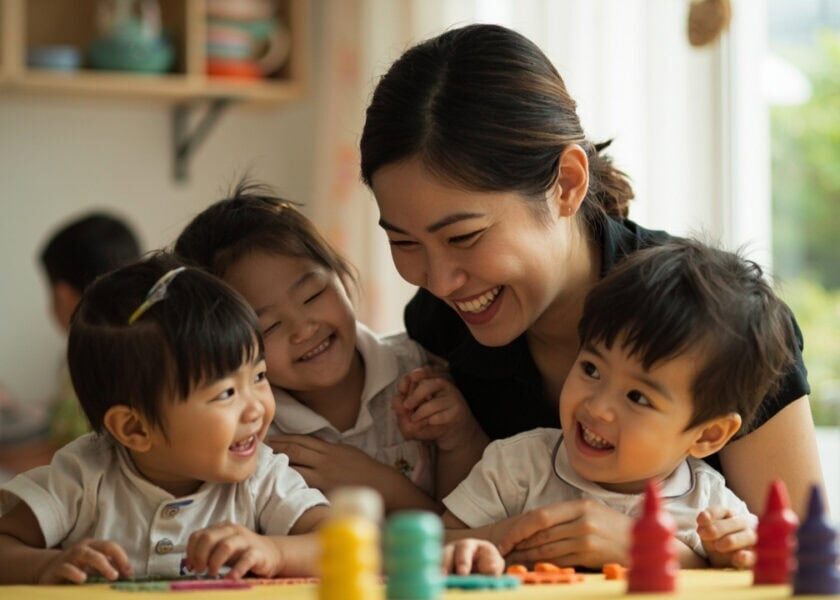
- There is laughter, not just compliance
- Children are not perpetually rushed from one activity to the next
- The room smells like a lived-in space, not just cleaned space
What to Notice About Interactions
Watch for the ratio of correction to encouragement. Watch for how caregivers handle conflicts between children. Watch for what happens during transitions—are they smooth or chaotic? Watch for whether children seem to trust their caregivers enough to explore independently, or whether they stay close, watching for threats.
A child who feels safe will take risks in their play. A child who is merely supervised will stay close to the adults who manage them.
Trusting What Your Visit Is Telling You
After all the observation, after all the questions, there is a question that remains. It is the question you cannot ask anyone but yourself: What is my own body telling me?
This is where many parents shortchange themselves. They arrive at a visit carrying enormous anxiety. They are worried about being judged, about asking the wrong questions, about seeming like a difficult parent. They are also worried, perhaps more deeply, about what they will feel. They are afraid that if they feel uncertain, it means they are failing.
But here is what I want you to understand: the anxiety you feel at a childcare visit is not a problem to be suppressed. It is a signal that you are taking something seriously. It is the appropriate response to a consequential decision.
But alongside that anxiety, there is something else. There is the felt sense of the place:
- The quality of the attention you received
- The way the caregivers spoke about the children in their care
- Whether you felt seen as a parent, or processed as a lead
- Whether you felt that this was a place that would know your child as an individual, or whether your child would be absorbed into a system that functions regardless of who enters it
You do not need to be able to articulate this clearly to trust it. But you do need to give yourself permission to feel it.
Processing After the Visit
Many parents rush from one centre to the next, trying to compare features and prices and credentials, and they leave every visit with a vague impression that dissolves into anxiety.
If you give yourself even twenty minutes after a visit to sit with what you observed, to let the experience settle, you will often find that clarity emerges. Not certainty, perhaps. But something more than confusion.
Take notes immediately after—before the next visit floods the previous impression. Write down what you noticed, what you felt, what questions remain unanswered. Your future self will thank you.
Common Questions to Hold Lightly
What if I feel overwhelmed during the visit? Give yourself permission to return for a second, unannounced visit if you need to. A quality centre will not object to this. In fact, it often reveals more than the first.
What if I cannot articulate why something felt off? You do not need to articulate it. You need to trust it. Your nervous system has been processing information before your conscious mind catches up. If something feels wrong, that feeling is worth investigating, even if you cannot explain it yet.
What if the centre has great reviews but I did not feel good there? Trust your observation over others’ experiences. Every child is different. Every family is different. A centre that works beautifully for one family may not be the right fit for yours. Your visit is about your child, not anyone else’s.
Go With Your Eyes Open
Here is what I have learned, watching Singapore parents navigate this search: the anxiety does not disappear when you find the right place. It softens. It becomes manageable. It transforms into something that looks more like trust than like fear.
And that transformation happens not because you stopped caring, but because you found a place that showed you, with honesty, that they were worthy of your trust.
That is what a quality visit feels like. Not certainty. Not perfection. A felt sense that you are in a place where your child will be known, not just managed. Where their cries will be answered not because a camera is watching, but because the person holding them is paying attention. Where the caregivers choose this work not because it is a job, but because something in them is drawn to the small, profound act of caring for someone else’s child.
You will know this when you feel it. You will know it in your body, in the way the room feels, in the way the caregivers speak not at your child but to them.
And when you know it, you will not need anyone to convince you.
A Different Kind of Visit
At EduNanny, we have built our approach around a belief that parents deserve more than a tour and a brochure. They deserve transparency. They deserve to see the reality of how we work, not the highlight reel.
This is why we invite parents to observe not just during planned tours, but in the ordinary reality of our day. Our caregivers are not just qualified—they are supported. Our ratios are designed around the reality of infant care, not just the regulatory minimum. We offer home-based pathways and community-based options, because we know that the right fit depends on the child and the family, not a single model that works for everyone.
We communicate with parents, not around them. Where we use tools like cameras, we do so not as surveillance but as transparency. We want you to know what is happening in your child’s day, because trust is built through visibility.
Our fee structures are designed to be accessible within the pilot framework. We believe that quality infant care should not require you to choose between your budget and your child’s wellbeing. Monday to Friday, in the care blocks that actually work for working families. CDA and Baby Bonus usability, because the systems exist and they should work for you.
Come and see. Bring your child, or come alone, and watch. Ask the hard questions. Notice what is happening in the room when no one is performing. Leave with actionable knowing, not vague impressions.
Your Next Step
Go. Visit. But this time, go with your eyes open. Go with your attention present. Go with the understanding that what you are feeling is not noise to be filtered out. It is the most important data you have.
Your child is waiting to be understood. And you are the one who will understand them best.
If you are ready to experience a different kind of childcare visit—one built around transparency, genuine warmth, and the belief that you deserve to see reality, not just the highlight reel—we invite you to come and see for yourself.
Because the right place will feel not like a compromise, but like a relief.