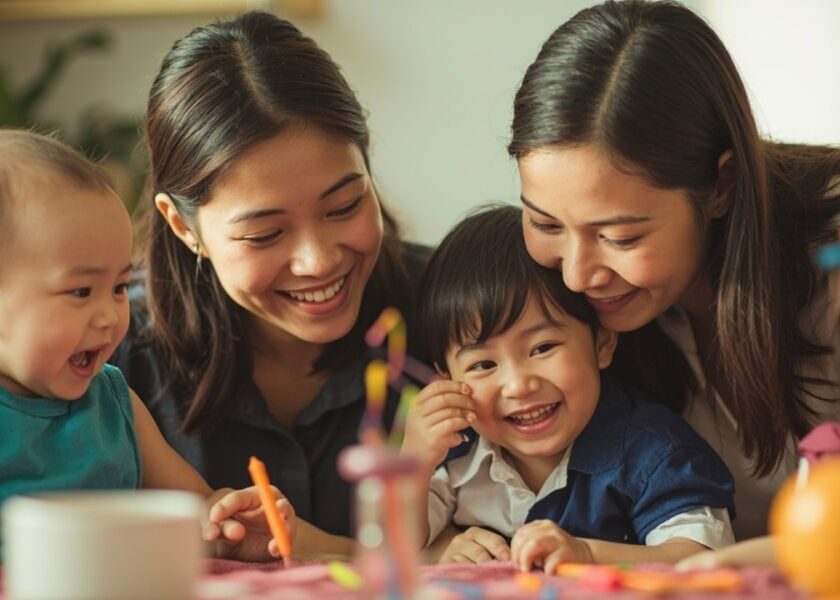
What Quality Childcare Communication Looks Like in Singapore
The Moment Every Singapore Parent Knows
There is a moment that every Singapore parent knows.
It happens at pickup. You arrive at the gate, or the lobby, or wherever the handoff takes place. Your child runs toward you, or is carried out still drowsy from a nap, or emerges with that particular quiet that means something happened during the day that you weren’t there to see.
And you ask the question that has become almost automatic — the question you ask every single day: “How was your day?”
Sometimes your child answers. “I played with blocks.” “We had cake.” “Miss so-and-so read us a story.” Sometimes they don’t answer at all. They change the subject, or they’re already thinking about dinner, the walk home, or the tablet that will appear in the car.
But you are still standing there. And in that moment, the person who has spent the last eight or nine hours with your child says something like: “She had a good day,” or “He was great today,” or perhaps just nods and smiles.
And you think: but what does that mean?
This is the moment I want to talk about today. Not because it is dramatic or unusual. Because it is ordinary. Because it happens every single day in Singapore, in childcare centres and kindergartens and home-based settings, thousands of times over.
The way we have learned to accept that vague, quiet answer tells us something important about what we have come to expect from childcare — and about what we should no longer accept.
Let me be clear about what I am not saying. I am not saying that Singapore parents are ungrateful, or anxious beyond reason, or expecting too much.
There is a gap — a real, persistent, unnamed gap — between what parents need to know about their child’s day and what most childcare arrangements are designed to communicate.
And this gap does not serve anyone. Not the parents, who leave pickup feeling vaguely uneasy and unable to articulate why. Not the caregivers, who are often doing excellent, attentive, loving work but have no framework or expectation to share what they observe. And not the children, who move between two worlds — home and care — that do not always talk to each other in ways that help the child feel whole, known, and secure.
The Trust You Leave Behind Each Morning
When a parent leaves their child in the morning, they are making a profound act of trust. They are saying: I believe this person, this place, will keep my child safe, will love my child, will notice my child. I believe that when my child laughs today, someone will hear it. When my child struggles, someone will see it. When my child changes — in small ways, in ways that matter — someone will be there to witness it, and will tell me.
That is not an unreasonable expectation. That is the minimum that trust deserves.
But here is what happens next. The parent leaves. The day unfolds. And the parent is, in a very literal sense, absent. They cannot see what happens. They cannot hear the conversation at circle time. They cannot notice that their child lingered near the window today, or that she did not want to join the painting activity, or that something about the way he said his friend’s name suggested a small hurt they will never know about unless someone tells them.
The parent is, in a very real sense, flying blind.
And what do we give them to navigate that blindness? A daily sheet. A food log. A checkbox that says “Had a good day.” A smile at pickup and a vague reassurance that tells them nothing.
This is the gap. This is the silence that tells you your childcare is not communicating enough.
Why “She Had a Good Day” Isn’t Communication
I want to pause here and make an important distinction, because it is the key to understanding what quality communication actually looks like.
There is information. And then there is communication. They are not the same thing.
Information is what a daily sheet provides. It answers factual questions: What did my child eat? When did they sleep? Did they have a bowel movement? These things matter. They are necessary. A parent needs to know whether their infant ate enough, whether their toddler napped. I am not dismissing the importance of these records.
But information is not communication. Information is data. It tells you what happened without telling you what it meant.
Communication is the interpretive layer. It is what a caregiver reveals when they say: “Today, your daughter did something interesting during free play. She kept returning to the building blocks even though she seemed frustrated that her tower kept falling. She didn’t ask for help, but she watched other children who were building successfully. I wondered if she was working something out.”
Communication is what you hear when a caregiver says: “Your son seemed a bit quieter than usual at lunch. He didn’t finish his food. I just want you to know in case you notice anything different at home.”
Communication is the difference between “She had a good day” and “She had a good day, and here’s what that looked like.”
Now, you might say: but surely caregivers are too busy, too overloaded, too stretched to provide that level of detail for every child, every day. Here I want to be honest, because this is where the conversation often breaks down.
If we are talking about a childcare centre with one teacher for fifteen toddlers, then yes — that level of communication may be genuinely unrealistic. That teacher may be running from one need to the next, barely able to document the basics, let alone offer meaningful insight. And that is not the teacher’s failing. That is a systemic failing.
But when ratios are better, when caregivers are given the time and the framework to observe and to share, communication changes. It becomes possible. It becomes the norm rather than the exception. And that is not a luxury. That is the actual work of understanding a child.
What Quality Updates Reveal About Your Child
So what does meaningful daily childcare communication look like in Singapore? It looks like a caregiver who knows your child’s rhythms well enough to tell you that today was unusual — that she didn’t eat as well as she usually does, or that he seemed more tired than his sleep schedule would suggest. It looks like updates that go beyond the log: observations about social dynamics, about emotional moments, about small triumphs and small struggles that you would never know about otherwise.
Here is what quality communication reveals:
1. Your Child’s Developmental Progress
Not in the abstract way of a milestone checklist, but in the specific, observed moments that show you how your child is growing. A caregiver who notices that your toddler used a new word, or that she figured out how to stack three blocks instead of two, or that he showed interest in a storybook for the first time — these are not trivial observations. They are windows into your child’s unfolding mind.
2. Your Child’s Emotional State
Whether they were anxious, joyful, frustrated, calm, seeking connection or needing space. A child who seems off at pickup may have had a difficult morning — or they may have simply tired themselves out with good, hard play. Without communication, you cannot know. With quality communication, you can read your child’s emotional day and respond appropriately at home.
3. Your Child’s Relational Security
How they interacted with other children, whether they were comfortable with their caregiver, whether they seemed at ease in the environment or fighting some quiet battle you would never see at home. This is perhaps the most important thing quality communication can reveal — whether your child feels safe and secure in the place where they spend most of their waking hours.
4. Caregiver Investment
Because when someone tells you something specific about your child, something that could only come from hours of attentive presence, you know that your child was not just being minded. Your child was being known. This is the invisible proof of quality care — the observation that proves someone was really there with your child, not just watching over them.
What to Notice at Pickup
Here is what I want you to notice when you evaluate whether your provider is communicating at a premium level.
Pay attention to what you are told. Not just whether it is positive — children can have positive days in childcare that is not actually meeting their needs. Pay attention to whether it is specific. If a caregiver can tell you something particular about your child’s day — a moment, an interaction, a detail — that is a sign of genuine attentiveness. If all they can offer is “She was good,” that is a sign that they may not have the time, the ratio, or the culture of observation to tell you more.
Ask questions. Not accusatory ones — you are not interrogating your caregiver. But ask questions that invite observation: “How was she with the other children today?” “Did he seem interested in the activities?” “Did anything stand out to you?”
If your caregiver struggles to answer, or seems put off by the questions, that tells you something. If they welcome the questions and engage thoughtfully, that tells you something else.
Notice whether your caregiver knows your child as an individual. Does she refer to your child’s preferences, their personality, their particular way of being in the world? Or does she speak in generalities that could apply to any child? The difference is significant. The difference is whether your child is a category or a person.
Signs Your Caregiver Truly Knows Your Child
| Genuine Knowledge | Going Through Motions |
|---|---|
| References your child’s specific preferences (“She always asks for the blue cup first”) | Speaks in generalities (“They all had snack time”) |
| Notes changes or patterns over days (“He’s been more tired than usual this week”) | Offers the same generic phrases daily |
| Describes specific moments or interactions | Only reports facts (food, sleep, diaper changes) |
| Welcomes your questions and adds to the conversation | Seems uncomfortable when asked follow-up questions |
| Remembers details from previous conversations | Seems surprised by information you share about your child’s habits |
| Can tell you about your child’s friendships and social dynamics | Cannot name other children your child plays with |
Addressing Your Concerns
“Isn’t this just soothing parental anxiety?”
No. This is a child experience issue. Communication is not about satisfying parental curiosity. It is about something far more important: a child’s right to be known.
A child who moves between home and childcare deserves consistency. They deserve to feel that their two worlds are connected, not separate. They deserve to know that the person who cares for them at home and the person who cares for them during the day are talking to each other, are seeing the same child, are working together to support them.
A child whose caregivers communicate well is a child who feels held — not just physically, but narratively. They are part of a story that everyone agrees on. They are not a different self at home and a different self at childcare, unconnected, unexplained.
This is what quality communication gives a child beyond what parents realize: it gives them coherence. It gives them the sense that their life makes sense, that the adults in their life are aligned, that they are known and valued in all the places they spend their days.
“Are you saying caregivers who don’t communicate this way don’t care?”
No. Many caregivers are doing excellent, attentive, loving work. But loving attention without communication is invisible to parents. And more importantly, without the time, ratios, and frameworks to support observation and sharing, even dedicated caregivers cannot deliver what they might want to deliver.
The gap is systemic, not personal. It is a structural failure of expectations and resources, not a failure of individual caregivers to care.
“Is this just for wealthy families who can afford premium childcare?”
This is exactly why initiatives like the ECDA Childminding Pilot matter. Fee structures are designed to be accessible. CDA and Baby Bonus funds can be used. The goal is to make quality care — including quality communication — a realistic option for families across income levels, not a privilege reserved for those who can afford it.
How EduNanny Structures Communication as a Standard
What I have described — this standard of communication, this depth of observation, this level of care — it does not happen by accident. It happens because of structure. Ratio. Culture. Expectation. It happens because a childcare organisation decides, as a matter of principle, that communication is not a bonus but a baseline.
EduNanny, a service under the Butler group, is part of the ECDA Childminding Pilot. This matters because it means EduNanny operates within a framework designed to test and model what quality infant and childminding can look like in Singapore.
The pilot operates with infant ratios that allow for genuine attention — up to one to three, in settings structured to make observation possible. Fee structures are designed to be accessible, to make quality care a realistic option for families rather than a privilege. CDA and Baby Bonus funds can be used, which means the financial architecture supports families in accessing what is being offered.
EduNanny offers both home-based and community or centre-based pathways, because families are not all the same, and the right fit matters. But across these pathways, there is a consistent commitment to communication as a standard.
Parents receive regular updates that go beyond the generic daily sheet. Caregivers are trained and supported to observe, to document, to share. In settings where transparency measures including CCTV are deployed, this is done not to surveil but to create a window — a real, verifiable window — into the child’s day.
Thomas, the AI chatbot integrated into EduNanny’s communication system, helps parents access information and bridges the gap between the end of the care day and the pickup moment. It creates a rhythm of exchange rather than a single, often inadequate conversation at the gate. Parents can ask questions. They can receive updates. They can engage with the communication loop rather than waiting passively for whatever their caregiver remembers to mention.
Technology does not replace human relationship. It cannot. The quality of care depends on the quality of the caregiver, on the ratios that allow genuine attention, on the culture that expects communication. Thomas is a tool — but it is a tool that reflects an understanding of what modern parents need: accessibility, responsiveness, a channel that does not close at 6 PM when the workday is just ending.
What EduNanny offers is not a promise of perfection. It is a commitment to a standard. Communication as a baseline, not a bonus. Observation as a practice, not an accident. The child’s day made visible to the parent who loves them.
What You Deserve to Take Away
If you are a parent in Singapore, I want you to know that you do not have to accept the silence. You do not have to settle for “She had a good day” when you know that phrase tells you nothing.
You are entitled to ask. You are entitled to expect more. You are entitled to a childcare arrangement that treats communication not as an optional extra but as a fundamental responsibility — because if they are caring for your child, they owe you that.
And if you are a caregiver — and I say this with deep respect — the observation you do matters more than you might realise. The small things you notice, the moments you document, the update you take time to write: these are not bureaucratic extras. They are acts of care that extend beyond the hours you spend with the child. They are how you tell a parent: I see your child. I see who they are. They are safe with me, and here is proof.
Communication is the invisible thread. It runs between parent and caregiver, between home and childcare, between the morning goodbye and the evening reunion. It is woven across years. And when it is strong, it sustains something irreplaceable: the trust that allows a parent to leave their child in someone else’s care and still sleep soundly at night, knowing that their child is not just safe but known.
That is what EduNanny is building. That is what the pilot is testing. That is what we believe every family in Singapore deserves: not just childcare, but care that communicates. Care that sees. Care that makes the invisible visible, one update at a time.
Because your child deserves a window into their day. And you deserve to see through it.
Ready to explore what quality communication looks like for your child? Connect with EduNanny to learn more about infant care and childminding options that put observation and transparency at the centre of the experience.