The Science and Art of the Morning Goodbye for Singapore Families
The Science Behind the Difficulty
The morning goodbye is not a necessary ordeal to be survived. It is not evidence of your failure as a parent or proof that your child will not be okay without you. It has structure. It has teachable elements. When you understand it—when you begin to design it with intention rather than react to it with anxiety—everything changes. Not just the morning, but the entire arc of your day, your child’s day, and the quality of trust that builds between you, your child, and the caregiver who receives them.
The Biology of Goodbye
Your child has spent their first months or years in an environment where your presence was constant. Your voice was the first sound they learned. Your arms were the original safe place. When you prepare to leave, their brain registers a separation. Even if they are in trusted hands, even if they adore their caregiver, the departure of a primary attachment figure creates a biological stress response that is real, measurable, and entirely normal.
But here is what we rarely discuss: it is not only your child who is stressed. You are stressed too. And your child knows it.
Children are extraordinary readers of emotional weather. Long before they have words, they are tracking your facial expressions, your breathing, the tension in your shoulders, the way your voice pitches upward as you say goodbye. They do not know that you are worried about the presentation at nine or the email you forgot to send. They only know that something is uncertain. They feel the anxiety radiating from you like heat from a stove, and it confirms what their own nervous system is already telling them: something is happening. Something is not quite right.
Your Calm Becomes Their Anchor
The quality of your morning goodbye is not only about what you say to your child. It is about what you are when you say it.
Your regulation is the first gift you give at the door. Not your words, not your kisses, not even the carefully rehearsed routine you have practiced in the mirror. Your regulation. The calm that you carry into that moment, the steadiness in your voice, the quiet confidence in your movements—these are the messages your child’s nervous system is listening for.
This is not about perfection. It is not about never feeling sad or conflicted or worried. It is about not allowing your anxiety to become the loudest signal in the room. Take a breath before you speak. Acknowledge your feelings without broadcasting them. Remember that your child is watching not just your face but the way your whole body holds the moment.
Children do not need parents who are fearless. They need parents who are regulated in the presence of fear.
The Caregiver as Your Partner
And this is where the partnership with your caregiver begins. The role of the caregiver in the morning transition is not administrative. It is not simply to receive a child and begin the day’s activities. The caregiver is, in that moment, an emotional bridge. They catch what you release. They confirm, moment by moment, that the world remains safe, that your departure was a transition, not an abandonment, that your child is held and known and valued in this new space.
When a caregiver receives a child at the door, something enormous is happening beneath the surface. The child is calibrating. They are asking, in a thousand silent ways, a question that matters more than almost any other: Is it safe here? Will I be okay? Will someone comfort me if I need it?
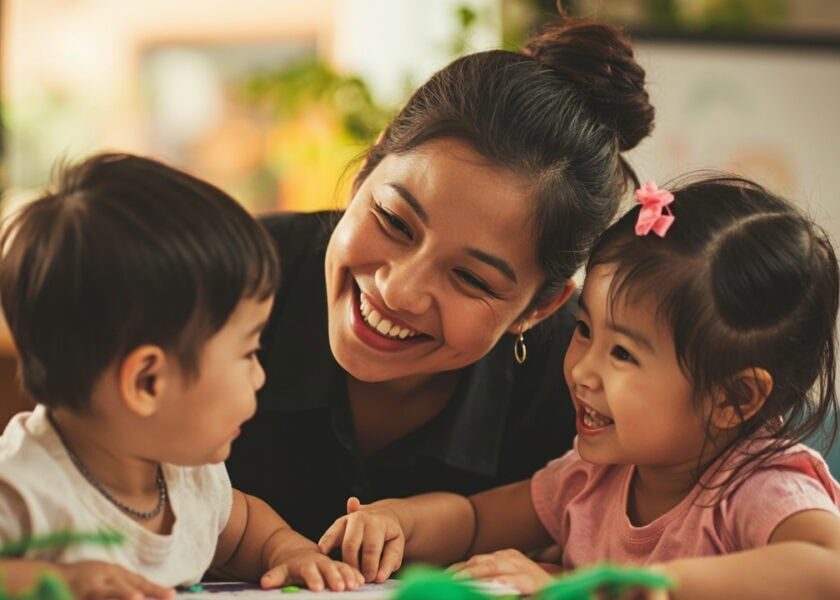
A quality caregiver answers this question not with grand gestures but with presence. A warm greeting. A calm voice. The gentle invitation to come inside, to see the familiar toys, to feel the rhythm of the space that they have been in before.
The caregiver who understands the morning transition understands that they are not just beginning a schedule. They are continuing a story. The parent has left a thread, and it is their job to pick it up and weave it forward until the child is settled, until their nervous system has downshifted from separation stress to ordinary engagement with the world.
This is skilled work. It requires training, patience, and a deep understanding of child development. It is work that is often invisible but always felt.
What Quality Morning Transitions Look Like
The first ten minutes of any childcare day are not merely a greeting. They are a quality indicator. They are the moment when trust is either built or eroded, when the child’s sense of security is either reinforced or quietly undermined.
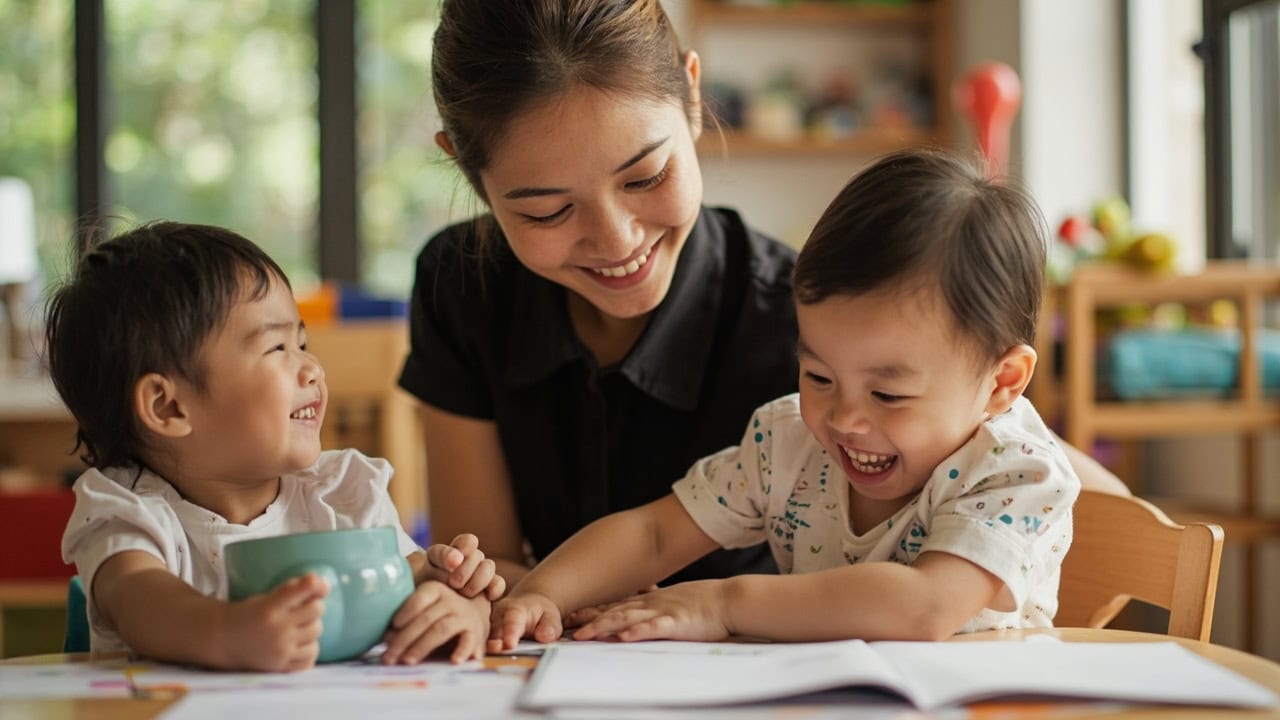
In smaller care settings—where one caregiver receives one, two, or three children—there is actual physical and emotional space to give each child the unhurried, warm receiving they need. There is no rush to the next item on a schedule. There is no room full of children all requiring simultaneous attention. There is one caregiver, or two at most, giving their full presence to the child who has just walked through the door.
This ratio, this intimacy of care, is not a luxury. It is the architecture of security.
When a child arrives and is met with full attention—with a voice that says their name, with a hand that reaches for theirs, with the familiar rhythm of the morning routine beginning again exactly as it did yesterday and will again tomorrow—something profound settles inside them. They begin to learn that goodbye is not permanent. That separation is temporary. That the world contains other warm places besides the ones they have always known.
Morning Needs by Age
Age changes how children experience the morning goodbye, and understanding these differences matters more than most parents are told.
| Age | What They Need | What Helps |
|---|---|---|
| Infants (0–12 months) | Consistency, warmth, presence | The same caregiver, same space, same time each day. Rhythm becomes their proof that the world is ordered and safe. |
| Toddlers (1–3 years) | Ritual, predictability, control | A consistent goodbye routine: the same words, the same gestures, the same sequence. Anticipation reduces terror. They need to feel some sense of control in an uncontrollable moment. |
| Preschoolers (3–6 years) | Explanation, trust signals, confidence | Brief explanations that you will return. But more importantly: they need to feel that you trust the caregiver. Your visible confidence at the door is the most reassuring thing you can offer. |
Infants experience the morning goodbye almost entirely as a biological event. They do not have the cognitive development to understand that you will return. They experience your departure as a genuine loss in the moment, and their distress is real and cannot be reasoned away. What helps an infant is not explanation but consistency.
With toddlers, something shifts. They now have enough cognitive development to begin understanding object permanence, to begin building the expectation of return. But they also have enough emotional sophistication to feel betrayed if the promise of return is broken, to test boundaries, to resist the goodbye precisely because they understand, in some nascent way, that it means something. Toddlers need ritual at the door more than ever.
Preschoolers can handle more. They can handle a brief explanation. They can handle the knowledge that you will return, that school or care is temporary. But they also need to feel that you trust the caregiver, that the arrangement is solid and chosen, that your confidence in the situation is genuine. If you hesitate at the door, if you linger with visible anxiety, your preschooler will absorb that doubt and carry it into their day.
Your Guilt Is Real—and It Is Informative
The way your chest tightens as you hand your child over, the second-guessing that follows you all the way to the MRT platform, the small voice in your head that asks if you are doing the right thing—these are not irrational feelings to be dismissed. They are the feelings of a loving parent navigating an impossible-seeming cultural and economic moment, where Singapore requires most families to have both parents working, where the village that once surrounded new parents has dispersed, where you are making a choice that feels both necessary and painful.
These feelings deserve to be acknowledged, not minimized. But they also deserve to be understood.
The guilt you feel at the door is not evidence that you are failing. It is evidence that you love your child deeply, that the bond between you is strong, that leaving—even temporarily—costs something. That cost is real. But it is not infinite. And it is not unmanageable.
When a morning goodbye has been handled with intention—when the parent has left regulated, when the caregiver has received warmly, when the daily rhythm has been consistent and reliable—you will see it in the evening. You will see a child who comes home still carrying the calm of the morning. A child who is not depleted by the day, not running on empty reserves of stress hormones, not collapsed into your arms as though they have survived a war.
A child who is curious, engaged, emotionally available. A child who wants to tell you about their day, show you what they made, ask you questions, settle into the rhythm of home as though home and childcare were never in conflict, as though they were always the same story.
This is the feedback loop that quality childcare creates. It is not just about what happens while your child is in care. It is about how the morning goodbye sets the emotional tone for your entire day, and how that day’s work and energy and clarity comes back home with you, so that the evening homecoming is also changed. Not perfectly. Not every single day. But reliably. Consistently. In a way that builds security rather than eroding it.
How to Choose: What to Look For Before You Commit
You do not have to figure this out alone. The morning partnership with your caregiver does not begin after you have signed forms and survived the first month. It begins when you are still deciding, when you are visiting arrangements, when you are asking questions and watching how a caregiver receives a child who is not even yours.
That first observation, that first gut feeling, is data. It is your child’s future morning goodbye being previewed in real time.
When you walk into a childminding space in the morning, notice what happens:
- Does the caregiver look up when you enter?
- Do they greet the arriving family with warmth?
- Do they seem present or distracted?
- Is the space calm and structured, or frantic?
- How do they handle the child who arrives crying?
- Are they gentle? Do they have the time and attention to comfort without rushing?
- Do they seem to genuinely enjoy being in this work?
These are not small details. These are the morning goodbye in its living form. The caregiver who receives your child with calm warmth, with genuine presence, with unhurried attention—watch what happens to your own nervous system when you see that. Watch how the guilt loosens its grip. Watch how the anxiety begins to transform into something closer to trust.
This is what you are looking for. Not perfection. Not a guarantee. But intention. Evidence that the person at the door understands what is happening in that moment and why it matters.
Practical Questions to Ask
- Visit during a morning transition if possible. See how caregivers greet children. See how they handle the moments when parents are still present. This is the real test of what daily life looks like.
- Ask about ratios. Smaller numbers mean more individual attention. In those first weeks and months, that attention is not a luxury—it is the foundation of trust.
- Ask about the goodbye routine. A caregiver who can articulate what they do at the door, and why, is a caregiver who understands attachment. That understanding matters more than a fancy curriculum.
- Notice how you feel. Your gut reaction to a space, a caregiver, a routine—this is information. If you feel calm and welcomed, that is a good sign. If you feel anxious or rushed, trust that instinct.
- Ask about communication. How will you know how your child’s day went? What can you expect in terms of updates? These questions matter, and any quality provider should have clear answers.
EduNanny Singapore: Built for This Moment
EduNanny Singapore, part of the BUTLER family, participates in the ECDA Childminding Pilot, and this context shapes everything about how they approach the morning transition.
They understand that the ratio of caregiver to child matters enormously in those first moments at the door. Smaller ratios mean unhurried receiving. They mean one caregiver, or two at most, giving their full presence to the child who has just walked through the door.
EduNanny’s caregivers are trained to understand the science and the art of receiving. They know that the first ten minutes of any childcare day are not merely a greeting. They are a quality indicator. They approach this with the seriousness it deserves—not because they are following a script, but because they understand what is at stake.
They also understand that the morning goodbye is not only about the child. It is about you. When a parent walks out of an EduNanny arrangement feeling calm, informed, and confident, that calm travels with them. It travels into their workday. It travels into the quality of their presence when they return. And it travels back, through the caregiver’s communication and the child’s easy homecoming, into the next morning.
The ECDA Childminding Pilot has created frameworks for this kind of care—frameworks that prioritize ratios that make unhurried receiving possible, that support caregiver training that makes warm, consistent transitions the norm rather than the exception. The pilot’s fee structures are designed to be affordable, to remove cost as a barrier to quality. CDA and Baby Bonus funds are usable, because Singapore has built in these financial tools precisely to support families in this stage of life. Care is available Monday to Friday in blocks that reflect how working families actually live.
These are not peripheral details. They are the infrastructure that makes quality morning goodbyes possible.
EduNanny has also implemented communication measures that keep parents informed throughout the day. Regular updates, open channels, the knowledge that you can ask and will receive an honest account of how your child’s day is going. This is not a marketing feature. It is an acknowledgment that you, as a parent, need to feel connected even when you are apart, and that quality care has nothing to hide.
Every Goodbye Is a Beginning
What we are describing when we describe a quality morning goodbye is not merely a smoother routine. We are describing the building of a child’s fundamental sense of security. We are describing the daily practice of trust, repeated hundreds of times across the early years, each goodbye and hello adding another layer of evidence that the world is reliable, that loved ones return, that other people can be trusted to care, that transitions are survivable and even positive.
When you leave your child in the morning, you are not just dropping them off. You are telling them something about the world. You are telling them that there are other safe places. That other people can love them. That your love does not diminish when you are apart. That life contains departures and returns, losses and reunions, and that all of it is navigable.
You are telling them, through the calm of your goodbye and the warmth of the caregiver who receives them, that they are held. That they have always been held. That they will continue to be held.
EduNanny was built for this. Not as a business proposition, but as an answer to a question that Singapore parents have been asking for years: Where can I leave my child and feel genuinely okay about it? Where will the morning goodbye be understood, not as a problem to be endured, but as a ritual to be designed? Where will someone meet my child at the door the way I would meet them if I could be there myself?
The answer is in the training, in the ratios, in the transparency, in the Monday to Friday care that fits your working life, in the affordable structures that make it accessible, in the caregiver who will be standing at the door tomorrow morning with calm hands and a warm voice and the full attention that your child deserves.
This is not a promise of perfection. No such promise can be honestly made. But it is a promise of intention. A promise that every morning, at the door, your child will be received with the understanding that what is happening in that moment matters enormously. That the caregiver who greets them knows what they are doing and why. That the ratios are designed to allow attention. That the training has prepared for exactly this. That the communication will keep you informed. That the rhythm will be consistent. That the relationship between your family and this caregiver is treated as the sacred trust it is.
Not when you understand it. Not when you have a partner in it. Not when you know that every intentional goodbye is quietly, daily, building the kind of security in your child that no amount of explanation or reassurance can match. It is built in the doing. In the consistent, warm, regulated repetition of the morning ritual. In the caregiver who picks up the thread every single day. In the parent who learns to breathe at the threshold and trust the process.
You are not abandoning your child in the morning. You are launching them. You are sending them into a space that has been prepared, into hands that have been trained, into a rhythm that will hold them steady.
And you are coming back. You are always coming back.
And when you do—when your child runs into your arms not depleted but content, not distressed but curious, not broken by the day but ready to share it—you will know. You will know that the morning goodbye worked. That it was good. That your child is secure, and so, in the evidence of that homecoming, are you.
If you are ready to explore what a quality morning transition could feel like for your family, EduNanny Singapore welcomes you to visit, to ask questions, to watch what happens at the door. To see, for yourself, what it looks like when a child is received with the understanding that every goodbye is, in fact, a beginning.
EduNanny Singapore is a development-oriented childminding and childcare service for families in Singapore. Learn more about our approach to quality care or get in touch to begin a conversation about your family’s needs.