What Quality Childcare Teaches Your Child Every Hour
What Your Child Is Learning in Quality Childcare
Let me name what is actually happening in those hours you are apart. These are not activities on a schedule. They are the living curriculum of early childhood:
- Executive function and self-regulation — the ability to focus, persist, and manage frustration, which predicts school success more reliably than any test score
- Social-emotional skills — learning to navigate conflict, share, take turns, and relate to peers with empathy
- Language development — richer vocabulary and communication skills through daily interaction with caregivers and other children
- Motor development — fine motor control and spatial reasoning through purposeful play with blocks, water, puzzles, and more
- Independence and confidence — the growing ability to try things on their own, solve problems, and trust their own capabilities
- Early numeracy and cognitive skills — discovery of patterns, numbers, cause and effect through natural curiosity-driven exploration
These are happening every hour your child is in quality care.
The Hidden Curriculum: Learning in Plain Sight
The hidden curriculum is the learning that happens in the ordinary moments—the moments that look like just play, just activity, just getting through the day.
Consider: the moment a toddler learns that hitting does not get a toy but asking does. The moment a child discovers that words can solve a problem faster than tears. The moment a group of three-year-olds negotiate who gets to be the train driver and, in doing so, learn the fundamentals of fairness, patience, and social problem-solving.
These are skills that no worksheet can teach and no screen can replicate. They come from experience—with peers, with trained caregivers who know how to guide rather than control, with an environment designed for growth.
Inside an Hour of Quality Childcare
Let me take you inside one of those hours, because I think it matters that we make the invisible visible.
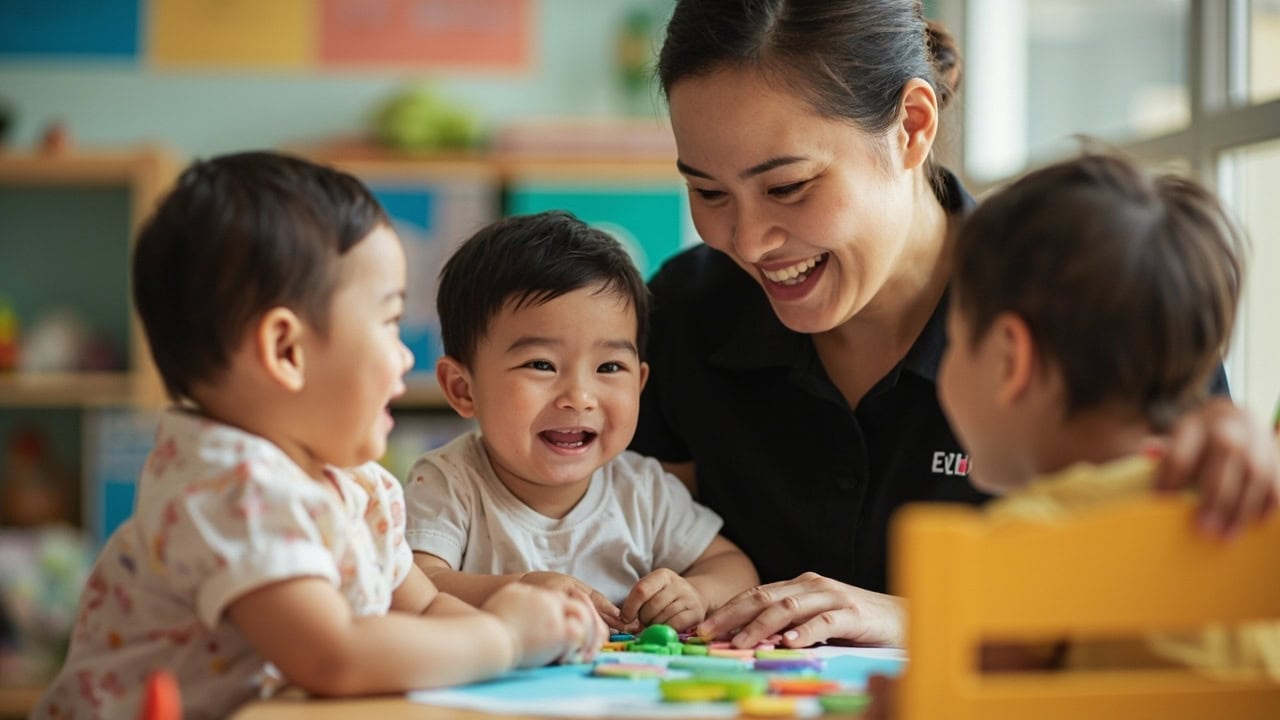
It is mid-morning in a quality infant and childminding programme. The room is calm but not silent. There is purposeful activity happening everywhere you look.
A caregiver is sitting on the floor with three toddlers, each with a set of wooden blocks. She is not directing them. She is not telling them what to build. She is observing.
- One child is stacking blocks as high as they will go, testing gravity with each addition, learning through trial and error about balance, weight, cause and effect.
- Another child has knocked their tower down and is rebuilding with apparent determination—the first lesson in persistence, in the understanding that failure is not final.
- The third child has abandoned blocks altogether and is lining them up in a row, counting quietly to himself, discovering the joy of numeracy through his own curiosity.
The caregiver notices all of this. She makes a mental note: the first child is refining their fine motor skills and spatial reasoning. The second child is developing resilience. The third child is exploring early mathematical concepts.
She does not interrupt their flow. She does not impose a lesson. She simply ensures the environment is safe, the materials are available, and the child who needs encouragement receives it. Later, she will document these observations—not as homework, but as the record of a child’s learning that she will share with parents. Because you deserve to know what we see.
Now consider what is happening socially. In this same room, a slightly older child is struggling because another child took the book they wanted. The caregiver does not rush in with a solution. She approaches calmly, crouches to their level, and asks a question: “I can see you both want the same book. What can we do?”
This is not micromanagement. This is scaffolding. She is teaching a child that conflict is normal, that feelings can be named, that problems have solutions, and that adults can help without taking over.
In that single moment, she is building emotional regulation, communication skills, and social competence. These are the skills that will determine how well your child navigates friendships, handles disappointment, and collaborates with others for the rest of their lives.
This is the education that happens before Primary One. Not the memorization of letters or numbers—though that may happen too, and naturally—but the deeper preparation that makes all learning possible.
Understanding Singapore Parents’ Anxiety
Before we go further, I want to acknowledge something real. Singapore parents carry a particular kind of anxiety that is uniquely shaped by our environment. We live in a society that values achievement. We understand the pressure of educational milestones. We know that Primary One is coming, and we want our children to be ready—not just academically, but socially, emotionally, in every way that matters.
We worry about whether they can sit still. Whether they can share with others. Whether they can communicate their needs, manage their frustrations, ask for help, try new things without fear.
These are not superficial concerns. These are the real competencies that determine how well a child will navigate school and life. And when you are not there to see your child practice these skills, it is natural to wonder if they are practicing them at all.
Here is what I want you to understand: in a quality childcare environment, your child is not just being watched. They are being guided by people who have been trained to read their cues, to understand their developmental needs, to scaffold their learning in ways that are both intentional and responsive.
What Quality Childcare Actually Looks Like
There is a difference—and it is not subtle—between supervision and education.
Supervision says: keep the child safe, fed, and out of trouble.
Education says: understand where this child is developmentally, what they need to grow, and how to create the conditions for that growth.
Supervision is passive. Education is intentional. Supervision asks: is anything going wrong? Education asks: what is going right, and how can we build on it?
Ratio, Training, and Intentional Environment
Quality care begins with ratio. When an infant or toddler has the attention of a trained caregiver without the distraction of too many other children, something fundamental changes. There is time to respond to cues, to engage in meaningful back-and-forth interaction, to notice the small victories that mark development.
EduNanny’s approach, operating within the ECDA Childminding Pilot framework, maintains ratios that allow for this responsiveness—up to one to three infants in care settings where applicable. This is not an accident. This is design. This is the architecture of attention that makes learning possible.
Quality care means trained caregivers who understand child development—not as a vague interest, but as a professional competency. These are people who can tell you why a two-year-old is having a meltdown over a broken cookie, who know that the behavior is developmentally appropriate and not a character flaw, who respond with calm rather than frustration because they understand what is happening in the child’s brain.
They are not babysitters. They are early childhood educators, and the work they do deserves recognition and respect.
In Singapore, as in many societies, there is a tendency to see childcare work as lesser—to assume that anyone can do it, that it requires patience but not skill. This is a mistake. The person who cares for your infant, who notices when your toddler is about to climb something unsafe and redirects them calmly, who helps your child navigate the social complexity of sharing and taking turns—this person is doing some of the most demanding and consequential work that exists. They are shaping neural architecture. They are building the foundations for everything that will follow.
Communication and Partnership
Quality care means communication. You should know what your child is doing. You should receive updates that go beyond “they had a good day”—updates that tell you about their discoveries, their challenges, their moments of triumph.
In EduNanny’s model, transparency is built into the programme through regular reporting and documentation of your child’s experiences and development. Quality care means partnership with you. Not the replacement of your role, but the extension of it. The best childcare programmes see themselves as working alongside parents, reinforcing at school what is taught at home, and keeping parents informed so that the two environments feel connected rather than separate.
Developmental Domains in Quality Care
When you choose a programme that treats childcare as education, you are choosing an environment that supports growth across every domain:
| Domain | What It Looks Like in Practice |
|---|---|
| Cognitive | Problem-solving, cause and effect, early numeracy, curiosity-driven exploration |
| Language | Rich conversation, vocabulary building, storytelling, expressive communication |
| Social-Emotional | Sharing, turn-taking, conflict resolution, empathy, emotional regulation |
| Physical | Fine motor control, gross motor activity, spatial reasoning, sensory exploration |
| Independence | Self-help skills, confidence, persistence, resilience, decision-making |
What Singapore Families Should Look For
For families navigating the early years in Singapore, there are pathways—home-based care, community-based settings, centre-based programmes—each with its own strengths, each serving different needs.
The ECDA Childminding Pilot represents a recognition at the policy level that families deserve options, that quality matters, and that affordability should not mean inadequacy. Within this landscape, EduNanny occupies a distinctive position: committed to making quality infant and childminding accessible, not just to those who can afford premium private arrangements, but to families across Singapore who need reliable, educational, nurturing care.
Look for:
- Trained caregivers who understand child development as a discipline
- Appropriate ratios that allow for individual attention and responsiveness
- Intentional environment designed to support development across multiple domains
- Transparent communication that keeps you informed about your child’s day
- Documentation of observations and developmental progress
- Partnership approach that works with you, not instead of you
Monday to Friday care blocks provide the routine that young children thrive on. CDA and Baby Bonus schemes can be utilized within pilot fee structures, making quality care more affordable for families. These are not abstract policy points—they are practical realities that mean the difference between a family feeling stretched and a family feeling supported.
For the Parent Carrying Guilt
I want to say something directly to you now, because I think you need to hear it.
Choosing quality childcare is not a compromise. It is not a concession you make because you have to work. It is a decision to give your child access to something you alone cannot provide—the rich, structured environment of early education, the invaluable experience of learning alongside peers, the guidance of trained professionals who understand child development as a discipline, not just a disposition.
When you choose a programme that treats childcare as education, you are not abandoning your role as your child’s first and most important teacher. You are extending it. You are partnering with people who will reinforce at school the values and foundations you build at home. You are giving your child the gift of multiple caring adults who each bring something different, who each see your child from a slightly different angle, who together form a network of support that makes your child more resilient, more curious, more capable.
There is research—robust, replicated, credible research—that tells us what children gain from quality early care:
- Language skills that are richer and more diverse than what they would develop in a single household
- Social competence that comes only from navigating relationships with other children, not just adults
- Independence—the ability to try things on their own, to solve problems without adult intervention, to trust their own capabilities
- Executive function skills, self-regulation, attention control that predicts academic success more reliably than any test score
- The joy of learning in an environment that is designed for them, that responds to their needs, that celebrates their curiosity
In quality childcare, your child is learning to be human. They are learning to navigate a world with others. They are building the capacity to think, to speak, to regulate, to relate, to try, to persist. They are growing in the ways that matter most—not just the academic ways that show up on assessments, but the deeper ways that show up as resilience, curiosity, kindness, and confidence.
They are not waiting for you to return. They are becoming themselves, with the support of caring adults who see them, know them, and invest in their development. And when you return at the end of the day, you are not picking up where you left off. You are meeting a child who has grown, who has learned, who has had experiences that have shaped them.
You are receiving, not a dependent who needs you to provide everything, but a person in the making—someone who is developing the capability to one day not need you at all, which is the whole point of parenting.
The hours you are apart are not lost hours. They are building hours. And the building happening there is not separate from what you do. It is addition. It is enrichment. It is the work of a village raising a child, as humans have always done, even as the shape of that village has changed.
Your Child Is Known Here
EduNanny was built on this belief: that every infant and young child deserves care that is worthy of their potential, and that every parent deserves to trust that their child is not just safe, but thriving.
We know that choosing childcare is one of the most consequential decisions you will make. We know that you are trusting us with the person you love most in the world. We do not take that lightly.
Every element of the programme—every ratio, every training protocol, every communication practice, every observation and documentation—is designed with a single question in mind: is this helping this child grow?
Our answer is not just philosophy. It is practice.
- It is the caregiver who notices that your child is frustrated with a puzzle and offers just enough help to let them feel the triumph of solving it themselves.
- It is the environment that is clean and safe but also stimulating, full of materials that invite exploration and discovery.
- It is the communication that tells you not just what your child ate for lunch but what they discovered, how they played, who they played with, what they are beginning to figure out.
EduNanny participates in the ECDA Childminding Pilot because we believe in the vision of quality, affordable, accessible care for Singapore families. We are here because we believe the hidden curriculum should not stay hidden—that you should know what your child is learning, and you should feel proud that you chose a programme that treats your child’s early years with the seriousness they deserve.
There is one more thing I want you to remember. The years before Primary One are not a rehearsal. They are not preparation for the real thing that comes later. They are the real thing. Every moment of your child’s early life is significant. Every interaction, every discovery, every challenge overcome is building the person they will become.
The neural pathways being formed in these years will shape everything that follows—how they learn, how they relate, how they handle difficulty, how they see themselves.
You cannot be present for all of it. No parent can. That is not a failure. It is the nature of raising a child in the modern world. But you can choose to make the hours apart count. You can choose a programme that understands what is at stake. You can choose caregivers who treat your child as a learner, a person, a being worthy of intentional education.
When you make that choice—when you choose quality, when you choose meaning, when you choose to trust that something valuable is happening in the hours you are away—you are not choosing absence. You are choosing a different kind of presence. You are choosing to open doors for your child that you alone could not open.
That is not something to feel guilty about. That is something to feel proud of.
When You Return at the End of the Day
So when you drop your child at the door tomorrow morning, and the weight settles in, and the quiet wondering begins—I want you to remember this:
Your child is in a place designed for their learning. They are with people who care about their growth. They are building skills that will serve them for a lifetime. They are not waiting for you. They are becoming themselves, and part of that becoming is happening right now, in the room you are leaving, with the caregivers who are honored to hold that space for them.
And when you return, you will see it. Not always in words they can tell you, but in the confidence they carry, the curiosity they show, the way they navigate the world with growing ease.
- You will see it in their language, richer than it was yesterday.
- You will see it in their relationships, more skillful than before.
- You will see it in their resilience, their persistence, their joy.
You will see what you hired for: an education that is worthy of your child.
That is what EduNanny provides. That is the promise made to you. And that is why, when you choose us, you are not choosing absence.
You are choosing growth. You are choosing excellence. You are choosing to trust that the hours apart are not lost hours but building hours, and that what is being built there is good, and strong, and true.
Your child is known here. Your child is growing here. And your child is ready for everything ahead.
If you would like to learn more about EduNanny’s approach to infant and childminding, or if you have questions about how we can support your family’s early years, we welcome the conversation. Visit our about page to learn more about who we are and what we stand for, or reach out to our team directly.