The Three Quiet Signs of Quality Every Singapore Parent Should Notice
The Guilt You’re Carrying Is Not Your Enemy
In Singapore, we have found a particular way to carry this weight. We work hard. We plan carefully. We compare syllabi and visit centres, ask friends for recommendations. And somewhere in that process, many of us encounter a quiet, persistent feeling that we need to justify what we are doing—that needing childcare is an admission of something, that if we were better parents, more patient parents, more resourceful parents, we would find a way to do this ourselves.
Here is something honest: the guilt you feel about needing childcare and the seriousness with which you are approaching this decision are coming from the same place. They are both expressions of how much your child matters to you.
The guilt says: I should be enough.
The seriousness says: my child deserves enough.
One of these feelings will not serve you. The other will.
What you are doing when you research, visit, and ask questions—and feel the gravity of this choice—is not compensating for a failure. You are doing exactly what a parent who takes their child seriously should do. You are discerning. And discernment is not guilt’s opposite. Discernment is guilt’s transformation into something useful, something that will actually help you find what you are looking for.
What Quality Childcare Actually Looks Like
Most parents walking into a childcare environment are looking for something they cannot quite name. They know what they want to avoid: a place that feels institutional, staff who seem tired, children who seem passive or distressed. They know the negative signals well.
What they struggle with is identifying the positive signals. What does quality actually look like, in observable terms, on a Tuesday morning when you are visiting with a dozen other parents who are trying to figure out the same thing?
The framework exists. Once you have it, you will be able to trust your judgment in a way that feels different from guesswork.
Three Places Where Quality Shows Itself
1. Watch how children move through the space.
In adequate care, children are managed. They are directed, redirected, prompted to sit, prompted to stop, guided from one activity to the next. This is not wrong. It is simply supervision.
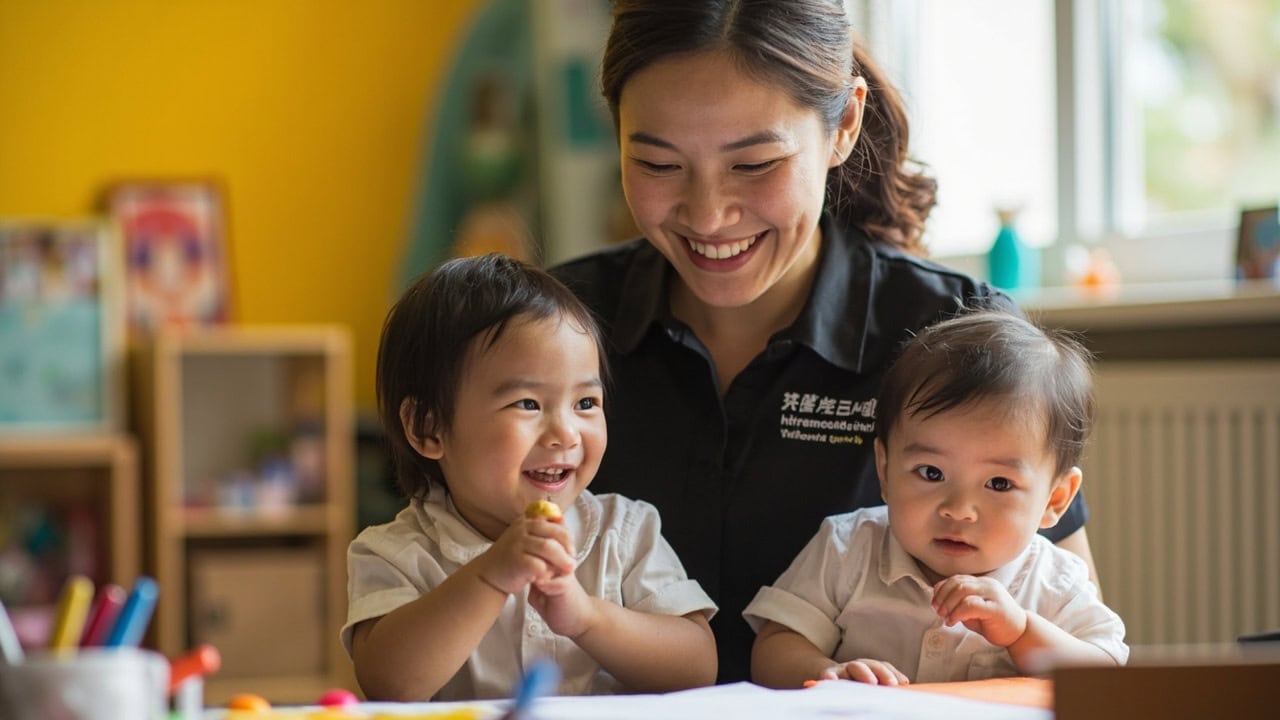
In quality care, children are engaged. They are doing things with intention, not because someone told them to, but because the environment and the adults in it have made doing things feel interesting. You should be able to see children who look curious, not just compliant. You should be able to see children who are working on something—even if that something is simply stacking blocks or pouring water from one container to another.
2. Watch how adults speak to children.
In adequate care, adults manage children. They give instructions, enforce rules, maintain order.
In quality care, adults respond to children. They notice what a child is doing. They join in without taking over. They ask questions that extend thinking rather than redirecting behaviour. When a child drops a toy for the fourth time, the response in adequate care might be distraction or redirection. The response in quality care might be genuine engagement with the child’s curiosity about gravity, about cause and effect, about what happens when.
3. Watch what happens when no one is performing for you.
Step away from the main interaction area. Sit in a corner for five minutes and observe. You will learn more in those five minutes than in the entire guided tour.
What do children do when they are not being directed? What do adults do when they are not being watched? The answers to these questions will tell you what the place is really like, because this is what most of your child’s experience will actually be.
Questions That Reveal Depth, Not Just Polish
Beyond observation, there are questions. Not all questions are equal.
Most parents ask logistics: What are the hours? What is the curriculum? What do they eat? These are important questions. They deserve answers. But they will not help you distinguish quality from adequacy, because adequate programmes have logistics too.
The questions that reveal depth are different. They are questions about philosophy and practice, about what happens in the moments when things are not going well.
- When my child is upset, what happens? Listen to the answer—not the policy, but the description. If the response sounds rehearsed, scripted, like something designed to reassure rather than inform, that is a signal. If the response sounds specific, thoughtful, like something someone has actually thought about and observed, that is a different signal.
- How do you know if a child is having a good day? Or a difficult one? If staff can answer this with concrete, observable examples, you are in a place where children are actually seen. If the answer is vague, you are in a place where children are managed.
- What happens when a child is doing something you did not plan for? The best early childhood environments are responsive, not just planned. If a child is fascinated by a crack in the floor or a beetle on the wall, what do the adults do? If they redirect to the planned activity, you are in a place where the schedule matters more than the child. If they recognise the moment and extend it, you are in a place where children’s interests drive learning.
- Tell me about the last time something did not go well. What happened? A confident, quality environment will not hide difficulty. Staff will be able to talk about challenges, about what they learned, about how they responded. A place that cannot speak honestly about difficulty is a place that is performing, not reflecting.
These questions will not give you all the answers. But they will give you access to the thinking behind the practice, and thinking behind practice is what separates quality from polish.
Why This Evaluation Matters More Than You Think
There is a reason that rigorous evaluation is connected to outcomes.
The children who develop most robustly in the early years are not necessarily in the most expensive programmes, or the most academically oriented programmes. They are the children whose caregivers are responsive, who are treated as thinking people even when they are very small, who have adults around them who are genuinely curious about what they are experiencing.
When you evaluate childcare with rigour, you are not just choosing a service. You are choosing an environment that will shape neural pathways, language acquisition, emotional regulation, and the foundational sense that the world is a place worth exploring. The first thousand days of life are not a marketing phrase. They are a developmental reality, and the quality of care during this period has measurable effects on outcomes that persist well beyond these years.
So when you feel the weight of this decision, when the guilt tells you that you should be doing this yourself, remember what you are actually choosing. You are choosing whether your child spends their days in a place that manages them or a place that engages them. You are choosing whether the adults around your child see your child as a responsibility or a person.
That weight is not guilt. That weight is understanding.
What We’ve Built, and What We Promise
EduNanny by BUTLER exists because we recognised something true about Singapore parents: you are not looking for the easiest option. You are not looking to offload. You are looking for a partner who takes this as seriously as you do.
We are part of the ECDA Childminding Pilot, which means we are embedded in a framework designed to provide quality care that is also accessible. Quality should not be a luxury available only to families with significant resources. The pilot structure means we can offer care within fee structures that do not require parents to choose between quality and sustainability.
We offer both home-based and community-based pathways, because families are different and needs are different. Some children thrive in smaller, home-like settings. Some families benefit from the community environment of a centre. We do not believe there is one right answer for everyone. We believe there is a right match for your family, and we work to help you find it.
Our infant ratios, where applicable, are structured to ensure that children are not simply supervised but seen. Up to one to three infants means that when your child is learning to roll, to reach, to communicate in the language of smiles and sounds and small hands, there is an adult nearby who can notice, who can respond, who can support that development rather than simply prevent accidents.
We have thought carefully about the practical realities of Singapore family life. Monday to Friday care blocks that align with actual working lives. CDA and Baby Bonus usability so that the financial architecture of Singapore family life works for you rather than against you. We serve families across Singapore, because the need for quality care does not stop at any particular district or postal code.
We want to be clear about something else too: we are not promising that every day will be perfect. Early childhood care is real work, and real work includes difficult moments. Children have hard days. Transitions are hard. The process of building trust between a family and a caregiver takes time and is not always smooth.
What we are promising is that we will take this seriously. That the adults in our environment are not just staff but partners. That the questions you ask will receive honest answers. That when something is not going well, we will work with you to understand it and address it, because this relationship is not a transaction. It is a collaboration in service of your child.
We have invested in transparency. Communication with parents is not an add-on; it is built into how we operate. Where deployed, CCTV measures exist not because we distrust our own staff but because we believe parents deserve to see, to know, to feel connected to what is happening in their child’s day. Our Thomas AI Chatbot exists because we know that parenting and childminding generate questions constantly. You deserve answers when you need them. You deserve support that meets you where you are.
You Have Every Right to Take This Seriously
You are carrying something real. The awareness that your child deserves more than adequate, that the early years are not filler before real life begins, that the adults who spend their days with your child are shaping something fundamental about who he or she will become.
This awareness is not a burden. It is what makes you a good parent.
The guilt will not serve you. It will not help you evaluate more carefully, or ask better questions, or make a more thoughtful decision. It will only make you doubt the very instincts that are pointing you toward something better.
But the seriousness, the discernment, the willingness to say: this matters and I will not settle—that will serve you. That will carry you through the visits and the questions and the comparisons. That will help you recognise quality when you see it.
Here is a summary of what to look for as you evaluate your options:
- Reframe your guilt. The seriousness you feel about choosing childcare is discernment, not compensation. It is pointing you toward the right decision.
- Watch children, not just environments. Look for curiosity, not just compliance. Children who are engaged look different from children who are managed.
- Watch adults when they are not performing. Step aside for five minutes and observe. The real culture of a place shows when no one is watching.
- Ask questions that reveal thinking. “What happens when my child is upset?” and “Tell me about the last time something went wrong” will tell you more than questions about curriculum and hours.
- Look for responsiveness, not just planning. Quality care bends to meet the child. Adequate care bends the child to meet the plan.
- Expect transparency. You should be able to see what is happening in your child’s day. Communication is not an add-on; it is part of quality care.
You have every right to take childcare seriously. You have every right to expect quality. You have every right to evaluate with rigour and to refuse anything that does not meet the standard your child deserves.
EduNanny was built for parents who believe this. For parents who understand that choosing carefully is not about anxiety. It is about love, expressed as action, in the world where your child will spend their early days.
Your child is lucky to have a parent who takes this decision seriously. And if you are looking for a place that takes it seriously too, we would be honoured to be part of your story.
If you are beginning to research your options in Singapore, we welcome that process. Whether you are just starting to explore or are ready to ask your questions in person, EduNanny is here. Not as a transaction, but as a conversation.
Learn more about who we are or get in touch when you are ready.