What Singapore Parents Should Know About Childcare That Goes Beyond Supervision
What Your Child Experiences in Those First Hours
Imagine for a moment that you are your child. Not the version you see in the evenings, tired and reaching for you, full of the day. Imagine your child as they are at nine in the morning, walking or being carried into a space that is not home, where the light is different, the sounds are different, and the people are not the ones who have held them since birth.
That moment is enormous. It is enormous for the child who is shy and needs a few minutes of watching before they can enter a room. It is enormous for the child who runs in eagerly because they have already learned that this place feels like a continuation of something warm. It is enormous for the child who hesitates at the door, not because anything is wrong, but because the world outside the family is a new country and they are only just beginning to map it.
What happens next, in the hours that follow, is not simply childcare. It is your child’s first experience of navigating an identity outside the safe circle of home. It is the first time they are being held by a world that does not yet know their history, their birth story, or their name the way you do.
And the way that world receives them—warmly, indifferently, or thoughtfully—teaches your child something they cannot yet put into words.
A child who is met with patience when they are frustrated learns that their big feelings are not too much. A child who is given words for what they are experiencing—not just “stop that” but “you look like you are feeling really frustrated right now, and it is okay to feel that”—learns that their inner world has structure and meaning, and that someone outside their family can hold it with care. A child who is allowed to try something difficult, fail, and gently try again learns something about their own resilience that no bedtime story can teach them in quite the same way.
These are not small things. These are the building blocks of a self.
Supervised, or Known?
There is a distinction that matters enormously here: the difference between a supervised child and a known child.
Supervision is important. It is the baseline—the first thing we all look for. But supervision is about the outside of a child: what they are doing, where they are, whether they are safe.
Being known is about the inside. It is understanding that this particular child becomes dysregulated when transitions are rushed. It is noticing that this child lights up around music in a way that signals something about who they might become. It is recognizing that a child’s silence at drop-off is not defiance—it is processing, and it needs space, not pressure.
Quality childcare does not just watch your child. It holds your child’s inner world. It holds their story. And in doing so, it gives your child something that will shape them far more powerfully than any vocabulary list or motor skill exercise: the experience of being a person whose inner life matters to someone who is not their parent.
That experience is rare. It is precious. And it is not inevitable in any childcare arrangement. It has to be built into the philosophy, the training, the ratios, the daily rhythms of the place. It has to be something caregivers believe in, not just something a centre claims.
When a child is genuinely known by the adults who care for them during the day, it changes their relationship with the world. It teaches them, at a cellular level, that they are worthy of thoughtful, consistent, attentive care. And that quiet, foundational belief in one’s own worth becomes the ground from which everything else grows.
The First Community Beyond the Family
Your child’s world, in the earliest years, is almost entirely defined by family. Home is the universe. The people in it are the entire human context in which your child exists. And then, gradually, childcare opens the door to something new: a community.
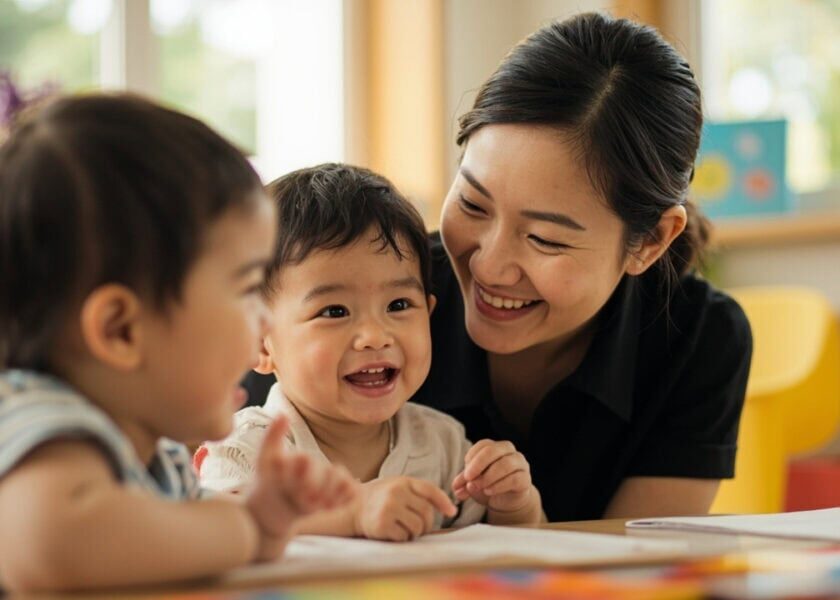
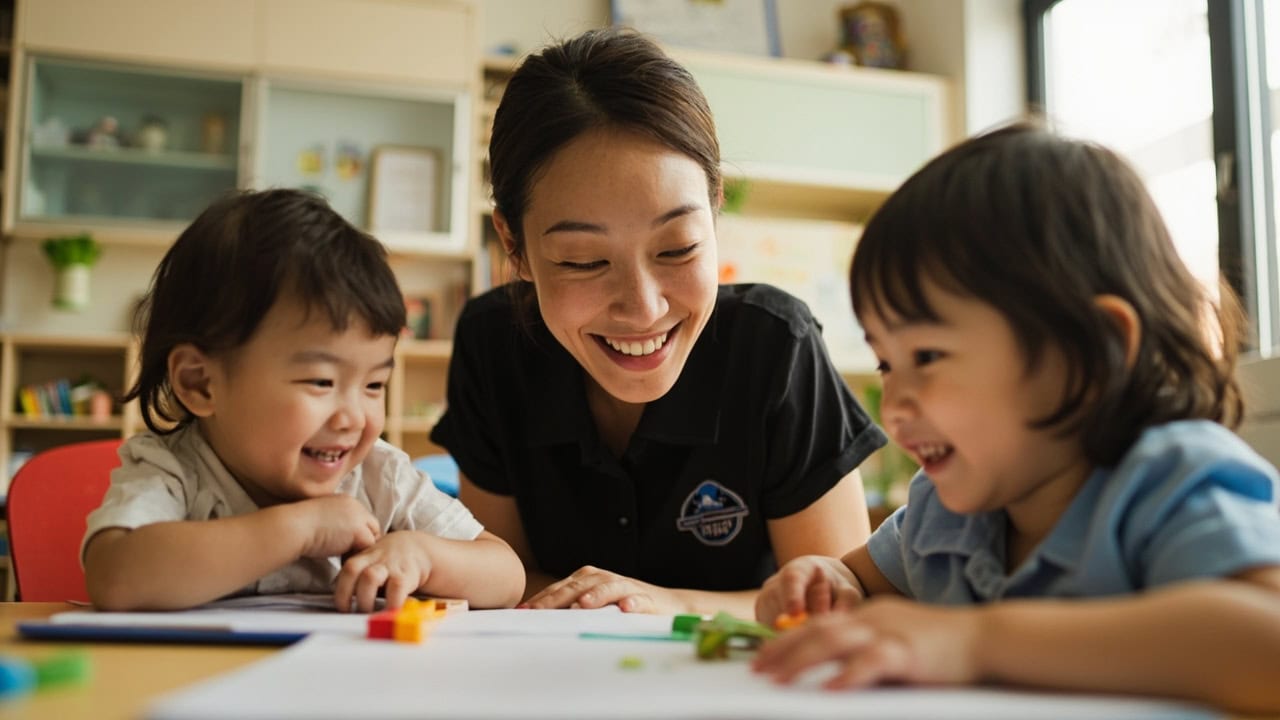
A circle of other children who are also learning how to share, how to wait, how to feel frustrated and recover. A caregiver who is not a grandparent or an aunt, but a person who has chosen this work and who brings their own warmth and understanding of child development to your child’s day.
For many children in Singapore, childcare is the first place they learn that the world contains people who are not family and who still treat them with kindness and consistency. It is the first place they learn that they can belong somewhere beyond the home, that a group of people can be a place of safety and learning, that they can be part of something.
What your child learns about belonging there becomes a template. It becomes the baseline against which they measure every community they enter for the rest of their life—their school, their friendships, their workplace. The child who has felt genuine belonging in a childcare community carries that feeling forward. The child who has felt overlooked or merely managed carries that too, in a different way.
This is why we do not talk about childcare as infrastructure. Infrastructure is about systems and logistics. What quality childcare provides is not infrastructure. It is the first chapter in your child’s social and emotional life. It is where they learn whether the world outside home is a place they can trust.
Security and the Freedom to Explore
There is something the science of attachment tells us that, once you hear it, feels both obvious and profound: a child who feels emotionally secure is a child who is free to explore.
Security is not a luxury. It is the prerequisite. A child who does not feel safe—who does not feel that someone is reliably holding their inner world—cannot focus their energy on discovery, on curiosity, on becoming. Their energy is spent on managing anxiety, on holding themselves together, on wondering if the world is a place that will catch them.
When a child feels securely held—by a parent, by a caregiver, by a consistent and attuned environment—they can let go. They can walk into the block corner and build something that takes twenty minutes. They can approach another child with curiosity instead of fear. They can try a new food and decide they do not like it, and feel safe in that disagreement. They can explore their own preferences, their own interests, their own emerging sense of who they are.
Security does not limit a child. It liberates them. And the hours your child spends in quality childcare are hours in which this security is either being built up or quietly worn down, depending on the philosophy of the place, the training of the caregivers, and the ratios that determine whether any individual child can be truly seen on any given day.
How a Caregiver Holds Your Child’s Story
A caregiver in a quality childcare arrangement is not simply someone who feeds your child and keeps them from harm. A caregiver, in this understanding, is something closer to a keeper of your child’s emotional narrative.
They are the person who will notice that your child has been coming in a little withdrawn this week and wonder what might be happening at home. They are the person who will recognize that your child’s favourite book is the one about the little lost duckling and understand that your child may be processing something about separation, and will read it with extra tenderness today. They are the person who will remember that your child does not like sudden loud sounds and will prepare them before the fire drill, not because it is on a checklist, but because they genuinely know your child.
They are also the person who gives your child language for what they feel. Children do not arrive in the world knowing how to name what they experience. A toddler feels frustration and communicates it the only way they know how—a push, a scream, a thrown toy. This is not bad behaviour. It is a child without a vocabulary for their emotional experience.
One of the most profound things a caregiver can do is give them that vocabulary. To hear, again and again:
- “You look sad that your block tower fell”
- “I see you are so excited right now, your whole body is buzzing”
- “It is hard to wait, isn’t it? Let’s count together while we wait”
These moments may seem small. In the moment, they last perhaps thirty seconds. But they are not small. They are teaching your child that feelings have names, that they can be talked about, that someone outside themselves understands what is happening inside them and can reflect it back in a way that makes it manageable.
A child who has been given this language by a caregiver who truly knows them has been given a bridge between their inner world and the world outside. They will carry that bridge with them into every relationship, every classroom, every difficult conversation they ever have.
This kind of knowing requires temperament alignment. It requires that the caregiver and the child are genuinely suited to each other, that the caregiver has the patience and the insight and the warmth that this particular child needs. Small ratios create the conditions in which this becomes possible. When one caregiver is responsible for fewer children, they can know each one. They can hold each one’s story.
What to Look For: A Practical Guide for Parents
For parents researching their options in Singapore, it helps to understand what quality actually looks like. Quality childminding is not defined by flashy facilities or impressive curricula. It is defined by the felt experience of your child during those hours.
Here are markers of care that goes beyond supervision:
- Emotional attunement: Caregivers notice not just what your child is doing but how your child is feeling. They respond to moods, not just behaviours.
- Consistent relationships: Your child sees the same faces day after day. There is continuity in who holds their story.
- Patient presence: Frustration is met with calm. Big feelings are not punished or dismissed. Your child learns that their inner world can be trusted.
- Language for feelings: Caregivers name what they observe. “You seem disappointed” becomes a tool your child learns to use themselves.
- Space to try and fail: Difficult tasks are supported, not removed. Your child learns resilience by experiencing it.
- Individual recognition: Your child is not a room number or a schedule slot. They are a person with preferences, quirks, and a unique way of being in the world.
When you visit a childcare arrangement, consider not just the facilities but the feeling in the room. Observe the caregivers’ faces—do they light up when a particular child enters the room? Notice how transitions are handled—when a child resists a change of activity, is there patience? Ask about their philosophy of emotions. How do they respond when a child is frustrated or upset? Listen for language—not just management strategies, but genuine attunement.
Ask about ratios. Can each caregiver genuinely know each child? This is not just a logistics question—it is the structural condition for emotional holding. Ask what a typical day looks like. Is there space for your child to follow their own interests, or is every moment scheduled and directed?
And trust your own observation. You know your child. If something feels off, or if something feels deeply right, pay attention to that.
Common Questions Parents Carry
Will my child feel abandoned or anxious?
Anxious separation is common and developmentally normal. But the quality of the care environment determines whether that anxiety resolves into security or persists into distress. In quality care, a child learns that departures are temporary, that the caregiver holds their world reliably, and that the space outside home can be trusted.
How do I know my child’s inner world is being held?
You ask questions. Not just “what did they eat?” but “how were they today? How did they seem when they arrived? Did anything stand out to you?” A caregiver who knows your child will have observations that go beyond the log sheet. They will notice the small things—the book your child kept returning to, the moment of quiet withdrawal that preceded a breakthrough, the way your child’s face changes when they master something new.
Is home-based or centre-based care better?
Both can offer quality. The question is not the setting but the philosophy within it. Home-based care offers the intimacy of a smaller environment and the comfort of familiar surroundings. Centre-based care offers community and peer interaction. What matters most is that the ratios allow your child to be genuinely known, whoever is doing the knowing.
Our Approach at EduNanny
We want to speak honestly about what we offer, because you deserve honesty about the practical realities of the care we provide.
EduNanny operates within the ECDA Childminding Pilot, and we believe this structure reflects something important about our approach. The pilot was designed to provide families with more personalized, home-based childcare pathways, and it is built on a philosophy that aligns with everything we have been describing.
Our care arrangements offer small ratios—up to one to three infants in our infant care settings—which means your child is not one face in a group of fifteen. It means there is space for your child to be known, for their temperament to be recognized, for their emotional narrative to be held by someone who has the capacity to hold it.
We offer Monday to Friday care blocks, and we have designed our fee structures to be accessible within the pilot framework, with CDA and Baby Bonus usable to support families in managing costs.
Our caregivers are trained, vetted, and supported in their work, because we know that the quality of your child’s inner experience during the day depends directly on the quality of the person holding it.
Where CCTV measures are deployed, they are there not because we have anything to hide, but because we understand that trust is built through openness. A parent who feels assured is a parent who can let go. And a parent who can let go is a parent whose child will, in turn, feel less of the underlying tension that comes from sensing a worried goodbye.
We have also built Thomas, our AI-powered chatbot, designed to make communication between parents and our team effortless and responsive. Not because technology replaces the human connection that matters most, but because parents in this city work extraordinarily hard, and anything we can do to make the connection between home and childcare more seamless and more transparent is something worth building.
All of this—every practical element of what we offer—is in service of one thing: giving your child a place where their inner world is held with the same care and intentionality that you give it at home.
Come and See Who Your Child Is Becoming
We want to close by returning to the question we started with, because it deserves to be restated now, after everything we have explored together.
Who is your child becoming in the hours you are not there?
We believe this is the most important question a parent can ask about childcare, because it moves us past logistics and safety into the territory of meaning. It is the question that says: I understand that my child is not simply being looked after. My child is being formed. My child is building a self, hour by hour, day by day, and the people and environments that surround them during these hours are part of that building.
Choosing childcare is not a logistical decision. It is a developmental one. It is one of the first and most consequential choices you make as a parent, not because it determines whether your child gets into the right primary school—it may, and that is fine—but because it shapes your child’s relationship with the world outside home, with other people, with their own emotions, with the question of whether they are safe to be exactly who they are.
We are not asking you to choose EduNanny because we have the best facilities or the lowest prices or the most locations. We are asking you to come and see because we believe we can show you something that matters: a place where your child is not just supervised but known. Not just occupied but engaged. Not just safe but held—emotionally, thoughtfully, consistently held.
Come and see who your child is becoming here.
Because your child is already becoming someone. They have been since the day they were born. And the question is not whether this becoming will happen—it will. The question is whether the environment in which it happens will honor the full depth of your child’s inner life.
We believe it should. And we believe we can show you what that looks like.
At EduNanny, we believe every child deserves to be known. Speak with our team to learn more about our approach to thoughtful, development-oriented childcare in Singapore.